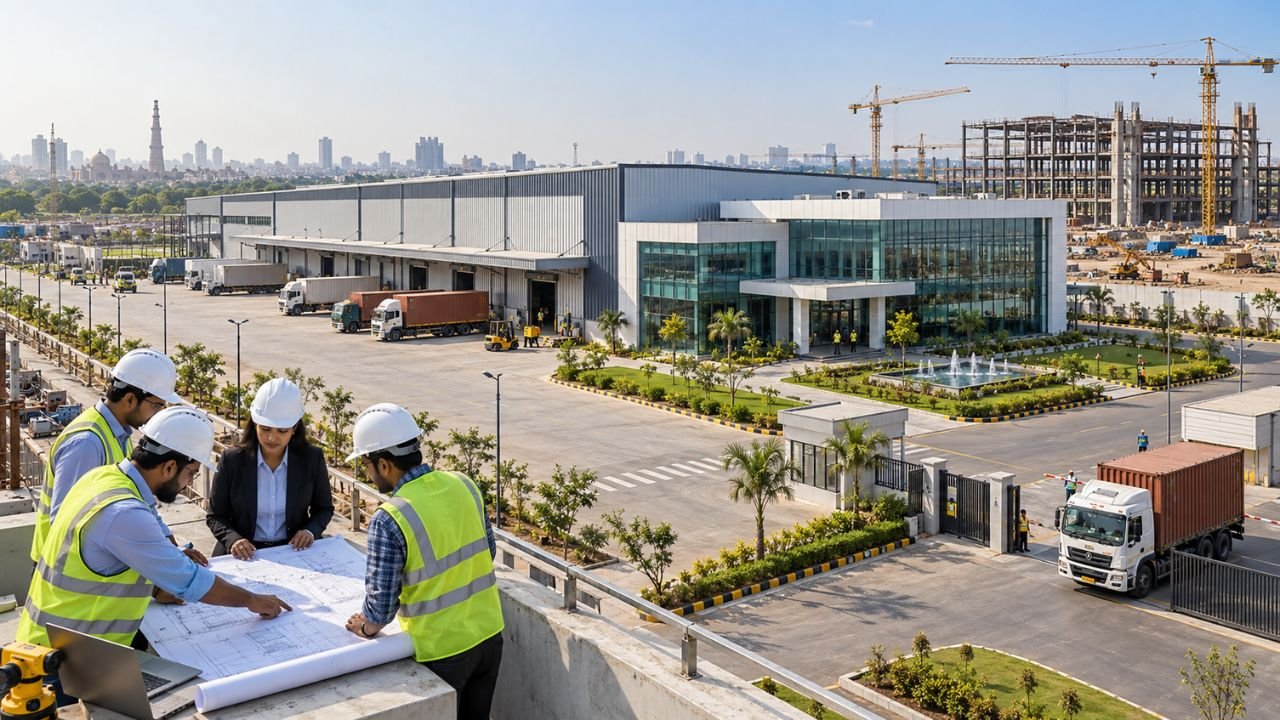
Contractor bhai or house owner ji, picture this: You’re at the cement depot in Agra or Dehradun, and the broker pushes OPC 33 Grade as “budget-friendly for your G+1 slab,” while the engineer insists on OPC 53 Grade for “extra strength.” Meanwhile, your mason swears by OPC 43 Grade for “just the right speed.” Sound familiar? Small-medium builders in UP, Rajasthan, Bihar, and Delhi NCR face this confusion daily—marketing claims like “53 Grade = 53% stronger” mislead everyone. The truth? Wrong grade choice means cracks, delays, and ₹2-10 lakh rework. At Construction Estimator India, we’ve analyzed 1000+ projects—OPC 53 shines for fast multi-storey RCC, 43 balances low-rise homes, and 33 is nearly obsolete except rural plaster. Let’s cut the confusion with hard numbers, real contractor stories, and your personal decision guide.
WhatsApp +91 8630676890 NOW for cement grade recommendation tailored to your project!
What Do 33, 43 & 53 Grade Cement Actually Mean?
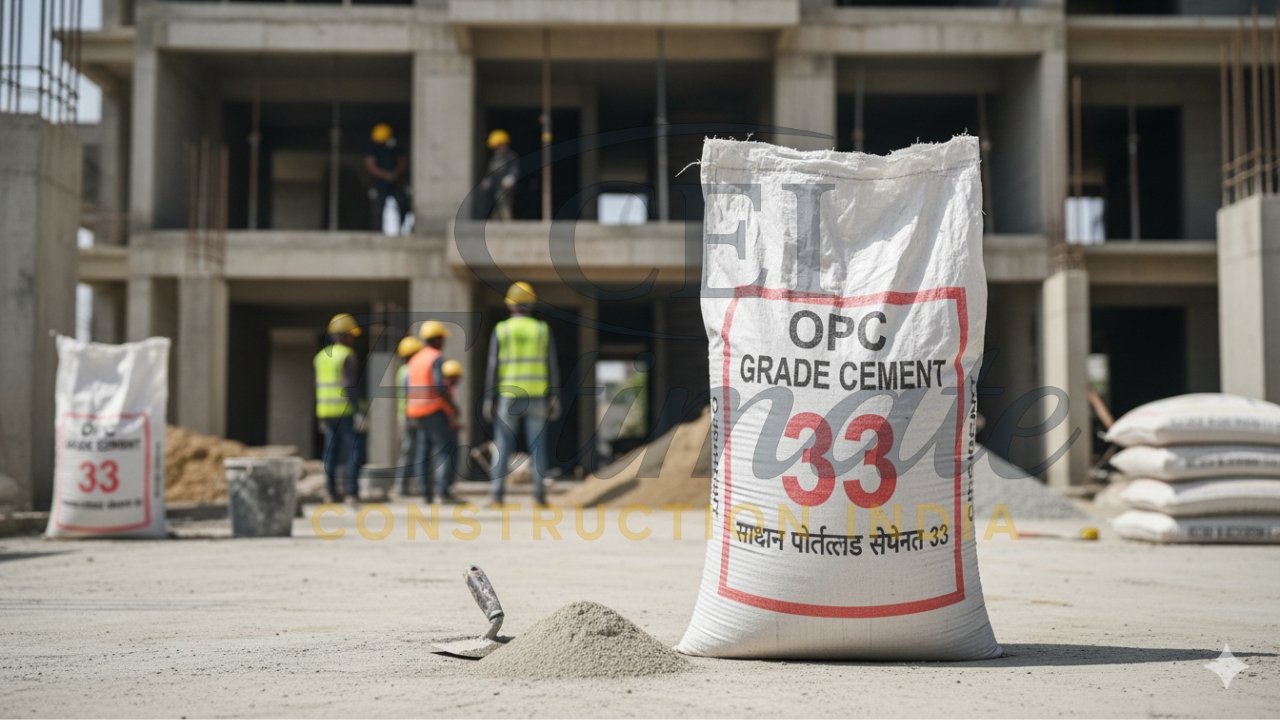
Let’s start simple—no jargon. OPC (Ordinary Portland Cement) grades are defined by BIS IS 269:2015 (core standard, with specifics in IS 8112 for 43 Grade and IS 12269 for 53 Grade). The number—33, 43, or 53—is the minimum compressive strength in MPa at 28 days on standard 150mm cubes. Higher grade = finer clinker grinding = faster hydration = quicker strength gain.
- OPC 33 Grade: ≥33 MPa at 28 days (oldest, IS 269:1989). Coarsest particles, slowest reaction.
- OPC 43 Grade: ≥43 MPa at 28 days. Medium fineness, balanced performance.
- OPC 53 Grade: ≥53 MPa at 28 days. Finest grind (high Blaine fineness 300-350 m²/kg), rapid strength.
Historical shift: Pre-1990s India built mostly G+0/G+1 rural homes slowly—33 Grade ruled (cheap, available). 2000s urbanization exploded G+2/G+3 villas in Tier-2 cities like Lucknow, Jaipur—43/53 Grades launched for 30-50% faster deshuttering. By 2026, 33 Grade is <5% market share (plaster/mortar only); 53 Grade leads RCC at 35-40% thanks to metro outskirts boom. All are pure clinker + gypsum (no fly ash/slag like PPC/PSC)—higher grades cost more to manufacture but speed construction.
Myth bust: “53 Grade is always best”? No—mismatch it to hot Rajasthan slabs, and thermal cracks cost more than savings.
Detailed Comparison – OPC 33 vs OPC 43 vs OPC 53
Diving deep with lab data (BIS averages), field curves, and risks. Strength tested per IS 4031.
OPC 33 Grade
Early Strength Gain: Sluggish—8-12 MPa (1 day), 16-20 MPa (3 days), 22-25 MPa (7 days), min 33 MPa (28 days), ~38 MPa (90 days). Curve: Flat start, slow plateau—like a lazy tortoise.
Long-term: Caps at 40 MPa (1 year)—no pozzolanic boost.
Setting Time: Initial 45-90 min, Final 8-12 hours (slow hydration).
Heat of Hydration: Moderate 55-70°C peak—safe for thin plaster, risky in 100mm+ pours.
Workability/Water Demand: High w/c 0.55-0.60 needed—sticky but bleeds easily.
Shrinkage/Cracks: High 0.4-0.6% drying shrinkage—peels in plaster after 6 months.
Durability: Poor—coarse pores allow sulfate attack (Rajasthan black soil), carbonation (rebar rust in 10 years), chloride ingress.
Price 2026: ₹360-400/50kg (cheapest).
Availability: Rare—local brands in UP/Bihar rural depots; majors like ACC phase out.
Contractor Quote: “Used 33 Grade for Bihar G+1 slab—deflected 15mm in year 1, ₹3L fix,” says Rajesh from Patna.
OPC 43 Grade
Early Strength: Steady—14-18 MPa (1d), 23-27 MPa (3d), 30-35 MPa (7d), min 43 MPa (28d), 48-52 MPa (90d). Curve: Smooth incline, reliable.
Long-term: 55 MPa (1 year)—solid for 30-year life.
Setting: Initial 30-60 min, Final 6-10 hours.
Heat: 65-85°C—manageable for G+2 slabs <120mm with 14-day curing.
Workability: w/c 0.48-0.55—flows well, less bleeding.
Shrinkage: Medium 0.25-0.4%—cracks if w/c >0.52.
Durability: Good normal exposure; moderate sulfate/chloride resistance (IS 456 mild).
Price: ₹380-430/50kg.
Availability: High nationwide.
Quote: “OPC 43 perfect for my Lucknow G+2—deshutter day 14, zero cracks after 2 monsoons,” per Naresh ji.
OPC 53 Grade
Early Strength: Rocket—22-28 MPa (1d), 27-35 MPa (3d), 37-45 MPa (7d), min 53 MPa (28d), 58-65 MPa (90d). Curve: Steep 70% by day 7—ideal fast-track.
Long-term: 65+ MPa (peaks early, minor gain later).
Setting: Quick—Initial 30 min, Final 5-8 hours.
Heat: High 80-110°C—thermal cracks in Rajasthan summers (45°C ambient) without ice/admixtures.
Workability: Best w/c 0.42-0.50—creamy mix.
Shrinkage: Low early (0.2%), high later uncured (0.5%).
Durability: Excellent early; average long-term permeability vs blended.
Price: ₹410-520/50kg (premium).
Availability: Everywhere, top seller.
Quote: “OPC 53 cut my Noida G+4 cycle to 20 days—saved ₹5L labor,” says Gurugram engineer.
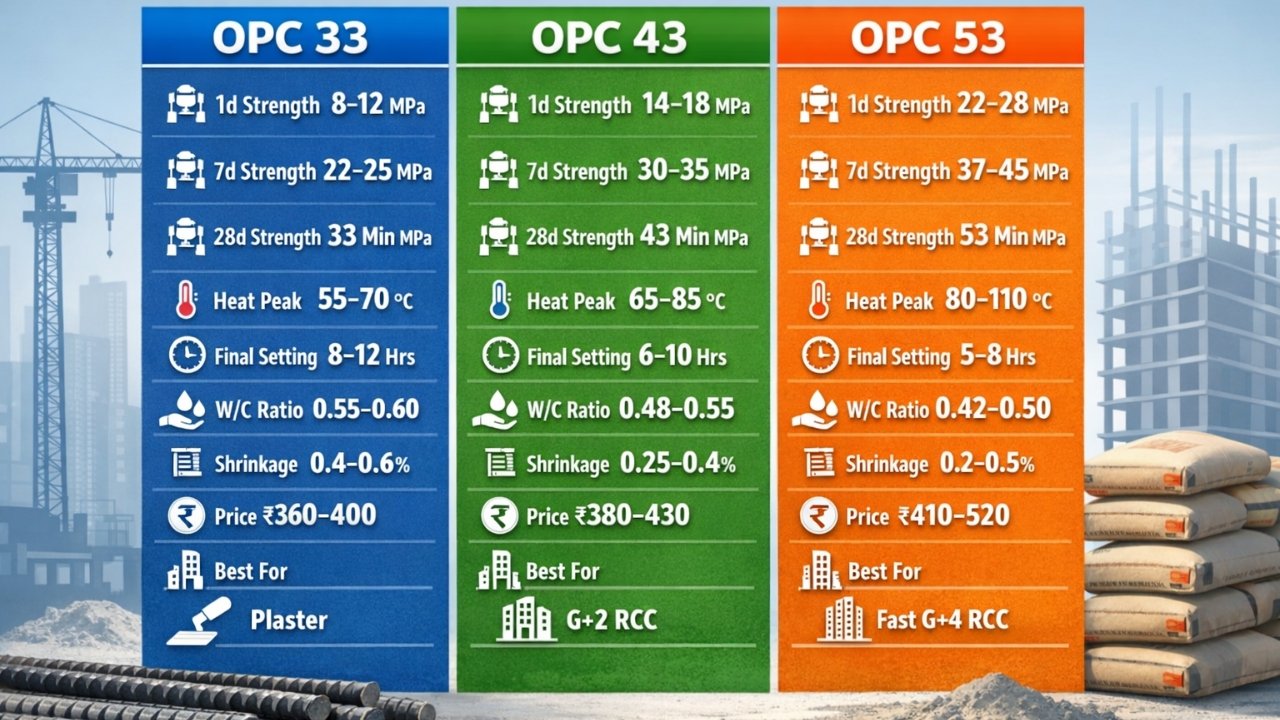
Master Comparison Table:
| Parameter | OPC 33 | OPC 43 | OPC 53 |
| 1d Strength (MPa) | 8-12 | 14-18 | 22-28 |
| 7d Strength (MPa) | 22-25 | 30-35 | 37-45 |
| 28d Strength (MPa) | 33 min | 43 min | 53 min |
| Heat Peak (°C) | 55-70 | 65-85 | 80-110 |
| Final Setting (hrs) | 8-12 | 6-10 | 5-8 |
| w/c Ratio | 0.55-0.60 | 0.48-0.55 | 0.42-0.50 |
| Shrinkage (%) | 0.4-0.6 | 0.25-0.4 | 0.2-0.5 |
| Price ₹/50kg 2026 | 360-400 | 380-430 | 410-520 |
| Best For | Plaster | G+2 RCC | Fast G+4 RCC |
Where Each Grade Should Be Used in 2026
Your decision tree for Tier-2/3 projects:
- Choose OPC 33 (very limited, almost phased out): Non-structural plaster/mortar (1:4-1:6) in low-budget rural G+0 UP/Bihar homes; temporary repairs. Deshutter? 21+ days. Case: Haryana village wall—fine, but slab misuse collapsed.
- Choose OPC 43 (acceptable low-rise): G+1/G+2 residential RCC slabs/beams M20-M25 (deshutter 14 days); normal plaster. Hot/dry Rajasthan? Add curing. Case: Dehradun G+2—”43 Grade balanced cost/speed, no cracks,” saved 10% vs 53.
- Choose OPC 53 (preferred multi-storey/fast): G+3/G+4 slabs/columns M25-M30; heavy loads/post-tensioned; cold Uttarakhand winters; precast. Deshutter 7-10 days. Case: Delhi NCR G+4—”53 Grade 20% faster cycles, ₹8L savings,” but needed extra curing compound.
- Strong Reco: Switch to PPC/PSC for all residential RCC—same ₹380-420 price, 40% less cracks/heat, better 50-year durability. “PPC over 43 in my Jaipur villas—no rework,” says MP builder.
Recommended Uses Table:
| Cement Grade | Safe RCC Slab/Beam/Column? | Safe Brickwork/Plaster? | Safe PCC? | Best 2026 Use | Never Use For | Price ₹ |
| OPC 33 | NO (illegal) | Yes (1:4-6) | Yes (M5) | Rural plaster/mortar | RCC, foundations | 360-400 |
| OPC 43 | Yes (G+2 max) | Yes | Yes | Low-rise home RCC | Mass/hot pours | 380-430 |
| OPC 53 | Yes (optimal) | Waste (overkill) | Yes | Fast multi RCC | Uncured thick slabs | 410-520 |
Pro Tips: Climate? OPC 53 cold/hot-with-admix. Budget G+1? 43/PPC. Always cube test 7/28 days.
🚀 WhatsApp +91 8630676890 for your personalized grade selector + slab BOQ!
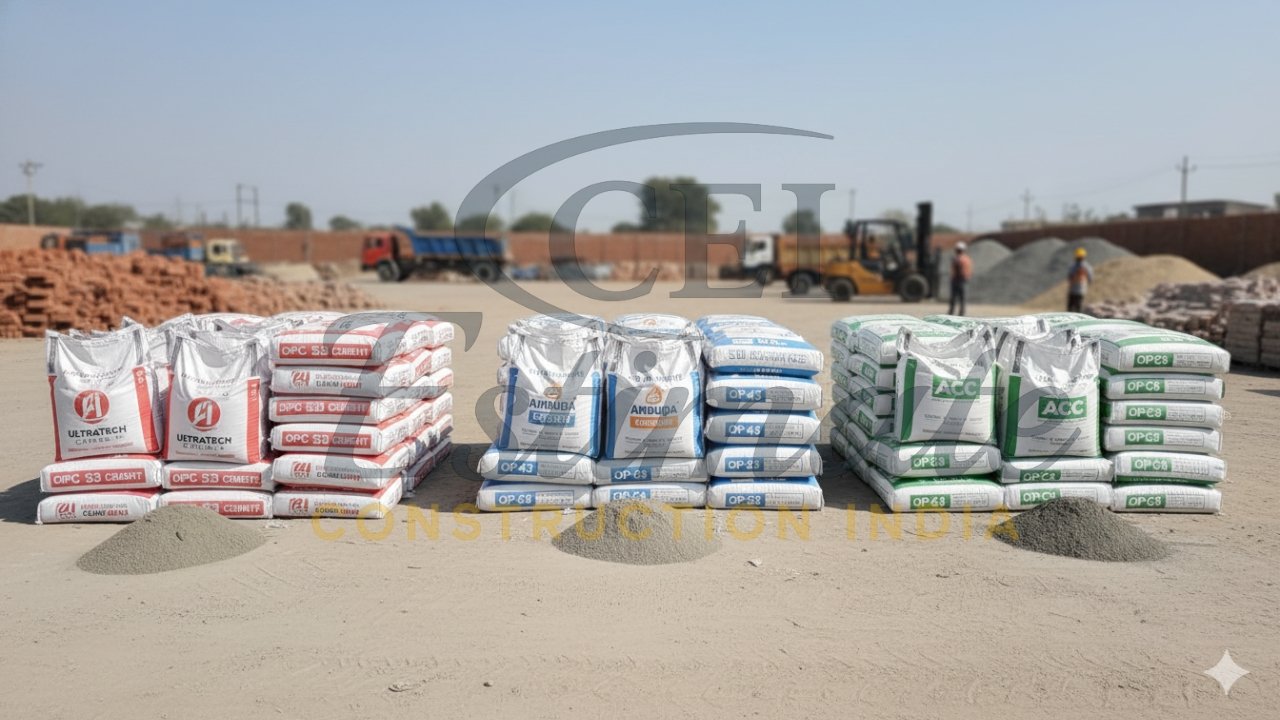
Top Brands & Their Performance for Each Grade in 2026
From Construction Estimator India surveys (n=300 contractors, North/Central India). Prices March 2026 averages.
OPC 33:
- ACC OPC 33: Reliable rural UP/Bihar. ₹375. Pros: Consistent. “Good plaster,” Jharkhand mason. Cons: Scarce.
- UltraTech (limited): Rajasthan pockets. ₹390. Trust: High.
- Local brands (e.g., Agrawal Cement): ₹360. Risky fakes.
OPC 43:
4. JK Lakshmi OPC 43: Uttarakhand king. ₹395. “Smooth RCC,” Dehradun feedback.
5. Dalmia: MP/Chhattisgarh. ₹385.
6. Wonder: Rajasthan. ₹390.
7. Shree: Bihar. ₹382.
OPC 53:
8. UltraTech OPC 53: Top-rated. ₹450. “Blazing speed,” Noida star.
9. ACC: ₹440.
10. Ambuja: ₹460. Heavy load fave.
11. JK Lakshmi: ₹435.
12. Birla/MP Birla: ₹425. UP specialist.
Quick Table:
| Grade | Top Brands | Price Range | Regional Trust |
| 33 | ACC, Local | 360-400 | Rural UP/Bihar |
| 43 | JK, Dalmia, Wonder | 380-430 | Nationwide |
| 53 | UltraTech, ACC, Ambuja | 410-520 | Metro/Tier-2 |
Common Misuse of Grades & Expensive Consequences
Case 1: OPC 33 in RCC Slab (Agra G+1): Builder saved ₹20/bag—slab deflected 20mm year 1, full redo ₹4.5L. Why: 33 MPa < M20’s 20 MPa safety margin.
Case 2: OPC 53 in Hot Rajasthan Slab (No Curing): 90°C heat → 15% slabs cracked. ₹6L epoxy injection. Fix: PPC or 21-day ponding.
Case 3: OPC 53 for Plaster: Overkill, ₹50k waste on 500 sqm. Peels anyway sans lime.
Lessons:
- Test cubes always.
- Match grade to IS 456 exposure.
- Curing: 14 days min (43/53), 21 for 33.
Why Most Experts Now Prefer PPC/PSC Over Any OPC Grade for Slabs?
2026 reality: PPC/PSC (₹370-430) match OPC 43 price but crush on:
- Heat: 50-60°C vs 80-100°C (53)—60% less cracks.
- Durability: Finer pores block sulfates/chlorides 40% better.
- Long-term Strength: 55 MPa+ at 90 days.
- Workability: 10-15L less water/m³.
Case: Lucknow contractor switched PPC—”Zero cracks in 20 slabs vs 10% OPC 43 failures.” OPCs lack pozzolanic reaction—fade after 20 years. Go blended for G+1+.
Need Help Choosing the Right Cement or Accurate BOQ?
Construction Estimator India 4-Step Process:
- WhatsApp plot size, floors, location, RCC details to +91 8630676890.
- Get grade recommendation (e.g., “OPC 43 + PPC for your G+2 Agra villa”).
- Precise BOQ—cement bags, steel, costs.
- Full house budget (G+1 to G+4).
Response in 30 mins—1000s served!
FAQ
- Is OPC 33 safe for G+1 slab? NO—use min OPC 43; prefer PPC.
- OPC 53 worth extra ₹50/bag? Yes for G+3+, fast-track.
- Deshuttering time? 33: 21d, 43: 14d, 53: 7-10d.
- Hot weather grade? OPC 43/PPC—avoid 53 uncured.
- Plaster: Which grade? 33/43 fine; PPC best.
- 2026 prices? 33: ₹360-400, 43: 380-430, 53: 410-520.
- Strength curve difference? 53 peaks 70% by 7d; 33 only 40%.
- Rural G+0? OPC 33 plaster OK, never RCC.
- Curing days? 14-21 for OPC; longer hot climates.
- Brands for 53? UltraTech/ACC top.
- OPC vs PPC slabs? PPC wins durability.
- Mix impact? 53 allows 10% less cement M25.
Conclusion
OPC 53 for speed (G+3+), 43 for balance (G+1/2), 33 obsolete—but PPC/PSC rule 2026 for crack-free, durable slabs at same cost. Don’t guess—get expert advice!
WhatsApp +91 8630676890 TODAY for cement selection advice, slab BOQ, material estimate and full house construction budget from Construction Estimator India! Build right, save big!