Building a house in 2025 requires utmost care, or else you’ll burn a hole in the pocket. In the modern Indian construction landscape, costs are driven by volatile material prices—where steel can jump to ₹82,000 per ton and cement fluctuations can disrupt even the most carefully planned budgets. For most Indians, home construction represents one of the biggest investments of their lives. However, many homeowners end up overspending significantly due to a lack of planning or falling into the trap of unnecessary upgrades. Understanding precisely how to plan home construction in India is the first line of defense against these financial pitfalls.
At Construction Estimator India, we believe that transparency and data are the keys to building successfully. You can save ₹3–8 lakh on your home construction with practical cost-reduction strategies that don’t compromise quality. Achieving these savings requires a shift from guesswork to data-driven decision-making. Before you lay a single brick, it is essential to understand your financial landscape. We recommend maintaining a contingency of 10–15% of the total construction cost to handle unexpected expenses like site complications or minor price hikes.
Before construction begins, you must ensure you have the minimum funds required, which includes the full estimated project cost, local municipal approval charges, and the aforementioned contingency. For a standard independent house in India, this typically means having ₹30–35 lakhs ready for basic homes, while premium homes often require ₹50–70 lakhs or more. To avoid the “budget creep” that plagues many projects, use your construction cost calculator before every decision. Construction Estimator India offers a free cost estimate and budget consultation to help you navigate these numbers. Contact us at +91 8630676890 to start your journey with a precise financial roadmap.
Design & Planning Cost-Saving Tips (Save ₹2–5 Lakh)
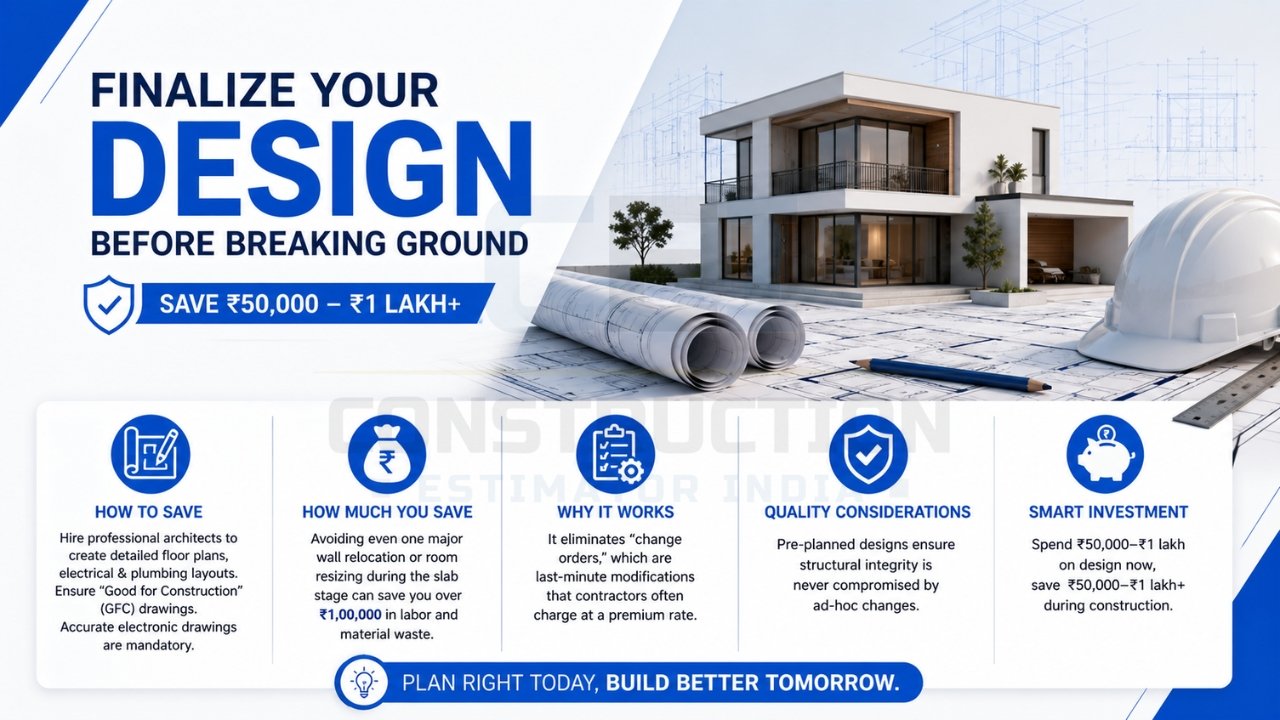
Finalize Your Design Before Breaking Ground (Save ₹50,000–₹1 Lakh+)
One of the most expensive mistakes a homeowner can make is modifying the design once the work has started. Spend ₹50,000–₹1 lakh on thorough architectural design and don’t touch it once construction begins. Making abrupt changes after construction starts often leads to the demolition of already built structures, wastage of materials, and additional labor charges.
-
How to Save: Hire professional architects (or architectural firms in your area) to create detailed floor plans, electrical drawings, and plumbing layouts. Ensure these are “Good for Construction” (GFC) drawings. Accurate electronic drawings are mandatory; this facilitates future maintenance and prevents guesswork by site laborers.
-
How Much You Save: Avoiding even one major wall relocation or room resizing during the slab stage can save you over ₹1,00,000 in labor and material waste.
-
Why it Works: It eliminates “change orders,” which are last-minute modifications that contractors often charge at a premium rate.
-
Quality Considerations: Pre-planned designs ensure structural integrity is never compromised by ad-hoc changes.
Reduce Square Footage—Think Small and Cozy (Save 10–20%)
One way to dramatically reduce costs is to just reduce the square footage of the entire home. Every extra square foot adds to the cost of the foundation, roofing, flooring, and finishing. Think small and cozy to slash costs without losing functionality.
- How to Save: Eliminate unused spaces like overly wide corridors or guest rooms that remain vacant for 11 months a year. Opt for open-plan living areas that make smaller footprints feel larger.
- How Much You Save: At an average construction rate per sq ft of ₹1,500–₹2,000, reducing your plan by just 200 sq. ft. can instantly save ₹3,00,000–₹4,00,000.
- Why it Works: Smaller footprints require fewer materials and less time to build, naturally bringing down the overall project cost.
- Quality Considerations: Focus your budget on high-quality materials for the smaller space rather than spreading a thin budget over a massive area.
Build Upward, Not Outward—Two-Story Design (Save 15–25%)
Another smart strategy is to build upward with a two-story design rather than outward. A single-story “ranch” style house requires a much larger foundation and a larger roof area for the same living space compared to a two-story house.
- How to Save: If you need 2,000 sq. ft. of space, build a 1,000 sq. ft. ground floor and a 1,000 sq. ft. first floor. This halves the foundation and roofing costs, which are two of the most expensive components of a building.
- How Much You Save: Savings typically range from ₹2,00,000 to ₹4,00,000 depending on soil conditions and roofing material.
- Why it Works: Foundation depth and slab area are reduced, minimizing concrete and steel consumption.
- Quality Considerations: Ensure the structural design is vetted by an engineer for the additional vertical load.
Choose a Simple Roof System (Save 15% on Roofing)
Complex roof designs with multiple valleys and peaks significantly increase labor costs and the chance of future leakages. Opt for a simple roof system to keep costs manageable. Instead of a heavy concrete roof, consider using GP steel for truss work topped with ceramic tiles—this can save about 15%.
- How to Save: Use a flat roof or a simple gable roof. If using a slope, combining a steel truss with clay ceiling tiles below can reduce heat and costs simultaneously.
- How Much You Save: For a 1,500 sq. ft. area, moving from a complex concrete slab to a steel truss system can save ₹45,000–₹60,000.
- Why it Works: Steel trusses are faster to install and require less material than heavy RCC slabs.
- Quality Considerations: Use high-grade galvanized steel to prevent rust and ensure proper waterproofing.
Keep Interior Height to 10 Feet (Save 5–10%)
Homeowners often desire 11 or 12-foot ceilings for a “grand” feel, but costs increase with height. Every additional foot of height requires more bricks, more plaster, more paint, and taller scaffolding. Keep the interior height of the house to 10 feet to balance aesthetics and budget.
- How to Save: Stick to the standard 10-foot lintel and slab height. It is comfortable, code-compliant, and thermally efficient for cooling.
- How Much You Save: Reducing wall height from 12ft to 10ft for a 1,500 sq. ft. home can save ₹50,000–₹80,000 in masonry and finishing.
- Why it Works: It directly reduces the quantity of material required for all vertical surfaces.
- Quality Considerations: 10 feet is the optimal height for standard fan rods and air conditioning efficiency.
Material Selection Money-Saving Strategies (Save ₹1.5–4 Lakh)
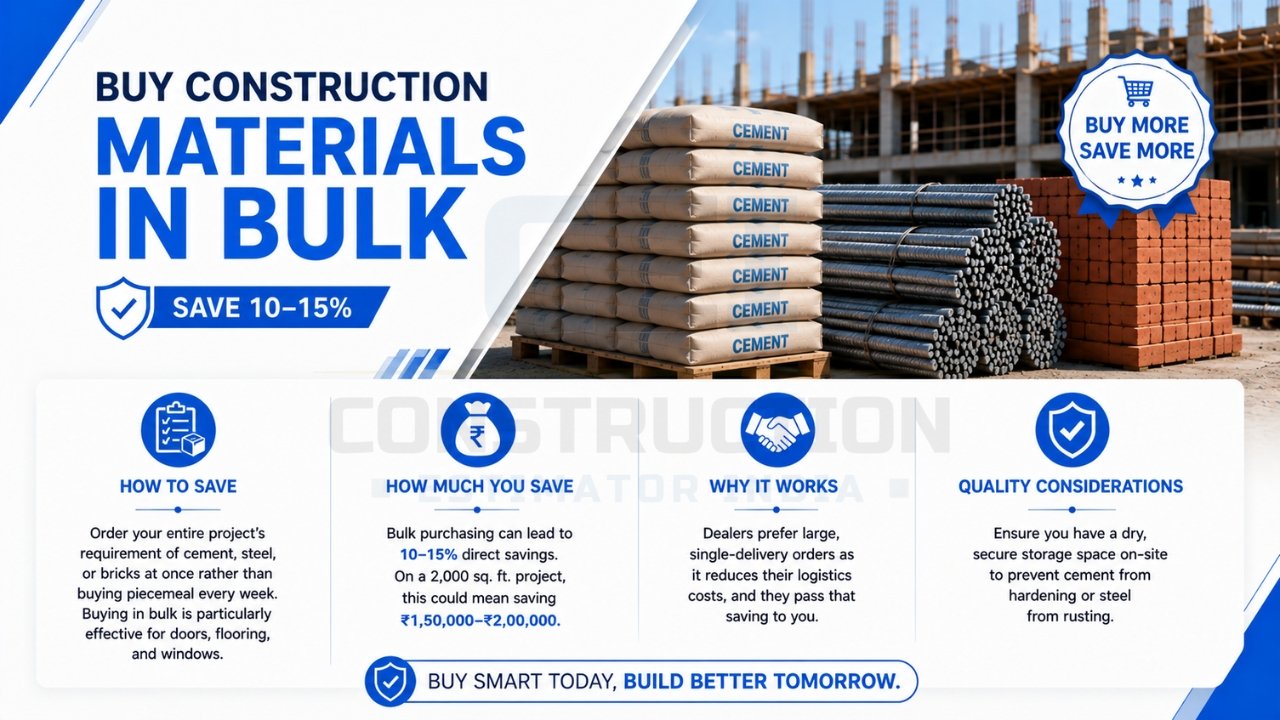
Buy Construction Materials in Bulk (Save 10–15%)
One of the best ways to save money on construction materials is to buy them in bulk. When you order large quantities at once, you gain significant bargaining power. Buy construction materials in bulk and this will ensure dealers offer you a discount.
- How to Save: Order your entire project’s requirement of cement, steel, or bricks at once rather than buying piecemeal every week. Buying in bulk is particularly effective for doors, flooring, and windows.
- How Much You Save: Bulk purchasing can lead to 10–15% direct savings. On a 2,000 sq. ft. project, this could mean saving ₹1,50,000–₹2,00,000.
- Why it Works: Dealers prefer large, single-delivery orders as it reduces their logistics costs, and they pass that saving to you.
- Quality Considerations: Ensure you have a dry, secure storage space on-site to prevent cement from hardening or steel from rusting.
Buy from Authorized Dealers Directly (Save 5–10%)
How to Save: Find the regional distributors for major brands like Tata Tiscon or UltraTech. Present your Bill of Quantities (BOQ) and negotiate for “Builder rates.”
- How to Save: Find the regional distributors for major brands like Tata Tiscon or UltraTech. Present your Bill of Quantities (BOQ) and negotiate for “Builder rates.”
- How Much You Save: Direct dealing saves ₹20–₹40 per bag of cement and ₹500–₹1,000 per ton of steel.
- Why it Works: It eliminates the middleman’s commission and ensures you get fresh, high-quality stock.
- Quality Considerations: Checking the “date of packing” on cement is vital; cement older than 3 months loses strength.
👉 Build smarter and avoid costly mistakes. Speak with our construction experts today.
Use Exposed Brick Instead of Concrete Blocks (Save 8–12%)
While concrete blocks are commonly used for walls, some choose to build with exposed brick, believing this saves money. Knowing the difference between RCC and brick construction helps evaluate these decisions. Exposed brickwork, when done skillfully, eliminates the need for both internal and external plastering and painting.
- How to Save: Use high-quality wire-cut bricks for exterior walls. Use a neat pointing technique for the joints.
- How Much You Save: You save roughly ₹50–₹70 per square foot by eliminating plaster and paint.
- Why it Works: Plastering and painting are labor-intensive; removing these steps slashes the finishing timeline and budget.
-
Quality Considerations: Knowing which grade cement is best for plastering ensures the underlying plaster is finished robustly and smoothly by the mason using a sponge finish, eliminating the need for putty.
Choose Tiles Under ₹60 per Sq Ft (Save ₹20,000–₹40,000)
Flooring is a massive cost center. Select tiles costing less than Rs 60 per square foot to keep your budget intact. Choose 2X2 size 0-joint tiles—this saves on both material and the labor required for grout filling.
- How to Save: Look for “commercial grade” or “standard grade” vitrified tiles from major brands. They are often structurally identical to premium grades but may have minor color variations that are invisible to the untrained eye.
- How Much You Save: Moving from ₹120/sqft tiles to ₹50/sqft tiles for a 1,000 sq. ft. area saves ₹70,000.
Why it Works: Standard sizes are mass-produced and cheaper to install than large-format slabs.
- Quality Considerations: Always check for “warpage” or “bend” in budget tiles before purchasing the entire lot.
Omit Exterior Wall Putty (Save ₹15,000–₹30,000)
Avoid exterior wall putty. While it makes the wall smoother, it is often unnecessary for exteriors. Although material costs are low, labor costs are five times higher for putty application compared to direct painting.
- How to Save: Apply a high-quality exterior primer directly onto the plaster followed by two coats of weather-shield paint.
- How Much You Save: On a standard home, this can save ₹20,000 in labor and material.
- Why it Works: Putty is prone to peeling in heavy rain if not applied perfectly; skipping it reduces risk and cost.
- Quality Considerations: Ensure the underlying plaster is finished smoothly by the mason using a sponge finish.
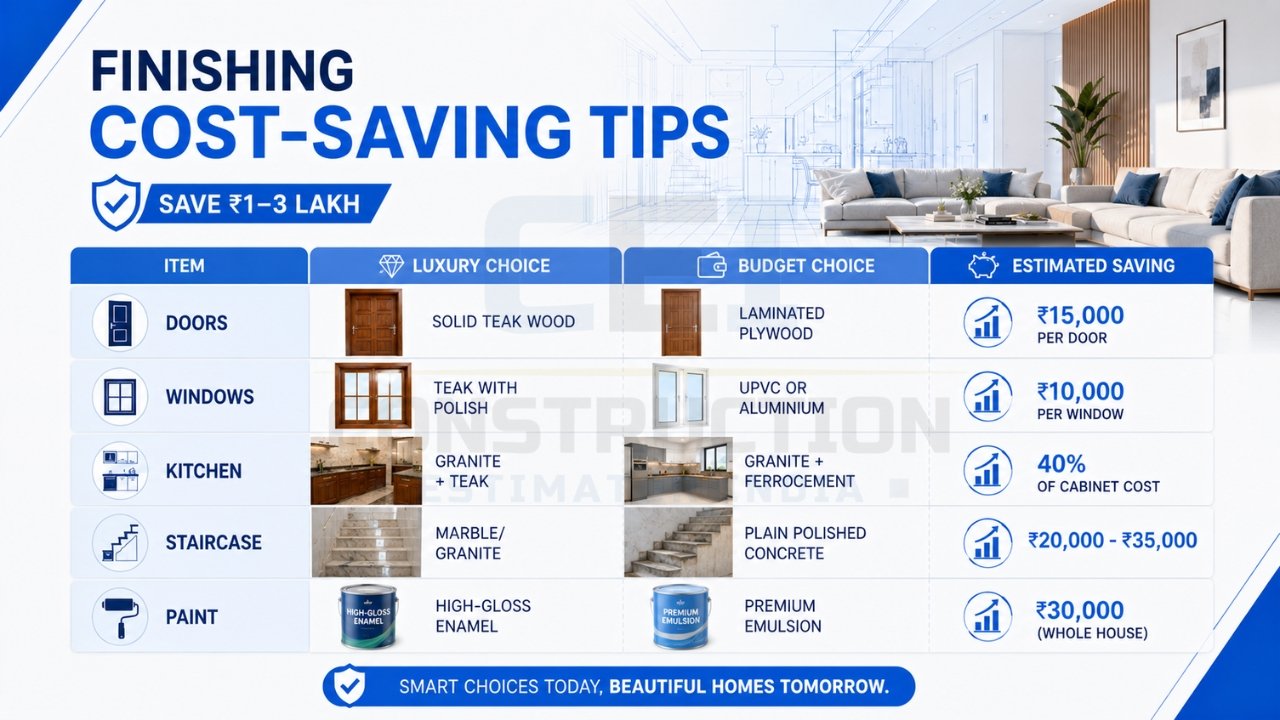
Finishing Cost-Saving Tips (Save ₹1–3 Lakh)
| Item | Luxury Choice | Budget Choice | Estimated Saving |
|---|---|---|---|
| Doors | Solid Teak Wood | Laminated Plywood | ₹15,000 per door |
| Windows | Teak with Polish | UPVC or Aluminium | ₹10,000 per window |
| Kitchen | Granite + Teak | Granite + Ferrocement | 40% of Cabinet Cost |
| Staircase | Marble/Granite | Plain Polished Concrete | ₹20,000 – ₹35,000 |
| Paint | High-Gloss Enamel | Premium Emulsion | ₹30,000 (Whole House) |
Simplify Painting Technique (Save ₹20,000–₹40,000)
Avoid “Texture” or “Royal” finishes which require specialized labor and multiple coats. Use a high-quality premium emulsion with a simple roller finish. This provides a clean, modern look at a fraction of the price.
Use Laminate/Print-Finished Plywood Doors (Save ₹10,000–₹25,000)
Instead of solid wood doors for every room, use laminate-finished flush doors. They are moisture-resistant, require zero polishing, and are ready to install. This saves thousands on carpenter labor and expensive wood polish.
Plain Concrete Steps for Staircase (Save ₹15,000–₹35,000)
Cladding a staircase in granite or marble is expensive. Use plain concrete steps with a smooth cement finish or “IPS” flooring for a minimalist industrial look. You can even add color oxides to the cement to match your interiors.
Aluminium/Ferrocement Cupboards (Save 40%)
Instead of heavy wood or plywood wardrobes, use aluminium or ferrocement slabs for the internal shelving of your cupboards. You only need to add a wooden or laminate frame and doors to the front to achieve a premium look while saving significantly on interior costs.
👉 Get expert cost-saving strategies tailored to your house construction budget and requirements.
Electrical & Plumbing Cost Savers (Save ₹30,000–₹80,000)
Avoid Unnecessary Switches and Light Points (Save ₹10,000–₹25,000)
Electricians often suggest 6-8 light points per room to increase their labor bill. Avoid unnecessary switches and light points. Stick to a functional layout: 2 lights, 1 fan, and 2-3 power points per room. This reduces the length of conduit pipes, wires, and the cost of expensive switch plates.
Keep Kitchen Area Plain During Construction (Save ₹20,000–₹50,000)
Don’t let your builder install a permanent concrete kitchen platform. Keep the kitchen area plain during construction. Later, install a modular kitchen with a standalone granite top. This allows you to customize the storage without the “dead weight” of concrete slabs which are difficult to modify.
Reduce Construction Waste & Machinery Costs (Save ₹20,000–₹60,000)
Reduce Construction Waste (Save 5–8%)
The average Indian construction site wastes 10-15% of materials due to poor handling. Reduce construction waste by supervising the mixing of mortar and the cutting of steel. If you are handling RCC construction, using broken bricks for PCC (Plain Cement Concrete) and collecting fallen mortar for reuse can save lakhs.
Rent Machinery Instead of Buying (Save 40–60%)
For specialized equipment like concrete mixers, vibrators, or scaffolding, rent machinery instead of buying it. This saves you the capital investment and the headache of maintenance and storage after the project is over.
Common Mistakes That Increase Costs
- Making Abrupt Changes: Avoid making any unnecessary changes after construction starts. It is the #1 budget killer.
-
Skipping Structural Drawings: Without an engineer’s drawing, contractors often “over-design” by using extra steel “just to be safe,” which wastes thousands of rupees.
- Not Comparing Quotes: Always get at least three detailed BOQ quotes from different contractors. Construction Estimator India can help you audit these quotes to ensure you aren’t being overcharged.
Frequently Asked Questions (FAQs)
- How can I save ₹5 lakh on my 1,500 sq. ft. home?
By combining strategies: reducing square footage by 100 sq. ft. (saves ₹1.5L), building a two-story design (saves ₹1L), buying materials in bulk (saves ₹1L), and choosing budget tiles/finishes (saves ₹1.5L). - Is it cheaper to build during the monsoon?
No. Labor productivity drops, and materials like cement and steel are prone to damage. Start construction in the dry season to save 5–10% on labor efficiency and prevent material wastage. - Does a “labor-only” contract save money?
It can, provided you have the time to manage material procurement. You save on the contractor’s 10-15% markup on materials, but you must be vigilant about waste and theft. - Should I use branded or local cement?
Always use branded cement (like UltraTech or ACC) for structural elements. However, you can use slightly cheaper local brands for non-structural work like plastering or boundary walls. - Is red brick cheaper than AAC blocks?
AAC blocks are usually cheaper overall because they are larger (faster labor) and require less mortar and plaster. - What is the best way to handle the kitchen budget?
Omit the concrete slab during construction. Use a freestanding modular kitchen later to avoid permanent, unchangeable structures. - How do I avoid “hidden charges” from contractors?
Ensure your contract includes a detailed Bill of Quantities (BOQ). At Construction Estimator India, we provide transparent BOQs so you know the exact cost of every gram of steel. - Can I skip the architect to save money?
No. A good design saves more than it costs. A poor design leads to wastage that far exceeds an architect’s fee. - How much should I spend on flooring?
Stick to vitrified tiles under ₹60 per sq. ft.. Avoid marble or granite for large areas unless your budget is flexible. - Does a simple roof really save money?
Yes. A complex roof with multiple slopes requires expensive shuttering and specialized labor. A flat RCC roof is the most cost-effective. - How can I save on plumbing?
Keep all bathrooms and the kitchen close to each other (vertically or horizontally) to reduce the length of piping and drainage lines. - What is the first step to saving money?
Get a professional cost estimate. Construction Estimator India offers a free initial consultation at +91 8630676890.
Contact Construction Estimator India for Cost Help
Don’t let the fear of high costs stop you from building your legacy. At Construction Estimator India, we specialize in “forensic-level” cost breakdowns that identify every saving opportunity before you spend a single rupee. We also assist with regulatory compliances like RERA Uttarakhand or your specific state board.
-
Free Cost Estimate: Get a ballpark figure for your dream home.
-
Detailed BOQ Services: Know exactly what you are paying for.
-
Budget Consultation: Learn where to splurge and where to save.
Contact Us Today:
-
-
Call/WhatsApp: +91 8630676890
-
Conclusion
Building your home in India doesn’t have to be a financial nightmare. By focusing on smart planning, bulk material procurement, and functional finishing, you can save ₹3–8 lakh on your home construction while still ensuring a safe, beautiful, and high-quality residence. Remember, the most successful projects are those where the homeowner is empowered with data. Use your construction cost calculator before every decision and partner with experts like Construction Estimator India to guide your journey. Your dream home is possible—budget-friendly, beautiful, and built to last.