Applying for a construction loan in India is a significant milestone for any homeowner or builder. Whether you are dealing with a public sector giant like SBI or private players like HDFC Bank and ICICI, the documentation process is rigorous. One of the most critical documents you will need to submit is a detailed construction estimate, professionally known as a Bill of Quantities (BOQ). To secure a BOQ for bank loan India approval, you must ensure that your document is not just a rough set of numbers, but a structured, technical breakdown of your entire project cost.
👉 Need a BOQ for Bank Loan Approval? Get Expert Assistance Today.
The primary reason banks in India—under guidelines from the Reserve Bank of India (RBI)—insist on a detailed BOQ is to verify the technical and financial viability of your construction project. The bank needs to see exactly where the money is going—from the excavation of the foundation to the final coat of paint. A BOQ provides a comprehensive list of work items, their specific quantities based on architectural drawings, current market rates, and the total projected expenditure. Without this document, the bank cannot determine the “Loan to Value” (LTV) ratio, which ultimately decides how much funding you will receive. Knowing how to plan home construction in India from day one ensures this financial layout is flawless.
In this guide, we will walk you through the entire process of creating a bank-ready estimate. We will cover the essential components, a step-by-step preparation method, and common pitfalls to avoid. At Construction Estimator India, we specialize in helping clients bridge the gap between architectural plans and bank approval by providing professional, formatted estimates.
If you need a BOQ for bank loan India in a clear format, contact Construction Estimator India on WhatsApp / Call +91 8630676890.
What Is a BOQ and Why Do Banks Need It?
Understanding the fundamental purpose of this document is the first step toward getting your loan approved without multiple queries from the bank’s technical officer.
Simple Definition of BOQ (Bill of Quantities)
In plain language, a BOQ is a detailed “shopping list” for your construction project. It breaks down the entire building process into individual items of work. Each item is assigned a unit of measurement (like square feet or cubic meters), a specific quantity derived from your building plans, a unit rate (the cost per unit), and a total amount. For example, instead of saying “Foundation cost: 5 Lakhs,” a BOQ will specify the volume of earth to be excavated, the amount of cement concrete to be poured, and the weight of steel reinforcement required.
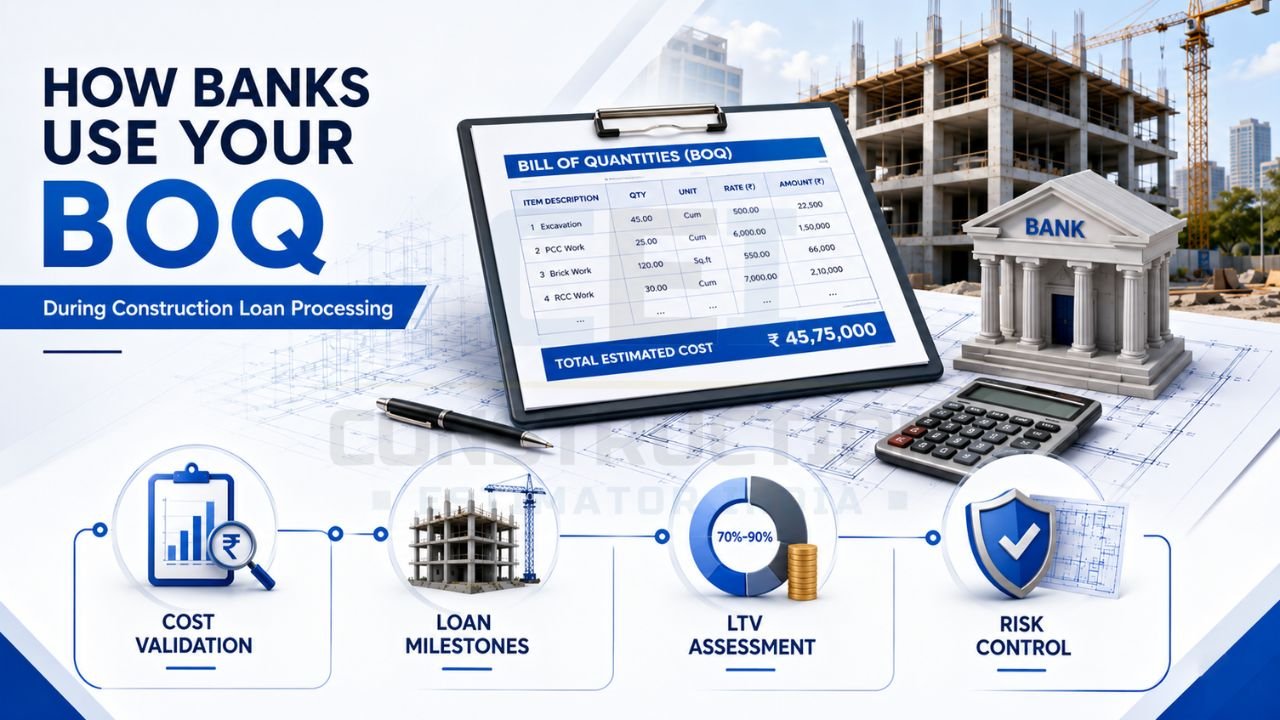
How Banks Use Your BOQ During Construction Loan Processing
When you submit an application, the bank’s technical team evaluates the project. They use the BOQ to:
- Validate Project Cost: They check if your estimated cost is realistic. If you estimate a low baseline house construction per sq ft rate but the local market rate is much higher, they may worry you will run out of funds mid-construction.
- Determine Disbursement Stages: Construction loans are usually released in installments (e.g., foundation level, plinth level, slab level). The BOQ helps the bank define these milestones.
- Assess Loan-to-Value (LTV): Banks typically fund 70% to 90% of the construction cost. The BOQ provides the base figure for this calculation.
- Risk Mitigation: By reviewing the quantities, the bank ensures the project is structurally sound and follows the submitted plans.
BOQ for Bank Loan India: Key Expectations
Every bank has a slightly different internal checklist, but the core expectations for a BOQ for bank loan India remain consistent. They look for:
- Clarity: Every item must be clearly described (e.g., “M20 Grade RCC” instead of just “Concrete”).
- Market Consistency: Rates must align with current local market conditions or Government Schedule of Rates (SOR).
- Professionalism: The document should be on the letterhead of a qualified engineer or a professional firm like Construction Estimator India.
- Logical Flow: The items should follow the actual sequence of construction.
👉 Get Accurate BOQ Documentation for Smooth Construction Loan Processing.
Essential Parts of a Bank-Ready BOQ
A professional BOQ is structured to be read easily by a bank manager who might not have a background in civil engineering.
Header and Project Information
The top of the document must clearly identify the project. It should include:
- Applicant Name: As per the loan application.
- Site Address: The exact location where construction will take place.
- Plot Area and Built-up Area: Total area of the house (e.g., G+1, 1500 sq. ft.).
- Estimate Date: Banks usually require an estimate prepared within the last 3-6 months.
- Consultant Details: Name and contact of the engineer or firm preparing the report.
Item-Wise Quantity and Rate Table
This is the “meat” of the document. It must be presented in a tabular format with the following columns:
- Item No: Serial number for easy reference.
- Description of Work: A detailed explanation of the material and labor involved.
- Unit: The standard measurement (e.g., Cum, Sqm, Kg, Running Meter).
- Quantity: The numerical value calculated from the drawings.
- Rate: The cost per unit.
- Amount: Quantity multiplied by the Rate.
Summary of Costs and Grand Total
After the detailed tables, you must provide a summary page. This groups the costs into major heads like “Civil Works,” “Electrical Works,” and “Plumbing & Finishing.” This summary allows the bank officer to see the big picture at a glance. The grand total must be written clearly in both numbers and words.
Certification and Signature Block
This is non-negotiable. A BOQ for bank loan India must be signed and stamped by a registered civil engineer, architect, or an authorized valuer. This seal acts as a guarantee of the document’s accuracy.
Step-by-Step: How to Prepare a BOQ for Bank Construction Loan
Preparing a BOQ requires a mix of mathematical precision and market knowledge. Here is how the experts at Construction Estimator India handle the process.
Step 1: Collect Drawings and Basic Project Details
You cannot prepare an accurate BOQ without a final set of architectural drawings. You need the floor plans, elevations, and sections. If it is a G+1 house, ensure you have the roof plan as well. These drawings provide the dimensions needed to calculate volumes and areas.
Step 2: Divide the Project into Major Work Heads
Break the construction down into logical phases. Common heads include:
-
Substructure (Foundation & Plinth) — where choosing the right foundation types for house construction in India controls the initial budget.
-
Superstructure (Walls & RCC Slabs) — heavily dependent on professional execution by building contractors.
- Superstructure (Walls & RCC Slabs)
- Plastering and Pointing
- Flooring and Tiling
- Doors and Windows
- Internal and External Painting
- Electrical and Plumbing Installations
Step 3: Take Quantities from Drawings or Area
This is the most technical part, known as “Quantity Take-off.” For example, to calculate the quantity of brickwork, you take the length of the walls, multiply by the height, and multiply by the thickness, while subtracting the areas for doors and windows. Understanding the structural dynamics of RCC vs brick construction in India will significantly refine these quantity take-offs.
👉 Need Help Preparing a BOQ? Consult Our Construction Estimation Experts.
Step 4: Assign Realistic Rates Based on Market or PWD/CPWD SOR
Rates vary by city. You can use the local market rate or refer to the Central Public Works Department (CPWD) Schedule of Rates. For instance, knowing which grade cement is best for plastering allows you to assign exact pricing to finishing line items. Banks prefer rates that are realistic; excessively low rates might be flagged as an “unrealistic estimate.”
Step 5: Calculate Amounts and Prepare Item-Wise Table
Multiply the quantity of each item by its assigned rate. For example:
- Item: RCC M25 for Slabs
- Quantity: 25 Cum
- Rate: ₹7,500/Cum
- Amount: ₹1,87,500
Step 6: Prepare Cost Summary, Contingencies and Grand Total
Once all items are calculated, sum them up. It is standard practice to add a small percentage (usually 3-5%) for “Contingencies” to account for unforeseen expenses. This gives the bank confidence that you have a buffer.
Step 7: Format, Review and Sign Your BOQ
The final document should be clean, free of typos, and professional. Ensure that the total on the summary page matches the sum of the individual items. Finally, get the document signed and stamped by the authorized professional.
Before you submit your construction estimate to the bank, reach out to Construction Estimator India on WhatsApp / Call +91 8630676890 for a professional BOQ review.
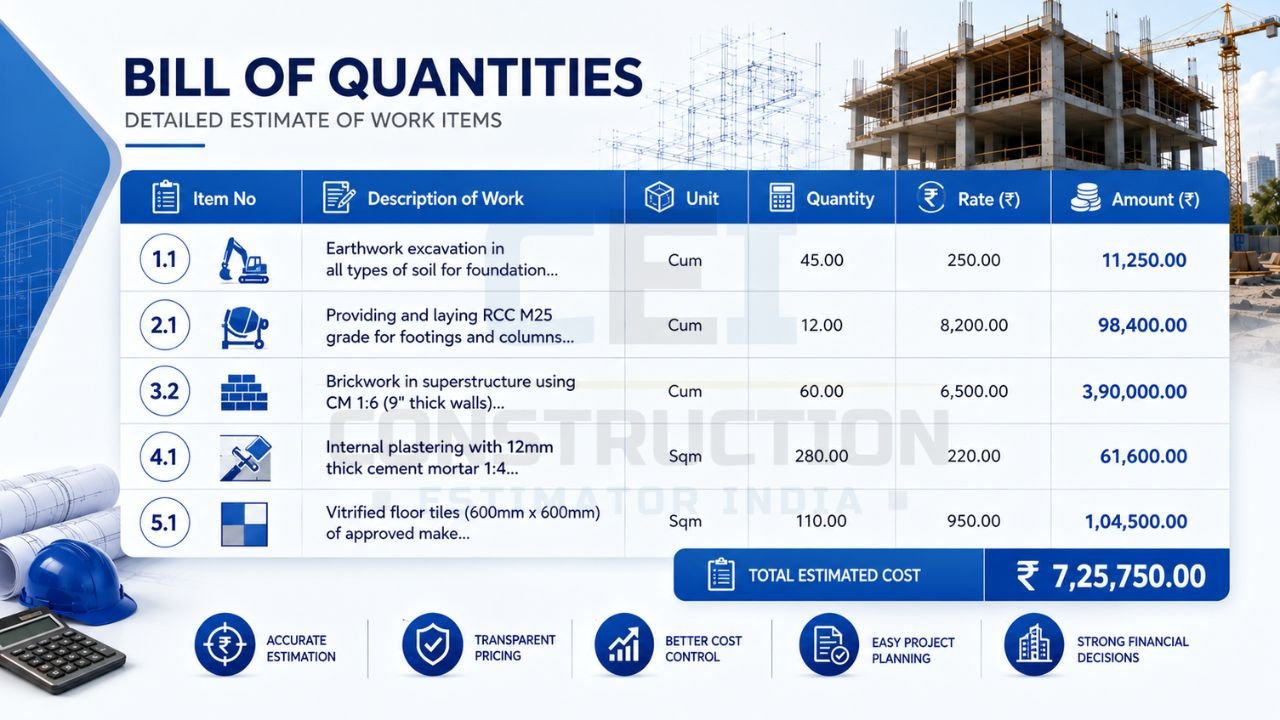
Example Outline of a BOQ for Bank Loan India
To give you an idea of what the bank expects, here is a simplified outline of how your items should be presented.
| Item No | Description of Work | Unit | Quantity | Rate (₹) | Amount (₹) |
|---|---|---|---|---|---|
| 1.1 | Earthwork excavation in all types of soil for foundation… | Cum | 45.00 | 250.00 | 11,250.00 |
| 2.1 | Providing and laying RCC M25 grade for footings and columns… | Cum | 12.00 | 8,200.00 | 98,400.00 |
| 3.2 | Brickwork in superstructure using CM 1:6 (9″ thick walls)… | Cum | 60.00 | 6,500.00 | 3,90,000.00 |
| 4.1 | Internal plastering with 12mm thick cement mortar 1:4… | Sqm | 280.00 | 220.00 | 61,600.00 |
| 5.1 | Vitrified floor tiles (600mm x 600mm) of approved make… | Sqm | 110.00 | 950.00 | 1,04,500.00 |
(Note: The numbers above are illustrative. Actual quantities and rates will depend on your specific architectural design, geographic location, and localized pricing like your specific plaster cost per square foot with material.)
Common Mistakes in BOQ for Bank Construction Loans
Even a small error can lead to the bank rejecting your file or asking for a resubmission, which delays your funds.
- Missing Engineer Details: Submitting an estimate without a valid registration number or seal of an engineer.
- Vague Descriptions: Using terms like “Standard Quality” instead of specifying the brand or grade of material.
- Mathematical Errors: If the column totals don’t match the summary, the bank will doubt the entire document’s credibility.
- Ignoring Major Heads: Forgetting to include electrical wiring, plumbing, or compound walls can result in an under-funded loan.
- Unrealistic Rates: Setting rates significantly higher or lower than the current local market price.
- Discrepancy with Plans: If your architectural plan shows 3 bathrooms but the BOQ only accounts for plumbing in 2, it creates a “query.”
- No Signature/Seal: A plain printout from an Excel sheet is rarely accepted by Indian banks without a physical or digital verified signature.
👉 Get Detailed and Bank-Ready BOQ Reports for Your Construction Project.
Practical Tips to Make Your BOQ Bank-Friendly
To ensure a smooth approval process, follow these expert tips:
Keep Descriptions Clear and Non-Technical
While it is a technical document, the bank manager needs to understand it. Instead of just writing “1:2:4 Concrete,” write “Cement Concrete (1:2:4) for Plinth Protection.”
Avoid Under-Estimating or Over-Estimating Total Cost
If you under-estimate to show you can afford the project, the bank may think you can’t finish it. If you over-estimate to get more loan, the bank’s technical valuer will catch the discrepancy and slash the approved amount anyway. Aim for “Market Reality.”
Match BOQ with Your Loan Application Details
If your loan application says you are building 2,000 sq. ft., your BOQ quantities must reflect a 2,000 sq. ft. structure. Any mismatch is a red flag.
Keep a Soft Copy and Print Copy Ready
Banks often ask for a PDF for their digital records and a signed hard copy for the physical file. Having both ready saves time.
If you want a BOQ for bank loan India that is easy for banks to understand, contact Construction Estimator India on WhatsApp / Call +91 8630676890.
How Construction Estimator India Can Help with BOQ for Bank Loan India?
At Construction Estimator India, we understand the nuances of Indian banking requirements. We don’t just provide a list of numbers; we provide a document designed for approval.
Our team of senior civil engineers and quantity surveyors will:
- Perform a detailed quantity take-off from your provided architectural drawings.
- Apply the most current and realistic market rates based on your specific city and state.
- Format the report to meet the specific requirements of banks like SBI, HDFC, PNB, and ICICI.
- Provide a professional summary that highlights the value of your project.
Whether you are building a new home from scratch or financing an extensive house renovation, we ensure your estimates are technically ironclad.
👉 Start Your Project with a Reliable BOQ and Expert Cost Estimation Support.
Frequently Asked Questions: BOQ and Bank Construction Loans
What is BOQ for bank loan India and why is it important?
A BOQ (Bill of Quantities) is a document that lists all materials and labor required for your construction project along with their costs. It is essential because banks use it to verify your project’s total cost and determine how much loan they can safely provide.
Do all banks in India ask for a detailed BOQ for construction loans?
Yes, almost all major banks and NBFCs in India require a detailed cost estimate or BOQ. While some may accept a simple summary for very small loans, a detailed BOQ is standard for house construction loans to ensure the project is viable.
Can I use an area-based estimate instead of a full BOQ?
While some banks might initially look at an “Area x Rate” estimate for a preliminary offer, the final sanction and disbursement almost always require an itemized BOQ to track construction progress accurately.
Who should sign and stamp the BOQ for bank submission?
The document should be signed and stamped by a Registered Civil Engineer (with a license from the local municipal body or Council of Architecture) or a professional valuation firm.
How accurate does my BOQ need to be for bank approval?
It should be highly accurate, typically within a 5-10% margin of the actual expected costs. Significant errors can lead to a shortage of funds during the final stages of your construction.
How can Construction Estimator India help me prepare my BOQ?
We take your building plans and convert them into a professional, bank-ready document. We handle all the complex calculations and ensure the rates are realistic, saving you from bank queries and delays.
Conclusion
Preparing a BOQ for bank loan India is a technical task that forms the backbone of your loan application. A clear, well-structured, and realistic estimate not only helps in faster loan approval but also serves as a roadmap for your construction budget. By avoiding common mistakes like vague descriptions and unrealistic rates, and by ensuring your document is signed by a professional, you significantly increase your chances of a hassle-free sanction.
If you are planning to apply for a construction loan and need a clear BOQ for bank loan India, contact Construction Estimator India on WhatsApp / Call +91 8630676890 for professional BOQ and estimate support.