
For the vast majority of Indians, building a home is the most significant financial and emotional investment they will ever make; it is the culmination of years of savings and dreams. Learning how to plan home construction in India can save many headaches, but unfortunately, the Indian construction landscape is notoriously fragmented and often unregulated, leading many homeowners to fall prey to unreliable, unprofessional, or even dishonest contractors. These “bad contractors” can turn a dream project into a nightmare of structural failures, endless delays, and disappearing funds. Common issues range from blatant poor work quality and overcharging to the complete abandonment of projects after taking substantial advances.
The financial impact of a bad contractor can be staggering. Depending on the size of the project—be it a small renovation or a multi-story independent house—the direct financial loss often ranges from ₹50,000 to over ₹10 lakhs. This does not even account for the cost of rectifying poor work or the rental expenses incurred due to prolonged delays. Beyond the money, the emotional stress, family strain, and wasted time are often irreparable. Homeowners frequently feel helpless because they lack formal documentation or a clear understanding of the legal recourse available to them in the Indian context.
The reality is that you do not have to be a victim; while the situation may seem dire, there are established protocols for recovery and protection. The best way to deal with an unreliable contractor is with documentation and clear, professional written and verbal communication. This guide serves as a comprehensive manual for navigating these disputes. At Construction Estimator India, we have spent over 15 years witnessing these challenges and helping homeowners resolve them. If you are currently facing a dispute, we offer a Free Consultation and Free Legal Advice at +91 8630676890 to help you reclaim control of your project. Don’t let a bad contractor ruin your home investment—take action now.
20 Signs Your Contractor is Bad or Unreliable
Lack of Licenses or Insurance
One of the best ways to handle bad contractors is to prevent issues from arising in the first place by verifying credentials before hiring. In India, you must check if the contractor or their firm has a valid business license, GST registration, or enrollment with local bodies like the MCD, ADA, or Nagar Palika. Verify if they have insurance coverage for their workers and your property; a lack of license or insurance is a major red flag. Unlicensed “thekedars” cannot be reported to formal state licensing boards, making recovery much harder if they disappear. Always ask for proof of registration to ensure legal accountability.
Constantly Missing Deadlines or Making Excuses for Delays
One of the earliest indicators of an unprofessional contractor is a consistent failure to meet timelines. In the Indian market, contractors often “kite” money—taking an advance from you to finish a previous client’s project, resulting in your project being stalled. If work is consistently behind schedule with no clear communication, you must act. You should keep track of when photos were taken and maintain a written log of site activity. Keep a detailed timeline of progress or lack thereof; delays cost you not just time, but significant money in rental expenses and material price inflation.
Poor Work Quality That Doesn’t Meet Standards
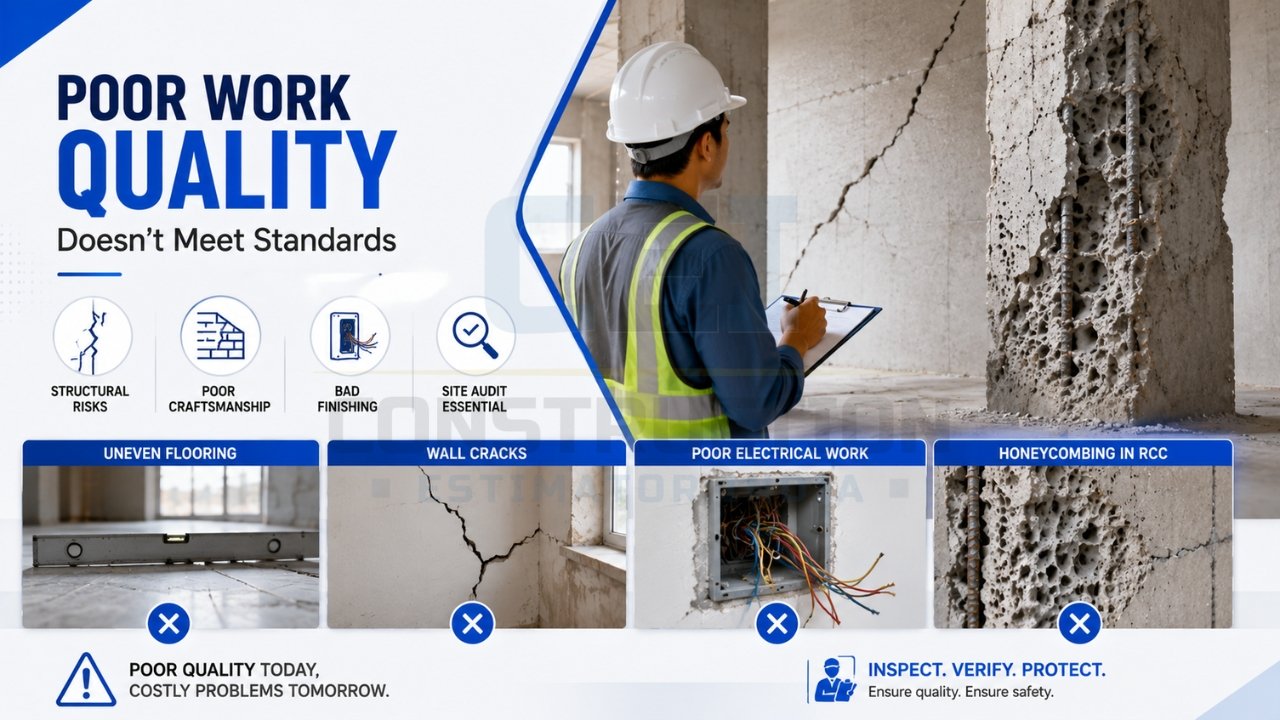
Poor craftsmanship is not just an aesthetic issue; it can be a structural hazard. Visible defects such as uneven flooring, wall cracks appearing within weeks, or poor electrical finishing are signs of incompetence or corner-cutting. Taking steps to confirm that the work done in your home was subpar will help hold your contractor accountable. You should use a building inspector or a professional consultant like Construction Estimator India to perform a site audit and evaluate the work. Knowing precisely what is RCC construction helps spot structural warning signs like wide diagonal cracks (wider than 1mm) or honeycombing in columns, which are critical red flags that point to poor RCC execution.
Using Substandard or Cheaper Materials Than Agreed
Material fraud is rampant in Indian construction; a contractor might quote for branded “Grade A” materials but secretly use unbranded or lower-grade alternatives to increase their profit margin. They may claim it is the “same quality,” but the durability will differ significantly. Understanding, for example, which grade cement is best for plastering in india empowers you to call out material fraud. If a contractor uses subpar materials, include it in your documentation immediately. Always verify material delivery receipts, check the branding on cement bags and pipes, and ensure all materials are ISI-marked. Substandard materials drastically reduce the lifespan of your building and lead to expensive repairs later.
👉 Protect yourself from costly mistakes, unfinished work, and contractor-related disputes.
Constantly Asking for More Money
A dishonest contractor often uses “under-quoting” as a trap, providing a low initial estimate to win the project and then introducing “unexpected costs” once you are committed. While minor variations are normal, regular demands for more money beyond the agreed budget indicate poor planning or intentional deception. Never pay a contractor up front for any significant work, and don’t pay less than market price assuming you may outplay them; if the price is too good to be true, they will likely try to make up the difference through constant cost escalations.
Poor Communication and Unresponsiveness
If a contractor stops answering your calls for days, avoids site meetings, or provides vague progress updates, they are likely hiding issues. A lack of transparency is often a precursor to project abandonment. First, schedule a time to speak when both parties are free of distractions to address these concerns professionally. If unresponsiveness persists, it is a clear sign they no longer prioritize your project. Communication is the bridge to project success, and its breakdown indicates a lack of professionalism that should not be ignored.
Abandoning Project or Working Very Slowly
Total abandonment is the worst-case scenario where worker presence on-site dwindles to nothing, or work stops entirely for weeks. This usually happens when the contractor has mismanaged your funds. A contractor failing to meet a basic standard of professionalism by essentially ghosting the site is in breach of contract. This leaves you with an unfinished, often unsafe structure that is vulnerable to weather damage. Early action is required here—if you notice a significant slowdown, do not wait for the contractor to return; begin the documentation and termination process.
No Written Contract or Verbal Agreement Only
Never pay a contractor up front for any significant work without a signed agreement. Before you talk to your contractor, review the renovation contract you signed to understand your legal standing. If you only had a verbal agreement, it is much harder to prove terms in court, but you should immediately communicate your concerns in writing to create a paper trail. Verbal agreements are difficult to prove, and rogue contractors rely on this lack of documentation to escape accountability. Construction Estimator India can help you draft or review contracts at +91 8630676890 to prevent these scenarios.
Immediate Actions to Take When You Notice Bad Contractor Behavior
Step 1: Document Everything Thoroughly
In any legal or consumer dispute in India, the person with the best records wins. You must document the issues by taking pictures and videos of all problem areas, including poor work quality, delays, and substandard materials. Keep track of when photos were taken and maintain a written log or daily diary of site activity. The more evidence, the better for holding someone accountable. Save all WhatsApp messages, emails, SMS, and call recordings, as WhatsApp logs are increasingly accepted as evidence in Indian courts. Store these documents in a secure cloud folder and keep physical copies; documentation is your best defense against a bad contractor.
Step 2: Review Your Contract Thoroughly
Before you talk to your contractor, review the renovation contract you signed. Check the scope of work, timeline, payment schedule, and quality standards. Identify exactly where the contractor is violating the agreement, such as failing to meet a specific milestone or using a non-approved material brand. Reviewing the contract for termination terms is best when ending the relationship to ensure you do not inadvertently breach the agreement yourself. If you only had a verbal agreement, document what was promised in writing and ask the contractor to confirm it via message to establish the terms of your “handshake” deal.
Step 3: Communicate in Writing Professionally
Stop having casual site conversations that leave no record. Communicate in writing: more evidence, better for accountability. Write a formal email or letter stating, “I have concerns regarding the project and want to discuss the following points…”. Share specific areas of concern with photos and videos attached, explaining why the work does not meet expectations. Refrain from settling for a verbal agreement—get written confirmation of any promises made. Frame the conversation with a focus on solutions rather than pure blame to keep the contractor engaged, but send the communication via email, WhatsApp, and Registered Post for maximum legal weight.
Step 4: Set Clear Expectations and Timeline for Corrections
If you start noticing issues with their work, address them as soon as possible by laying out next steps including terms for corrections and a timeline for repairs. Specify exactly what needs to be fixed (e.g., “The dampness in the north wall must be treated by June 20th”) and set a firm deadline, typically 7-15 days. State clearly that failure to meet this deadline will result in payment suspension or contract termination. Get a written agreement on the correction timeline. If the contractor misses this final, documented chance, you have solid grounds for formal firing.
Step 5: Stop Payment Until Issues Resolved
Money is your only real leverage with a rogue contractor. Stop all payments until the contractor fixes identified issues. You should ideally pay about 25% up front with progress payments thereafter; never pay for any work up front in full. Calculate the fair value of work completed correctly and withhold any balance for substandard or unfinished portions. Never make any final payments until all work is completed satisfactorily. Use the withheld payment as leverage for quality work and notify the contractor formally in writing about the suspension of payment and the reasons for it.
Legal Steps to Take Against Bad Contractor in India
Step 1: Send Legal Notice Through Advocate
If you want to initiate legal action, first send a well-drafted legal notice under an advocate’s letterhead. This is the most effective way to show the contractor you are serious. The notice should detail the contract, the specific breaches (delays, quality), and your demands for a refund or completion within 15 to 30 days. A legal notice is the first formal step before filing a court case and often motivates the contractor to settle without litigation. Construction Estimator India can recommend experienced construction lawyers at +91 8630676890 to assist with this process. The typical cost ranges from ₹5,000 to ₹15,000.
Step 2: File Consumer Court Complaint
Under the Consumer Protection Act, 2019, construction is considered a “service,” and you can file a consumer case for a contractor dispute. This is often faster and cheaper than civil court. Get a bill from the contractor; if he refuses, write a letter demanding it before filing your case. You can file in the District Consumer Forum for claims up to ₹50 lakhs, where you can claim a refund, repair costs, and compensation for mental harassment. The process typically takes 6-18 months, and you can even represent yourself without an expensive lawyer.
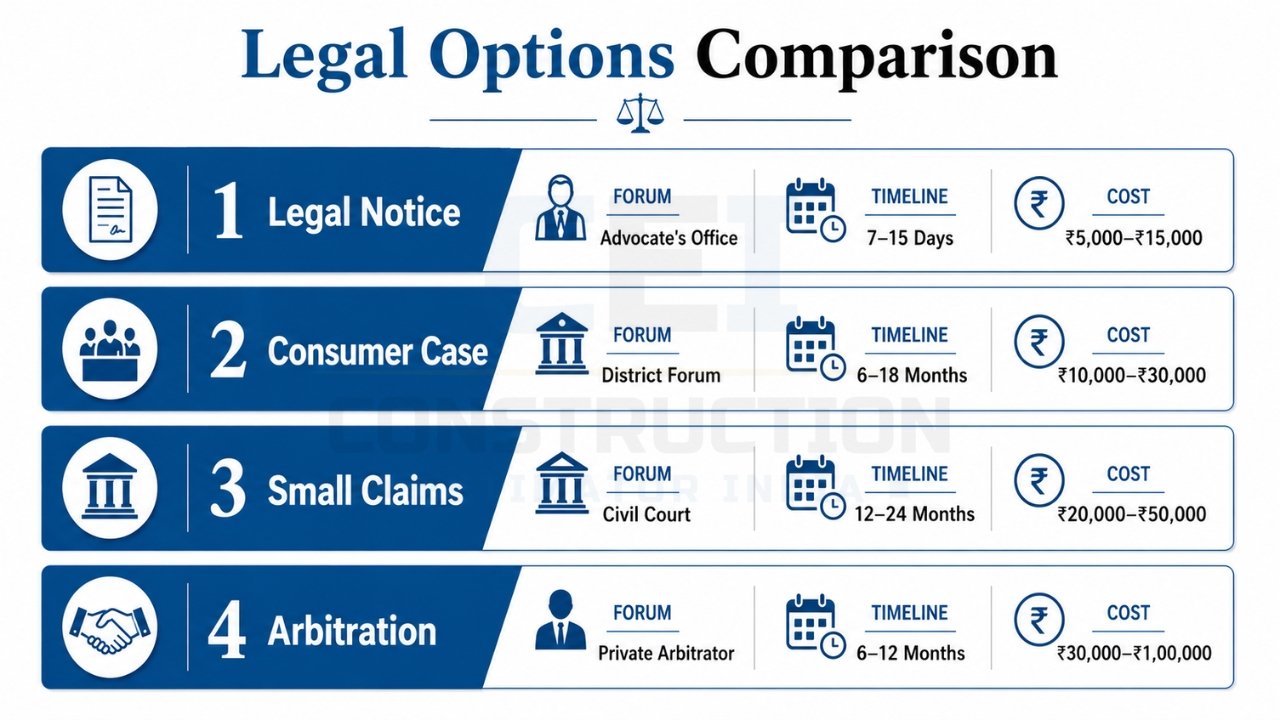
| Legal Option | Forum | Typical Timeline | Estimated Legal Cost |
|---|---|---|---|
| Legal Notice | Advocate’s Office | 7-15 Days | ₹5,000 – ₹15,000 |
| Consumer Case | District Forum | 6-18 Months | ₹10,000 – ₹30,000 |
| Small Claims | Civil Court | 12-24 Months | ₹20,000 – ₹50,000 |
| Arbitration | Private Arbitrator | 6-12 Months | ₹30,000 – ₹1,00,000 |
👉 Get independent construction expertise to assess your situation and plan the next steps.
Step 3: Contact State Licensing Board
If your contractor claims to be licensed or registered, reach out to the state licensing board for licensed contractors. In states like Uttarakhand (via RERA) or Delhi, reporting a contractor for violations like using substandard materials or abandoning a project can lead to the suspension of their license. This creates a “black mark” on their professional record, which is a powerful deterrent for contractors who rely on government or large-scale private work. Escalating your complaint to the licensing board is a critical step in holding registered professionals accountable.
Step 4: File Small Claims Court Case
For disputes involving smaller amounts (typically up to ₹1-5 lakhs), file in small claims court. This is a simplified civil process where you can take the contractor to court to try to recoup payment. While it requires an attorney, the procedures are less formal than a full civil suit. If the amount is substantial enough to hurt your finances but too small for high-level litigation, suing in small claims is the most direct path. It serves to legally establish the debt and allows for asset attachment if the contractor refuses to pay.
Step 5: File Bond Insurance Claim
Check if your contractor has a “Performance Bond” or insurance; this is common with registered firms. Contact the contractor’s bonding company if they are bonded and file a bond insurance claim to recover the costs of hiring a new contractor to finish the work. The bonding company will investigate the claim and, if valid, pay for project completion up to the bond limit. Always make sure significant contractors are bonded before hiring—this is your insurance if they perform poorly or fail to finish the project.
Step 6: File RERA Complaint
If your project involves a builder or is part of a larger development, you can escalate by filing a complaint with the Real Estate Regulatory Authority (RERA). RERA governs developers and builders in India and specifically handles poor quality construction, delays, and false promises. Submit your complaint online with evidence of violations and payment receipts. RERA has the power to order work correction, compensation, or a full refund with interest. The process typically takes 6-12 months and is highly effective for projects registered under the authority.
How to Fire Your Contractor and Terminate Agreement?
When to Fire Your Contractor
If bad behavior continues despite formal notice, consider firing the contractor and filing a complaint. A contractor failing to meet the basic standard of professionalism—by missing multiple deadlines, failing to correct poor work, or ghosting the site—should not be allowed to continue. Simply fire them if they are not meeting standards; don’t wait too long as early action reduces financial loss and prevents further structural damage to your property. If trust is lost, a “clean break” is necessary to protect your remaining investment.
How to Terminate Contract Properly?
Review your contract for termination terms before ending the relationship. If nothing is in the contract or you had a verbal agreement, communicate your decision in writing, citing specific reasons such as delays or poor quality. Write a formal termination letter that states the specific date and time they must vacate the site and notify them that access is revoked. Send this via email, WhatsApp, and Registered Post to create a paper trail and prevent claims of “wrongful termination”. Changing site locks or notifying security immediately after they leave is standard procedure to protect the site.
Pay for Completed Work According to Agreement
Afterward, pay for the completed work per your original agreement to avoid counter-suits for non-payment. However, you should pay only for work actually completed properly; do not pay for substandard work that needs to be ripped out. Deduct the cost of necessary corrections from any remaining balance and ensure you get a signed receipt stating that this is the “Final Settlement of Dues”. This protects you from future claims and ensures that your payment reflects only the quality work that was actually delivered.
Alternative Dispute Resolution Options
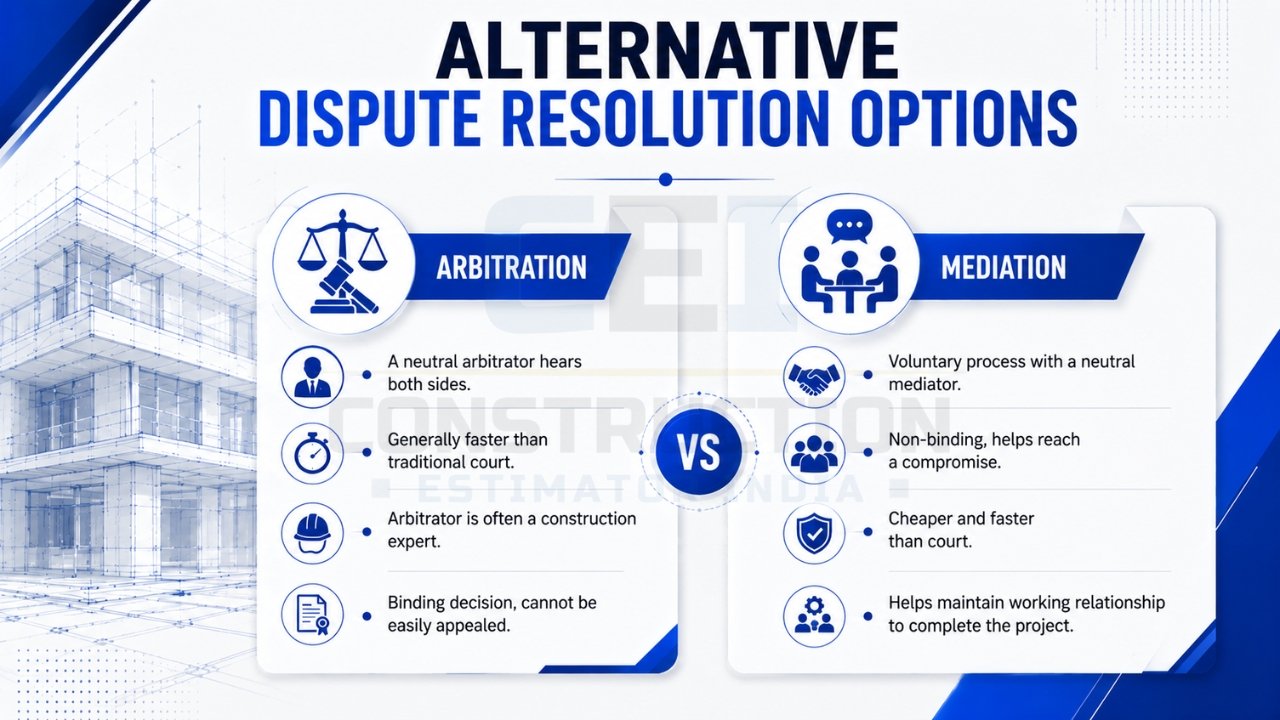
Arbitration
Some construction contracts contain binding arbitration clauses. This means instead of going to court, a neutral third-party arbitrator hears both sides and makes a binding decision. You can request arbitration to discuss and dispute inadequacies; it is generally faster than traditional court and the arbitrator is often a construction expert who understands technical issues better than a judge. While faster, it is still formal and results in a decision that cannot be easily appealed.
Mediation
Mediation is a voluntary process where a neutral mediator helps you and the contractor reach a compromise. It is non-binding, but useful if the contractor is generally good but has hit a temporary hurdle. You should seek solutions together, such as hiring a third-party inspector or bringing in a mediator to resolve the impasse. Mediation is much cheaper and faster than court, helping maintain a working relationship if you still want the contractor to finish the project under strict supervision.
👉 Ensure your project stays on track with professional advice tailored to your situation.
How to Protect Yourself from Bad Contractors in Future?
Do Your Research and Vet Contractors Thoroughly
Before hiring any contractor, it’s important to do your research and thoroughly vet them. Check their licenses, GST registration, and insurance coverage. Ask for references and follow up with them before hiring; visit their previous project sites to inspect work quality firsthand. Check online reviews on Google and Facebook to see if other homeowners have had issues with delays or abandonment. Thorough vetting is the most effective way to prevent contractor disputes before they even begin.
Get Multiple Bids and Compare
Get multiple bids from different contractors to compare prices and services. Don’t choose the cheapest option automatically, as an extremely low bid often indicates that the contractor is planning to use substandard materials or will later demand “unexpected costs”. Compare the scope of work, timelines, and the bill of quantities (BOQ) carefully. Knowing the basic plaster cost per square foot with material in india helps evaluate if a bid is too good to be true. Remember, don’t pay less than market price assuming you may outplay them; quality construction has a baseline cost that must be met for a safe and durable home.
Hire Registered Construction Companies
Try to hire a registered construction company or contractor rather than an unregistered “Thekedar”. Seeking professional building contractors in roorkee (or in your region) guarantees you are working with entities that have a legal identity, GST registration, and significantly more accountability. They are less likely to disappear overnight and are subject to stricter regulatory oversight. While they may charge a bit more, the peace of mind and legal protection they offer are worth the investment.
Get Written Contract with Detailed Terms
Have a detailed contract before starting any work; never work on a verbal agreement only. The contract should include a detailed Bill of Quantities (BOQ), payment milestones tied to work progress, and penalty clauses for delays (e.g., ₹500-₹1000 per day). Put everything in writing, including any changes made to the project and their impact on the timeline and budget. Construction Estimator India provides contract review services at +91 8630676890 to ensure your interests are protected before you sign.
Pay Progress-Based, Not Upfront
Never pay a contractor up front for any significant work. The standard professional practice is to pay about 25% up front and make progress payments only after specific milestones are met. Consider using a payment schedule based on milestones—such as 15% after foundation, 20% after the lintel level—rather than paying in full at the start or end. Never make any final payments until all work is completed satisfactorily and a final inspection is performed. This ensures the contractor remains motivated to maintain quality and finish on time.
Trust Your Instincts
Trust your instincts—if something doesn’t feel right during the initial meetings, it’s best to avoid working with that contractor. If a contractor is pushy, avoids answering technical questions, or seems dishonest about their credentials, walk away. If you notice any red flags early on, it is better to lose a potential deal than to lose lakhs of rupees to a scam or poor workmanship. Prevention is significantly cheaper than litigation.
When to Contact Construction Estimator India for Help
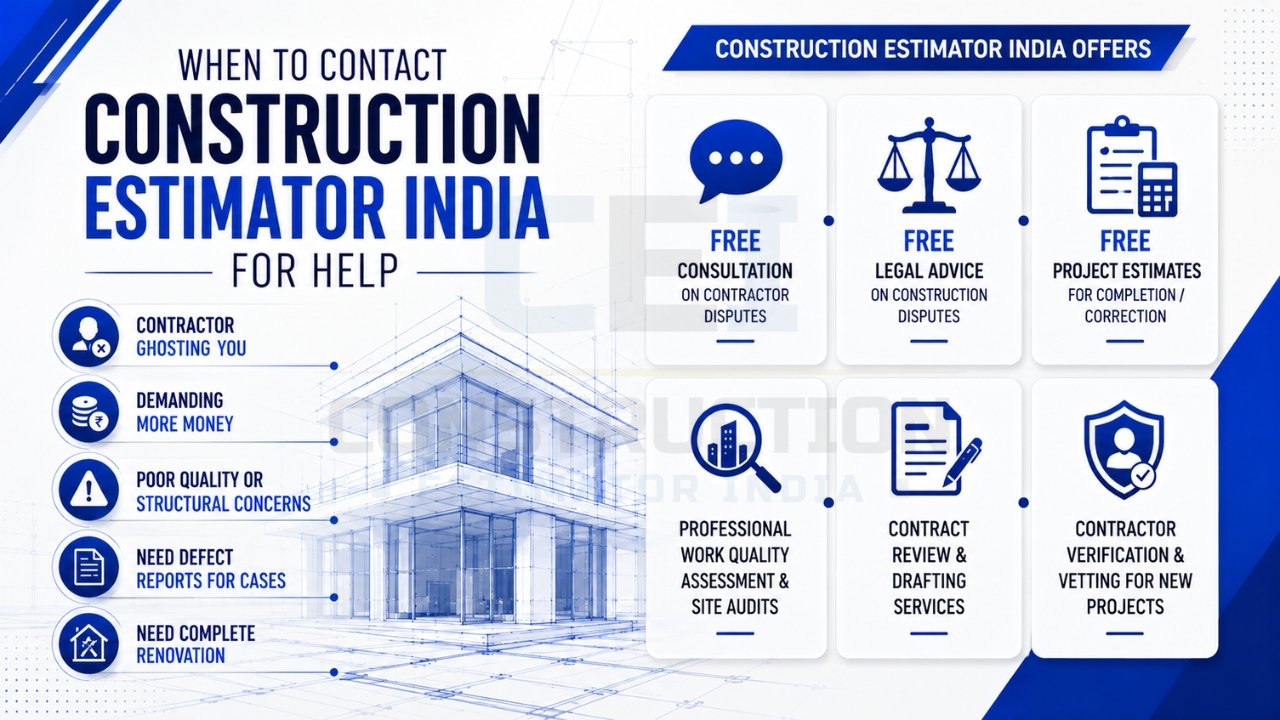
Navigating a construction dispute alone can be overwhelming. Construction Estimator India acts as your technical and strategic ally. You should contact us if the contractor is ghosting you, demanding more money without progress, or if you are unsure if the work is structurally sound. We offer professional “Defect Reports” that are vital evidence for consumer court or small claims cases. If things go wrong and you need a complete overhaul, our house renovation roorkee services ensure your home is restored perfectly.
Construction Estimator India offers:
- Free consultation on contractor disputes.
- Free legal advice on construction disputes.
- Free project-specific estimates for completion/correction.
- Professional work quality assessment and site audits.
- Contract review and drafting services.
- Contractor verification and vetting for new projects.
Don’t face contractor disputes alone—get expert help from professionals with 15+ years of experience. Contact: WhatsApp/Call +91 8630676890 to get your project back on track.
👉 Don’t Let a Bad Contractor Cost You More. Contact Our Experts.
Frequently Asked Questions (FAQs)
Q1: What should I do first if my contractor is doing poor work?
First, document everything thoroughly—take pictures and videos of all problem areas, keep a written log with dates, and maintain a timeline of progress. Second, review your contract to identify where the contractor is violating the agreement. Third, communicate in writing professionally with a focus on solutions, not blame. Stop payments until issues are resolved and set a clear timeline for corrections. The best way to deal with an unreliable contractor is with documentation and clear, professional written and verbal communication.
Q2: Can I file a consumer court case against my contractor?
Yes, absolutely. You can file a consumer complaint against a contractor for poor service, defective work, or financial loss under the Consumer Protection Act. Get a bill from the contractor; if he refuses, write a letter demanding it before filing your case. You can file in the District Consumer Forum for claims up to ₹50 lakhs. It is faster than civil court, and you can claim compensation for repair costs and mental agony. Familiarize yourself with consumer protection laws to strengthen your case.
Q3: How do I fire my contractor properly?
Review the contract for termination terms before ending the relationship. If there is nothing in the contract or you had a verbal agreement, communicate the decision in writing citing specific reasons such as delays or poor quality. Send a formal termination letter via email and registered post. Afterward, pay for the completed work per your original agreement, but only for work that meets quality standards. Ensure a witness is present when they vacate the site and document the site condition immediately. Simply fire them if they are not meeting standards.
Q4: What is a legal notice and when should I send it?
A legal notice is the first formal step before filing a court case. If you want to initiate legal action, first send a well-drafted legal notice under an advocate’s letterhead. Send this when the contractor ignores your complaints or refuses to fix work. It gives them a 15-30 day window to resolve the issue before you sue. It often serves as a wake-up call that settles the dispute without needing to go to court. Construction Estimator India can recommend construction lawyers at +91 8630676890.
Q5: Can I get my money back from a bad contractor?
Yes, you can sue to recoup payment. Options include filing in small claims court for smaller disputes (up to ₹1-5 lakhs), taking the contractor to civil court for larger losses, or filing a bond insurance claim if the contractor is bonded. Alternatively, contact the contractor’s bonding company directly. You will need strong documentation of the overpayment and the cost of fixing their poor work to win your case. You’ll likely need to hire an attorney for civil court actions.
Q6: What if I don’t have a written contract with my contractor?
While difficult, it is not hopeless. If nothing is in the contract or you had a verbal agreement, communicate the decision in writing citing specific reasons for your complaint. Use WhatsApp chats, bank transfer records, and witness statements to prove the existence and terms of the agreement. You can still file a consumer complaint as long as you can prove you paid for a service that was not rendered properly. Put everything in writing for future projects to avoid this risk.
Q7: How much does it cost to sue a bad contractor?
Costs vary by path: a Legal notice is ₹5,000–₹15,000. Consumer court involves a small filing fee (₹500-₹5,000) plus lawyer fees. Small claims or civil court can cost ₹20,000–₹50,000+ depending on the complexity. Arbitration may cost ₹30,000–₹1,00,000. Construction Estimator India can recommend affordable lawyers at +91 8630676890 to ensure you don’t spend more on legal fees than the claim is worth.
Q8: Should I continue paying the contractor while the dispute is ongoing?
No, stop all payments until the contractor fixes identified issues. Never pay a contractor up front for any significant work and never pay for any work up front in full. Pay only for work actually completed properly, not for substandard work. You should ideally pay about 25% up front and progress payments afterward. Never make any final payments until all work is completed satisfactorily. Use the withheld payment as leverage; if you keep paying, they have zero incentive to fix mistakes.
Q9: What if the contractor is not responding to my complaints?
If the contractor is unresponsive, consider firing them and filing a complaint. Send a legal notice through an advocate as the first formal step. If there is still no response, file a consumer court complaint or report them to the state licensing board. You can threaten to call the state licensing board or post actual photos and comments on review websites if they refuse to respond to your refund demands. Slamming them on social media reviews is often an effective escalation tactic.
Q10: Can I hire another contractor to fix poor work?
Yes, but first formally terminate the old one. Call a couple of contractors for bids to fix the work, then ask for that amount back from the total owed to the original contractor. Get a written assessment from the new contractor about why the previous work was bad; this document is vital evidence for consumer court or small claims cases. You can take the original contractor to court to try to recoup this repair payment. Do not let the new contractor start until the old one is legally terminated. Getting an assessment from a trusted firm offering architects and architecture firms in roorkee (or elsewhere) provides indisputable technical backup.
Q11: How long does it take to resolve a contractor dispute in India?
A legal notice takes 15-30 days for a response. A Consumer court case usually takes 6-18 months, which is much faster than civil court, which can take several years. Arbitration or mediation can take 3-12 months. Because consumer court is relatively fast, it is the preferred route for most homeowners. Construction Estimator India can help speed up the resolution by providing the technical reports needed to prove your case quickly.
Q12: How do I contact Construction Estimator India for contractor dispute help?
You can reach Construction Estimator India by calling or WhatsApping +91 8630676890. We offer Free consultations on contractor disputes, free legal advice on construction disputes, and free project-specific estimates for completing or correcting your home. Don’t face these stressful disputes alone—get expert help from professionals with 15+ years of experience in the Indian construction industry.
Contact Construction Estimator India for Contractor Dispute Assistance
If you are struggling with a contractor who has stalled your project or provided poor quality work, do not wait until your budget is gone. Construction Estimator India is a leading consultancy with over 15 years of experience in handling complex construction disputes across India.
Our Specialist Services Include:
- Free Initial Consultation: We listen to your problem and provide an immediate strategy.
- Free Legal Advice: Expert guidance on consumer court, legal notices, and RERA.
- Work Quality Assessment: Professional engineers visit your site to document defects for court evidence.
- Detailed Project Estimates: Get a free project-specific estimate for what it will take to fix and finish your home.
- Contractor Vetting: We help you hire reliable, licensed professionals for your next project.
WhatsApp/Call: +91 8630676890
Get your FREE action plan today and stop the financial drain of a bad contractor.
Conclusion: Don’t Let a Bad Contractor Ruin Your Investment
The best way to deal with an unreliable contractor is with documentation and clear, professional written and verbal communication. Taking steps to confirm that the work done in your home was subpar will help hold your contractor accountable, and the more evidence, the better for holding someone accountable. Home construction is likely your biggest life investment—protect it with the same rigor you used to save for it. By educating yourself using resources from institutions like the Indian Institute of Architects, you can ensure your project’s standards meet the mark.
One of the best ways to handle bad contractors is to prevent issues from arising in the first place through thorough vetting and detailed contracts. However, if behavior continues despite your best efforts, you must consider firing the contractor and filing a formal complaint. Take action early to reduce your financial loss. Whether you choose the path of mediation, consumer court, or a formal legal notice, being informed and documented is your greatest strength.
Construction Estimator India offers free consultation for all types of contractor disputes. Get your FREE legal advice and action plan today by calling +91 8630676890. Don’t face contractor disputes alone—let our experts help you get your project back on track and secure the home you deserve.