Building your first home in India is a monumental milestone, but in 2026, it comes with a unique set of challenges. With fluctuating commodity prices and a heightened focus on sustainable building, the most common question hitting every homeowner’s mind is: How Much Material Is Required for a 1000 sq ft House? Whether you are constructing a 2BHK in the suburbs of Agra or a compact villa in Uttar Pradesh, over-ordering leads to dead capital, while under-ordering causes site delays and multiple transportation costs.
For a standard 1,000 sq. ft. built-up area (which typically yields a carpet area of 700–800 sq. ft.), material consumption follows specific engineering “thumb rules.” In 2026, a typical RCC (Reinforced Cement Concrete) framed house requires approximately 400 to 480 bags of cement, 3 to 4.5 tons of steel, and roughly 18,000 to 22,000 bricks. However, these numbers are not set in stone. Factors such as soil bearing capacity in the Indo-Gangetic plains of UP, the choice between G+0 and G+1 structures, and the quality of finishes (Basic vs. Premium) can cause a ±10-20% variation. To understand how these quantities translate into a total budget, start by reviewing the 1000 sq ft house construction cost in India for 2026.
Key Assumptions for 1000 sq ft House Material Calculation
Before calculating 1000 sq ft house material quantity India 2026, we must establish the baseline for our estimates:
- Built-up Area: 1,000 sq. ft. (This includes the thickness of walls, balconies, and common areas).
- Structure Type: RCC Framed Structure (Columns, Beams, and Slabs).
- Storeys: Ground Floor (G+0) or a simple G+1 residential unit.
- Quality Levels:
- Basic/Economy: Standard local materials (₹1,700–₹2,300 per sq. ft.).
- Standard/Mid-Range: Branded cement/steel, vitrified tiles (₹2,300–₹3,000 per sq. ft.).
Major Materials Required: Quantities & Breakdown
The “Big Five” materials—Cement, Steel, Sand, Aggregate, and Bricks—constitute the lion’s share of your structural budget. Below is the itemized requirement for a 1,000 sq. ft. house based on 2026 thumb rules, it is vital to perform a professional construction material estimation in India to account for your specific architectural design.
1. Cement (Bags)
Cement is used in three main stages: Foundation/RCC, Masonry (brickwork), and Plastering. or structural “bones,” ensure you use top-rated cement for homes in India to prevent cracks in your slabs and columns.
- Thumb Rule: 0.4 to 0.48 bags per sq. ft.
- Total for 1000 sq. ft.: 400 – 480 Bags.
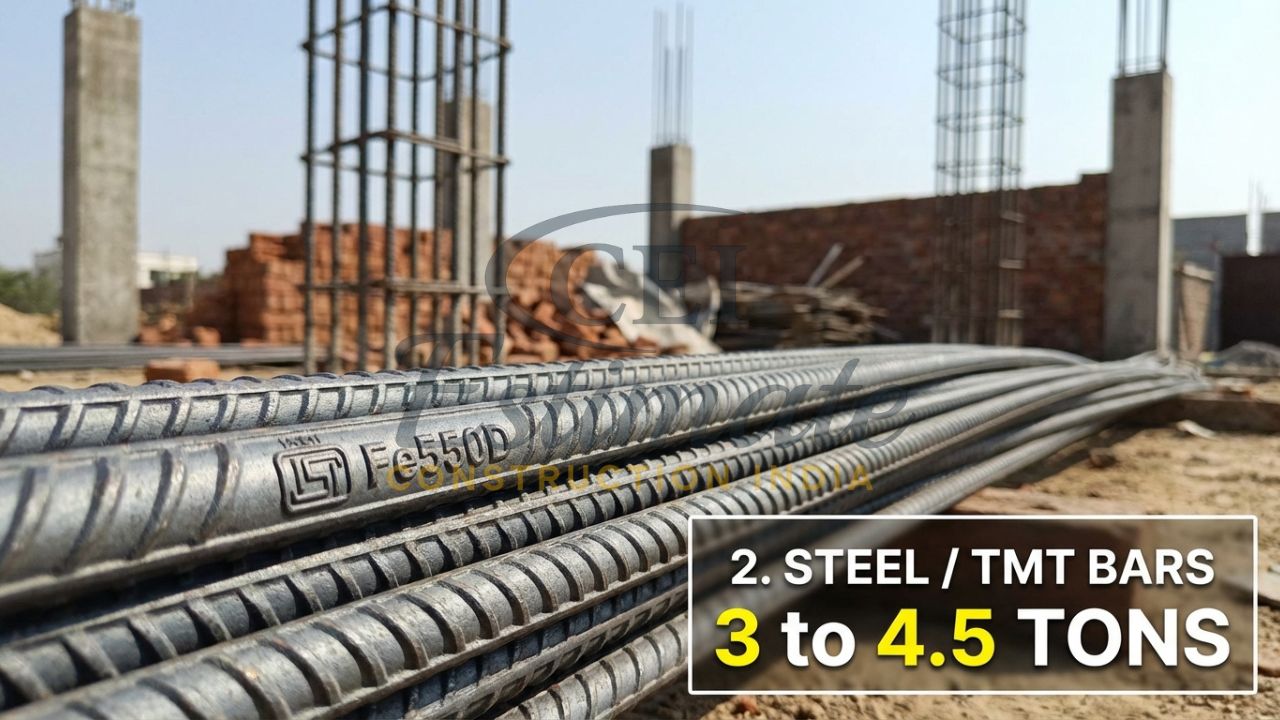
2. Steel / TMT Bars (Kg/Tons)
The “backbone” of your house. Steel required 1000 sq ft construction depends heavily on the number of columns and the slab thickness. Given the volatility of metal prices in 2026, utilizing a specialized metal estimator can help you track the exact tonnage required for your specific slab thickness and column spans.
- Thumb Rule: 3 kg to 4.5 kg per sq. ft.
- Total for 1000 sq. ft.: 3,000 – 4,500 kg (3 to 4.5 Metric Tons).
3. Sand (Cft)
In 2026, most builders in UP and Agra prefer M-Sand (Manufactured Sand) or P-Sand (Plaster Sand) due to environmental regulations on river sand.
- Thumb Rule: 1.8 to 2.2 cft per sq. ft.
- Total for 1000 sq. ft.: 1,800 – 2,200 cft.
4. Aggregate (Cft)
Crushed stones (20mm and 10mm) used for concrete mixing.
- Thumb Rule: 1.35 to 1.5 cft per sq. ft.
- Total for 1000 sq. ft.: 1,350 – 1,500 cft.
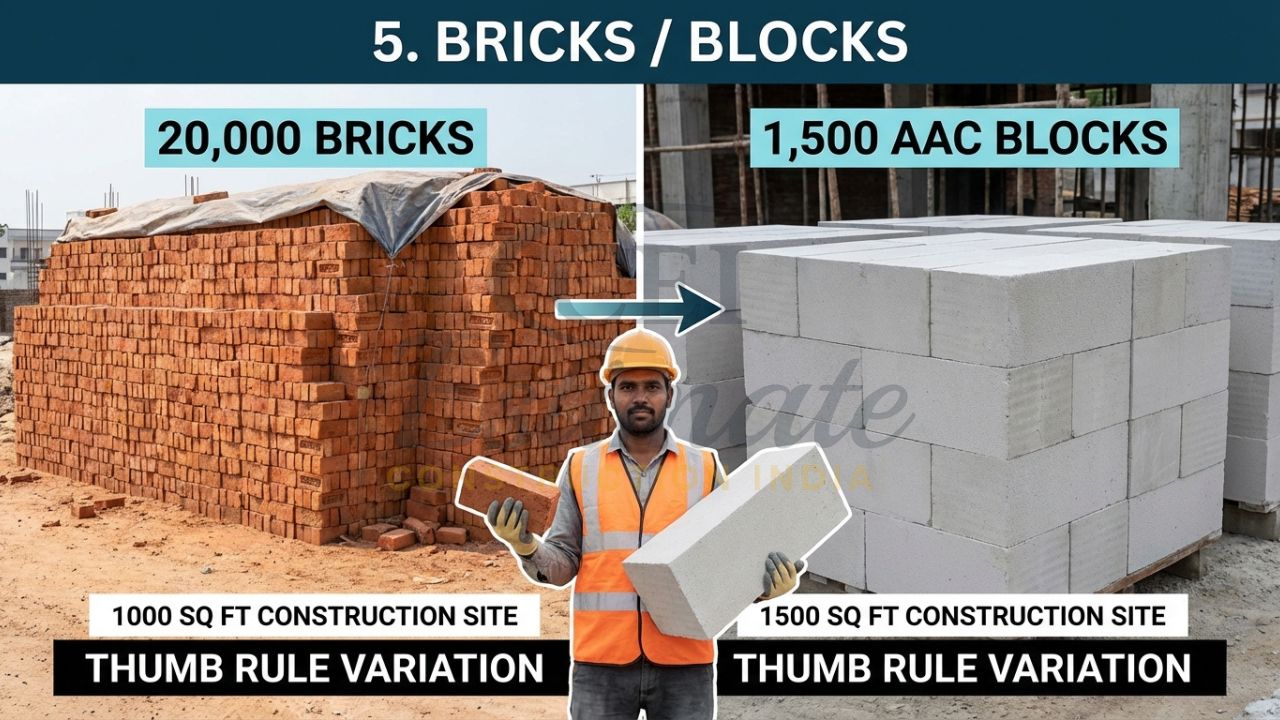
5. Bricks / Blocks (Nos)
If using traditional red clay bricks (9″x4″x3″), the count is high. If using AAC blocks, the count is lower but the volume is same.
- Thumb Rule: 10 to 22 nos per sq. ft. of total wall area.
- Total for 1000 sq. ft.: 10,000 – 22,000 Bricks (varies by wall thickness).
Material Summary Table for 1000 sq. ft. House (2026)
| Material | Thumb Rule (per sq. ft.) | Total Quantity (1,000 sq. ft.) | Est. 2026 Rate (Agra/UP) |
| Cement | 0.4 – 0.48 Bags | 400 – 480 Bags | ₹380 – ₹450 / bag |
| Steel (TMT) | 3 – 4.5 Kg | 3 – 4.5 Tons | ₹65,000 – ₹78,000 / ton |
| Sand (M-Sand) | 1.8 – 2.2 Cft | 1,800 – 2,200 Cft | ₹45 – ₹65 / cft |
| Aggregate | 1.35 – 1.5 Cft | 1,350 – 1,500 Cft | ₹55 – ₹75 / cft |
| Bricks | 18 – 22 Nos | 18,000 – 22,000 Nos | ₹8,000 – ₹10,000 / 1000 pcs |
| Paint | 0.15 – 0.2 Litres | 150 – 200 Litres | ₹250 – ₹600 / litre |
| Tiles | 1.2 – 1.3 sq. ft. | 1,200 – 1,300 sq. ft. | ₹45 – ₹120 / sq. ft. |

City-Wise & Quality-Wise Variations 2026
The material list 1000 sq ft house Agra UP looks different from a metro like Mumbai. In Tier-2 cities, local sourcing of bricks and sand often reduces carriage costs, though quantities remain structurally similar.
| Feature | Tier-2 (Agra/Lucknow/UP) | Metros (Delhi/Mumbai/Bangalore) |
| Carriage/Lead | Lower (Local kilns/quarries) | Higher (Long-distance transport) |
| Wastage Rate | 5% – 8% (Manual handling) | 3% – 5% (Ready-mix/Modern tools) |
| Steel Grade | Mostly Fe500/Fe550 | Fe550D / Fe600 (High-rise focus) |
| Masonry Preference | Traditional Red Bricks | AAC Blocks / Concrete Blocks |
Choose Your Construction Services
Connect with verified experts for your project. We provide professional
General Contractors, Sub-contractors, Builders, and Material Suppliers.
Our network also includes specialized 3D Rendering Developers and Interior Experts.
Beyond the Structure: Finishing Materials
Once your “Grey Structure” is complete, your material focus shifts to finishing.
- Plastering: The plaster cost per square foot with material in India involves a separate calculation for cement and fine sand.
- Painting: Finally, the cost of painting a house in India depends on the paintable area of your 1000 sq ft home, which is typically 3.5 times the floor area.
Budgeting and Estimation Logic
In the Indian market of 2026, there is a significant difference between a rough “guess” and an actionable plan.
- Labor Management: Material quantities are only half the story. You must also account for the labor cost for house construction in India to ensure your total budget remains intact.
- Accuracy Levels: While thumb rules provide a ballpark, they are similar to an Abstract Estimate. For actual purchasing, you need a Detailed Estimate. You can learn the detailed estimate vs abstract estimate in construction differences to see why precision saves lakhs.
- Market Realities: Always verify these quantities against the current construction cost per sq ft in India to ensure you aren’t overpaying for raw commodities.
How to Calculate Material Quantities Accurately
While thumb rules are great for initial budgeting, they are not precise enough for purchasing. To get an accurate sand aggregate bricks for 1000 sq ft home list, follow these steps:
- Finalize Drawings: You cannot calculate material without a structural and architectural plan.
- Detailed Takeoff: Calculate the volume of concrete for every column, beam, and slab ($L \times B \times D$).
- Deduct Openings: Subtract the area of doors and windows from the total wall area to find the exact brick count.
- Wastage Factor: Add a 5% margin for cement/sand and a 3-5% margin for steel cutting waste.
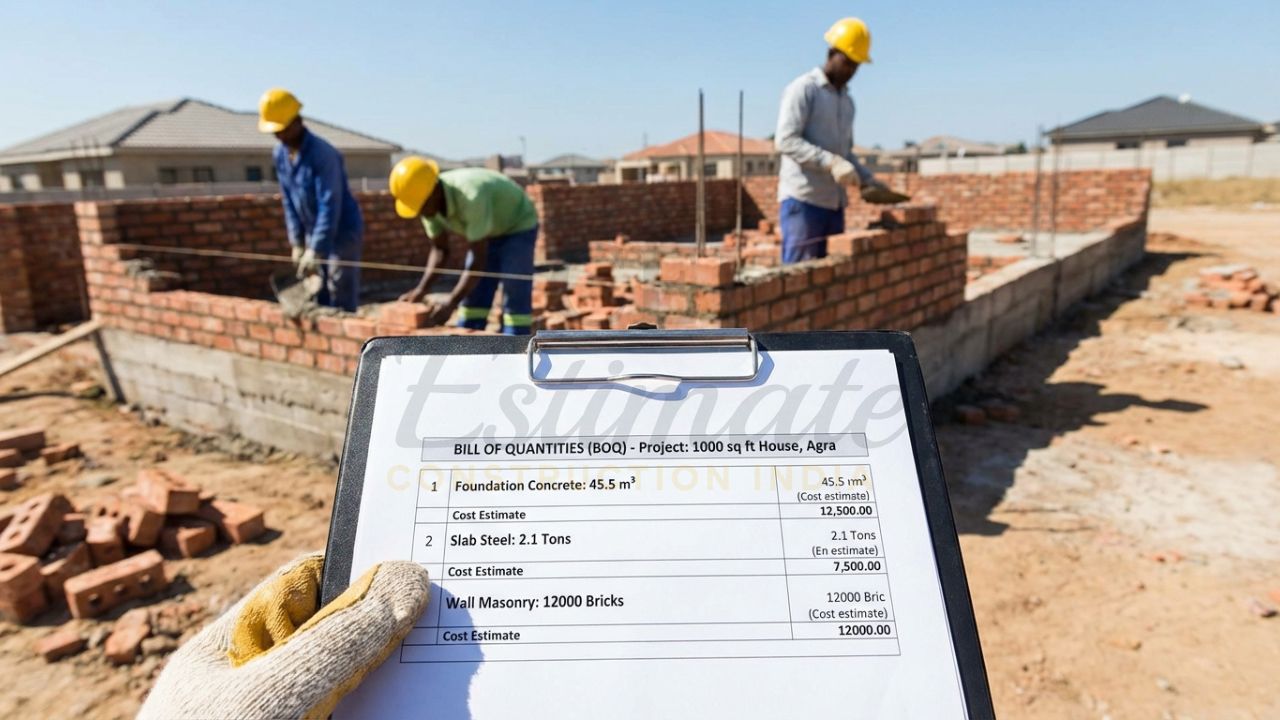
- Preparation of BOQ: Create a Bill of Quantities (BOQ) which lists every material item, its unit, and total quantity.
Tips to Optimize Material Usage & Reduce Waste in 2026
- Bulk Purchase: Buying cement in a single lot of 400 bags can save you ₹20–₹40 per bag compared to retail buying.
- Use AAC Blocks: They reduce the dead load of the building, which in turn reduces the steel required 1000 sq ft construction significantly.
- Phased Procurement: Purchase steel all at once to maintain grade consistency, but buy cement in batches to ensure it remains “fresh” (not older than 3 months).
- Switch to M-Sand: It has zero silt and no organic impurities, requiring less cement for the same strength compared to river sand.
- Proper Storage: Build a temporary shed. Cement exposed to moisture is a total loss.
Why Professional Material Takeoff is Essential?
In the 2026 Indian market, the price difference between “Standard” and “Premium” construction can be ₹5–10 Lakhs for a 1,000 sq. ft. house. Without a professional takeoff, you are at the mercy of the contractor’s “rough guesses.” A professional 1000 sq ft house material quantity India 2026 report ensures that you buy exactly what you need, helping you negotiate with suppliers from a position of strength and avoiding the common trap of mid-project “material shortages.”
“Want a precise material quantity takeoff and cost estimate for your 1000 sq ft house in 2026 without guesswork or waste? Construction Estimator India provides detailed, accurate BOQ (Bill of Quantities) services starting just at ₹10,000 INR. Our experts calculate exact cement, steel, sand, aggregate, bricks, and finishing material needs tailored to your design, location (including Agra/UP), and quality—helping you buy smart, save 5-15% on materials, and avoid overruns.
Contact us today:
Phone/WhatsApp: +91 86306 76890
Email: info@constructionestimatorindia.com
Get your customized 1000 sq ft house material estimate in just 24 hours!”
Frequently Asked Questions (FAQs)
How much cement is required for a 1000 sq ft house in India 2026?
For a standard 1,000 sq. ft. built-up house in 2026, you will need approximately 400 to 480 bags of cement. This includes cement for the foundation, RCC columns, beams, slabs, brick masonry, and plastering. If you are building a G+1 structure, the requirement will increase to roughly 750–850 bags total.
How many tons of steel are needed for 1000 sq ft house construction?
On average, steel required 1000 sq ft construction ranges from 3 to 4.5 tons (3,000–4,500 kg). The exact amount depends on your structural design—specifically the number of columns and the thickness of the roof slab. Using high-strength Fe550D bars in 2026 can sometimes optimize this quantity.
What is the sand and aggregate quantity for a 1000 sq ft house?
In 2026, for a 1,000 sq. ft. home, you will require roughly 1,800 to 2,200 cft of sand (preferably M-Sand) and 1,350 to 1,500 cft of aggregate (20mm/10mm). These materials are essential for concrete casting, mortar for brickwork, and the final plastering of walls.
How many bricks are required for a 1000 sq ft house in UP or Agra?
In UP or Agra, where red bricks are traditionally used, you will need between 18,000 and 22,000 bricks for a 1,000 sq. ft. single-story house. If you opt for modern AAC blocks (Aerated Autoclaved Concrete), you would need approximately 1,200 to 1,500 blocks, which significantly reduces the mortar and labor requirement.
How accurate are thumb rules for material required in 1000 sq ft house?
Thumb rules are excellent for initial budgeting and have an accuracy of about ±10-15%. However, they should not be used for actual material ordering. Factors like site soil conditions, specific architectural spans, and 2026 local building bylaws in cities like Agra can shift these requirements. For ordering, a professional BOQ is always recommended.