Planning to build your dream home in 2026 requires more than just a beautiful blue-print; it requires a surgical understanding of the House Construction Cost Floor Wise in India 2026. As we navigate through 2026, the Indian construction industry is witnessing a unique intersection of technological advancement and inflationary pressure. With the implementation of stricter RERA norms across more states and a 6% to 8% year-on-year rise in raw material costs, “guesstimating” your budget is a recipe for financial disaster.
As we move through the year, the industry faces a 6% to 8% rise in raw material costs. Whether you are constructing a single-story bungalow or a multi-story G+3 apartment, understanding how costs scale with each level is critical. While the ground floor carries the heavy “foundation factor,” upper floors introduce costs like material lifting and vertical utility mapping. To get a baseline of current market trends, start by reviewing the construction cost per sq ft in India for 2026.
Detailed Floor-Wise Cost Breakdown 2026
The house construction cost per floor in India does not remain constant. Generally, the rate per square foot decreases slightly for upper floors because the expensive foundation and excavation costs are absorbed by the ground floor.
1. Ground Floor (The Foundation Stage)
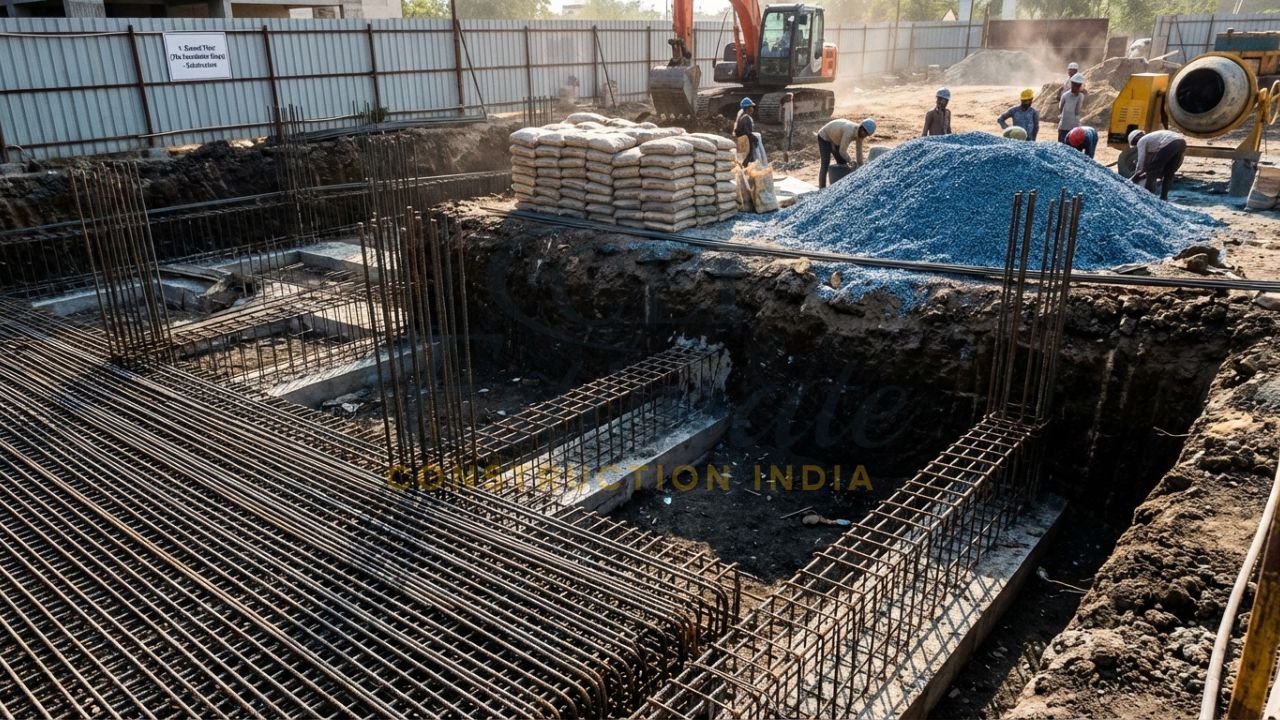
The ground floor is the most capital-intensive due to earthwork, footings, and plinth beams.
- Average Rate: ₹1,800 – ₹2,200 per sq. ft.
- Pro Tip: If you are building in a rural area, costs may vary due to logistics; see our guide on village house construction cost in India for a localized breakdown.
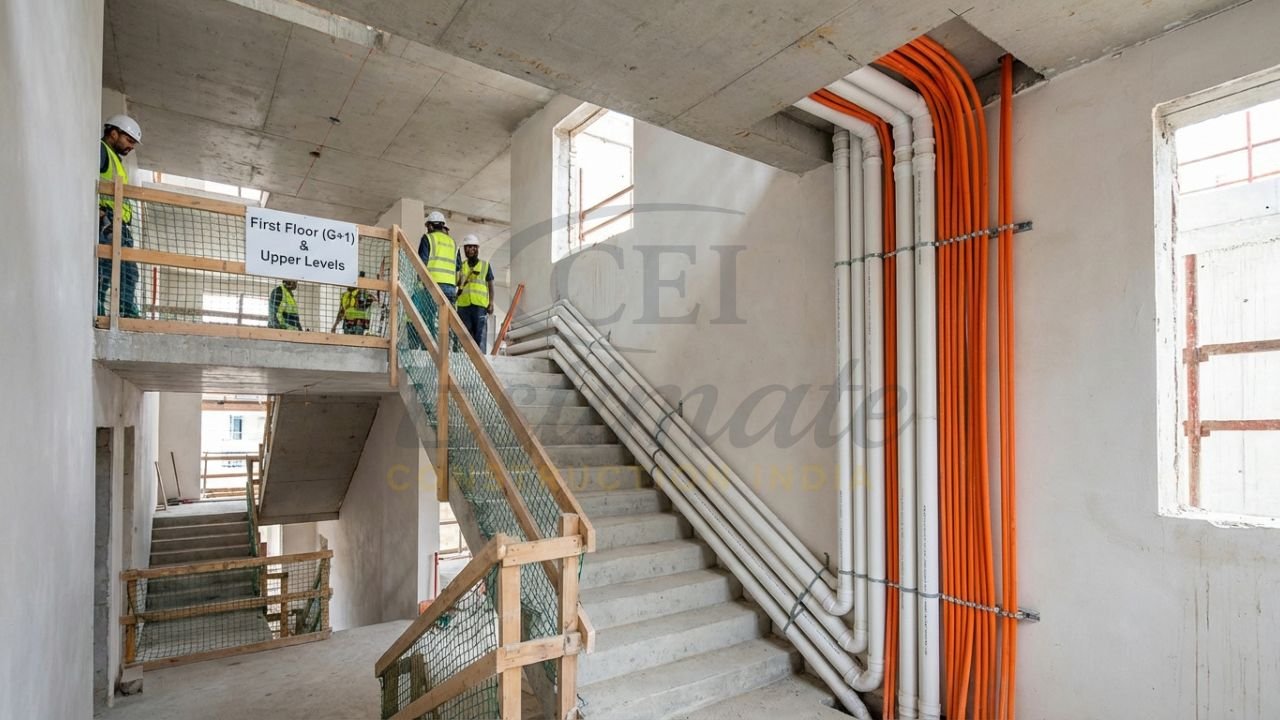
2. First Floor (G+1) & Upper Levels
When adding a first floor, you save on foundation costs but add expenses for the RCC slab and stairs.
- Average Rate for First Floor: ₹1,500 – ₹1,800 per sq. ft.
- Vertical Utilities: This stage requires meticulous electrical work planning in house construction to ensure conduits are properly aligned between floors.
3. G+2 and G+3 Structures
For triple-story builds, you must account for “lift” charges (the cost of carrying materials to height) and thicker columns. For a standard 1000 sq ft house construction cost calculation, a G+2 project typically ranges between ₹47L – ₹54L in 2026.
Average Construction Cost Per Sq Ft in India 2026
To understand the floor wise building estimation India context, we must first look at the baseline cost per square foot. These rates are categorized by the quality of construction:
2026 Construction Quality Tiers
| Quality Type | Description | Rate Range (per sq. ft.) |
| C-Class (Basic) | Standard bricks, local sand, basic tiles, local paint. | ₹1,450 – ₹1,650 |
| B-Class (Standard) | Branded cement/steel, vitrified tiles, UPVC windows. | ₹1,700 – ₹2,100 |
| A-Class (Premium) | Italian marble, teak wood, high-end fittings, automation. | ₹2,300 – ₹3,200+ |
Detailed Floor-Wise Cost Breakdown 2026
This is the core of your planning. The House Construction Cost Floor Wise in India 2026 does not remain constant; it usually decreases slightly per square foot for upper floors (as foundation costs are absorbed by the ground floor), but total project cost climbs.
1. Single Floor (Ground Floor) House Construction Cost
The ground floor is always the most expensive per square foot because it includes the foundation, excavation, and plinth work.
- Average Rate: ₹1,800 – ₹2,200 per sq. ft. (Standard Quality)
- Total Cost Estimates for Ground Floor (2026):
| Area (sq. ft.) | Total Cost (Standard Finish) | Total Cost (Premium Finish) |
| 1,000 | ₹18,00,000 – ₹22,00,000 | ₹25,00,000+ |
| 1,500 | ₹27,00,000 – ₹33,00,000 | ₹37,50,000+ |
| 2,000 | ₹36,00,000 – ₹44,00,000 | ₹50,00,000+ |
Choose Your Construction Services
Connect with verified experts for your project. We provide professional
General Contractors, Sub-contractors, Builders, and Material Suppliers.
Our network also includes specialized 3D Rendering Developers and Interior Experts.
2. Double Floor (G+1) House Construction Cost
When adding a first floor, you save on foundation costs but add expenses for the RCC slab, staircase, and additional plumbing/electrical vertical stacks.
- Average Rate for First Floor: ₹1,500 – ₹1,800 per sq. ft.
- Total G+1 Project Cost (Standard Quality):
- 1,000 sq. ft. (Total 2000 built-up): ₹33,00,000 – ₹38,00,000
- 1,500 sq. ft. (Total 3000 built-up): ₹49,50,000 – ₹57,00,000
3. Triple Floor (G+2) House Construction Cost
Building a G+2 structure is popular for joint families or rental income. The G+2 house cost in India includes higher costs for lifting materials (labor “lift” charges) and more complex structural stability checks.
- Average Rate for Second Floor: ₹1,450 – ₹1,750 per sq. ft.
- Total G+2 Project Cost (Standard Quality):
- 1,000 sq. ft. (Total 3000 built-up): ₹47,00,000 – ₹54,00,000
- 2,000 sq. ft. (Total 6000 built-up): ₹94,00,000 – ₹1,08,00,000
4. Four Floor & Above (G+3/G+4) House Construction Cost
For G+3 and above, you must account for Lifts/Elevators (which cost ₹4L to ₹8L) and mandatory fire safety features in many Indian municipalities.
- Average Rate for Upper Floors: ₹1,400 – ₹1,700 per sq. ft. (excluding lift)
- Structural Note: Columns will be significantly thicker, increasing the steel consumption of the entire building.
Material & Labor Cost Breakdown 2026
To understand the house construction cost per floor India 2026, we must look at the specific commodity prices. For instance, the best cement for brickwork in India might differ from the grade used in your RCC slabs.
Understanding the various types of cement in India (OPC vs. PPC) can help you optimize strength and cost across different floors.
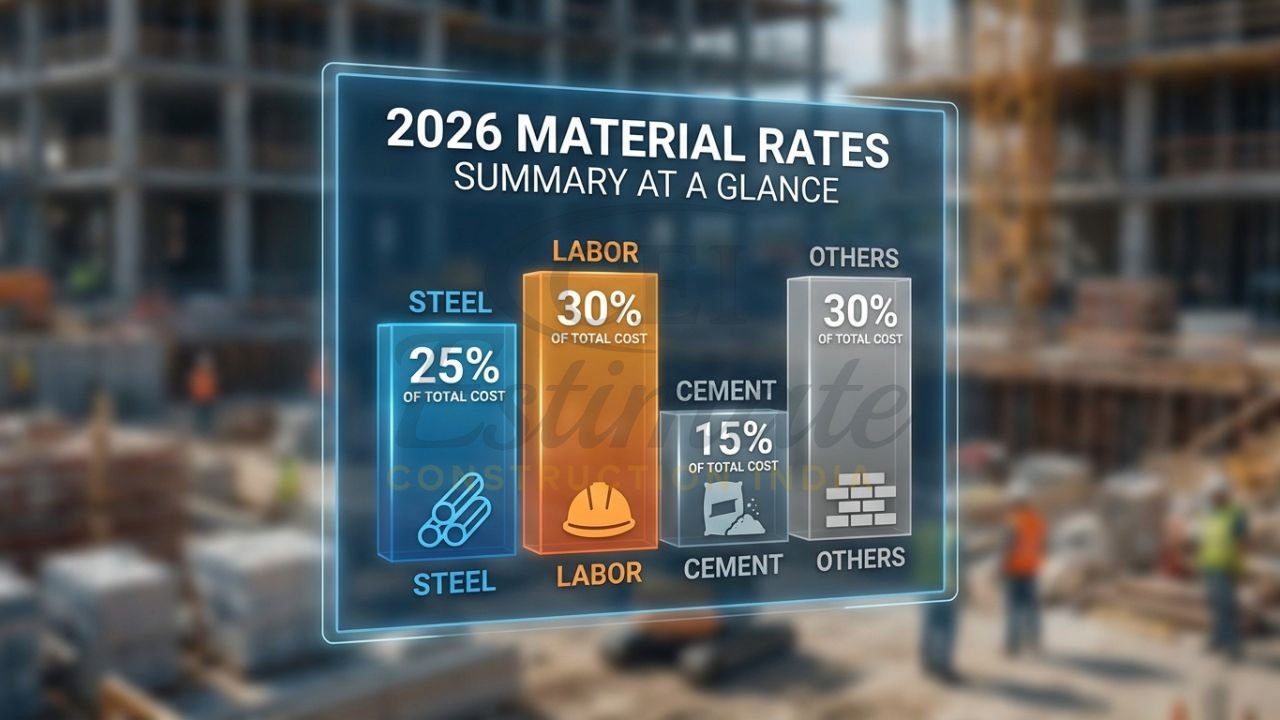
| Material/Component | % of Total Cost | Current 2026 Estimated Rates |
| Cement | 12% – 15% | ₹420 – ₹480 per bag |
| Steel (TMT) | 20% – 25% | ₹72,000 – ₹82,000 per Ton |
| Sand/Aggregate | 8% – 10% | ₹60 – ₹90 per cu. ft. |
| Bricks (Red/Fly-ash) | 6% – 8% | ₹8 – ₹12 per piece |
| Labor Cost | 25% – 30% | ₹350 – ₹550 per sq. ft. |
Labor rates vary significantly; in Mumbai or Bangalore, skilled labor may charge up to ₹600/sq.ft. for premium finishes.
City-Wise & State-Wise Comparison Table (2026)
The House Construction Cost Floor Wise in India 2026 is not uniform. A G+1 in Kerala costs differently than a G+1 in Bihar due to material availability and labor laws.
| City / Region | Standard Rate (sq. ft.) | G+1 Total (2000 sq. ft.) | Trend in 2026 |
| Mumbai / MMR | ₹2,400 – ₹3,000 | ₹48L – ₹60L | Rising (High labor) |
| Delhi-NCR | ₹1,900 – ₹2,400 | ₹38L – ₹48L | Stable |
| Bangalore / Hyderabad | ₹2,000 – ₹2,500 | ₹40L – ₹50L | High (Material cost) |
| Chennai / Kolkata | ₹1,800 – ₹2,200 | ₹36L – ₹44L | Moderate |
| Tier-2 (Lucknow, Jaipur) | ₹1,600 – ₹1,900 | ₹32L – ₹38L | Competitive |
Smart Tips to Reduce House Construction Cost in 2026
Reducing your house construction cost per floor in 2026 requires strategic planning rather than cutting corners on quality.
- Framed Structure Planning: If you plan to add floors later, build a strong RCC frame now. It’s cheaper than retrofitting columns later.
- Standardize Openings: Use standard sizes for doors and windows to avoid expensive “custom-made” surcharges.
- Direct Sourcing: Buy cement and steel directly from wholesalers or authorized dealers to save 5-10% on retail margins.
- Avoid Changes Mid-Way: Structural changes during the second-floor construction can increase costs by 20% due to wastage and rework.
- Use Fly-ash Bricks: They are cheaper, more uniform, and require less mortar than traditional red bricks.
How to Get Accurate Floor-Wise Estimation?
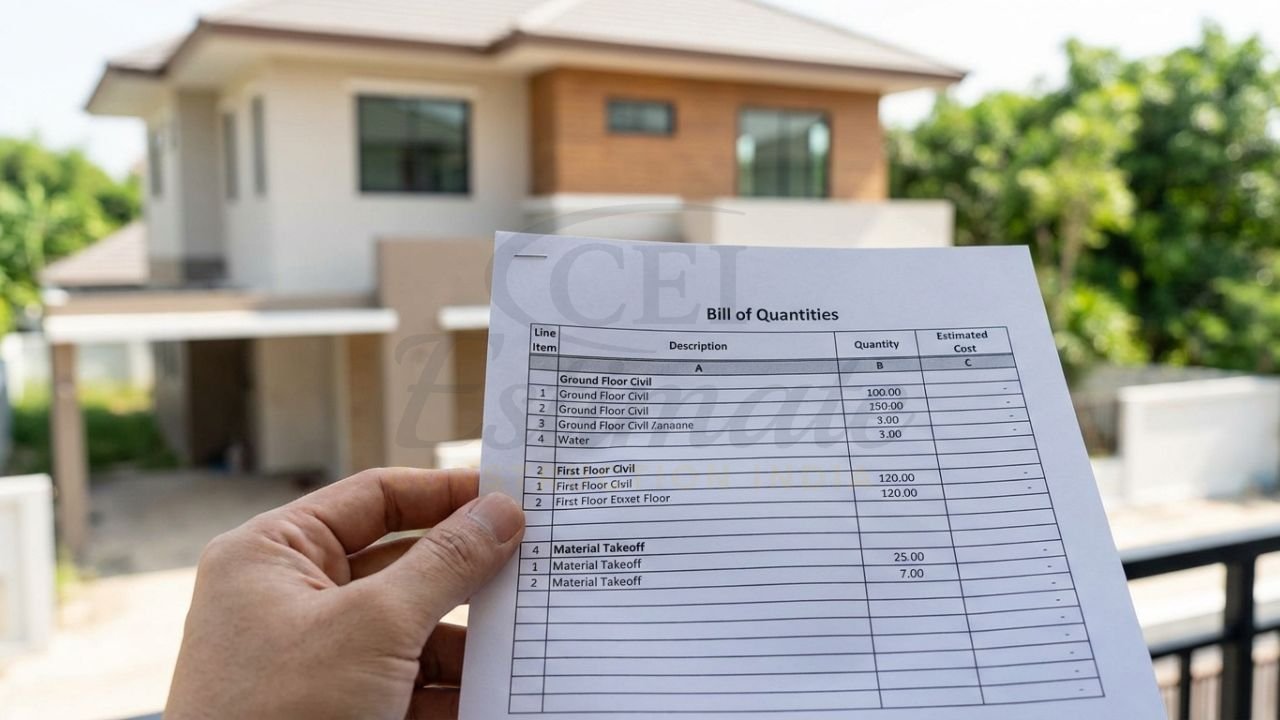
Relying on a contractor’s “rough estimate” often leads to a 20% budget overrun. To get the true House Construction Cost Floor Wise in India 2026, you need a professional Bill of Quantities (BOQ). Professional estimators use current 2026 market data to provide a “material takeoff”—telling you exactly how many bags of cement and tons of steel each floor will consume. This allows you to audit your contractor and ensure no materials are being wasted or siphoned off.
Ready to get precise and professional house construction cost estimates for your dream project in 2026? Construction Estimator India offers accurate floor-wise estimating services starting just at ₹10,000 INR. Whether you are planning a single-floor, G+1, G+2 or higher house, our expert team delivers detailed material takeoff, labour breakup, and total project cost so you never face budget overruns.
Contact us today:
Phone/WhatsApp: +91 86306 76890
Email: info@constructionestimatorindia.com
Get your customized quote in just 24 hours and build with complete peace of mind!
Frequently Asked Questions (FAQs)
What is the average house construction cost floor wise in India 2026?
In 2026, the average cost for the ground floor ranges between ₹1,800 to ₹2,200 per sq. ft. due to foundation expenses. Subsequent floors (First, Second, Third) usually cost between ₹1,450 to ₹1,750 per sq. ft. as the structural foundation costs are already covered. For a standard 1,000 sq. ft. per floor project, expect a total budget of approximately ₹35 Lakhs for a G+1 and ₹52 Lakhs for a G+2 structure.
How much does a G+1 house cost in India in 2026?
A G+1 house (Ground + 1 Floor) with a total built-up area of 2,000 sq. ft. (1,000 sq. ft. per floor) typically costs between ₹33 Lakhs to ₹40 Lakhs for standard quality construction in 2026. This includes labor, civil materials (grey structure), and basic finishing like tiling, painting, and plumbing. Premium finishes can push this cost above ₹50 Lakhs.
Does floor-wise construction cost change by city in 2026?
Yes, significantly. The house construction cost floor wise in India 2026 is highest in Mumbai and Bangalore due to high labor wages and logistics. In contrast, Tier-2 cities like Indore or Nagpur offer 15-20% lower costs. Furthermore, southern states often have higher costs for river sand, while northern states might face seasonal labor shortages during harvest seasons, affecting the per-floor rate.
What is included in professional floor-wise estimation services?
Professional services provide a detailed Bill of Quantities (BOQ) for each level. This includes a breakdown of cement, steel, sand, and bricks required for the ground floor vs. upper floors. It also accounts for specialized costs like staircases, terrace waterproofing, and vertical plumbing stacks. Such an estimation helps homeowners stay within budget and prevents contractors from overcharging.
How can I reduce my house construction cost per floor in 2026?
The best way to reduce your house construction cost per floor in 2026 is to use a “Load Bearing” structure for single stories or a “Framed” structure for multi-story builds to optimize steel use. Additionally, choosing locally available materials, avoiding complex architectural protrusions, and hiring a professional estimator to prevent material wastage can save you up to 15% on the total project cost.