
As a contractor or site engineer in the Indian construction industry, you likely hear the terms “Estimate” and “BOQ” every single day. While they might seem like two names for the same thing, understanding the difference between estimate and BOQ is the key to running a profitable business and avoiding legal disputes.
In the first 2-3 lines of any project discussion, clarity is vital; if you confuse a preliminary budget with a detailed Bill of Quantities, you risk losing lakhs of rupees in under-quoted items. Grasping how to plan home construction in India from a financial standpoint is what separates successful firms from those that struggle. This guide is designed to help small and medium contractors, site engineers, and students understand how these tools work together to ensure project success.
👉 Confused Between an Estimate and a BOQ? Get Expert Guidance for Better Project Planning.
In this comprehensive guide, we will cover:
- What an estimate is and its role in early budgeting.
- What a BOQ is and why it is the backbone of billing.
- How they are different but deeply related.
- How to use them for tenders, client negotiations, and bank loan approvals.
At Construction Estimator India, we specialize in helping contractors bridge the gap between rough guesses and professional documentation. Whether you are bidding for a new government tender or building a private bungalow, having a professional set of documents is non-negotiable.
If you want professional support for your estimate and BOQ, contact Construction Estimator India on WhatsApp / Call +91 8630676890.
What Is an Estimate in Construction?
Simple Definition for Contractors
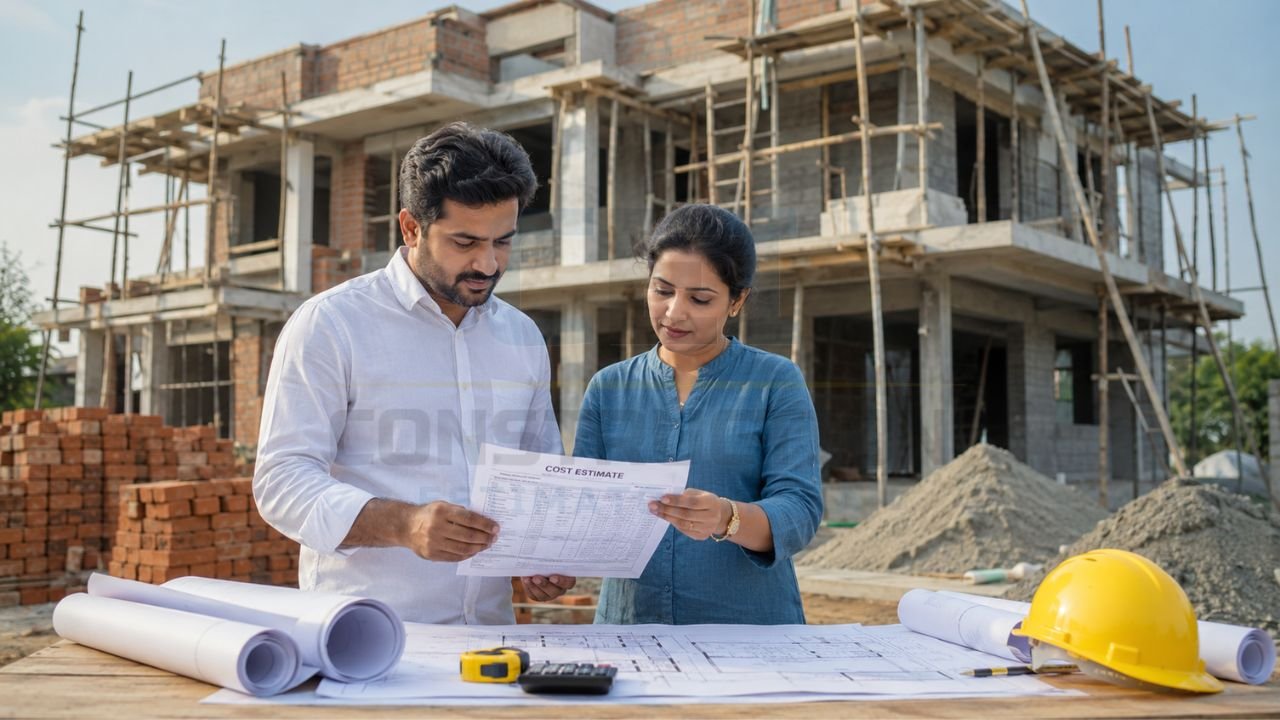
An estimate is a calculated approximation of the total cost of a construction project. It is usually prepared before the project starts to give the owner or the contractor an idea of the financial commitment required. It is based on a mix of assumed quantities, prevailing market rates (like the baseline house construction per sq ft rate), and previous experience.
Main Purpose of an Estimate
The primary goal of an estimate is feasibility.
- Budgeting: To check if the owner has enough funds to complete the project.
- Bank Approvals: Most Indian banks require a “Detailed Estimate” to sanction home or commercial loans.
- Tender Pricing: Contractors use estimates to decide the “Lump Sum” or “Percentage” they want to quote for a project.
👉 Choose the Right Cost Planning Method for Your Construction Project.
Typical Contents of an Estimate
A standard estimate usually includes:
- Project summary (location, built-up area).
- High-level quantities (e.g., total volume of concrete or total square footage).
- Item rates including labor, material, and machinery.
- Contingency charges (usually 3–5%) and contractor profit (usually 10–15%).
Example:
Imagine you are building a 1,000 sq. ft. house in a city like Dehradun or Lucknow. A contractor might provide an estimate stating: “Total construction cost will be ₹18 Lakhs at a rate of ₹1,800 per sq. ft.” This is a high-level estimate that helps the owner decide if they can afford the build.
Construction Estimator India helps contractors prepare these professional estimates so that your client understands exactly what they are paying for from day one.
What Is a BOQ (Bill of Quantities) in Construction?
Simple Definition of BOQ
A Bill of Quantities (BOQ) is a detailed, item-wise list of all materials, labor, and services required for a project. Unlike an estimate, which might be “rough,” a BOQ is “exact” based on the structural and architectural drawings. Understanding localized costs, such as the exact plaster cost per square foot with material in India, is what makes a BOQ highly accurate.
Main Purpose of a BOQ
- Transparent Bidding: When a client gives a BOQ to five different contractors, they can compare the rates easily because the quantities are fixed.
- Fair Billing: During the project, you get paid for the work you actually do (measurement-based billing).
- Variation Handling: If the client decides to add an extra room, the BOQ provides the base rates to calculate the extra cost fairly.
Typical Contents of a BOQ
A professional BOQ contains a table with columns for:
- Item Number: For easy reference (e.g., 1.1, 1.2).
- Description: Clear details of the work (e.g., “M20 Grade Concrete for Footings”).
- Unit: How the item is measured (e.g., Cum, Sqm, Rmt, Kg).
- Quantity: The exact amount calculated from drawings.
- Rate: The cost per unit (to be filled by the contractor).
- Amount: Quantity multiplied by the rate.
Example:
For the same house project, the BOQ will not just say “₹18 Lakhs.” It will list:
- Excavation: 50 Cum
- Reinforcement Steel: 3.5 MT
- Brickwork (1:6): 45 Cum
- Vitrified Tiles: 90 Sqm
Construction Estimator India excels at creating these detailed item lists so that you don’t miss a single bag of cement in your billing.
Difference Between Estimate and BOQ: Core Concepts
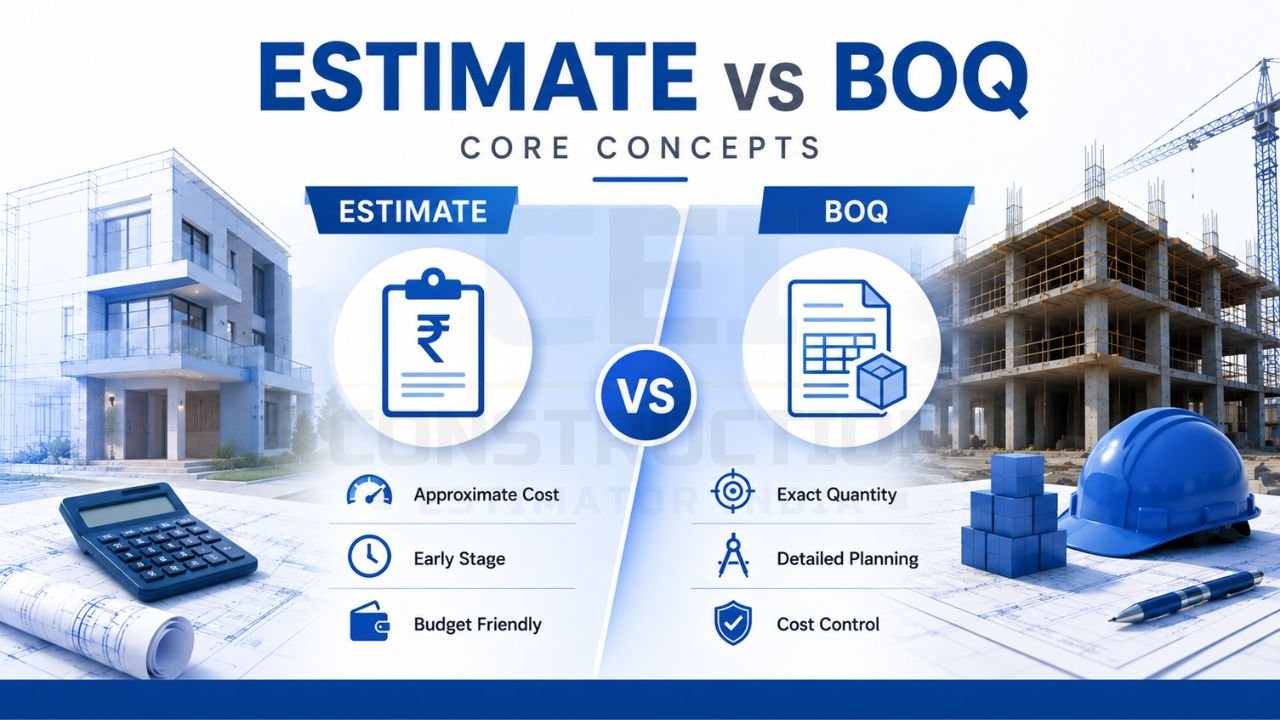
The difference between estimate and BOQ is often the difference between a project that makes money and one that goes into debt. While an estimate tells you “how much it might cost,” the BOQ tells you “exactly what needs to be done.”
Level of Detail
An estimate is often high-level and can be based on “thumb rules” or per-square-foot rates. A BOQ is incredibly detailed. In an estimate, you might see “Plumbing Work: ₹1.5 Lakhs.” In a BOQ, you will see the exact length of every 1-inch CPVC pipe, the number of elbows, and the count of washbasins.
Basis of Quantities
Estimates are often made using “Approximate Quantities” before full drawings are ready. A BOQ is based on a “Quantity Take-off” from final, approved drawings. If the drawing says the wall is 10 feet high, the BOQ will reflect exactly that. Understanding structural elements, like evaluating foundation types for house construction in India, allows estimators to quantify these elements correctly.
Usage in Project Lifecycle
- Estimate: Used in the Pre-Construction phase for planning and fund arrangement.
- BOQ: Used in the Construction and Post-Construction phases for tendering, daily site management, and preparing R.A. (Running Account) bills.
👉 Need a Professional Estimate or BOQ? Consult Our Experts Today.
Role in Contractor’s Profit and Risk
In a simple estimate, if you forget to include the cost of a boundary wall, you might have to pay for it from your own pocket. With a BOQ, if the boundary wall isn’t in the list, you have a legal right to claim it as an “Extra Item.” The BOQ protects the contractor’s margin by defining the scope of work clearly.
Before submitting your quote or bank documents, reach out to Construction Estimator India on WhatsApp / Call +91 8630676890 for a review of your estimate and BOQ.
How Estimate and BOQ Work Together in Real Projects?
In professional Indian construction projects, these two documents work as a sequence.
From Drawings to BOQ to Estimate
-
Drawings: Top architects and architecture firms provide the structural and visual plans.
- Quantities: A Quantity Surveyor (like those at Construction Estimator India) measures the lengths, widths, and heights.
- BOQ: These measurements are listed in the BOQ format (without rates).
- Estimate: The contractor fills in the rates to arrive at the final estimate.
Using BOQ to Build a Strong Estimate
The most successful building contractors in India don’t guess. They take a blank BOQ and perform a “Rate Analysis.” They check the current price of cement, sand, and labor, add their profit, and then fill the BOQ. The total of this priced BOQ becomes the most accurate estimate possible.
Using Estimate and BOQ for Tenders and Billing
In government tenders like those managed by the Central Public Works Department (CPWD), the department provides the BOQ. Your job as a contractor is to submit your “Estimate” by quoting a percentage above or below the department’s base rates. Once you win the work, the BOQ becomes the “Contract Price Schedule” against which you submit your monthly bills.
Common Mistakes Contractors Make with Estimate and BOQ
Even experienced contractors in India fall into these traps. Understanding the difference between estimate and BOQ helps you avoid these 8 common mistakes:
- Confusing BOQ with a Square-Foot Estimate: Quoting ₹2,000/sq.ft. without a BOQ is dangerous. If the client chooses expensive Italian marble later, your “estimate” will fail, but a BOQ would have specified the tile type.
- Not Preparing a BOQ for Private Projects: Many contractors build houses for private owners based on a hand-written note. When disputes happen over “how much sand was used,” there is no BOQ to prove the quantities.
- Using Wrong Units: Measuring steel in “bundles” instead of “Kilograms” or “Metric Tonnes” leads to massive billing errors.
- Ignoring “Hidden” Items: Forgetting items like “Curing,” “Scaffolding,” or “Wastage” in the BOQ eats up your profit.
- Not Updating the Estimate: When the site measurements change, the BOQ must be updated. If you don’t update the estimate, you won’t know you are losing money until the project ends.
-
Unclear Descriptions: Writing “Painting” instead of specifying the method, such as knowing how to use white cement for waterproofing prior to finishing, leads to clients demanding expensive solutions for cheap prices.
- Ignoring Lead Charges: In many parts of India, the cost of transporting material to a hilly or remote site is high. If your BOQ doesn’t account for “Lead and Lift,” your estimate will be wrong.
- Copy-Pasting BOQs: Every project is unique. Using a BOQ from a previous project for a new site with different soil conditions is a recipe for disaster.
Practical Tips for Contractors: Using Estimate and BOQ Correctly

Always Start from Drawings and Measurements
Never give a price over the phone. Ask for the plan, calculate the quantities, and build a BOQ first.
Keep BOQ Clear and Well-Organised
Divide your BOQ into sections: Civil Work, Electrical, Plumbing, and Finishing. This makes it easier for the client to read and for you to track.
👉 Get Reliable Cost Estimates and Detailed BOQs for Better Planning.
Build Estimate from BOQ, Not Just Guesswork
Use the BOQ to do a proper material indent. Understanding the difference between RCC and brick construction helps you pinpoint exactly how many structural materials to order.
Review Both Before Signing Contract or Taking Loan
Double-check your rates against standards set by the Bureau of Indian Standards (BIS). Once a BOQ is part of a signed contract, changing rates is nearly impossible in the Indian legal system.
If you want your estimate and BOQ to be clear, professional and bank-friendly, contact Construction Estimator India on WhatsApp / Call +91 8630676890.
Estimate vs BOQ for Bank Loans and Client Transparency
In India, if your client is applying for a home loan from major institutions like the State Bank of India (SBI) or HDFC Bank, the bank will demand a “Detailed Estimate” built upon a solid BOQ.
- Bank Logic: The bank wants to ensure the loan amount matches the work. A vague estimate might lead to under-funding, leaving the project stuck.
- Transparency: A clear BOQ builds trust. When a client sees that you have calculated every single brick, they are more likely to pay your bills on time without questioning every rupee.
- Documentation: Construction Estimator India supports contractors in preparing bank-ready documentation that follows standard Indian codes and formats.
Frequently Asked Questions: Difference Between Estimate and BOQ
What is the basic difference between estimate and BOQ in construction?
The basic difference between estimate and BOQ is that an estimate provides a total expected cost (the “What”), while a BOQ provides a list of every single item and quantity needed to reach that cost (the “How Much of What”). An estimate is a destination; the BOQ is the map.
Do I really need both estimate and BOQ for small projects?
Yes. Even for a small renovation, an estimate helps the client with their budget, and a BOQ helps you as a contractor to order materials without wastage.
Can I use only per sq ft rates instead of BOQ?
You can use per sq. ft. rates for a very rough initial discussion, but never for a legal contract. A BOQ is much safer because it accounts for specific site conditions and material qualities.
Who should prepare the BOQ – contractor or consultant?
Ideally, a consultant or quantity surveyor should prepare the BOQ based on the architect’s drawings. The contractor then fills in the rates to create the final estimate.
How can Construction Estimator India help me with estimate and BOQ?
Construction Estimator India provides expert services to calculate quantities from your plans, prepare detailed BOQs, and create professional estimates for tenders, bank loans, and private contracts.
Conclusion
Understanding the difference between estimate and BOQ is the first step toward becoming a professional, high-earning contractor in India. An estimate gives you the “big picture,” but the BOQ gives you the “details” that protect your profit and ensure the project is completed without disputes.
Whether you are a site engineer looking to improve your documentation or a contractor aiming to win bigger projects, using both tools correctly will set you apart from the competition. Don’t leave your profits to guesswork.
If you want expert help to prepare or review your estimate and BOQ for upcoming projects, contact Construction Estimator India on WhatsApp / Call +91 8630676890.