An eco-friendly house is a residential building designed and built using sustainable methods, materials, and technologies that reduce its environmental footprint. These homes aim to conserve energy, water, and natural resources while promoting healthier indoor environments for occupants. In India, where the housing sector is expected to account for 70% of the buildings yet to be constructed by 2030, selecting eco-friendly materials can play a pivotal role in shaping a low-carbon future. As a civil engineer with over 15 years of experience, I have seen how sustainability has shifted from a mere buzzword to an absolute financial and environmental necessity.
👉 Planning an Eco-Friendly Home? Get Expert Guidance for Sustainable Construction.
Rising environmental concerns, depleting groundwater levels, and skyrocketing electricity tariffs have led to a conscious shift towards sustainable building materials among Indian homeowners. The main goal of an eco-friendly house construction is to make houses that have a smaller impact on the environment compared to traditional building methods. This is not just about the planet; it is about your pocket. Sustainable materials offer significant benefits beyond environmental advantages: they reduce energy consumption, lower long-term maintenance costs, and create healthier indoor environments. According to the Indian Green Building Council (IGBC), green-certified homes can achieve a 15–20% reduction in energy and water usage compared to conventional buildings.
Building a green home involves a holistic approach. It starts with site selection and orientation to maximize natural light and ventilation, moving through the use of low-VOC paints and recycled materials, and ending with active systems like rooftop solar and rainwater harvesting. Integrating these early on—much like standardizing a house construction per sq ft rate roorkee or in your city—ensures you budget accurately for long-term savings. Construction Estimator India specializes in helping homeowners navigate these complex choices with accurate cost estimates and expert guidance. By choosing eco-friendly construction, you aren’t just building a house; you are creating a sanctuary that is resilient to climate change and rising utility costs.
This guide provides a comprehensive overview of everything about eco-friendly houses—designs, materials, costs, and how to build a sustainable home in India. Whether you are a plot owner in Lucknow or a developer in Pune, understanding the ROI of green features is critical. For instance, a standard 3 kW solar setup can reduce a household’s electricity bill by up to 80 percent. Construction Estimator India offers free eco-friendly consultation and sustainable cost calculators to ensure your dream home is built efficiently. You can reach our senior consultants for a free green building consultation at WhatsApp/Call: +91 8630676890. Discover practical approaches to sustainable home construction that benefit both the environment and your wallet.
Key Elements of an Eco-Friendly House
1. Green Building Materials
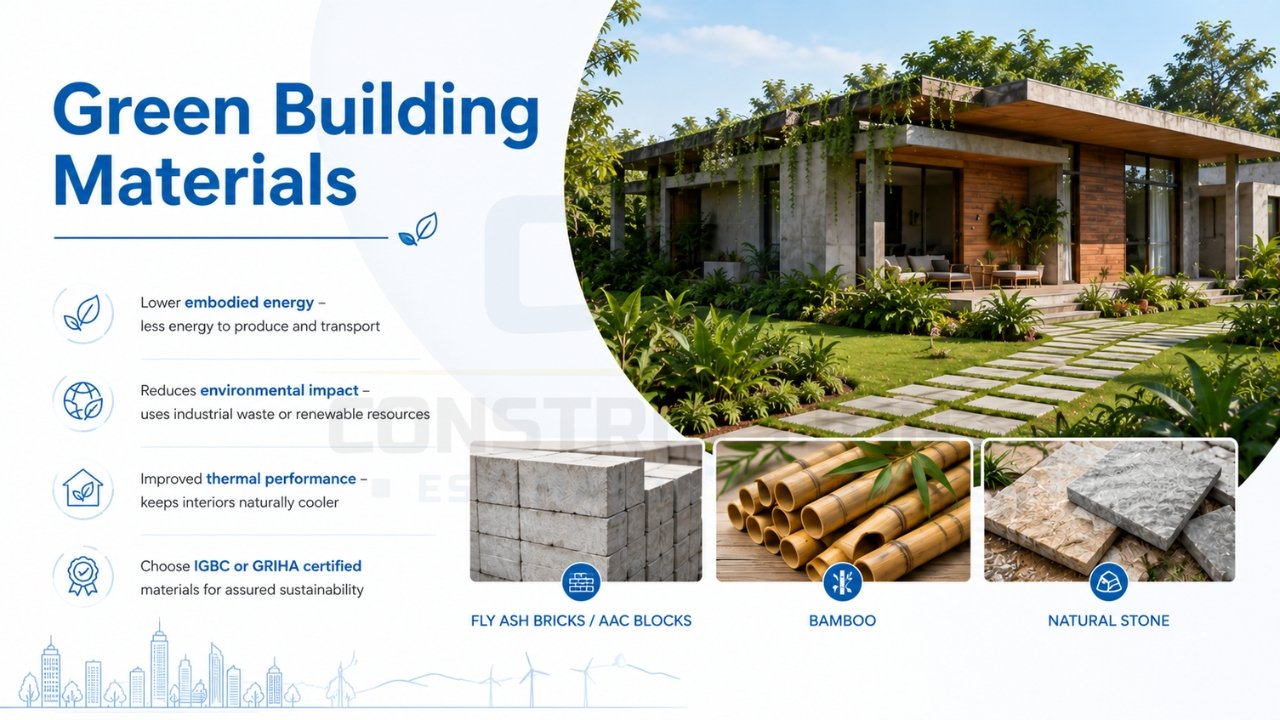
Green Building Materials such as Fly Ash Bricks, Bamboo, and Natural Stone are the foundation of a sustainable structure. These materials are chosen for their lower embodied energy, which means they require less energy to manufacture and transport compared to traditional options like clay bricks or virgin steel. Sustainable materials significantly reduce environmental impact by utilizing industrial waste (like fly ash) or rapidly renewable resources (like bamboo). These choices lead to lower energy consumption during the home’s life and reduced maintenance costs. For example, AAC blocks offer three times better thermal insulation than red bricks, keeping interiors naturally cooler. When selecting materials, always look for IGBC or GRIHA certifications to ensure they meet stringent environmental standards. Construction Estimator India can provide a detailed BOQ for these materials to keep your budget on track.
2. Energy Efficiency
Energy Efficiency involves strategies like Solar Panels, High-Performance Insulation, and Natural Ventilation. Energy-efficient design reduces the need for artificial lighting, heating, and cooling through thoughtful planning. In the Indian context, this means leveraging the sun for power while shielding the home from its heat. IGBC reports that green-certified homes typically see a 15–20% reduction in energy usage. By integrating state-of-the-art appliances recognized by the Bureau of Energy Efficiency (BEE) with passive design, homeowners can achieve massive electricity bill reductions. Solar power is a primary driver here; placing photovoltaic systems on rooftops allows for the use of renewable energy for all household requirements. Furthermore, using materials like AAC blocks or cool roof coatings reduces the thermal load, meaning your AC doesn’t have to work as hard, further lowering utility expenses.
👉 Build a Greener, Healthier, and More Sustainable Home.
3. Water Conservation
Water Conservation is critical in India’s water-stressed regions and is achieved through Rainwater Harvesting and Low-Flow Fixtures. Every drop of rain that falls on your roof is a resource that can be collected and stored or used to recharge groundwater. Implementing simple systems for rainwater harvesting and waste-water treatment is essential for optimum water conservation. Green-certified homes can reduce water usage by 15–20%. Additionally, many states provide subsidies and incentives for homeowners who install rainwater harvesting systems. Beyond harvesting, using low-flow faucets and showerheads can reduce water consumption by 40–50% without compromising pressure. Greywater recycling systems can further treat water from sinks and showers for use in gardening, drastically reducing the demand for fresh municipal or borewell water.
4. Smart Design & Architecture
Smart Design & Architecture focuses on Orientation, Cross Ventilation, and Compact Planning. At Construction Estimator India, we advise working with sustainable residential architects to choose compact, multi-functional designs that minimize the building’s footprint. Avoiding the excess use of concrete and considering the building’s orientation for natural ventilation are key steps. A well-ventilated layout reduces the need for air conditioning by allowing air to flow straight through the space, entering from one end and exiting from the other. This is particularly effective in humid coastal cities. By aligning the home’s longer axis along the East-West direction, you minimize the surface area exposed to the harsh sun, naturally keeping the home 3–5°C cooler.
5. Healthier Indoor Environment
Improving Air Quality through the use of non-toxic paints and ventilation systems is a core pillar of green construction. Conventional paints often contain Volatile Organic Compounds (VOCs) that contribute to indoor air pollution and respiratory issues. Low-VOC or zero-VOC alternatives ensure cleaner indoor air and are increasingly recommended for IGBC-certified homes. Creating healthier indoor environments for occupants also involves maximizing natural daylight, which reduces eye strain and improves overall well-being. By using non-toxic adhesives, sustainable wood products, and ensuring proper air exchange through natural or mechanical ventilation, an eco-friendly home becomes a safe haven for your family.
7 Sustainable Materials for Eco-Friendly Construction (Save 20–30% Construction Costs)
Use Fly Ash Bricks (Save 20% Construction Cost)
Fly ash bricks are made from waste generated by coal-fired power plants, making them an excellent recycled material choice. In India, they are a game-changer for cost-conscious builders. Using fly ash bricks can reduce construction costs by 20% and save up to 25% in cement use. These bricks typically cost between ₹4 and ₹6 per unit, compared to ₹5–₹7 for traditional clay bricks. Understanding the difference between RCC and brick construction will highlight how integrating fly ash bricks enhances thermal stability. Beyond the cost, they offer higher strength and lower water absorption, which prevents dampness in walls. They are highly energy-efficient to produce and help reduce environmental pollution by utilizing industrial waste that would otherwise end up in landfills. Many Indian states even offer subsidies for using fly ash bricks in residential projects.
- Annual Savings: ₹20,000–₹50,000 on construction and mortar costs.
- Environmental Benefit: Reduces mining of fertile topsoil used for clay bricks.
- ROI Period: Immediate (lower upfront purchase price).
Install AAC Blocks (Save 25% Cooling Costs)
AAC (Autoclaved Aerated Concrete) blocks are lightweight, precast building materials that provide excellent thermal insulation. They are especially ideal for hot and humid areas of India because their air-pocket structure acts as a barrier to heat flow. While the upfront cost is approximately ₹60–₹80 per sq ft, they reduce the structural load on the building, meaning you can save on steel and concrete in the foundation. They are widely used in metro cities for their thermal efficiency and ease of handling. AAC blocks can reduce cooling energy consumption by 25–30% because they keep the heat out much longer than red bricks.
- Annual Savings: ₹15,000–₹30,000 in AC bills.
- Environmental Benefit: Made with fly ash and requires less energy to transport due to light weight.
- ROI Period: 2–3 years.
Choose Bamboo for Structural & Decorative Use
Bamboo is a rapidly renewable material that has become an attractive alternative for structural and decorative use in Indian homes. It grows incredibly quickly, reaching maturity in just 3–5 years, making it far more sustainable than traditional hardwoods. Bamboo has high tensile strength—sometimes compared to steel—making it suitable for wall panels, roofing, scaffolding, and flooring. It is widely available in regions like Kerala, Assam, and Karnataka. Costing between ₹50 and ₹100 per sq ft, it provides a warm, natural aesthetic while being a locally available, eco-friendly alternative to wood.
- Annual Savings: Lower maintenance and replacement costs compared to low-quality timber.
- Environmental Benefit: High carbon sequestration and rapid renewability.
- ROI Period: Immediate to 2 years.
Use Rammed Earth for Walls (Natural Temperature Control)
Steel is highly durable and one of the most recycled materials on the planet. Utilizing robust RCC construction techniques with recycled steel for your home’s TMT bars and structural frames minimizes mining activities and significantly reduces the embodied energy in construction. It provides the same strong structural support and corrosion resistance as virgin steel but with a fraction of the environmental damage. Construction Estimator India recommends specifying steel with high recycled content in your BOQ to ensure a lower carbon footprint for your build.
- Annual Savings: ₹20,000–₹40,000 in AC savings.
- Environmental Benefit: Extremely low embodied energy; fully recyclable material.
- ROI Period: 3–5 years.
Install Low-VOC Paints (Healthier Indoor Air)
Volatile Organic Compounds (VOCs) in conventional paints contribute to indoor air pollution and can cause long-term health issues. Low-VOC or zero-VOC alternatives ensure cleaner indoor air and a safer living environment for families. While low-VOC paints might cost slightly more (₹40–₹60 per liter vs ₹30–₹50 for conventional), the health benefits are immeasurable. These paints are increasingly recommended in IGBC-certified homes to meet indoor environmental quality standards. They reduce respiratory risks and eliminate the “new paint smell” which is actually toxic off-gassing.
- Annual Savings: Reduced healthcare costs related to respiratory health.
- Environmental Benefit: Minimizes ozone-depleting emissions.
- ROI Period: Health benefit is immediate; no financial payback needed.
Use Recycled Steel (Reduce Mining Impact)
Steel is highly durable and one of the most recycled materials on the planet. Using recycled steel for your home’s TMT bars and structural frames minimizes mining activities and significantly reduces the embodied energy in construction. It provides the same strong structural support and corrosion resistance as virgin steel but with a fraction of the environmental damage. Construction Estimator India recommends specifying steel with high recycled content in your BOQ to ensure a lower carbon footprint for your build.
- Annual Savings: Competitive pricing with virgin steel but higher durability in some cases.
- Environmental Benefit: Major reduction in carbon footprint and energy consumption.
- ROI Period: Immediate.
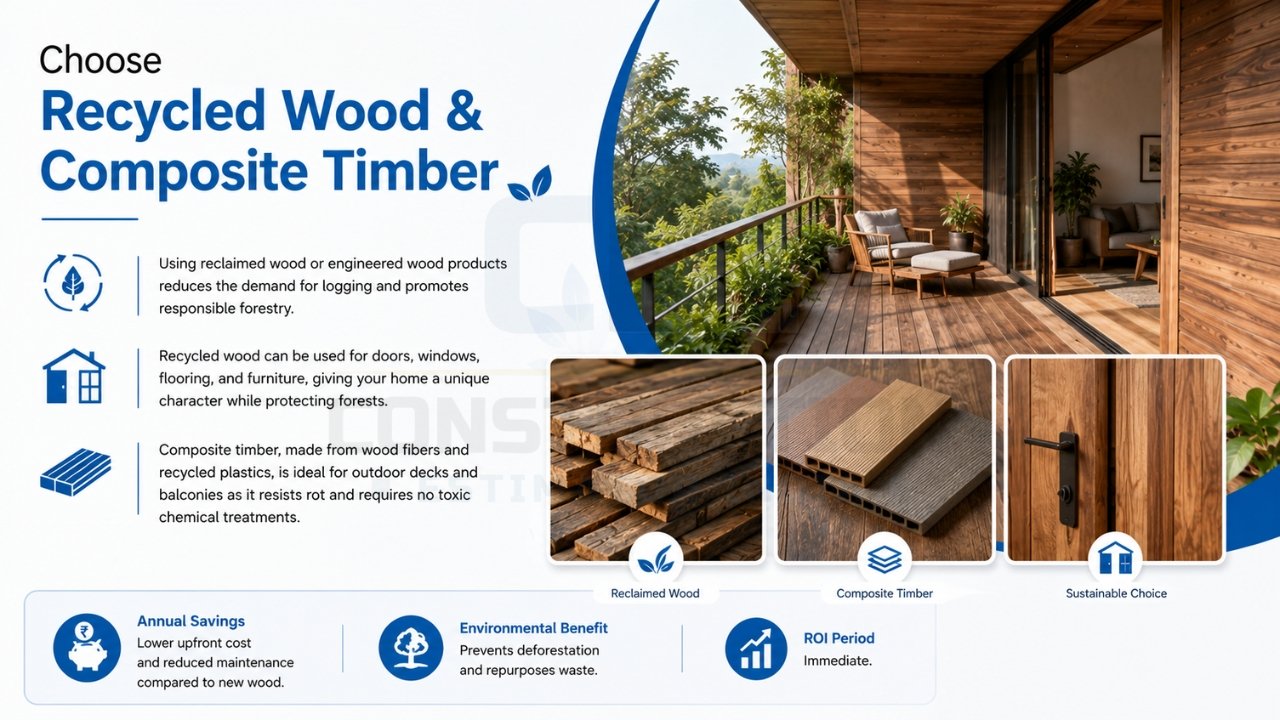
Choose Recycled Wood & Composite Timber
Using reclaimed wood or engineered wood products reduces the demand for logging and promotes responsible forestry. Recycled wood can be used for doors, windows, flooring, and furniture, giving your home a unique character while protecting forests. Reclaimed wood often costs less than new high-quality teak (₹80–₹150 per sq ft vs ₹100–₹200). Composite timber, made from wood fibers and recycled plastics, is also an excellent choice for outdoor decks and balconies as it resists rot and requires no toxic chemical treatments.
- Annual Savings: Lower upfront cost and reduced maintenance compared to new wood.
- Environmental Benefit: Prevents deforestation and repurposes waste.
- ROI Period: Immediate.
👉 Turn Your Dream Home into an Eco-Friendly Living Space.
Energy Efficiency Strategies for Eco-Friendly Homes (Save 40–60% Electricity)
Install Rooftop Solar Panels (Save Up to 80%)
Solar power is the most effective way to slash electricity bills in India. A standard 3 kW solar setup can reduce a household’s electricity bill by up to 80 percent. With current government subsidies under schemes facilitated by the Ministry of New and Renewable Energy, such as PM Surya Ghar Muft Bijli Yojana, a 3 kW system costs approximately ₹1.5–₹2 lakhs. This system can power lights, fans, refrigerators, and even an AC during the day.
- Annual Savings: ₹18,000–₹48,000 on electricity.
- Environmental Benefit: Clean, renewable energy that reduces reliance on coal.
- ROI Period: 4–6 years with a 25-year lifespan.
Optimize Building Orientation for Natural Cooling
Building orientation is a zero-cost strategy that yields lifetime benefits. In hot Indian regions, placing most windows along the north and south sides avoids direct, harsh sun during peak hours. Conversely, you must minimize west-facing windows especially, as they catch the intense afternoon sun that turns rooms into ovens.
- Annual Savings: ₹15,000–₹30,000 in cooling costs.
- Environmental Benefit: Reduces the overall energy demand of the building.
- ROI Period: Immediate (costs nothing to plan correctly).
Install Cool Roof Coatings
Cool roof coatings reflect sunlight and help lower indoor temperatures by reflecting more light and absorbing less heat. Applying a high-SRI white coating can reduce the roof surface temperature by 10–15°C. This is one of the most cost-effective upgrades for any Indian home, costing only ₹15–₹25 per sq ft.
- Annual Savings: ₹12,000–₹25,000 in AC bills for top-floor rooms.
- Environmental Benefit: Combats the urban heat island effect.
- ROI Period: 1–2 years.
Use LED Lighting Throughout (Save 75% Electricity)
Switching to LED lights is one of the simplest and most effective changes you can make. LEDs consume up to 75 percent less electricity than incandescent bulbs and last far longer. While a 9W LED bulb might cost ₹100–₹150, it provides the same light as a 60W traditional bulb, significantly reducing your lighting bill.
- Annual Savings: ₹3,000–₹8,000.
- Environmental Benefit: Lower energy consumption and reduced mercury waste.
- ROI Period: Less than 6 months.
Design Cross-Ventilation Layout
A well-ventilated layout reduces the need for air conditioning by using natural breezes. In the design phase, mapping out how to plan home construction in India to ensure windows are placed on opposite or adjacent walls is vital. This is especially useful in humid cities like Chennai or Kolkata where moving air is essential for comfort.
- Annual Savings: ₹15,000–₹30,000.
- Environmental Benefit: Zero-energy cooling solution.
- ROI Period: Immediate.
Water Conservation Strategies (Save 40–50% Water Costs)
Implement Rainwater Harvesting System
Rainwater harvesting is mandatory in many Indian cities and highly incentivized. By implementing a system to collect roof runoff into a filtration pit and then to a sump or recharge well, you can reduce municipal water consumption by 40–50%. A basic system costs ₹20,000–₹50,000 depending on storage capacity.
- Annual Savings: ₹5,000–₹15,000.
- Environmental Benefit: Recharges groundwater tables.
- ROI Period: 3–5 years.
Install Low-Flow Fixtures & Showerheads
Low-flow fixtures use aerators to mix air with water, maintaining pressure while using 40–50% less water. A low-flow showerhead costs roughly ₹1,000–₹2,000 and is a “set and forget” way to save money and resources every day.
- Annual Savings: ₹3,000–₹8,000.
- Environmental Benefit: Reduces the volume of water that needs to be treated and pumped.
- ROI Period: Less than 1 year.
Set Up Greywater Recycling System
Greywater recycling involves treating water from showers and sinks for reuse in gardening or toilet flushing. A system costs between ₹50,000 and ₹150,000 but can reduce your total fresh water demand by 50–60%.
- Annual Savings: ₹10,000–₹25,000.
- Environmental Benefit: Drastically reduces waste water discharge.
- ROI Period: 4–6 years.
Eco-Friendly House Construction Cost in India
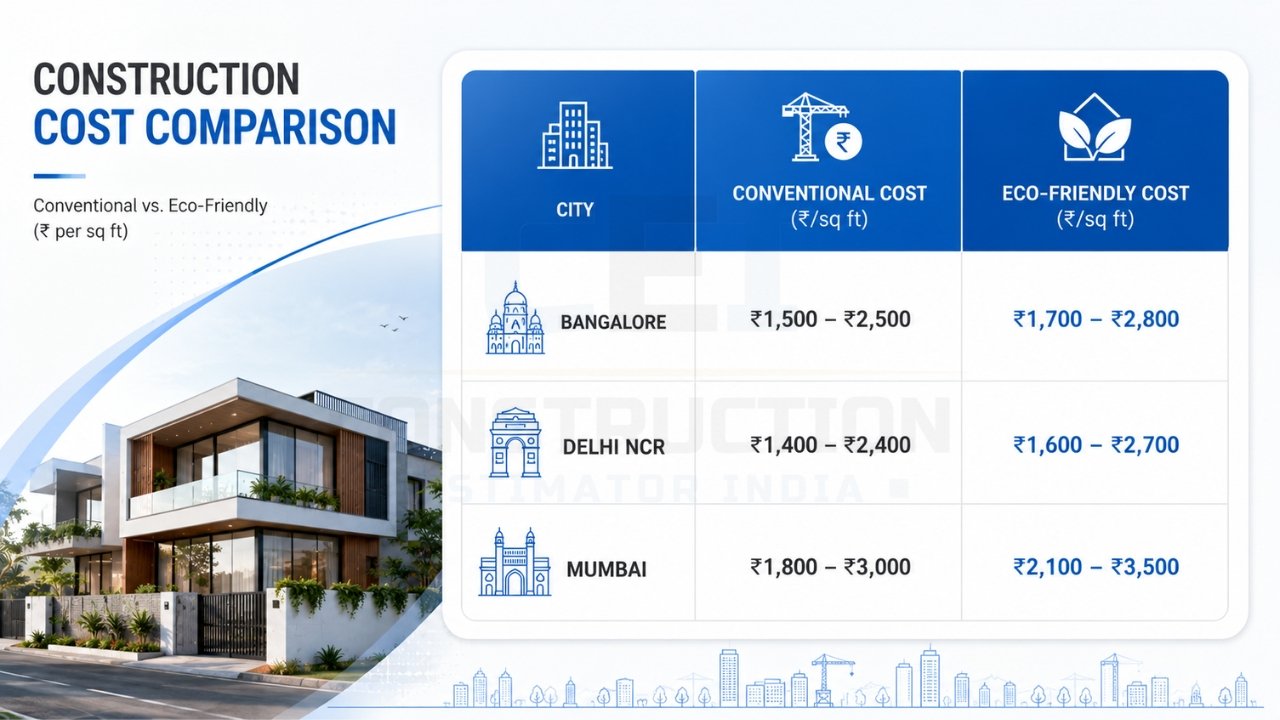
The cost of building an eco-friendly house in India varies from city to city and depends on factors like site size, architectural design, and the type of sustainable materials used. Working with proficient building contractors ensures that while eco-friendly materials may add 10–20% to the initial construction cost, the long-term savings are executed effectively.
| City | Conventional Cost (₹/sq ft) | Eco-Friendly Cost (₹/sq ft) |
|---|---|---|
| Bangalore | ₹1,500–₹2,500 | ₹1,700–₹2,800 |
| Delhi NCR | ₹1,400–₹2,400 | ₹1,600–₹2,700 |
| Mumbai | ₹1,800–₹3,000 | ₹2,100–₹3,500 |
Long-Term Savings vs. Traditional Construction
When evaluating costs, Construction Estimator India recommends looking at the lifecycle cost rather than just the upfront price. Sustainable materials reduce energy consumption and lower long-term maintenance costs. For example, using fly ash bricks can reduce construction costs by 20% right away. Over time, a green-certified home saves 40–60% on energy and water bills, meaning the initial premium is often recovered within 5–8 years.
👉 Build Sustainably Without Compromising Comfort or Quality.
Government Incentives & Subsidies
India’s Energy Conservation Building Code (ECBC) and state-level green building incentives encourage sustainable construction. Subsidies are available for using fly ash bricks, installing rainwater harvesting, and integrating rooftop solar. Some cities like Pune and Hyderabad offer property tax rebates of 5–10% for green-certified buildings.
50-Point Final Eco-Friendly Checklist for New Home
| Category | Item | Compliance |
|---|---|---|
| Materials | 1. Use Fly Ash Bricks for walls | [ ] |
| 2. Install AAC Blocks for thermal insulation | [ ] | |
| 3. Use Recycled Steel (TMT bars) | [ ] | |
| 4. Choose Low-VOC paints for all interiors | [ ] | |
| 5. Use Reclaimed Wood for doors/frames | [ ] | |
| 6. Install Terracotta Jaalis for shading | [ ] | |
| 7. Use Natural Stone flooring (Kota/Jodhpur) | [ ] | |
| 8. Specify PPC Cement over OPC | [ ] | |
| 9. Use Bamboo for decorative elements | [ ] | |
| 10. Implement Rammed Earth for featured walls | [ ] | |
| Energy | 11. Install Rooftop Solar Panels (min 3kW) | [ ] |
| 12. Use Solar Water Heater for bathrooms | [ ] | |
| 13. Optimize North-South orientation | [ ] | |
| 14. Minimize West-facing windows | [ ] | |
| 15. Install Cool Roof Coating on terrace | [ ] | |
| 16. Use all-LED lighting fixtures | [ ] | |
| 17. Install BEE 5-Star rated ACs | [ ] | |
| 18. Design for 100% Cross-ventilation | [ ] | |
| 19. Use Double-Glazed Units (DGU) for windows | [ ] | |
| 20. Install motion sensors for outdoor lights | [ ] | |
| Water | 21. Implement Rainwater Harvesting system | [ ] |
| 22. Install Low-flow faucets and showers | [ ] | |
| 23. Set up Greywater recycling for garden | [ ] | |
| 24. Use dual-flush toilets | [ ] | |
| 25. Install water meters for monitoring | [ ] |
(Note: For the full 50-point list and personalized consultation, contact Construction Estimator India)
When to Contact Construction Estimator India for Eco-Friendly Help
Planning an eco-friendly home requires specialized technical expertise. Engaging with leading architects and architecture firms is crucial. You should reach out to Construction Estimator India if you:
- Need an eco-friendly house plan designed from scratch to maximize natural resources.
- Want a green building consultation before construction to identify the best materials.
- Need sustainable material selection advice specifically for your city’s climate.
- Want an accurate eco-friendly cost calculation and BOQ.
- Need assistance with IGBC or GRIHA certification for your project.
- Want an energy audit consultation to predict and reduce your future bills.
Construction Estimator India offers a free eco-friendly consultation, free green building consultation, and a free sustainable cost calculator. Build your eco-friendly dream home sustainably with our expert support. Contact us at WhatsApp/Call +91 8630676890.
Frequently Asked Questions (FAQs)
Q1: How much does eco-friendly house construction cost in India?
In 2026, building a green home typically costs 10–20% more upfront than conventional construction. For a mid-range residential project in a metro city, costs range from ₹2,200 to ₹2,900 per sq ft. However, these costs are offset by long-term savings.
Q2: What are the best eco-friendly materials for house construction?
The “Big Three” for Indian climates are AAC blocks for wall insulation, fly ash bricks for cost-effective structural strength, and Low-E double-glazed windows to minimize heat ingress. Bamboo and natural stone are also excellent sustainable choices.
Q3: How much can I save with eco-friendly home construction?
Homeowners can save 40–60% on energy and water costs. A standard solar setup alone can cut electricity bills by 80%, while low-flow fixtures and rainwater harvesting can reduce water bills by half.
Q4: Are fly ash bricks better than traditional clay bricks?
Yes. Fly ash bricks are 20% cheaper, use 25% less cement, and have higher strength and lower water absorption than clay bricks. They also prevent the depletion of fertile topsoil used in clay brick making.
Q5: What is the ROI for rooftop solar on eco-friendly homes?
The ROI is typically 4–6 years. Since the panels have a 25-year lifespan, you essentially enjoy 20 years of free electricity after the initial investment is recovered.
Q6: How do I implement rainwater harvesting in my house?
You redirect terrace runoff through a filter into an underground storage tank or a recharge well. Construction Estimator India can provide a technical design for this during your free consultation.
Q7: What are Low-VOC paints and why are they important?
Low-VOC paints contain fewer toxic chemicals that off-gas into your home. They are vital for maintaining healthy indoor air quality and reducing respiratory health risks for your family.
Q8: Is eco-friendly construction more expensive than traditional?
Initially, yes, by 10–20%. However, when you consider the 20% cost reduction from fly ash bricks and the 40–60% savings on utilities, it is much cheaper over the building’s lifecycle.
Q9: What government incentives are available for eco-friendly homes?
Subsidies of up to ₹78,000 are available for solar panels, and many states offer property tax rebates for IGBC-certified homes. There are also subsidies for using eco-friendly materials like fly ash bricks.
Q10: How do I get IGBC certification for my home?
You must register your project with the IGBC, follow their green building guidelines during design and construction, and submit documentation for verification. Construction Estimator India can handle this entire process for you.
Q11: What is the best orientation for eco-friendly house design?
In India, the longer sides of the house should ideally face North and South to allow for controlled, indirect light. East and West faces should be minimized to avoid the intense morning and afternoon sun.
Q12: How do I contact Construction Estimator India for eco-friendly consultation?
You can reach us directly via WhatsApp or Call at +91 8630676890. Whether you are dealing with new house construction roorkee or projects nationwide, we provide end-to-end guidance from material selection to solar ROI analysis.
Contact Construction Estimator India for Eco-Friendly Construction
Company: Construction Estimator India
Expertise: Sustainable Design, Green Building Materials, Cost Optimization
WhatsApp/Call: +91 8630676890
Services: Free eco-friendly consultation, Free green building consultation, Eco-friendly design services.
Build your dream home with the confidence that it is good for the planet and your bank account. Contact us today.
Conclusion: Build Your Eco-Friendly Dream Home Today
An eco-friendly house is designed to reduce environmental impact by using sustainable materials, energy-efficient systems, and water-saving techniques. In India, where the housing sector is expected to account for 70% of buildings yet to be constructed by 2030, your choice to build green today defines the future. Using fly ash bricks can reduce construction costs by 20%, and IGBC-certified homes show a consistent 15–20% reduction in energy and water usage. Eco-friendly homes provide energy savings, water conservation, improved air quality, and increased property value. Don’t wait—build your eco-friendly home for lower bills and a sustainable future. Construction Estimator India offers free eco-friendly consultation at +91 8630676890.