In the rapidly evolving landscape of Indian residential architecture, the duplex house plan has emerged as a symbol of sophisticated urban living. For many Indian families, building a home is a once-in-a-lifetime journey. As plot sizes in cities like Bangalore, Pune, Delhi NCR, and Lucknow become more compact and expensive, the need to build vertically has become a necessity rather than a luxury. A duplex house is essentially a single residential unit spread across two floors, connected by an internal or external staircase. It offers the perfect blend of privacy and togetherness, allowing multi-generational families to live under one roof while maintaining distinct zones for social interaction and private rest.
Whether you are looking for a modern aesthetic with large glass facades or a traditional layout that prioritizes Vastu and natural ventilation, choosing the right duplex house plan early in the process is critical. A well-thought-out plan ensures that your home feels spacious, well-lit, and functional. However, understanding how to plan home construction in India reveals that a duplex involves more complexity than a standard single-storey home. It requires careful consideration of structural loads, staircase placement, and vertical plumbing lines. Without professional guidance, homeowners often find themselves facing unexpected costs or design flaws that are difficult to correct once construction begins.
👉 Planning Your Dream Duplex Home? Get Expert Guidance Before You Build.
This is where Construction Estimator India plays a vital role in your home-building journey. We specialize in helping homeowners understand the real-world implications of their design choices by providing precise cost estimations and material quantity takeoffs. Before you lay the first brick, you must know if your dream plan aligns with your financial reality. If you are planning a duplex house and want to understand realistic construction costs for your plot, you can contact Construction Estimator India on WhatsApp / Call +91 8630676890 for practical estimation support. Our goal is to ensure you build with confidence, avoiding the common budget overruns that plague many self-construction projects in India.
Understand What a Duplex House Plan Really Is
A duplex house plan is often misunderstood as simply “two houses on top of each other.” In the Indian context, it is much more nuanced. It is a architectural strategy to maximize the potential of a small to medium-sized residential plot. By stacking the living areas, you free up ground space for parking or a small garden while doubling your living area.
Duplex vs Single-Storey and Apartment Living
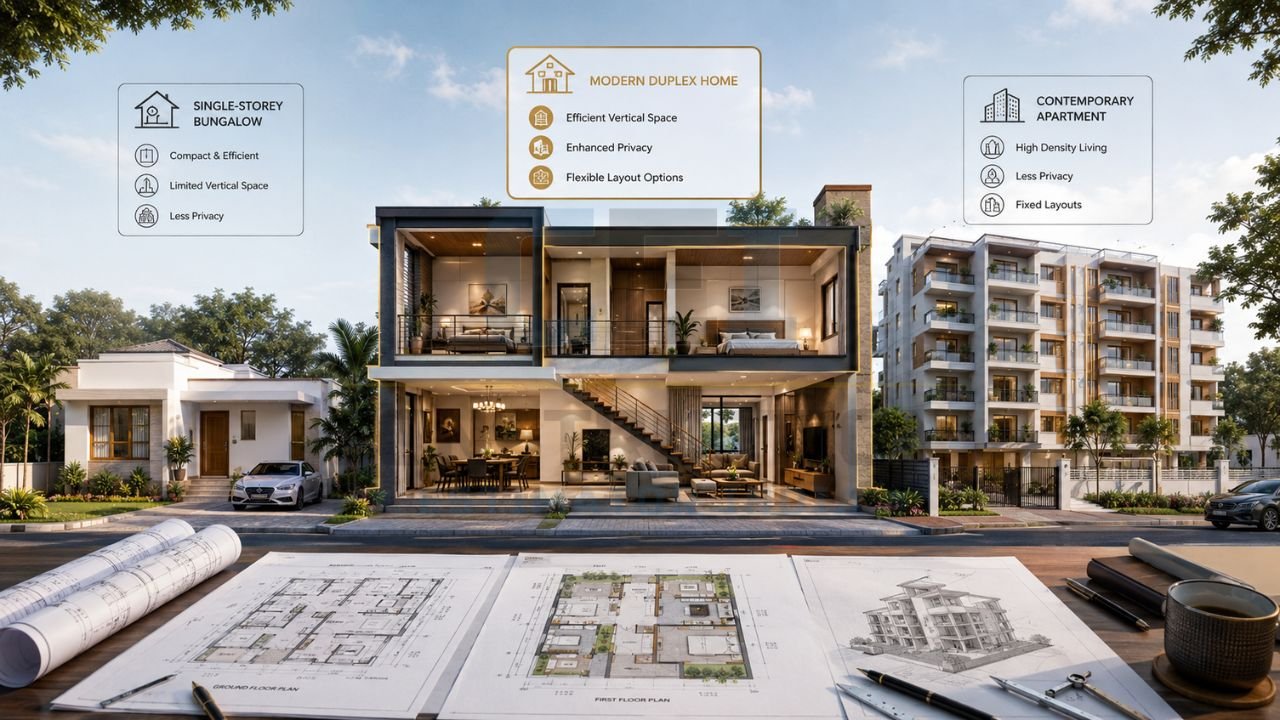
A duplex offers a unique middle ground between the isolation of an apartment and the potential sprawl of a large single-storey bungalow. In an apartment, you are confined by the developer’s rigid layout and shared common areas. In a single-storey house, you might run out of plot area if you want three or four bedrooms plus a large living room. A duplex solves this by utilizing vertical space.
This matters for duplex house planning because it changes how you perceive your house construction per sq ft rate. A 1200 sq ft single-storey house might feel cramped, but a 1200 sq ft duplex (600 sq ft per floor) allows for a clear separation of “public” and “private” zones. A common mistake is treating each floor as a separate entity without a cohesive design theme, leading to a disconnected living experience.
Common Types of Duplex Houses in India
There are three primary configurations popular in the Indian market. The first is the “Internal Staircase Duplex,” where the stairs are located inside the living or dining area, creating a grand, unified feel. The second is the “Rental-Friendly Duplex,” where the staircase is external or located in a separate foyer, allowing the upper floor to be rented out or used by a different family branch. The third is the “Side-by-Side Duplex,” common on wider plots, where two units share a common central wall.
Choosing the right type depends on your long-term goals. If you need monthly income to pay off a home loan (from providers like SBI or HDFC Bank), the rental-friendly layout is superior. A mistake often made is choosing a rental layout but failing to provide independent utility meters or water tanks.
👉 Turn Your Duplex House Plan into a Well-Planned, Cost-Effective Reality.
When a Duplex House Plan Makes Sense for Your Family
A duplex is ideal for growing families or those living with elderly parents. It allows parents to stay on the ground floor (avoiding stairs) while children and grandchildren enjoy the privacy of the first floor. It is also perfect for professionals who work from home and need a quiet office space away from the main living area.
This decision dictates the “weight” of the design—where do you put the most expensive finishes? A constraint to keep in mind is the total built-up area allowed by local municipal bylaws set by bodies like the Town and Country Planning Organisation (TCPO). Many people mistake “luxury” for “large area” and end up with a house that is too big for their budget.
Check Your Plot Size, Shape, and Basic Regulations
Before diving into architectural aesthetics, you must understand the physical and legal boundaries of your land. In India, every municipality has specific rules regarding how much of your plot you can actually build upon.
Typical Plot Sizes and Their Duplex Possibilities
In Indian residential colonies, plot sizes often follow standard dimensions like 20×40 ft (800 sq ft), 30×40 ft (1200 sq ft), or 30×50 ft (1500 sq ft). A 20×40 plot is challenging but can accommodate a compact 2BHK duplex. A 30×40 plot is the “sweet spot” for a spacious 3BHK duplex with car parking.
Understanding these dimensions is the first step in creating a functional duplex house plan. You need to visualize the footprint of the house versus the open space. Start by measuring your plot and checking for any irregularities like non-parallel boundaries. On smaller plots, you have to be very efficient with the “dead space” like corridors. A common mistake is trying to fit too many rooms into a small plot, resulting in tiny, dark rooms that lack ventilation. Before you finalise your duplex house plan with the architect, Construction Estimator India can help you estimate the budget and compare different layout options. Reach out on WhatsApp / Call +91 8630676890.
Setbacks, Road Width, and Local Rules
“Setbacks” are the mandatory open spaces you must leave between your house walls and the plot boundary. Generally, you need more space in the front and less on the sides and back. These rules are influenced by the road width in front of your house; wider roads often allow for more height or higher Floor Space Index (FSI).
Ignoring these rules can lead to legal notices or the demolition of unauthorized portions. You must consult a local licensed engineer to know the exact setbacks for your specific colony. Proper setbacks also ensure that your neighbors don’t block your light and air. A typical constraint is the “line of construction” enforced by the development authority. A frequent error is building right up to the edge to save space, only to be denied a permanent electricity or water connection later. Construction Estimator India provides guidance on planning built-up area in line with these local constraints and your budget.
How Plot Constraints Affect Duplex Layout?
The shape of your plot (rectangular, square, or irregular) and the direction it faces (North, East, etc.) will dictate where the entrance, kitchen, and bedrooms go. For instance, an East-facing plot is highly prized in India for Vastu reasons, allowing the main entrance to capture the morning sun.
This matters because a duplex has a larger “vertical shadow.” If your plot is narrow and deep, the middle of the house might become very dark. You must plan for “cut-outs” or “ducts” to bring in light. Step-by-step, mark the cardinal directions on your plot map and identify where the most wind and light will come from. North and East sides should ideally have more windows. A mistake people make is ignoring the neighboring houses; if your neighbor has a tall wall on your North side, your North-facing windows will be useless. Construction Estimator India helps homeowners estimate construction costs while considering these design necessities.
Plan Core Spaces in a Duplex House
The heart of a duplex house design is how the rooms are distributed across the two levels. A logical flow is essential for daily comfort and long-term utility.
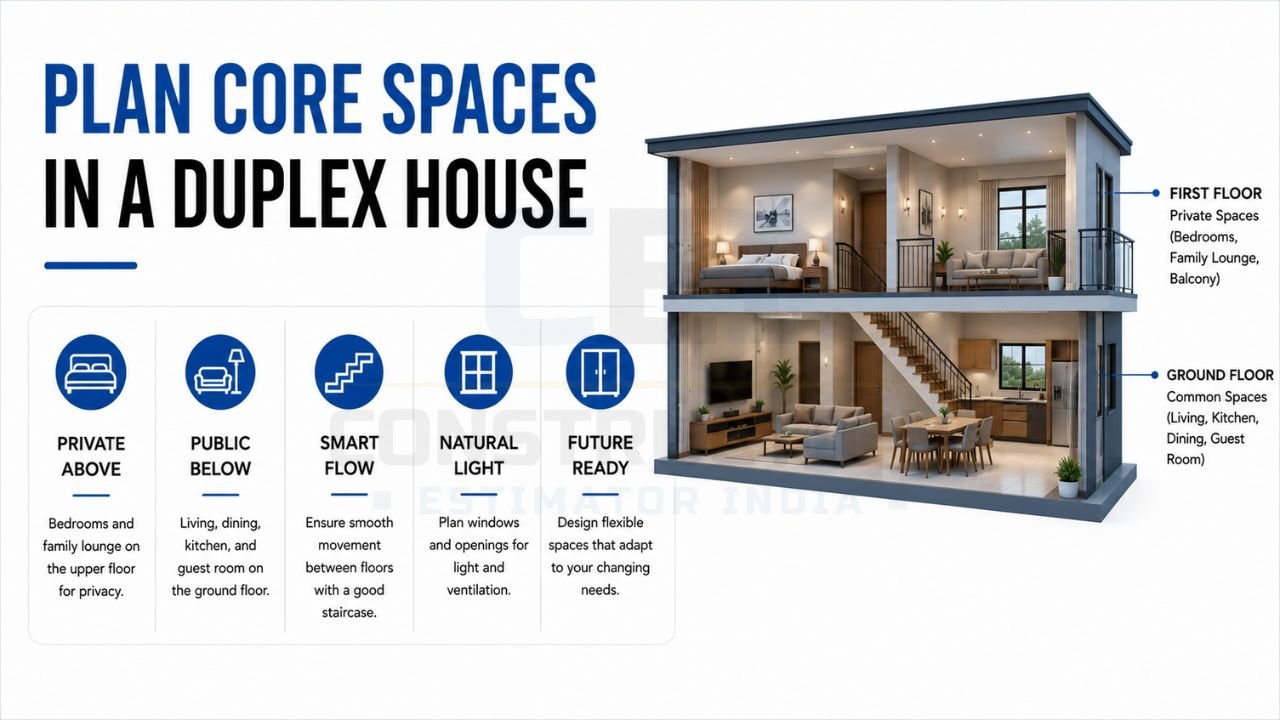
Ground Floor Planning: Parking, Entry, Living, Kitchen, One Bedroom
The ground floor is the “active” zone. It must accommodate car parking, a welcoming entrance foyer, a formal living room, a dining area, and the kitchen. Most Indian families also prefer at least one bedroom on the ground floor for elderly parents or guests.
This configuration handles all the foot traffic. Top architects and architecture firms often design the living and dining as semi-connected to create a sense of vastness. A major constraint is the parking space; in cities, you must prioritize a 12×15 ft area for an SUV. A common mistake is placing the kitchen in a way that smoke travels upward to the bedrooms.
👉 Get Expert Support for Duplex House Planning, Cost Estimation, and Construction.
First Floor Planning: Family Area, Bedrooms, Balconies
The first floor is the “private” zone. This is typically where the master bedroom and children’s bedrooms are located. A central family lounge or “pajama gallery” is a great addition, serving as a private space for the family to gather before sleep.
This layout ensures that even if there are guests downstairs, the family can relax upstairs undisturbed. Bedrooms should ideally have attached bathrooms and walk-in wardrobes if space permits. Balconies are non-negotiable in an Indian duplex; they provide a connection to the outdoors and help in cooling the house. Aim for at least one large balcony attached to the master bedroom. A constraint here is the plumbing; try to align the upstairs bathrooms with the ones downstairs to save on piping costs. A mistake is forgetting a small utility area or a place to dry clothes on the first floor. Construction Estimator India provides detailed material estimation to help you plan these features within budget.
Staircase Position and Vertical Circulation
The staircase is the most important architectural element in a duplex. It is not just a way to go up; it is a design statement. It can be a straight flight, U-shaped, or a grand spiral. Its position—whether central, in a corner, or near the entrance—defines the entire flow of the house.
If the staircase is central, it acts as a light well if you have a skylight above it. If it is in the corner, it saves living room space but might make the upstairs feel disconnected. You should choose a staircase width of at least 3.5 ft for easy movement of furniture. Use anti-skid tiles and provide sturdy handrails. A common mistake is making the “risers” too high (more than 7 inches), which makes climbing difficult for seniors. If you are planning a duplex house and want to understand the structural and cost impact of different staircase designs, reach out to Construction Estimator India.
Duplex Layout Options for Different Needs
Not all duplexes are the same. Your lifestyle and financial goals should dictate the layout.
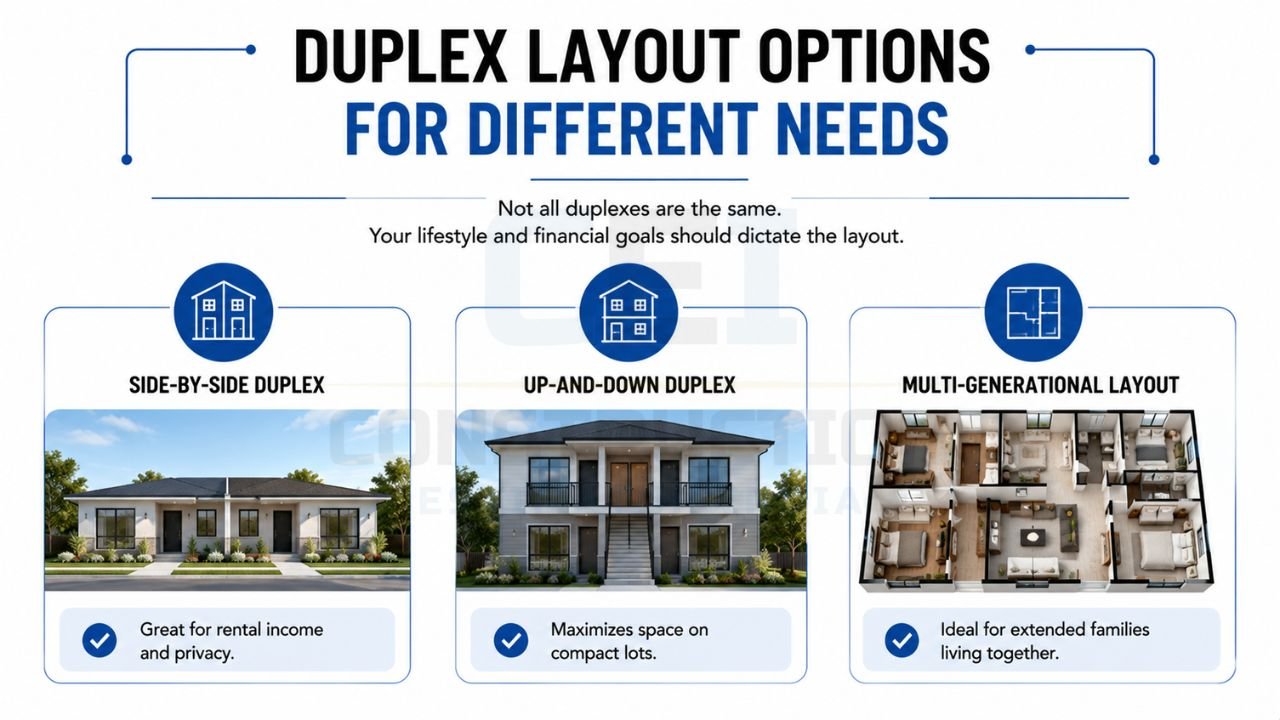
Family-Only Duplex (Single Unit, Internal Staircase)
This is the classic “villa” style. The entire house functions as one home. It usually features a double-height living room which creates a massive “wow” factor. The internal staircase becomes a focal point of the interior decor.
This matters for families who want a premium lifestyle and don’t intend to share their space. It offers the best internal communication and air circulation. Plan for a large, open-concept ground floor and use the space under the stairs for a creative storage unit or a small pooja room. The constraint is the higher cost of heating and cooling a large open volume. A common mistake is not considering the noise transfer from the living room to the upstairs bedrooms. Construction Estimator India helps you estimate the premium finishes required for such “Family-Only” luxury builds.
👉 Build Your Duplex Home with Smart Planning and Accurate Cost Estimates.
Semi-Independent Duplex With Rental Potential
In this layout, the ground floor and first floor can function as two independent units if needed. This is achieved by placing the staircase outside the main living area, usually in a separate stairwell.
This is a very practical choice for the Indian middle class. You can live on one floor and rent the other to help pay your home loan, or keep it for when your children grow up and need their own independent space. Ensure each floor has its own kitchen or at least a kitchenette provision. The constraint is that you lose the “grandeur” of an internal staircase. A mistake often made is not providing separate entries for the tenant, leading to a loss of privacy. Before you finalise your plans, Construction Estimator India can help you calculate the “Rental vs Luxury” cost trade-off.
Compact Duplex for Smaller Plots
On plots as small as 600-800 sq ft, a duplex is the only way to get a 2BHK or 3BHK. These designs use “vertical stacking” where the footprint is small but the house goes up to G+1 or G+2 levels.
This matters for urban dwellers in congested areas. Use light colors, large mirrors, and “floating” furniture to make the spaces feel larger. Opt for a spiral or a compact folded-plate staircase to save floor area. Avoid unnecessary walls; use glass partitions instead. A common mistake is over-furnishing these small spaces, making them feel claustrophobic. Reach out to Construction Estimator India on WhatsApp / Call +91 8630676890 to get a quantity takeoff for a compact duplex that maximizes every inch of your small plot.
Structural and Practical Considerations
A duplex is a heavier structure than a single-storey house. It requires a more robust “skeleton” of columns and beams to ensure safety for decades.
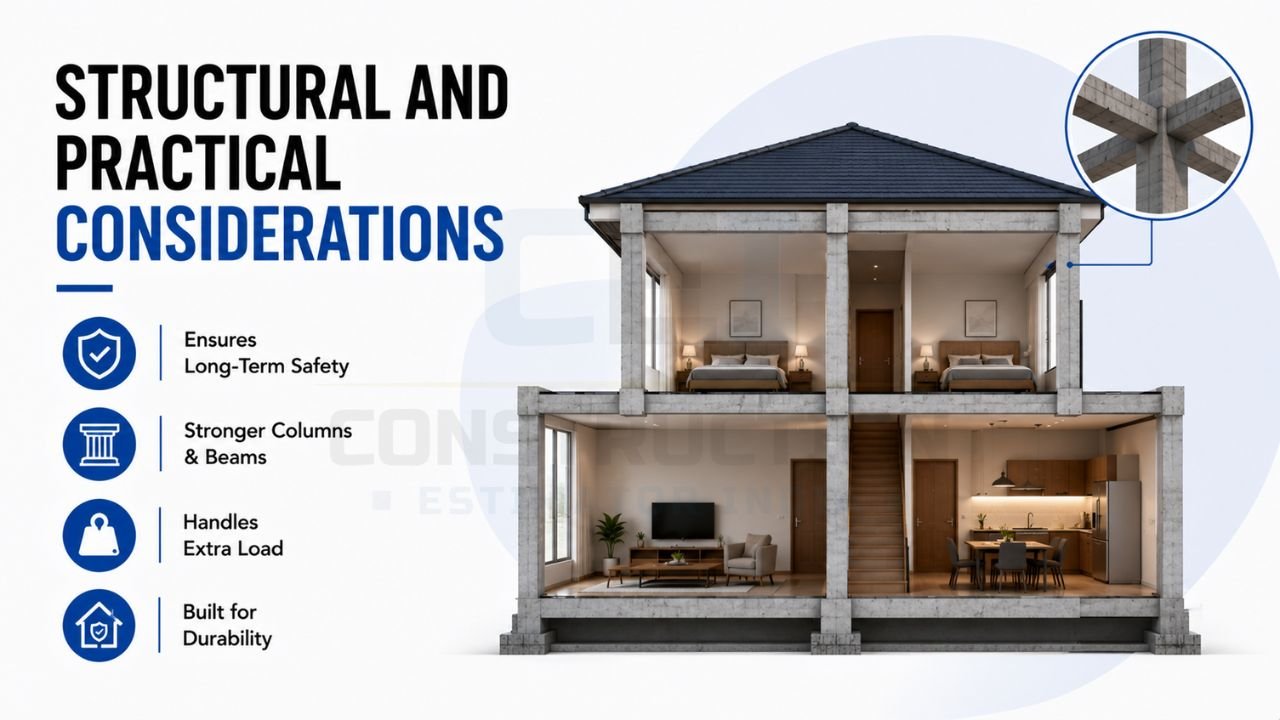
Column Grid, Beam Directions, and Openable Spaces
The “Column Grid” is the map of vertical concrete pillars that support the house. Knowing what is RCC construction proves why these columns must be perfectly aligned from the foundation to the roof of the first floor. Any misalignment can cause structural cracks. A common mistake is changing the room layout on the first floor so much that the walls don’t sit on the beams below, leading to structural stress.
👉 Need a Custom Duplex House Plan? Consult Our Construction Experts Today.
Natural Light, Ventilation, and Privacy in Duplex Design
In the hot and humid Indian climate, a house that breathes is a house that lives. A duplex can often feel hot on the upper floor if not planned correctly. Privacy is also a concern if your neighbors are very close.
Proper ventilation reduces electricity bills and prevents mold. Use the “Stack Effect” where hot air rises and escapes through vents or windows near the ceiling, drawing in cool air from below. Place larger windows on the North and East sides. For privacy, use “louvers” or frosted glass on the side-facing windows. A constraint in many Indian cities is the lack of “setback” space which limits window size. A mistake is having a beautiful glass facade that faces the West sun, turning your home into a greenhouse. You can share your design ideas with Construction Estimator India to see how adding specialized windows or insulation affects the construction budget.
Waterproofing, Noise, and Long-Term Maintenance
With two floors, the chances of plumbing leaks affecting the ceiling below are doubled. Good maintenance starts during construction. Knowing how to use white cement for waterproofing in specific joint areas is a baseline defense. A mistake people make is choosing cheap plumbing fixtures that leak within two years, destroying expensive false ceilings.
Cost Planning and Budgeting for a Duplex House
Building a duplex is generally 15-25% more expensive per square foot than a single-storey house of the same total area, due to additional RCC work and the cost of the staircase and extra bathrooms. Establishing firm baselines aligned with the Bureau of Indian Standards (BIS) ensures these costs remain predictable.
Major Cost Drivers for Duplex Construction
The biggest expenses in a duplex are the “Grey Structure” (foundation, columns, beams, slabs) where selecting specific foundation types dictates early costs. “Finishing” (flooring, painting, woodwork, electrical/plumbing) usually equals or exceeds the cost of the grey structure. A mistake is starting construction with only the “Grey Structure” budget, only to realize you don’t have enough for tiles and paint.
Approximate Thinking: Built-up Area vs Budget
In 2026, a mid-range duplex in an Indian city might cost between ₹2,200 to ₹3,500 per sq ft of built-up area. A 2000 sq ft duplex (1000 per floor) would thus require a budget of approximately ₹45 to ₹70 lakhs.
This “Per Sq Ft” thinking is a good starting point but can be misleading. You must be deeply aware of localized finishings, such as knowing exactly your plaster cost per square foot with material in India, to prevent “Quote” surprises from local building contractors.
How Construction Estimator India Helps With Quantity and Cost Estimation?
We bridge the gap between your dream and your bank balance. We take your architectural drawings and break them down into a “Bill of Quantities” (BOQ)—exactly how many bags of cement, tons of steel, and sq ft of tiles you need.
This transparency allows you to buy materials directly and save on contractor markups. It also prevents “Quantity Fraud” where a contractor might over-order materials for their other sites. We provide guidance on room layouts that are cost-effective to build. Before you sign any contract, contact Construction Estimator India on WhatsApp / Call +91 8630676890 for an independent verification of your construction budget.
Common Mistakes People Make With Duplex House Plans
Learning from the errors of others is the cheapest way to build a better home.
Poor Staircase Location and Space Eating
Many homeowners place the staircase right in the middle of a small living room, making the room unusable for furniture or TV placement. Or, they make the staircase so narrow that moving a bed or a wardrobe to the first floor becomes impossible.
A staircase should be integrated, not intrusive. If you have a small plot, consider placing the stairs along a side wall. This point matters for the “vibe” of your home—a bad staircase feels like an obstacle. Ensure there is enough “headroom” so tall people don’t hit their heads. A mistake is not planning for lighting on the stairs, which can lead to accidents at night.
Ignoring Parking and Entry Experience
In the rush to maximize the living room, people often leave only a tiny 8×10 ft space for parking, which is useless for modern cars. Similarly, the entrance might open directly into the dining area or the kitchen, which lacks “privacy for the residents.”
A good duplex house plan provides a clear “Transition Zone” from the outside to the inside. Even a small 4×4 ft foyer makes a huge difference. Ensure the parking area is sloped correctly so water doesn’t enter the house during monsoons. A mistake is placing the electrical meter board in the middle of the entrance wall, ruining the aesthetics.
Over-complicating Layout Without Matching Budget
Adding too many balconies, complex “G+2” vertical levels, or circular walls might look good in a magazine but they are incredibly expensive to build and maintain.
Simplicity is elegance. A clean, rectangular or L-shaped plan is easier to build, has fewer structural risks, and costs less. Action: focus on 2-3 “Hero Features” like a grand door or a nice balcony and keep the rest of the layout functional. A mistake is building a very complex exterior (elevation) that requires constant painting and cleaning due to dust accumulation. Construction Estimator India can help you estimate the cost of “Complex vs Simple” designs before you start.
Adapting Duplex Plans for Future Flexibility
Your needs today will not be your needs in 15 years. A smart home-builder plans for the “Future Version” of their family.
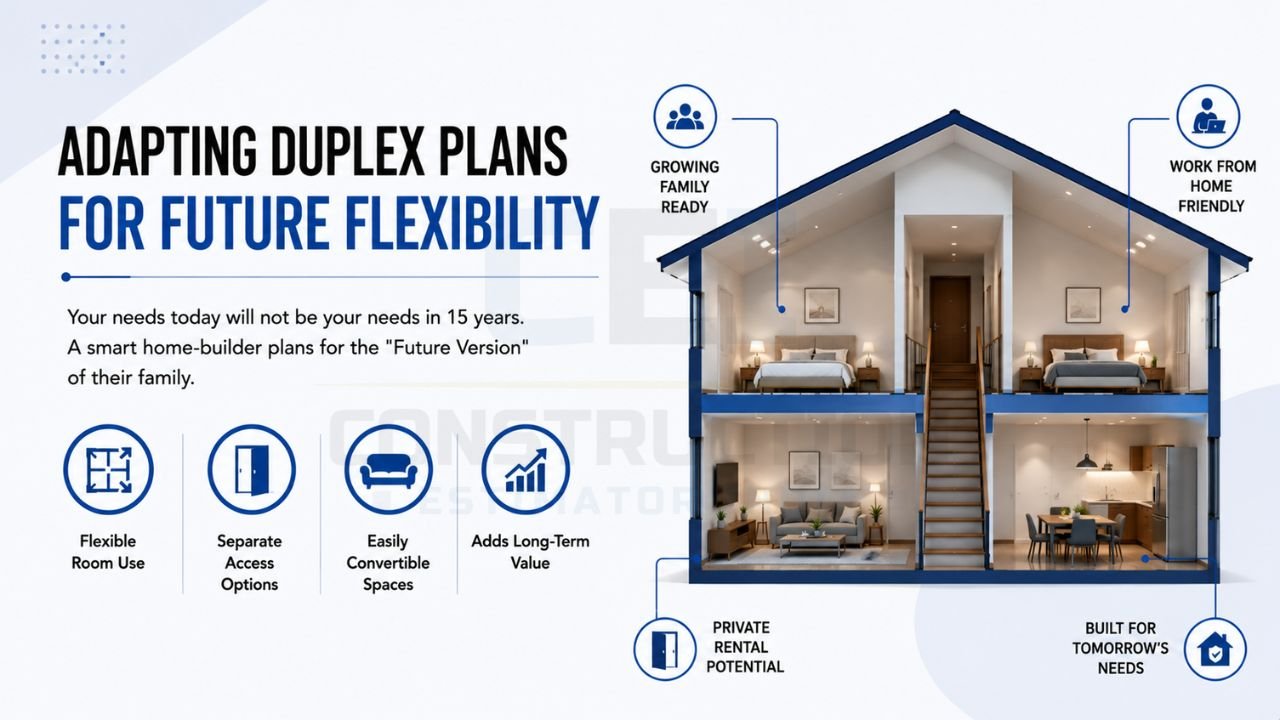
Planning for Elderly Parents and Children’s Future
As parents age, they will find it harder to climb stairs. Similarly, children will eventually need their own study desks and more privacy.
A ground-floor bedroom with a wide door (for wheelchair access if needed) and a grab-bar in the bathroom is a forward-thinking move. For children, ensure their rooms have enough power points for computers and gadgets. This matters because it saves you from expensive “Renovations” later. A common mistake is not providing a “Common Lounge” where the two generations can interact comfortably.
👉 Build a Modern, Functional, and Future-Ready Duplex Home with Confidence.
Considering Rental Conversion or Home Office
With the rise of “Work from Home,” a small 10×10 ft cabin on the first floor or the terrace is a great investment. Or, you might want to convert the upper floor into an Airbnb or a rental unit if your children move to another city for work.
Include provisions for a separate entrance and separate plumbing lines from day one. Even if you don’t use them now, “Plugging and Playing” later is much cheaper than breaking walls. A constraint is the local “Use of Land” rules; ensure your home office doesn’t violate residential bylaws. A mistake is not providing enough “Plug Points” or internet cabling (LAN) in every room. Construction Estimator India provides free guidance on how to plan these “Future-Ready” features within your current budget.
Structural Provisions for Possible Extra Floor (Where Allowed)
In many Indian towns, you can build up to G+2 or even G+3. If you only have the budget for G+1 now, you should still design the foundation for G+3.
This is the most cost-effective way to “Grow” your home. Ensure your columns have “Starter Bars” (exposed steel) on the roof and that your water tank and staircase are positioned so they don’t have to be moved later. This matters because a foundation cannot be “Strengthened” easily once the house is built. A common mistake is using a foundation designed only for G+1 and then trying to add a floor later, which leads to structural failure. You can reach out to Construction Estimator India on WhatsApp / Call +91 8630676890 for a “Phased Construction” cost plan.
FAQs: Duplex House Plans in India
Is a duplex house more expensive than a normal single-storey house?
Yes, typically 15-20% more expensive per sq ft. This is due to the cost of the intermediate RCC slab, the staircase, and the need for a stronger foundation to support two levels. However, it saves on land cost per sq ft of living area.
What plot size is ideal for a duplex house plan?
While you can build a duplex on even a 600 sq ft plot, a 30×40 ft (1200 sq ft) plot is considered ideal. It allows for 3-4 bedrooms, two living areas, and dedicated car parking without feeling cramped.
Can I design a duplex now but use one floor for rental later?
Absolutely. This is a “Semi-Independent Duplex.” You must ensure the staircase is accessible from the outside and that both floors have independent kitchen provisions and electricity meters.
How do I estimate the budget for my duplex house?
The best way is to get a professional BOQ. You can contact Construction Estimator India at +91 8630676890. We analyze your plan and give you a detailed breakdown of material and labor costs based on your city’s current rates.
When should I contact an estimator like Construction Estimator India in the planning process?
The ideal time is after your architect gives you the first “Draft Plan” but before you finalize the structural drawings. This allows you to adjust the design if the estimated cost is higher than your budget.
What are the Vastu essentials for a duplex house?
For a duplex, the staircase should ideally be in the South or West part of the house and should turn in a clockwise direction. The Master Bedroom is best in the Southwest, and the Kitchen in the Southeast.
Conclusion: Design Your Duplex House Plan With Comfort and Budget in Mind
Building a duplex house in India is a journey that requires balancing architectural dreams with engineering reality and financial constraints. By understanding what a duplex truly is, studying your plot’s limitations, and planning your core spaces with vertical circulation in mind, you can create a sanctuary that serves your family for generations. Remember that the “Staircase” and the “Column Grid” are the two pillars of a successful duplex; get them right, and the rest will follow.
Don’t let your home-building dream turn into a financial nightmare. Early estimation is the key to a stress-free construction experience. If you are planning a duplex house on your plot in India and want help estimating construction cost, quantities, and possible layout options, you can contact Construction Estimator India on WhatsApp / Call +91 8630676890 before you finalise your house plan. Our experts are ready to provide you with the precision and clarity you need to build a home that is as sturdy as it is beautiful.