
Imagine this: You’re building a boundary wall in your Uttarakhand village, or a retaining wall in Rajasthan’s hills. Months later, stones start bulging out, cracks spiderweb across the foundation, or worse—big chunks fall during monsoon rains. We’ve seen it too often at Construction Estimator India—all because of one simple mistake: the wrong cement mortar ratio. Don’t let your stone masonry fail. In this guide, we’ll give you the exact 2026-recommended ratios for random rubble, coursed rubble, ashlar, and more—straight from Indian standards—to build walls that last decades without cracks, leaks, or wasted cement.
Why Cement Mortar Ratio Is Even More Critical in Stone Masonry Than Brickwork?
Cement mortar is the “glue” that binds stones in masonry—cement paste mixed with sand and water, hardening to fill joints and transfer loads. In stone masonry, it’s even more critical than brickwork because:
- Larger, irregular joints: Random rubble or coursed rubble stones create bigger gaps (up to 50mm+), demanding richer mixes to avoid voids and honeycombing.
- Higher shear & compressive forces: Stone walls handle massive loads, especially in foundations, retaining walls, or seismic zones like Himachal or North-East India.
- Irregular stone shapes: Unlike uniform bricks, stones don’t align perfectly—wrong ratios lead to weak bonding and stones popping out over time.
- Exposure to elements: Rain, soil moisture, and freeze-thaw in hilly areas (Uttarakhand, Madhya Pradesh) demand weather-resistant mixes to prevent erosion and cracks.
- For high-moisture areas, choosing the best cement for exterior walls in India ensures the mortar doesn’t erode over time.
Get the ratio wrong, and your wall weakens fast. Done right, it ensures strong bonding, no cracks, and 50+ year durability.
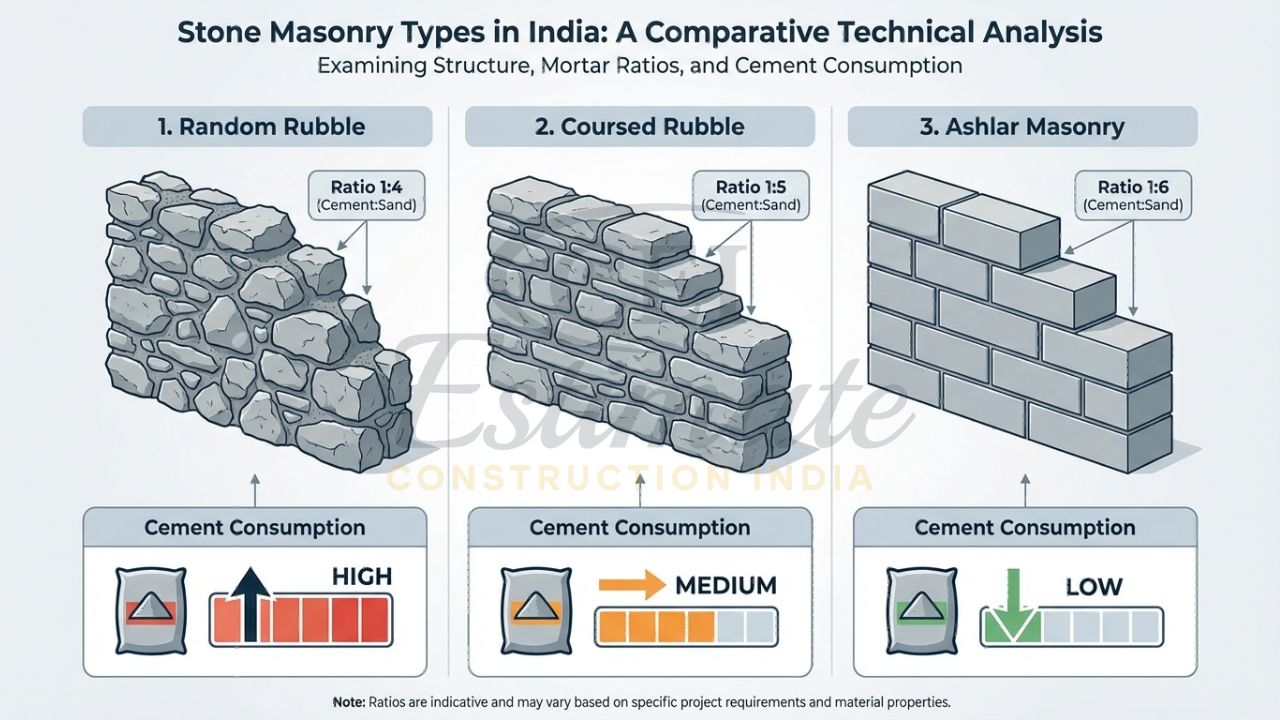
Recommended Cement Mortar Ratios for Stone Masonry in India 2026
Based on IS 2250:2023 updates and practical site experience across India, here are the most recommended cement:sand ratios (OPC 43/53 grade or PPC):
| Masonry Type | Recommended Ratio | Best For |
| 1:4 | Rich mix | Load-bearing foundations, retaining walls, seismic zones, random rubble, high-rainfall/hilly areas (Uttarakhand, Kerala) |
| 1:5 | Standard/popular | Normal stone walls, coursed rubble, boundary walls, non-critical load-bearing (Rajasthan, UP, Bihar) |
| 1:6 | Economical | Non-load-bearing partitions, low-height (<1.5m) boundary walls in dry areas (MP, Maharashtra plains) |
| 1:3 | Very rich (rare) | Heavy retaining walls or high-strength engineering structures |
Never use leaner than 1:6 for structural stone masonry—risks wall failure from poor bonding.
Water-cement ratio: Keep at 0.50–0.65 (25–32 litres water per 50kg cement bag). Slightly higher than brickwork due to stone absorption, but never exceed 0.70 to avoid weakness.
Choosing the Right Grade
For structural stone work, the grade of cement matters as much as the ratio. While many debate UltraTech Cement vs ACC Cement, both offer specialized products for masonry. For the “pointing” or finishing of stone walls, you can refer to our guide on which grade cement is best for plastering in India to achieve a crack-free finish.
Factors That Change the Ideal Cement:Sand Ratio on Stone Masonry Sites
No one-size-fits-all—adjust based on your site:
- Stone type: Hard granite/basalt? 1:5–1:6 ok. Soft sandstone/limestone? Go richer 1:4.
- Shape & size: Random rubble (irregular)? 1:4. Ashlar/coursed (neat)? 1:5–1:6.
- Sand quality: River sand? Standard ratios. M-sand? Add 5–10% more cement.
- Weather/exposure: High rainfall/hilly (Himachal, Odisha)? 1:4. Dry plains? 1:6.
- Wall type/height: Load-bearing >3m? 1:4. Low boundary <1.5m? 1:6.
- Admixtures: Plasticizers/superplasticizers let you use leaner mixes (e.g., 1:6 at 1:5 strength).
Test on-site and tweak for your project’s needs.
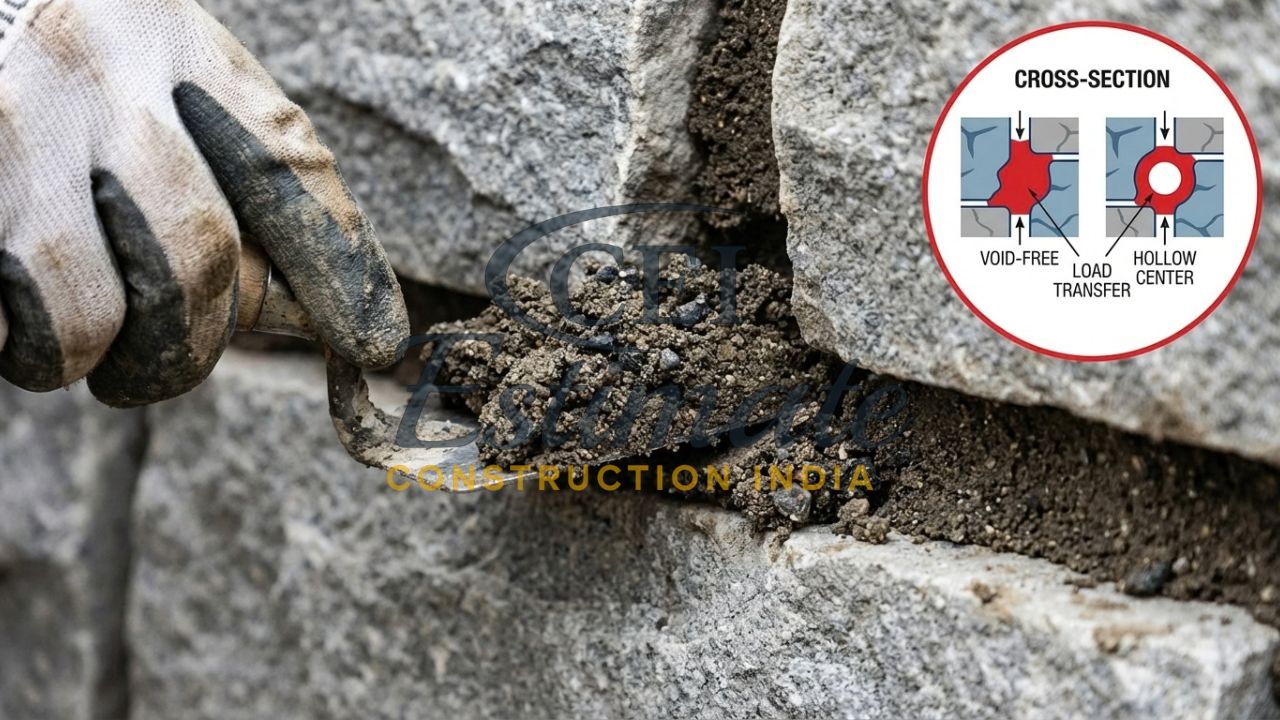
Step-by-Step – How to Prepare Perfect Cement Mortar for Stone Masonry
Follow this for void-free, crack-proof mortar:
- Measure accurately: Use weight (1 bag cement = 50kg; sand by volume or 1:5 = 250kg). Volume ok for small batches (1 bag: 5 headpans sand).
- Dry mix first: Spread cement + sand on plain ground/mixing platform. Mix thoroughly until uniform grey (5–7 mins).
- Add water gradually: Start with 0.50 w/c ratio (25L per bag). Mix to sticky consistency.
- Consistency test:
- Ball test: Form ball—holds shape, doesn’t slump.
- Hand feel: Sticky but not watery; sticks to trowel without dripping.
- Mix 5–10 mins more: Use shovels or machine. Soak stones 24hrs before laying.
- Pot life: Use within 1–1.5 hours—discard if it stiffens.
- Use only top-rated cement for homes in India to ensure the chemical bond is strong enough to hold heavy basalt or granite.
Estimation and Digital Precision
In 2026, guessing your material quantities leads to wasted cement and “dead capital.”
-
Consumption: A 450mm thick random rubble wall typically consumes 0.15–0.22 bags of cement per running meter.
-
Digital Takeoffs: For large retaining walls or commercial stone projects, utilizing the best construction takeoff software in India ensures your Bill of Quantities (BOQ) is accurate to the last bag.
Typical Cement & Sand Consumption for Stone Masonry Walls
Save money with these 2026 estimates (per m³ wall, including 25% joints/voids):
| Ratio | Cement (50kg bags/m³) | Sand (m³/m³ wall) |
| 1:4 | 0.30–0.40 | 0.12–0.16 |
| 1:5 | 0.24–0.30 | 0.10–0.13 |
| 1:6 | 0.20–0.25 | 0.09–0.11 |
- Per running metre (450mm thick random rubble wall, 1.5m high): 0.15–0.22 bags cement.
Common Mortar Mistakes in Stone Masonry & How to Avoid Them
Avoid these pitfalls—we’ve fixed enough failed walls:
- Too much water: Causes shrinkage cracks, weak joints. Fix: Stick to 0.50–0.65 w/c.
- Too lean mix (>1:6): Stones loosen over time. Fix: Use 1:4–1:6 only.
- Dirty water: Leads to efflorescence/weakness. Fix: Clean, potable water.
- Dry stones: Mortar dries fast, poor bond. Fix: Soak 24hrs.
- Unfilled voids: Honeycombing/leaks. Fix: Pack mortar thoroughly.
Warning: Poor mortar = structural failure risk!
Need Accurate Stone Masonry Material Estimate & Full House Budget?
At Construction Estimator India, we make it easy. WhatsApp +91 8630676890 now for your stone masonry estimate:
- Send wall dimensions, type (random rubble/coursed), location, height.
- We calculate exact cement bags, sand m³, BOQ using 2026 rates.
- Get full house masonry budget in 24hrs.
Perfect for Uttarakhand retaining walls or Bihar boundary projects!
Frequently Asked Questions (FAQ) – Stone Masonry Mortar
- Can I use 1:8 mortar for stone boundary walls?
No—too lean. Stick to 1:6 max for strength. - River sand vs M-sand for 1:5 mix?
River best; M-sand needs 1:4.5 adjustment. - What’s the best ratio for seismic zones like J&K?
1:4 always—extra strength. - How much water exactly per cement bag?
25–32L for 0.50–0.65 w/c. - Can plasticizers reduce cement in 1:6 mix?
Yes—up to 10% savings with same strength. - Soak stones how long before laying?
24 hours minimum. - Pot life of mortar in hot Rajasthan summer?
45–60 mins—mix small batches. - Consumption for 300mm coursed rubble wall?
0.18–0.25 bags/m³ at 1:5. - PPC or OPC for hilly moist areas?
PPC—better durability. - Fix cracks in old stone wall?
Rich 1:3 grout injection + repointing.
Build Strong Stone Walls That Last – Get Your Estimate Today!
You’ve got the ratios, tips, and warnings—now apply them for crack-free, durable stone masonry. Don’t guess quantities and waste cement.
WhatsApp +91 8630676890 RIGHT NOW for your stone masonry material quantity calculation, detailed BOQ, and full house construction budget from Construction Estimator India. Let’s build it right!