Imagine waking up to the news of a massive monsoon-induced landslide or a devastating short-circuit fire in an adjacent building block. For the residents of a high-rise society in Mumbai or Delhi, this isn’t just a nightmare; it’s a financial reality. A few years ago, a premium housing complex in North India suffered a catastrophic fire that damaged three floors and two elevators. The total repair cost exceeded ₹2 crores. Because the Resident Welfare Association (RWA) had allowed their insurance to lapse, every homeowner had to pay an emergency levy of nearly ₹3 lakhs. This financial shock caused deep resentment, legal battles, and stalled repairs for months.
In the rapidly evolving urban landscape of 2026, where vertical living is the norm, relying on luck is no longer a strategy. Managing a modern residential complex involves overseeing assets worth hundreds of crores. Without a robust safety net, a single disaster can wipe out the collective savings of hundreds of families. This guide aims to empower RWA members, facility managers, and residents with the knowledge to secure their homes effectively.
What is Building Insurance for Housing Societies in India?
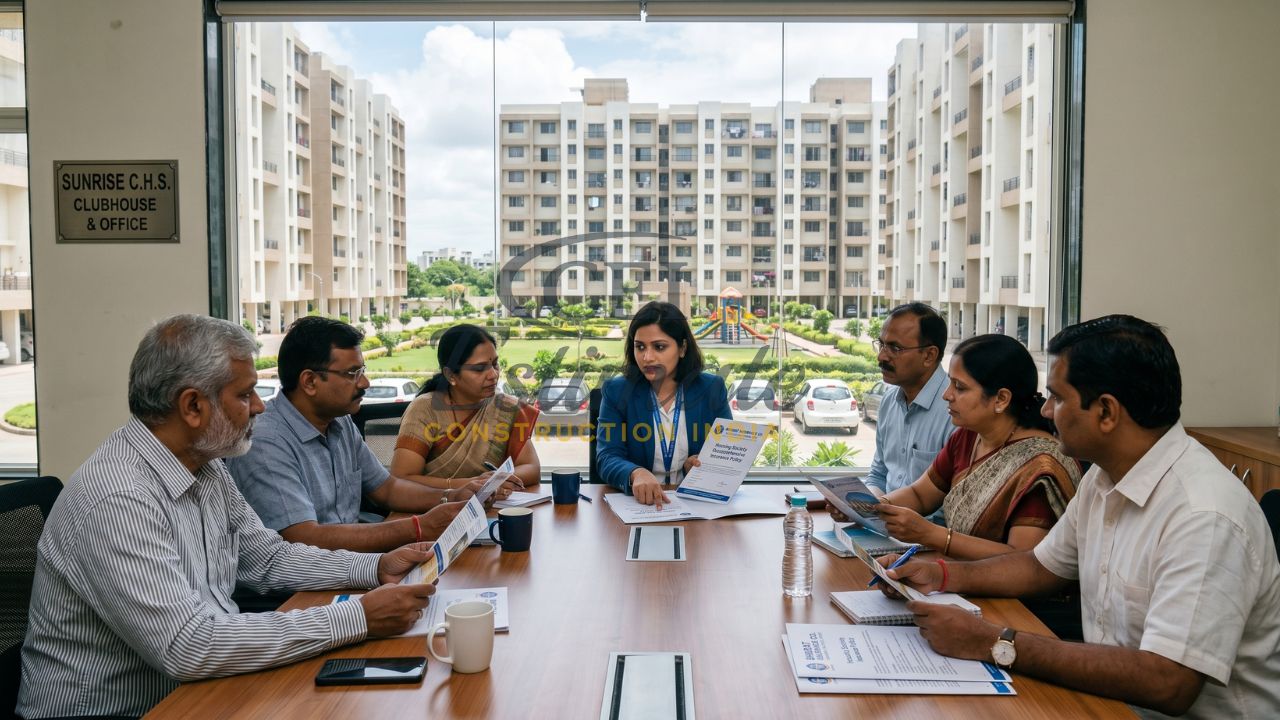
Building insurance for housing societies, often referred to as a “Master Policy,” is a specialized insurance product designed to protect the collective physical assets of an apartment complex. Unlike individual home insurance, which covers personal belongings and the interior of a specific flat, the society’s policy focuses on the “shell” and shared infrastructure.
When you invest in building insurance for housing society in India, you are essentially shielding the entire structural framework. This includes the foundation, the roof, the external walls, and all common areas that residents use daily. In the context of the housing society insurance in India market of 2026, these policies have become more comprehensive, covering modern risks like cyber-threats to smart building systems and environmental liability.
It is a common misconception that individual home insurance is enough. However, if a structural column in the basement is damaged due to an earthquake, your individual policy will not cover its repair. The master policy bridges this gap, ensuring that the structural integrity of the entire building remains intact without placing an undue financial burden on individual owners. Furthermore, many banks and regulatory bodies like RERA now mandate that societies maintain adequate insurance coverage to protect the interests of all stakeholders.
What Does Building Insurance Typically Cover?
A comprehensive apartment building insurance coverage plan is designed to be an all-encompassing shield. In 2026, insurers have expanded these categories to include “Allied Perils,” which go beyond simple fire protection.
The core coverage usually includes:
- Structure and Shell: The main physical framework of the building, from the basement to the terrace.
- Common Amenities: This covers shared spaces such as the clubhouse, gymnasium, swimming pool, and community halls.
- Essential Utilities: Critical infrastructure like lifts, transformers, diesel generators (DG sets), and central water pump systems.
- External Structures: Boundary walls, security cabins, and paved pathways.
Typical Coverage Table
| Coverage Category | Specific Items Included | Key Hazards Protected Against |
|---|---|---|
| Physical Structure | Foundation, columns, beams, roofs, external walls | Fire, Lightning, Earthquake, Landslide |
| Shared Infrastructure | Lifts, Transformers, Pumping Stations, STPs | Machinery Breakdown, Short-circuits, Floods |
| Recreational Areas | Gym, Clubhouse, Kids’ Play Area, Pool | Man-made hazards, Riots, Storm damage |
| Legal Liabilities | Third-party injuries on premises | Accidental falls, property damage to visitors |
Beyond these, modern policies often include “Add-on Covers” for terrorism, pipe bursts, and even loss of rent if a common area was used for revenue generation. Detailed information on these regulations can be found on the General Insurance Council of India website.
ICICI Lombard Housing Society Insurance – Review & Features
When evaluating the top players in the market, ICICI Lombard housing society insurance consistently stands out as a preferred choice for large-scale residential complexes in 2026. Their approach to common insurance for residential societies is built on transparency and digital efficiency.
One of the standout features of the ICICI Lombard policy is its focus on the “Reinstatement Value”. This ensures that in the event of a total loss, the society receives enough funds to reconstruct the building based on current market rates for labor and materials, rather than a depreciated market value.
Key Features Observed in 2026:
- Digital Ecosystem: Through their i-Partner portal, RWAs can manage claims, view policy documents, and add new assets instantly.
- High Claim Settlement: They maintain a claim settlement ratio consistently between 96% and 98%, which is crucial for building trust with society board members.
- Comprehensive Riders: The policy offers specific riders for “Machinery Breakdown,” which is vital for societies with high-end Schindler or Otis elevators.
- Liability Coverage: It includes third-party liability, protecting the society if a visitor or staff member is injured on the premises.
While the premiums might be slightly higher than some public sector insurers like New India Assurance, the ease of digital processing and the speed of surveyor visits often justify the cost for busy facility managers.
Insurance for Flooring Company in India – Why Contractors Also Need Protection
A common oversight for many housing societies is the risk introduced during renovation projects. If your society decides to upgrade the lobby with Italian marble or refurbish the gymnasium floor, you are likely hiring a specialized flooring contractor. This is where insurance for flooring company in India becomes relevant to the RWA.
As an office bearer, you must ensure that any contractor working within your premises has their own insurance. Flooring work involves heavy machinery, chemical adhesives, and the risk of damaging existing structures, such as breaking a concealed fire-fighting pipe while drilling.
If a contractor is uninsured, the financial liability for any damage they cause could fall back on the society’s master policy, potentially leading to higher premiums in the future. By requiring contractors to hold Public Liability Insurance and Workmen Compensation Insurance, the society ensures that any accidents involving the contractor’s staff or accidental damage to society property are covered by the contractor’s insurer. This “double layer” of protection is a hallmark of professional facility management in 2026.
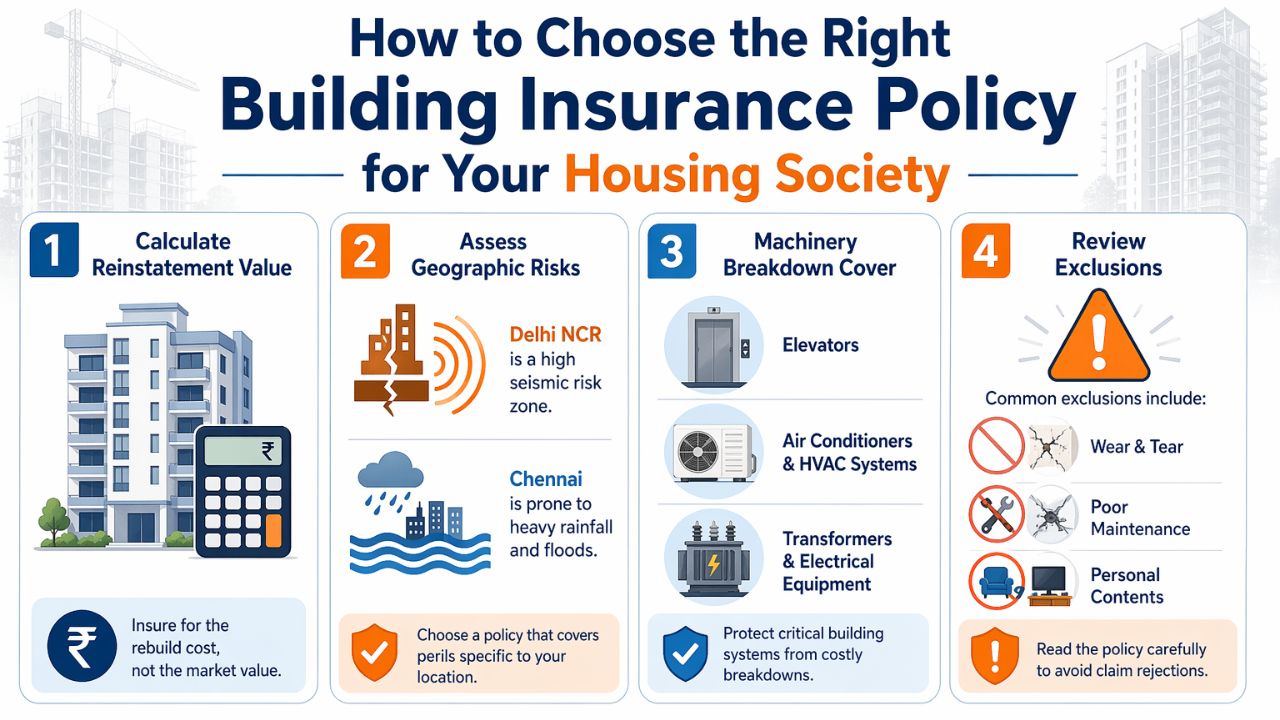
How to Choose the Right Building Insurance Policy for Your Housing Society?
Selecting a policy is not just about finding the lowest premium; it’s about ensuring the “Sum Insured” is accurate. Here are practical steps for RWA members:
1. Calculate Reinstatement Value
Do not base your insurance amount on the market price of the flats. Market price includes land value, which doesn’t disappear in a fire. Instead, calculate the cost to rebuild the structure from scratch using current 2026 material and labor rates. Consult a professional valuer to get this figure right.
2. Assess Geographic Risks
If your society is in a seismic zone (like Delhi-NCR) or a flood-prone area (like Chennai), ensure that earthquake and flood covers are not just “standard” but have adequate limits.
3. Check for Machinery Breakdown
Lifts, central air conditioning units, and large transformers are the lifeblood of modern societies. Standard fire insurance may not cover “internal” mechanical failure. Adding a machinery breakdown rider is essential.
4. Review Exclusions
No policy covers everything. Standard exclusions usually include:
- Normal wear and tear or gradual deterioration.
- Damage due to poor maintenance or design defects.
- Contents inside private apartments (which need individual home insurance).
For a deep dive into standard policy wording, the IRDAI official website provides comprehensive consumer education resources.
Cost of Building Insurance for Housing Societies in India
The cost of insurance in 2026 is surprisingly affordable when shared among all residents. Generally, the premium for a standard housing society policy ranges from 0.02% to 0.05% of the total reinstatement value annually.
Factors Affecting Insurance Premiums
| Factor | Impact on Premium | Why? |
|---|---|---|
| Age of Building | Higher for older buildings | Increased risk of structural failure or electrical fires. |
| Height of Structure | Higher for skyscrapers | Difficulty in firefighting and specialized lift systems. |
| Safety Equipment | Lower for societies with STPs/Sensors | Advanced fire-fighting systems and 24/7 security reduce risk. |
| Location | Higher in Seismic Zones IV and V | Greater statistical probability of natural disaster claims. |
On average, a homeowner might pay anywhere from ₹500 to ₹2,500 per year as their share of the society’s master policy premium, typically collected through monthly maintenance dues. This is a small price to pay for the peace of mind that a ₹500 crore asset is protected.
Frequently Asked Questions (FAQs)
- Does the society insurance cover my furniture and electronics inside my flat?
No. The society insurance covers the structure (walls, floors, roof) and common areas. For your personal belongings, you must purchase an individual “Home Content Insurance” policy. - Is it mandatory by law to have building insurance for housing societies?
While national laws vary, many state-specific RERA acts and co-operative society bylaws mandate that the developer or the RWA must maintain insurance for the building. Most banks also require it before approving home loans for the complex. - What is ‘Reinstatement Value’ in simple terms?
It is the current cost to reconstruct your building exactly as it was, using similar materials, without deducting for age or wear and tear. It ignores the price of the land. - Can we claim insurance for a leaking roof due to rain?
Generally, no. Insurance covers “sudden and accidental” damage, like a storm blowing the roof off. Gradual leakage due to poor waterproofing is considered a maintenance issue and is excluded. - How long does the claim settlement process take?
With digital-first insurers like HDFC Ergo or ICICI Lombard, survey reports are often filed within 48 hours. Depending on the scale of damage, final settlement can take between 15 to 45 days. - Does the policy cover the clubhouse and swimming pool?
Yes, most comprehensive master policies include common amenities like the gymnasium, clubhouse, and swimming pool as part of the total assets. - Who is responsible for paying the premium?
The RWA or the managing committee is responsible for paying the premium to the insurer. The cost is then distributed among the flat owners through the annual maintenance budget. - If a lift stops working due to old age, can we claim insurance?
No. Insurance does not cover “wear and tear” or “end of life” replacements. It only covers sudden breakdowns or damage caused by fire, short circuits, or natural disasters. - Can we add ‘Terrorism’ cover to our society insurance?
Yes, terrorism is usually an optional add-on cover that can be included for a small additional premium. - What documents are needed to buy a policy?
Usually, you need the building completion certificate, a professional valuation report of the structure, and details of the society’s registration.
Conclusion
Securing your housing society in 2026 is no longer just a “good to have” item on the RWA’s agenda; it is a fundamental responsibility. As we have seen, the risks—from natural calamities to mechanical failures—are far too high to ignore. A robust master policy ensures that your home remains a safe haven and a secure investment for the future.
Final Checklist for RWA Members:
- Audit your assets: Ensure all new additions (like solar panels or EV charging stations) are included in the policy.
- Choose Reinstatement Value: Always insure for the cost of rebuilding, not the market value.
- Verify Contractors: Always ensure any firm doing insurance for flooring company in India or other repairs is fully covered.
- Review annually: Don’t just auto-renew; check if construction costs in your city have risen and adjust your sum insured accordingly.
Protecting your collective home is the best investment you can make this year. Don’t wait for a disaster to realize the value of a good insurance policy. For expert advice and detailed estimates on construction costs to help you determine your sum insured, visit our resources at constructionestimatorindia.com.