Imagine you have just moved into a stunning high-rise apartment in Noida Sector 150. You spent months finalizing the deal for this premium 3BHK, which sits on land leased from the Greater Noida Industrial Development Authority (GNIDA). One evening, during a heavy monsoon storm, a massive leakage from the terrace causes structural damage to your ceiling and expensive wall paneling. When you approach the developer, they point you to the Resident Welfare Association (RWA), and the RWA points back to your personal insurance. This confusion is a nightmare for thousands of homeowners in Delhi-NCR, Meerut, and Ghaziabad. Understanding the nuances of building insurance for a leasehold flat is no longer just a legal formality; it is the only way to safeguard your hard-earned investment in a market dominated by leasehold land models.
In India, leasehold flats are increasingly common because development authorities like DDA, NOIDA, and YEIDA own the land and lease it to developers or individuals for 30 to 99 years. While you own the “structure” for the lease period, the land ownership remains with the lessor. This unique dynamic creates significant challenges in determining insurance responsibility. Does the lessor insure the land? Does the lessee insure the walls? To be clear, building insurance for a leasehold flat protects the physical structure of your apartment—including the foundation, walls, roofs, and permanent fixtures—even though you do not own the ground beneath it. This guide clarifies the division of responsibility between landlord and lessee, explains the mandatory IRDAI Bharat Griha Raksha standards, and provides construction estimators with the data needed for accurate project costing. By the end of this article, you will know exactly how to protect your leasehold asset against the unpredictable perils of 2026.
What is a Leasehold Flat and How Does It Affect Insurance?
A leasehold property in India means you have the right to occupy and use the building for a fixed duration, usually ranging from 30 to 99 years. Unlike freehold property, where you own both the land and the building perpetually, a leasehold arrangement means the land title stays with the lessor (often a government body or a private developer), while you hold the rights to the built structure.
This distinction is critical for insurance. Many people mistakenly believe that because they don’t own the land, they don’t need to insure the building. However, from an insurance perspective, you have an “insurable interest” in the structure you paid for. Even if the lease has 50 years left, a fire or an earthquake could destroy your home, leaving you with a massive financial loss while still being liable for lease rent. In 2026, as cities like Meerut and Ghaziabad expand through large-scale leasehold projects, recognizing that the “structure” is a separate insurable asset from the “land” is the first step in comprehensive risk management.
What is Building Insurance for a Leasehold Flat?
Building insurance for a leasehold flat is a specific policy that covers the “shell” of your apartment and the permanent fixtures within it. If you were to turn your apartment upside down and shake it, everything that remains attached—the walls, the floors, the plumbing, and the built-in kitchen cabinets—is covered by this insurance.
Unlike freehold insurance, which might cover the entire plot, leasehold insurance focuses purely on the reinstatement value of the flat itself. It ensures that if a disaster occurs, you have the funds to rebuild the flat to its original condition at 2026 material and labor rates. It is fundamentally different from contents insurance, which only looks at your furniture and clothes. For flat owners in NCR, this policy is the primary shield against structural failures and “Fire and Special Perils” that are common in high-density residential zones.
Who Should Buy Building Insurance for a Leasehold Flat – Lessor or Lessee?
In the Indian real estate landscape, the responsibility for insurance usually falls on the party that stands to lose the most financially if the structure is damaged.
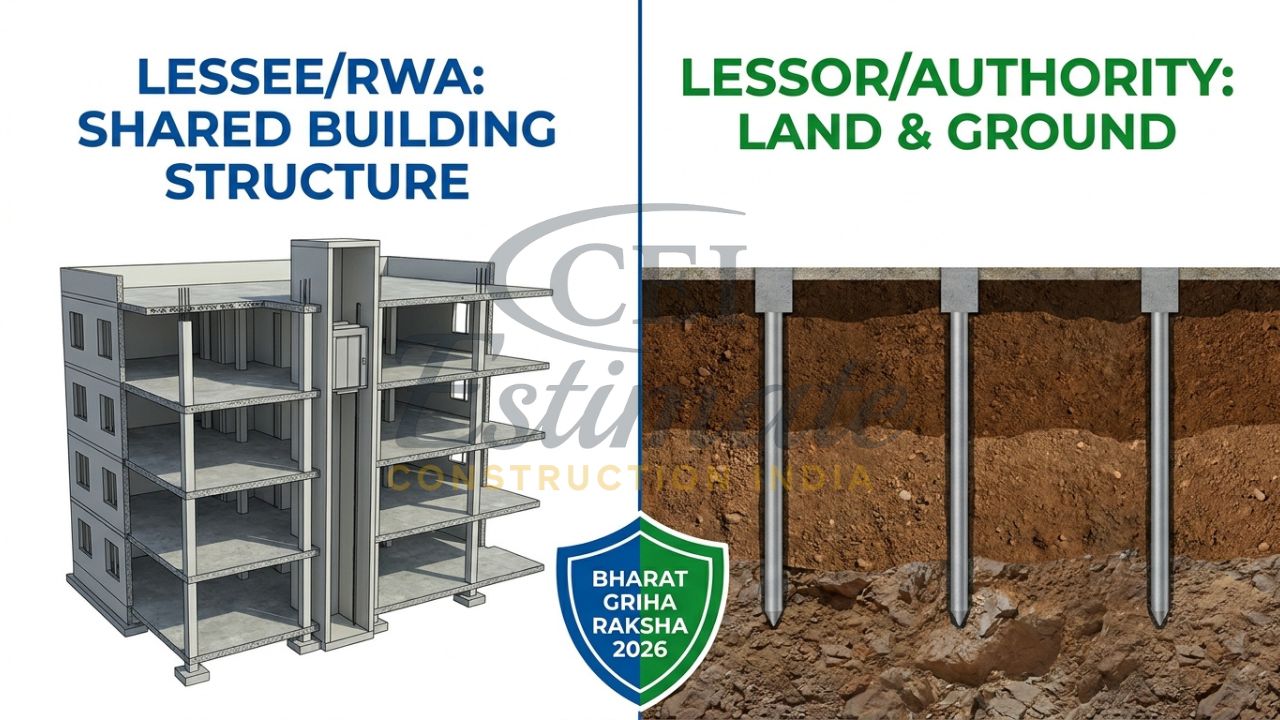
- The Lessee’s Responsibility: In most modern lease deeds in Uttar Pradesh and Delhi, the lessee (the flat owner) is responsible for insuring the interior structure and permanent fixtures of their specific unit.
- The RWA’s Role: For multi-story societies, the Resident Welfare Association (RWA) often takes a master policy for the entire building shell, including common areas like elevators, staircases, and the external facade.
- The Lessor’s Role: The landlord or development authority typically does not provide insurance for your individual flat. They may only insure their own administrative buildings or land-related liabilities.
Always check your lease deed. Some older deeds might have specific clauses requiring you to get permission from the lessor before choosing an insurer, though this is rare in 2026. In most cases, if you have a home loan, the bank will treat you, the lessee, as the primary responsible party for securing building insurance for a leasehold flat.
What Does Building Insurance for a Leasehold Flat Cover?
Under the 2026 IRDAI Bharat Griha Raksha guidelines, the coverage for building insurance for leasehold property is quite comprehensive. It protects your investment against a wide array of “Insured Perils.”
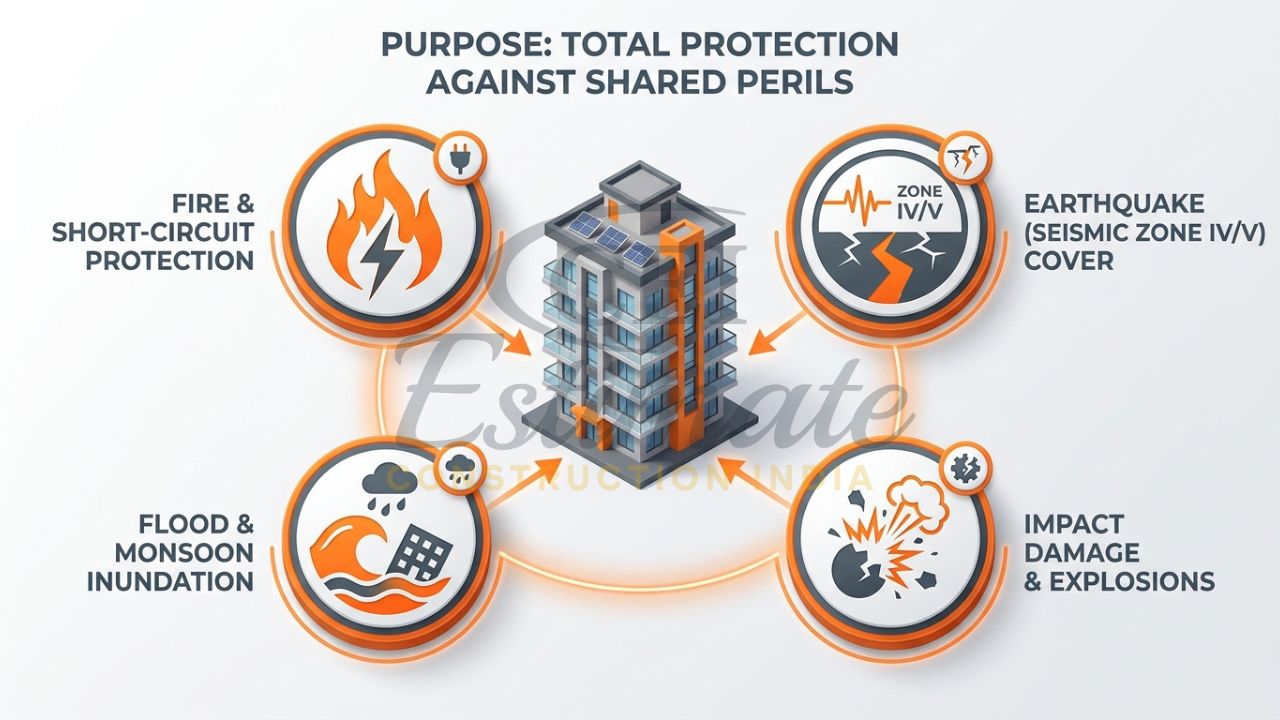
- Natural Calamities: This is essential for Northern India. It covers damage from earthquakes (Zone IV/V risks), floods, storms, cyclones, and landslides.
- Fire and Explosions: Includes accidental fires and gas cylinder explosions, which are major risks in high-rise apartments.
- Man-made Perils: Coverage for riots, strikes, and malicious damage to the structure.
- Impact Damage: If a vehicle crashes into a boundary wall or a falling tree damages the balcony.
- Utility Failures: Damage caused by the bursting of water tanks or overflowing pipes (though the repair of the pipe itself is usually excluded).
- Permanent Fixtures: Standard policies in 2026 include coverage for built-in wardrobes, modular kitchens, bathroom fittings, and concealed wiring.
- Common Areas: If the policy is taken by an RWA, it covers shared spaces like corridors, terraces, and the foundation of the entire complex.
Additional riders for leasehold flats can include “Loss of Rent” (if the flat becomes uninhabitable) and “Debris Removal” (the cost of clearing the site after a fire).
Building Insurance vs Contents Insurance for Leasehold Flats
It is vital to understand that insuring your walls does not automatically insure your sofa. The following table highlights the key differences for leasehold property owners in India.
| Feature | Building Insurance (Structure) | Contents Insurance (Possessions) |
|---|---|---|
| Primary Scope | Walls, roof, foundation, wiring, plumbing. | Furniture, electronics, jewelry, clothes. |
| Sum Insured Basis | Reconstruction cost of the flat. | Market value or replacement cost. |
| Who Should Buy? | Primarily the Flat Owner (Lessee). | Both Owners and Tenants. |
| Key Inclusions | Tiles, built-in cabinets, sanitary ware. | ACs, TVs, Laptops, Furniture. |
| Theft Protection | Covers damage caused during a break-in. | Covers the actual stolen items. |
| 2026 Premium | Lower (Approx. ₹2,000–₹4,000 for ₹50L). | Higher (Depends on the value of items). |
Is Building Insurance Mandatory for Leasehold Flats?
While the Government of India does not legally mandate insurance for every private flat, it becomes practically mandatory in several scenarios:
- Home Loans: If you are financing your flat through banks like SBI, HDFC, or ICICI, they will insist on a building insurance policy. Since the leasehold flat is the collateral, the bank wants to ensure its value is protected.
- RERA Compliance: Under the Real Estate (Regulation and Development) Act, developers are often required to maintain insurance for the building until it is handed over to the RWA.
- RWA Bylaws: Many modern societies in Noida and Ghaziabad make it mandatory for every owner to contribute to a master building insurance policy as part of their maintenance dues.
Even if not mandatory, it is highly recommended. In 2026, the small cost of a premium is a tiny price to pay to protect a multi-lakh investment from natural disasters.
How Much Does Building Insurance for a Leasehold Flat Cost in India?
In 2026, insurance for a leasehold flat remains surprisingly affordable. The premium is calculated based on the “Reinstatement Value”—the cost to rebuild the flat using 2026 material and labor rates—rather than the market value of the property.
- Average Premium Range: Typically 0.15% to 0.40% of the sum insured annually.
- Sample Cost for 2BHK (Meerut): For a 1,000 sq. ft. flat with a reconstruction cost of ₹2,500/sq. ft. (Total ₹25 Lakhs), the premium would be approximately ₹3,500 to ₹6,500 per year.
- Sample Cost for 3BHK (Noida): For a 1,500 sq. ft. flat with a reconstruction cost of ₹3,000/sq. ft. (Total ₹45 Lakhs), the premium would range from ₹7,000 to ₹12,000 per year, depending on add-ons.
Factors such as the age of the building, the floor level (higher floors may have different risk profiles), and the proximity to flood-prone areas in Uttar Pradesh will influence the final quote.
Step-by-Step Guide to Buying Building Insurance for a Leasehold Flat
- Check Your Lease Deed: Look for specific insurance requirements or clauses that mention who is responsible for the structure.
- Calculate Sum Insured: Use the formula: Total Carpet Area × Current Construction Rate per Sq. Ft. Do not use the market price you paid.
- Contact Your RWA: Check if they already have a master policy for the building shell. If they do, you may only need “Top-up” or “Contents” insurance.
- Compare Quotes: Use platforms like PolicyBazaar or contact insurers like New India Assurance, HDFC Ergo, or ICICI Lombard directly for Bharat Griha Raksha plans.
- Submit Documents: You will typically need the allotment letter, lease deed, completion certificate, and photographs of the flat.
Claims Process for Leasehold Flat Building Insurance
If a disaster strikes your leasehold flat, follow these steps for a smooth settlement:
- Immediate Intimation: Inform the insurer within 24–48 hours.
- Surveyor Visit: An IRDAI-licensed surveyor will assess the damage.
- Coordinate with RWA: If the damage affects the common structure (like the external walls), coordinate with the RWA as they may need to file a parallel claim on the master policy.
- Documentation: Provide the claim form, repair estimates from a professional contractor, and proof of the incident (like a fire department report).
Honesty is vital. Do not misrepresent “wear and tear” as “storm damage,” as this is the most common reason for claim rejection in 2026.
Why Estimators and Buyers Must Factor Building Insurance in Leasehold Projects?
At Construction Estimator India, we emphasize that insurance is a “soft cost” that should never be ignored in a project budget. For estimators preparing a Bill of Quantities (BOQ) for a leasehold renovation or a new build, including the insurance premium ensures a realistic financial plan for the client.
For buyers in Delhi-NCR, factoring in the cost of building insurance for a leasehold flat during the purchase phase prevents future budget shocks. It also demonstrates a professional approach to property management, ensuring that the asset remains bankable and protected throughout the lease term. Whether you are an individual builder in Meerut or a large-scale developer, accurate insurance valuation is a pillar of long-term project success.
Conclusion
Understanding building insurance for a leasehold flat is the difference between protecting a house and protecting your entire financial future. While the land might belong to a development authority, the structure and the life you build inside it are yours to safeguard. By recognizing your responsibilities as a lessee and opting for a robust Bharat Griha Raksha policy, you ensure that your investment in cities like Noida, Meerut, and Ghaziabad remains secure against the unpredictable perils of nature and man.
Don’t leave your leasehold property to chance. Review your lease deed today and ensure your sum insured reflects the actual 2026 reconstruction costs. For accurate cost estimation, professional BOQs, and insurance valuation services, contact Construction Estimator India.
- Contact us for a Professional BOQ: Person
- WhatsApp for Estimation Help: +91 8630676890
- Read our guide on “What is Home Structure Building Insurance?” to learn more about protecting your property’s shell.
FAQ – Building Insurance for Leasehold Flats in India
What is building insurance for a leasehold flat in India?
It is a policy that covers the physical structure and permanent fixtures of a flat (walls, floors, plumbing) against perils like fire and earthquake, specifically for properties where the land is on lease.
Who is responsible for insurance in a leasehold flat — lessee or lessor?
Usually, the lessee (flat owner) is responsible for the flat’s internal structure and fixtures, while the RWA handles the building’s shell. The lessor rarely insures individual flats.
Can I buy building insurance if my flat is on leasehold land?
Yes. You have an insurable interest in the built structure you purchased or constructed, regardless of land ownership.
How much does building insurance cost for a leasehold flat?
In 2026, premiums range from 0.15% to 0.40% of the reconstruction cost. A ₹50 Lakh flat would cost roughly ₹7,000–₹12,000 per year.
Does Bharat Griha Raksha cover leasehold apartments?
Yes, Bharat Griha Raksha is the standard IRDAI policy that covers both freehold and leasehold residential structures and/or contents.
What should I check in the lease deed regarding insurance?
Check for any mandatory insurance requirements, specific perils you must cover, or clauses regarding the lessor’s involvement in a claim.
Is building insurance mandatory for leasehold properties?
It is not legally mandatory for all, but banks require it for home loans, and RERA/RWA rules often make it a practical necessity.
How is sum insured calculated for a leasehold flat?
It is calculated as: Total Carpet Area × Current Construction Cost per Sq. Ft. It does not include the land value.
What happens to insurance if the lease expires?
If the lease expires and is not renewed, you lose insurable interest in the property, and the policy typically becomes void.
How to include building insurance cost when buying or estimating a leasehold flat?
Estimators should include the annual premium as a line item in the BOQ under “Operating/Soft Costs” to provide a full picture of the project’s financial liability.