
Imagine you are standing in a newly leased 2,500 sq. ft. office space in Noida or a high-end villa site in Mumbai. The client is excited, the designs are ready, but the pressure is on you to deliver a quote that is both competitive and profitable. In the fast-paced Indian construction market of 2026, many contractors and interior designers still rely on rough estimates or messy notebooks to price their services. This often leads to “missing items,” under-quoting, and eventually, awkward client disputes or lost profits.

 Download Plumbing, BOQ & Electrical Templates for Just ₹149 – Save ₹1,350 Today!
A well-structured BOQ format for construction projects is not just a price list; it is your professional insurance policy. Whether you are a civil contractor, an interior fit-out expert, or an MEP consultant, the accuracy of your documentation determines whether you win a prestigious tender or face a financial disaster. Winning a bid isn’t just about being the cheapest; it’s about being the most transparent and professional partner for your client. In this guide, we will walk through the essential components of creating airtight BOQ documents that safeguard your margins and build lasting trust.
What is a BOQ and Why Different Formats Are Needed?
A Bill of Quantities (BOQ) is the financial heart and DNA of any construction or renovation project. It is a structured, itemized list that details every material, labor task, and overhead cost required to bring a design to life. In the Indian context, it serves as a standardized checklist ensuring that no essential component—from the foundation concrete to the final coat of PU polish—is overlooked.
Get Complete Construction Estimation Excel Bundle – Limited Time Offer!
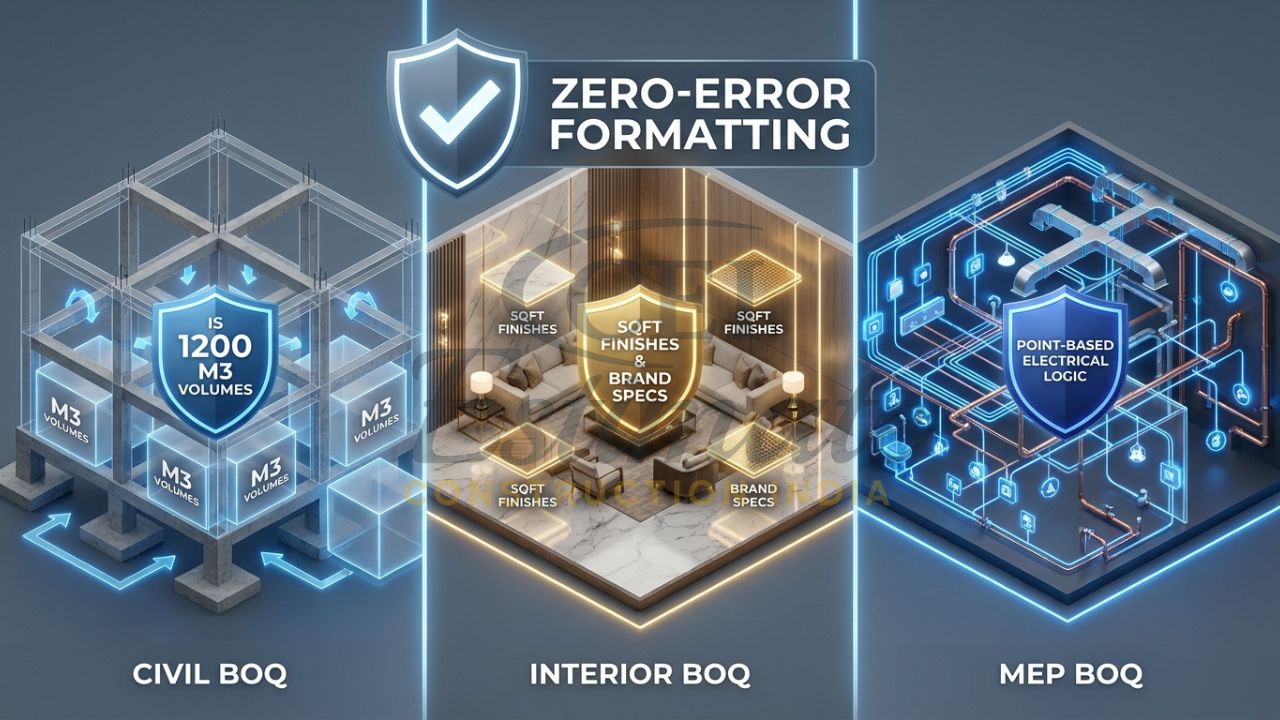
Different sectors of construction require specialized formats because their measurement units and focus areas vary significantly. For instance, civil work is often measured in cubic meters for concrete, while interior work revolves around square feet for finishes and running feet for modular cabinetry. Using a generic format for MEP (Mechanical, Electrical, and Plumbing) work is a common mistake; electrical work is point-based or meter-based, and failing to use a sector-specific layout can lead to massive calculation errors. Having the right format ensures that your technical specifications match the project’s unique requirements, making your proposal audit-proof and clear for all stakeholders.
Professional BOQ Format for Construction Projects
For any large-scale project, from residential towers to commercial complexes, a professional BOQ format is the backbone of cost control. It organizes hundreds of work items into logical categories, allowing for easy updates and comparison.
A standard professional format must follow Indian standard measurement rules, specifically IS 1200, to remain dispute-proof. The document should always start with a clear Header Section containing the project name, client details, and the preparation date Date. Below the header, the work is typically divided into categories like Preliminaries, Civil Work, and External Development.
Table 1: Standard Professional BOQ Structure
| Item Number | Description of Work | Unit | Quantity | Rate (₹) | Amount (₹) | GST (%) | Total Cost |
|---|---|---|---|---|---|---|---|
| 1.01 | Excavation in soil for foundation… | Cum | 150.00 | 450.00 | 67,500.00 | 18% | 79,650.00 |
| 2.01 | PCC (1:4:8) for foundation base… | Cum | 12.00 | 5,500.00 | 66,000.00 | 18% | 77,880.00 |
| 3.01 | 12mm thick cement plaster (1:4)… | Sqm | 450.00 | 185.00 | 83,250.00 | 18% | 98,235.00 |
Advanced professional formats also include a Grand Summary page that pulls subtotals from various trade sheets. This structure allows you to account for volatile material prices, such as steel and cement, which should be checked monthly to maintain accuracy.
BOQ Format for Interior Works
Interior works are uniquely challenging because they depend heavily on aesthetics, brand-specific materials, and diverse labor trades. When you prepare an estimate for a luxury residence or a corporate fit-out, you need the best BOQ sample Excel for interior works that handles items like modular furniture, false ceilings, and specialized wall finishes.
A professional interior BOQ often uses a room-wise or area-wise breakup. This is much easier for clients to understand—they can see exactly what they are paying for in the “Living Room” versus the “Master Bedroom”. Instead of a lump-sum entry for painting, a professional format breaks it down into surface preparation, primer, and specific finish coats like Luxury Emulsion or Texture.
Pro-Tips for Interior BOQs:
- Brand Specifications: Always specify brands like Hettich, Hafele, or Asian Paints to avoid disputes when the client expects premium quality.
- Wastage Factor: Include a 5-10% wastage allowance for expensive materials like Italian marble, veneers, and tiles.
- Material Takeoff: Use supporting sheets to calculate the exact number of handles, hinges, and plywood sheets needed.
Create Accurate BOQs, Plumbing & Electrical Estimates in Minutes!
BOQ Format for Civil Works
The civil BOQ focuses on the structural skeleton of the building. It prioritizes structural integrity and durability over surface aesthetics. This document is essential for government and private tenders where compliance with PWD or CPWD standards is mandatory.
Key categories in a civil BOQ include:
- Earthwork: Excavation, backfilling, and site leveling.
- Concrete Work: RCC (Reinforced Cement Concrete) for columns, beams, and slabs.
- Masonry: Brickwork or blockwork using specific mortar ratios.
- Steelwork: Reinforcement bars measured in Kilograms or Metric Tons.
- External Works: Roadwork, drainage systems, and boundary walls.
For civil projects, the rates often include city-wise multipliers to account for regional price differences in aggregates and sand. Precision in measurement (Volume = L x B x H) ensures that your “Amount” is backed by solid data rather than a guess.
BOQ Format for MEP Works (Electrical, Plumbing & HVAC)
MEP services often represent the most expensive part of a modern fit-out, especially in commercial office projects.
Electrical BOQ: This should be point-based or meter-based. It must detail specific wire grades (e.g., 1.5 sq.mm FRLS), conduit diameters, and smart-home components. Using a specialized electrical takeoff sheet helps calculate the exact length of wiring required, reducing material “disappearance” on-site.
Plumbing BOQ: Involves listing every fixture, pipe diameter, and valve. Contractors often face losses due to missing minor items like elbow joints or traps; a comprehensive list prevents these shortages. Always include a line item for Pressure Testing to ensure quality.
HVAC & Fire Safety: Particularly critical for office interiors, including data cabling, smoke detectors, and centralized AC ducting. These items require high-level technical descriptions and often come with GST-inclusive pricing for modular units.
Table 2: Comparison – Interior vs. Civil vs. MEP BOQ
| Feature | Interior Works BOQ | Civil Works BOQ | MEP (Elec/Plumb) BOQ |
|---|---|---|---|
| Primary Focus | Aesthetics & Brand Finishes | Structure & Durability | Functionality & Utilities |
| Common Units | Sqft, Rft, Nos | Cum, Kg, Sqm | Points, Rmt, Nos |
| Key Risk | Material Wastage & Finishes | Soil Conditions & Pricing | Missing Fixtures & Leaks |
| Timeline | 3 – 6 Months | 12 – 24+ Months | Parallel to Civil/Interior |
| Typical Margin | 15% – 25% | 10% – 15% | 12% – 18% |
How to Make BOQ in Excel – Step-by-Step Guide?
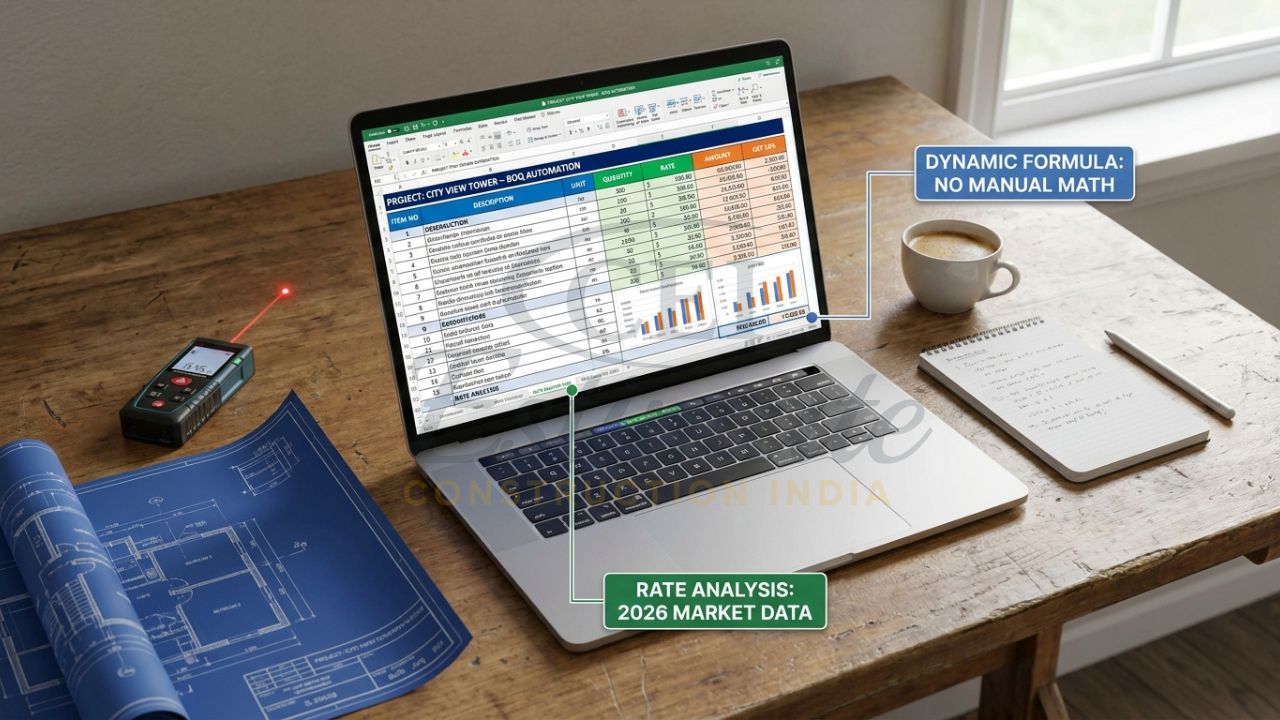
Excel is the gold standard for Indian contractors because of its flexibility and powerful formula capabilities. If you want to master how to make BOQ in Excel, follow these steps:
Win More Projects with Professional Excel Templates!
- Set Up the Workbook: Create separate tabs for “Data Input,” “Rate Analysis,” and the “Final BOQ Summary”.
- Define Header Columns: Use the standard columns: Item No, Description, Unit, Quantity, Rate, and Amount.
- Input Technical Specifications: Refer to site drawings for detailed descriptions (e.g., “35mm thick BWP Grade Flush Door”).
- Use Dynamic Formulas: Never hard-code final totals. Use formulas like =Quantity * Rate for line items and =SUM() for category totals.
- Automate Taxes: Create a dedicated GST dashboard to calculate CGST and SGST (typically 18%) automatically.
- Lock Calculation Cells: Highlight “Input Cells” in a different color (like yellow) and lock “Formula Cells” to prevent accidental errors.
Using a bill of quantities format in Excel significantly reduces manual math mistakes, which is a common cause of profit erosion.
How to Make BOQ for Tender – Best Practices?
When you learn how to make BOQ for tender, you are learning how to win. A tender document must be clear, professional, and compliant with the client’s standards.
- Preamble & Notes: Always include a section for assumptions, such as “Rates are inclusive of scaffolding up to 3 meters”.
- Detailed Takeoff: Never guess quantities. Perform a rigorous takeoff from AutoCAD or PDF drawings to ensure your bid is realistic.
- Rate Analysis: Your rates should reflect current 2026 market costs plus your desired profit margin (10-15% for civil, higher for interior).
- Inclusions & Exclusions: Clearly state if appliances or decorative artifacts are included to prevent “scope creep”.
- Professional Presentation: Use clean tables, bold headers, and your company logo to create a positive first impression.
Conclusion
Precision is the only path to sustained profitability in the modern Indian construction landscape. A well-structured BOQ format for construction projects transforms you from “just another contractor” into a professional partner that clients can trust. By moving away from manual, error-prone methods and adopting automated Excel templates, you can save over 30 hours per project while virtually eliminating the calculation errors that drain your bank account.
Final Checklist for Your Next BOQ:
- Are all units standardized (Sqm, Cum, Rft)?
- Is the 18% GST calculated on the subtotal?
- Have you specified brands for all interior finishes?
- Is there a 5-10% wastage allowance included?
- Are your formulas dynamic and error-checked?
Don’t leave your next project to chance. Start building your estimates with the confidence of an expert quantity surveyor today.
Frequently Asked Questions (FAQs)
- Is a BOQ the same as a rough estimate?
No, an estimate is a guess, while a BOQ is a detailed, legally binding document used for contracts and billing. - Why is Excel preferred over specialized software?
Excel offers unmatched flexibility and is accessible to almost every client and consultant without expensive licenses. - How often should I update the rates in my BOQ?
For volatile materials like steel and cement, check rates monthly. For interior items like paint, a quarterly update is usually sufficient. - Should I show GST separately?
Yes, for GST-registered entities in India, showing the tax breakup (CGST/SGST) is mandatory and allows clients to claim Input Tax Credit. - What is a “Material Takeoff Sheet”?
It is a supporting sheet where you calculate the actual counts of materials (e.g., number of cement bags) based on the quantities in the BOQ. - How do I handle material wastage in a BOQ?
Typically, you add a wastage factor (5-10%) to your quantities during the takeoff process to ensure you don’t run out of materials mid-site. - Can I use the same template for residential and commercial projects?
While the structure is similar, commercial projects require much more detail in MEP and fire safety sections. - What is the standard profit margin to include?
Usually 10-15% for civil works and 15-25% for interior works, depending on project complexity. - Why should I include an “Escalation Clause”?
It protects you if material prices rise significantly after the contract is signed, allowing for fair adjustments. - Is it necessary to follow IS 1200?
For official tenders and large-scale projects, following IS 1200 ensures your measurements are standardized and reduces disputes.