
Building houses and infrastructure near the sea is very different from construction in inland areas. Coastal regions in India—such as Kerala, Tamil Nadu, Andhra Pradesh, Odisha, West Bengal, Gujarat, Maharashtra, Goa, Lakshadweep, and the Andaman & Nicobar Islands—face extremely aggressive environmental conditions that can damage buildings quickly if the wrong construction materials are used.
One of the biggest problems in coastal construction is salt attack on concrete structures. The salty air and groundwater near the sea contain high levels of chlorides and sulfates, which can penetrate concrete and damage the reinforcement steel inside. Over time, this leads to serious issues such as:
- Corrosion of reinforcement steel
- Cracks in walls and slabs
- Plaster peeling
- Concrete spalling
- Reduced structural strength
- Early deterioration of buildings
Many homeowners and contractors make the mistake of using standard cement without considering marine conditions. However, cement selection plays the most important role in the durability of coastal structures.
Using the best cement for coastal areas ensures that the concrete remains dense, resistant to chemical attack, and capable of protecting steel reinforcement from corrosion for decades.
In this detailed guide, you will learn:
- Which cement is best for coastal areas in India
- The engineering reasons behind cement selection
- The best cement brands for sea-side construction
- Recommended concrete mix design for coastal houses
- Practical coastal construction tips from engineers
Whether you are a contractor, site engineer, mason, or homeowner planning a house near the sea, this guide will help you choose the right cement for coastal construction and build structures that last for generations.
Why Coastal Areas Are Dangerous for Concrete Structures?
Coastal environments are considered highly aggressive exposure conditions according to Indian construction standards. Concrete structures near the sea are constantly exposed to chemicals and moisture that accelerate deterioration.
Below are the main engineering reasons why coastal construction requires special cement.
Salt Penetration
Sea water contains large amounts of chloride salts. These salts can penetrate concrete through microscopic pores and reach the reinforcement steel.
- Effects of salt penetration include:
- corrosion of reinforcement bars
- expansion of steel
- cracking of concrete
- structural weakening.
Chloride Attack
Chloride ions are one of the biggest threats in marine construction.
- They cause:
- breakdown of the protective layer around steel
- initiation of corrosion
- rust expansion inside concrete.
- When steel rusts, its volume increases by 6–10 times, which creates internal pressure and leads to concrete cracking and spalling.
Sulfate Attack
Groundwater and seawater in coastal regions contain sulfate salts.
- Sulfates react with cement compounds and form expansive products, which cause:
- swelling of concrete
- cracking
- loss of strength.
- This is why sulfate resistant cement India is often recommended for marine structures.
High Humidity
Coastal regions experience high humidity throughout the year, which accelerates chemical reactions in concrete.
- Continuous moisture exposure leads to:
- faster corrosion of reinforcement
- reduced durability
- mold and plaster deterioration.
Carbonation
Carbon dioxide in the atmosphere reacts with concrete over time, reducing its alkalinity.
- Once alkalinity drops, reinforcement steel becomes vulnerable to corrosion.
Thermal Expansion
Coastal areas often experience temperature fluctuations between day and night, causing expansion and contraction in concrete.
- Poor-quality cement can lead to micro-cracks, which allow salt and moisture penetration.
Because of these factors, choosing the right cement for marine environment construction is critical for long-lasting buildings.
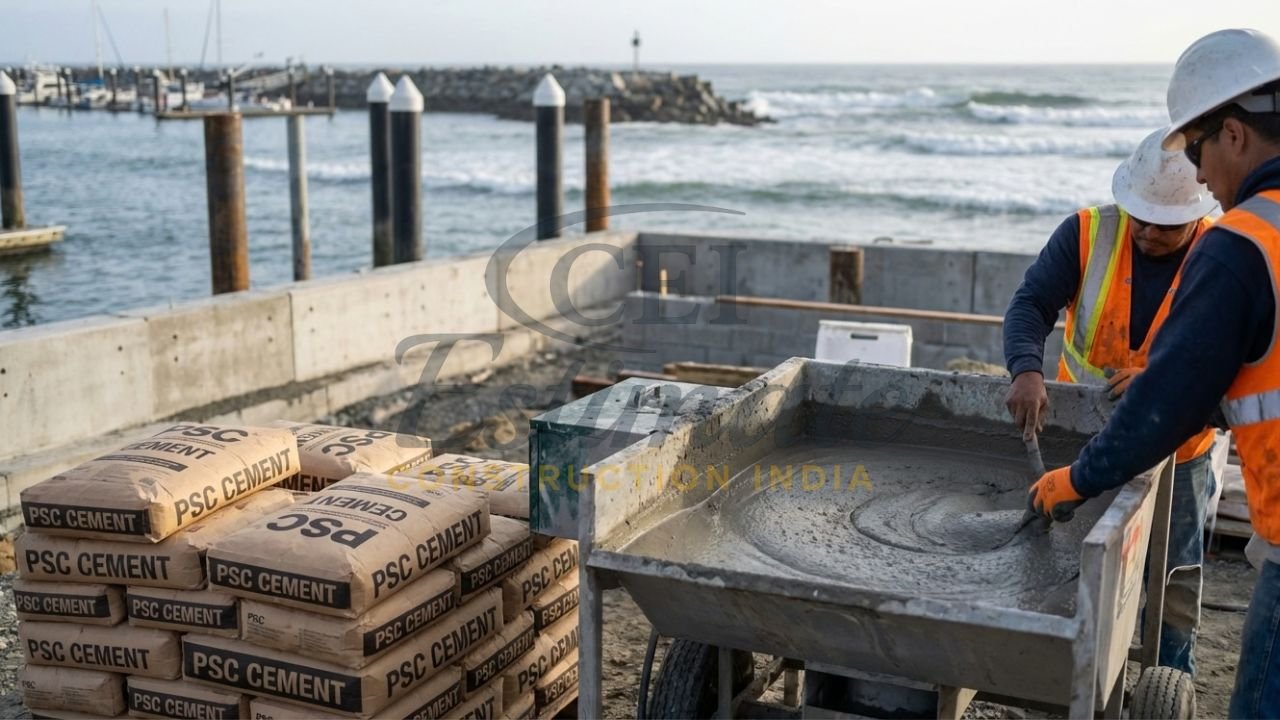
Which Cement Is Best for Coastal Areas?
Several types of cement are used in construction, but not all of them perform well in marine conditions.
The most common cement types used in India include:
- PSC (Portland Slag Cement)
- PPC (Portland Pozzolana Cement)
- OPC 53 Grade
- OPC 43 Grade
- Composite Cement
- Sulfate Resistant Cement
Cement Comparison Table
| Cement Type | Sulfate Resistance | Crack Resistance | Heat of Hydration | Durability | Best Use Case |
| PSC | Very High | Excellent | Low | Very High | Coastal and marine structures |
| PPC | High | Good | Low | High | Residential construction |
| OPC 53 | Low | Moderate | High | Moderate | Fast construction |
| OPC 43 | Low | Moderate | Medium | Moderate | General masonry |
| Composite Cement | High | Good | Low | High | Durable structures |
| Sulfate Resistant Cement | Very High | Good | Medium | High | Marine foundations |
Let’s examine each cement type in detail.
PSC (Portland Slag Cement)
PSC cement is widely considered the best cement for coastal areas. It is manufactured by blending granulated blast furnace slag with Portland clinker.
Key advantages include:
- excellent sulfate resistance
- low permeability
- improved durability
- reduced chloride penetration
- better protection of reinforcement steel.
Because of its dense microstructure, PSC cement significantly reduces the entry of harmful salts into concrete. It also produces lower heat during hydration, reducing the chances of thermal cracking.
PSC cement is widely used in:
- marine structures
- coastal buildings
- bridges
- harbors
- ports
- basements and foundations
For this reason, PSC cement is the most recommended cement for coastal construction in India.
PPC (Portland Pozzolana Cement)
PPC cement contains fly ash, which improves the long-term durability of concrete.
Advantages include:
- better resistance to chemical attack
- reduced heat generation
- improved workability
- good long-term strength.
PPC is suitable for:
- residential buildings
- plastering
- masonry work
- moderate coastal exposure.
However, compared to PSC cement, PPC offers slightly lower resistance to chloride penetration. For highly aggressive marine environments, PSC is generally preferred.
OPC 53 Grade Cement
OPC 53 grade cement is widely used because it develops high early strength.
However, in coastal construction, OPC has some disadvantages:
- higher heat of hydration
- increased risk of cracks
- higher permeability compared to blended cements.
Because of these factors, OPC cement is not the best cement for sea side construction, especially for structures directly exposed to salt.
OPC 43 Grade Cement
OPC 43 grade cement is mainly used for plastering, masonry, and small residential works.
While it provides adequate strength for normal construction, it lacks the chemical resistance needed for marine environments.
Therefore, OPC 43 is rarely recommended as the primary cement for coastal construction cement India.
Composite Cement
Composite cement combines fly ash and slag, providing enhanced durability and resistance to chemical attack.
Advantages include:
- improved resistance to sulfate attack
- reduced permeability
- good workability
- long-term durability.
Composite cement is gaining popularity in modern sustainable construction.
Sulfate Resistant Cement
Sulfate resistant cement is specially designed to resist sulfate attack in aggressive environments.
It contains lower amounts of tricalcium aluminate, which reduces chemical reactions with sulfate ions.
This type of cement is used in:
- marine structures
- sewage treatment plants
- coastal foundations
- underground structures.
However, it is usually more expensive and less commonly used for residential construction.
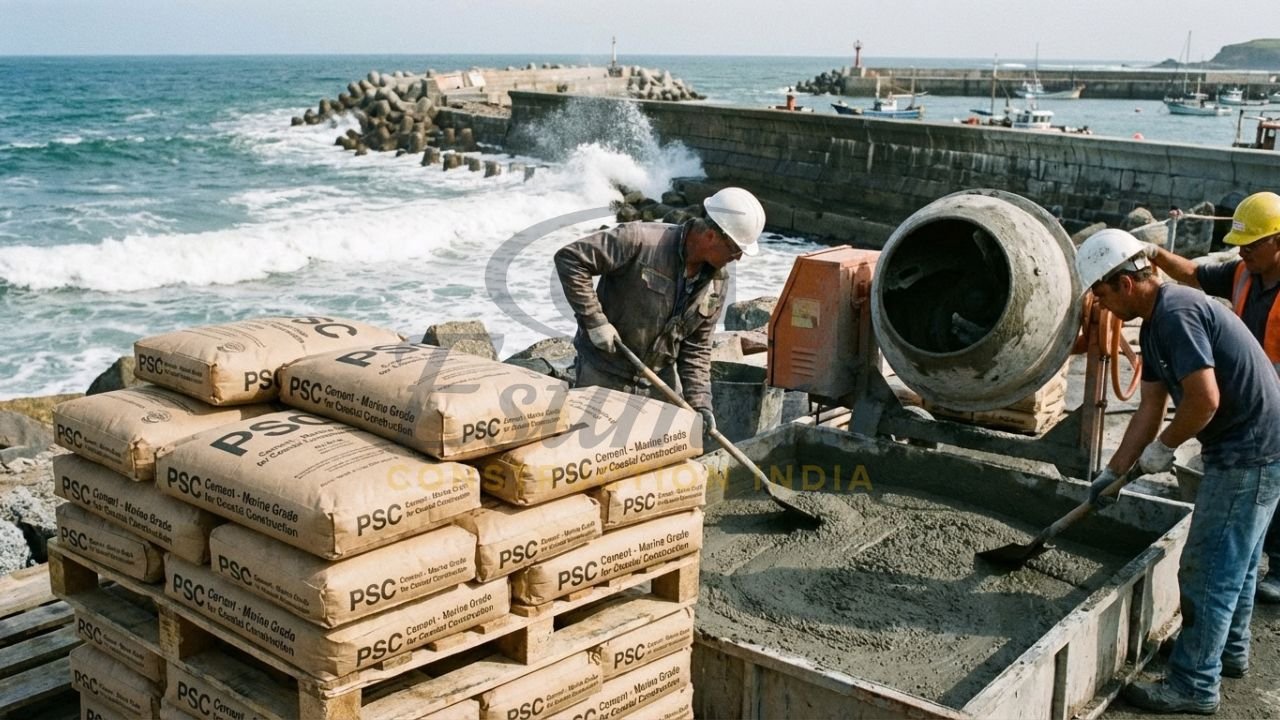
Why PSC Cement Is Best for Coastal Construction?
From an engineering perspective, PSC cement for coastal areas provides the best long-term durability.
The key reason lies in its chemical composition and hydration behavior.
- Slag Content Improves Sulfate Resistance PSC cement contains granulated blast furnace slag, which reacts slowly with water and forms additional cementitious compounds. This process improves resistance against sulfate attack.
- Reduced Permeability PSC cement produces a dense concrete structure, reducing pores and capillaries. This prevents:
- chloride penetration
- moisture ingress
- salt attack.
- Lower Chloride Diffusion The dense matrix slows down the movement of chloride ions through concrete, protecting reinforcement steel.
- Better Durability PSC cement structures often last 50–70 years or more in coastal environments when properly constructed.
- Corrosion Protection The improved microstructure protects reinforcement steel from corrosion by maintaining the alkalinity of concrete.
For these reasons, PSC cement is widely used in marine bridges, ports, and coastal buildings across India.
Top 10 Best Cement Brands for Coastal Areas in India 2026
Selecting the right brand is just as important as selecting the right cement type.
Below are the top cement brands recommended for coastal construction in India.
- UltraTech PSC Cement UltraTech is India’s largest cement manufacturer and produces high-quality PSC cement designed for marine environments. Advantages:
- high durability
- excellent sulfate resistance
- consistent quality. Typical price: ₹450–₹540 per 50 kg bag Best regions: Kerala, Tamil Nadu, Maharashtra, Gujarat.
- ACC PSC Cement ACC cement is widely trusted by contractors across India. Strengths include:
- strong sulfate resistance
- reliable quality control
- good long-term durability. Price range: ₹440–₹520
- Ambuja PSC Cement Ambuja cement is known for strong concrete strength and durability. It performs well in humid coastal environments. Price range: ₹430–₹510
- Dalmia PSC Cement Dalmia cement has a strong reputation in southern coastal regions of India. Advantages include:
- excellent chloride resistance
- strong durability. Price range: ₹420–₹500
- JSW Cement JSW cement uses advanced slag technology. It offers:
- high sulfate resistance
- improved durability
- sustainable production. Price range: ₹430–₹520
- Shree Cement PSC Shree cement produces reliable PSC cement for coastal construction. Known for:
- consistent strength
- good crack resistance. Price range: ₹420–₹490
- JK Lakshmi PSC Cement JK Lakshmi cement is widely used in western coastal regions. Benefits include:
- good workability
- strong durability. Price range: ₹430–₹500
- Heidelberg Mycem PSC Heidelberg cement produces Mycem PSC, known for its marine durability. Price range: ₹450–₹520
- India Cements PSC India Cements has strong presence in Tamil Nadu and Andhra Pradesh coastal belt. Price range: ₹420–₹480
- Birla Corporation PSC Birla cement offers reliable PSC cement for coastal projects. Price range: ₹430–₹500
Cement Brand Comparison Table
| Rank | Brand | Cement Type | Sulfate Resistance | Durability | Price | Best Coastal Region |
| 1 | UltraTech | PSC | Very High | Excellent | ₹450–540 | Pan India |
| 2 | ACC | PSC | High | Excellent | ₹440–520 | West Coast |
| 3 | Ambuja | PSC | High | Excellent | ₹430–510 | Gujarat |
| 4 | Dalmia | PSC | Very High | Excellent | ₹420–500 | South India |
| 5 | JSW | PSC | High | Excellent | ₹430–520 | Coastal Karnataka |
| 6 | Shree | PSC | High | Very Good | ₹420–490 | Maharashtra |
| 7 | JK Lakshmi | PSC | High | Good | ₹430–500 | Gujarat |
| 8 | Heidelberg Mycem | PSC | High | Good | ₹450–520 | East India |
| 9 | India Cements | PSC | Good | Good | ₹420–480 | Tamil Nadu |
| 10 | Birla Corporation | PSC | Good | Good | ₹430–500 | Odisha |
Best Concrete Mix for Coastal Construction
Using the right cement alone is not enough. The concrete mix must also be designed to resist salt penetration.
Recommended guidelines:
- Concrete grade: M25 to M30
- Water cement ratio: 0.40 – 0.45
- Use clean river sand
- Proper compaction using vibrators
- Minimum cement content: 360–400 kg/m³
Low water cement ratio ensures dense concrete with minimal permeability, which is critical for coastal durability.
Practical Coastal Construction Tips from Engineers
To ensure long-lasting structures in coastal regions, follow these practical engineering tips:
- Use PSC cement for coastal areas.
- Increase concrete cover to reinforcement.
- Maintain low water cement ratio.
- Use corrosion resistant reinforcement steel.
- Add waterproofing admixtures.
- Ensure proper vibration during concreting.
- Use good quality aggregates.
- Avoid contaminated sand containing salts.
- Cure concrete for at least 14 days.
- Apply external waterproof coatings.
Common Mistakes in Coastal Construction
Many coastal buildings fail early due to avoidable mistakes.
Common errors include:
- using OPC cement everywhere
- poor curing practices
- excessive water in concrete mix
- low concrete cover to reinforcement
- poor compaction.
These mistakes allow salt to penetrate concrete quickly, leading to early corrosion and cracking.
Cement Price in Coastal India (2026)
| Brand | Cement Type | Price per 50 kg | Region |
| UltraTech | PSC | ₹450–540 | Pan India |
| ACC | PSC | ₹440–520 | West Coast |
| Ambuja | PSC | ₹430–510 | Gujarat |
| Dalmia | PSC | ₹420–500 | South India |
| JSW | PSC | ₹430–520 | Coastal Karnataka |
| Shree | PSC | ₹420–490 | Maharashtra |
How We Help Builders Plan Coastal Construction Projects?
At Construction Estimator India, we help contractors, homeowners, and developers plan durable coastal construction projects.
Our services include:
- cement selection guidance
- BOQ preparation
- material quantity calculation
- coastal construction planning
- complete building budget estimation
Whether you are building a coastal house, resort, apartment, or commercial building, our experts help you choose the best cement for humid climate construction and prepare accurate material estimates.
Get Your Free Coastal Construction Estimate
📱 WhatsApp: +91 8630676890
Send your building drawings or plot details, and our experts will prepare a complete BOQ and construction material estimate.
Frequently Asked Questions
Which cement is best for coastal areas?
PSC (Portland Slag Cement) is widely considered the best cement for coastal areas because it offers excellent resistance to sulfate attack and chloride penetration.
Why is PSC cement recommended for sea-side construction?
PSC cement produces dense concrete with low permeability, which prevents salt and moisture from reaching reinforcement steel.
Is PPC good for coastal houses?
Yes, PPC can be used for moderate coastal conditions, but PSC provides better protection against salt attack.
What concrete grade is recommended near the sea?
Engineers typically recommend M25 to M30 concrete for coastal residential buildings.
Does salt damage concrete?
Yes. Salt causes chloride attack, which leads to corrosion of reinforcement steel and cracking of concrete.
Which cement prevents steel corrosion?
PSC cement and sulfate resistant cement provide the best protection against reinforcement corrosion.
Can OPC cement be used near the sea?
OPC cement can be used in some cases, but it is not the best cement for marine environment construction.
How long does concrete last near the sea?
Properly designed coastal structures using PSC cement can last 50–70 years or more.
What is the water cement ratio for coastal concrete?
Engineers recommend a water cement ratio of 0.40–0.45.
Which cement brands are best for coastal India?
Top brands include UltraTech, ACC, Ambuja, Dalmia, JSW, and Shree Cement.
Conclusion
Choosing the best cement for coastal areas is essential for building durable structures in marine environments.
Coastal regions expose buildings to salt, humidity, sulfates, and chloride attacks, which can quickly damage poorly designed concrete structures.
Among all cement types, PSC (Portland Slag Cement) is the most suitable option for coastal construction due to its:
- high sulfate resistance
- low permeability
- superior durability
- corrosion protection for reinforcement steel.
By combining PSC cement with proper concrete mix design, good construction practices, and adequate curing, coastal buildings can last for decades without major structural problems.
If you are planning to build a house or project near the sea, professional planning can save you lakhs of rupees in repair costs.
Get Professional Coastal Construction Planning
At Construction Estimator India, we help you select the right cement, calculate materials, and prepare complete construction budgets.
📱 WhatsApp: +91 8630676890
Get your coastal construction BOQ and material estimate today.