
In the world of heavy civil engineering, a bridge is not just a crossing; it is a commitment to a design life of 100 years or more. Yet, history is littered with bridge failures that could have been avoided. Recall the 2018 failure of a minor bridge in Jharkhand due to sulfate attack in the sub-soil, or the premature cracking in a flyover in Uttar Pradesh caused by high heat of hydration during summer pouring. These weren’t just construction errors; they were material selection failures.
In 2026, with India’s push for 100+ year design lives under the National Infrastructure Development Plan, the choice of cement has shifted from a simple cost decision to a critical safety parameter. This guide, brought to you by Construction Estimator India, cuts through the noise. We are here to tell you exactly which cement to use for bridges, why the IRC codes demand it, and which brands deliver the strength and durability required for the next century.
Why Cement Selection Is One of the Most Critical Decisions in Bridge Construction?
A bridge is subjected to a unique set of brutalities that a building rarely sees. It faces dynamic loading (vibrations from traffic), continuous environmental assault (rain, heat, freeze-thaw in hills, salt in coastal areas), and chemical aggression (sulfates in soil, chlorides in marine zones).
Why Cement Matters More Here Than Anywhere Else:
- Dynamic Loading & Fatigue: Unlike a static building, a bridge absorbs constant vibration. The cement matrix must be dense and flexible enough to handle the fatigue. A weak matrix leads to micro-cracks that propagate into structural failure.
- Permeability is Key: Water is the enemy. If water penetrates, it carries chlorides and sulfates that corrode the steel. The cement paste must be virtually impermeable.
- Heat Management: Bridge girders and piers are massive. High heat of hydration in OPC can cause thermal cracking as the core expands and the surface cools. Blended cements (PPC, PSC) generate less heat, reducing this risk.
- Chemical Resistance: In coastal zones (chlorides) or areas with sulfate-rich soil (like parts of Gujarat or the Indo-Gangetic belt), the cement must be chemically resistant to prevent the “concrete cancer” of rebar corrosion.
- Design Life: Bridges are designed for 100+ years. The cement must maintain its integrity against carbonation and chemical attack for a century.

Indian Bridge Code Requirements for Cement (IRC & IS Standards)
Before picking a brand, you must understand the legal and technical mandates. The Indian Roads Council (IRC) and Indian Standards (IS) are not suggestions; they are rules.
- IRC:112 (Concrete): This is the bible for concrete design. It mandates a minimum cement content (typically 380–450 kg/m³ for bridge superstructures) and a maximum water-cement ratio (0.40–0.45).
- IRC:21 & IRC:78: These govern the substructure and foundations. They explicitly require Sulfate Resisting properties in aggressive environments.
- IS 456 & IS 383: General requirements for concrete quality and aggregates.
- Minimum Strength: For bridge superstructures (girders, decks), the standard is usually M40 or M50 (40 MPa or 50 MPa).
- Sulfate Resistance: For foundations in sulfate-rich soil, the code mandates PSC or SRC (Sulfate Resisting Cement) to prevent ettringite formation.
Key Mandates:
- Minimum Cement Content: 380 kg/m³ for severe exposure, 360 kg/m³ for moderate.
- Max w/c Ratio: 0.45 for severe exposure, 0.40 for very severe (marine).
- Alkali-Silica Reaction (ASR): If using reactive aggregates, the cement must be low-alkali to prevent expansion.
Best Cement Grades for Bridge RCC – In-Depth Comparison
Choosing the right cement is about matching the material to the bridge component and the environment.
1. OPC 53 Grade (The Structural King)
- Best For: Superstructures (girders, deck slabs), pre-stressed concrete, and high-strength requirements (M40-M60).
- Why: It offers the highest early strength (27 MPa in 7 days), allowing for faster formwork removal and quicker completion of the superstructure.
- Caveat: High heat of hydration. Not ideal for massive piers or foundations where thermal cracking is a risk.
2. PPC (Portland Pozzolana Cement)
- Best For: Substructures (piers, abutments), foundations, and marine structures.
- Why: The pozzolanic reaction (fly ash) creates a denser matrix, reducing permeability and providing excellent sulfate resistance. It generates less heat, making it ideal for mass concrete in piers and abutments.
- Trade-off: Slower early strength gain.
3. PSC (Portland Slag Cement)
- Best For: Coastal bridges, areas with high sulfate soil, and high water tables.
- Why: The blast furnace slag provides superior sulfate resistance and extremely low permeability. It is the gold standard for durability in aggressive environments.
4. Composite Cement (IS 16415)
- Best For: General bridge components where a balance of strength and durability is needed.
- Why: A newer entrant, it combines the benefits of both worlds, offering good strength and moderate heat.
5. Sulfate Resisting Cement (SRC)
- Best For: Foundations in sulfate-rich soil or marine environments.
- Why: Specifically formulated to resist chemical attack from sulfates.
Comparison Table: Cement Types for Bridges
| Feature | OPC 53 | PPC | PSC | Composite (IS 16415) | SRC |
| Best For | Superstructure, Prestressed | Piers, Foundations | Coastal, Sulfate areas | General use | Foundations, Marine |
| Strength (28d) | 53 MPa | ~33-43 MPa | 43-53 MPa | 33-53 MPa | 33-43 MPa |
| Heat of Hydration | High | Low | Very Low | Low-Medium | Low |
| Sulfate Resistance | Low | Good | Excellent | Good | Excellent |
| Permeability | Medium | Low | Very Low | Low | Very Low |
| Cost (₹/bag) | ₹400-520 | ₹360-450 | ₹370-480 | ₹350-460 | ₹400-500 |
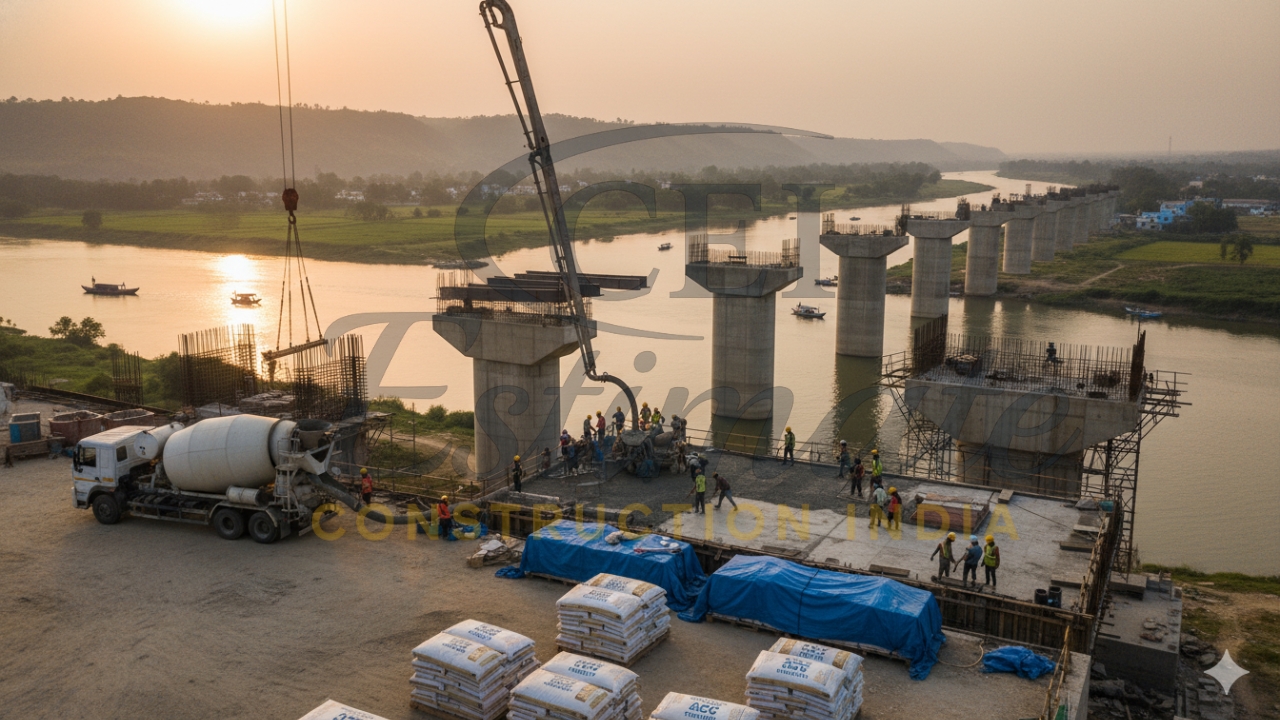
Top 12 Best Cement Brands for Bridge Construction in India 2026
Based on contractor feedback, IRC project references, and on-ground performance in 2026, here are the top brands for heavy civil works.
- UltraTech Cement (OPC 53 & Premium): The market leader. Their UltraTech G5 (OPC 53) is a standard in many NHAI projects. Known for consistent strength and low heat variants.
- Feedback: “Reliable for long spans, used in the 50km+ flyover projects in UP.”
- Price: ₹460-550/bag.
- ACC (Adani) OPC 53: A close second, known for high-quality clinker and consistent fineness.
- Feedback: “Excellent for pre-stressed girders.”
- Price: ₹450-540/bag.
- Ambuja (Adani) OPC 53: High workability and good bond strength.
- Price: ₹440-530/bag.
- JK Lakshmi (OPC 53): A favorite in North India for its reliability.
- Price: ₹420-500/bag.
- Dalmia (OPC 53 & DSP): Known for high early strength and durability.
- Price: ₹430-520/bag.
- Wonder Cement (OPC 53): Gaining traction for its “non-sag” properties in bridge decks.
- Price: ₹400-500/bag.
- Shree/Bangur (OPC 53): Strong in the East and North.
- Price: ₹410-510/bag.
- Heidelberg (Mycem) OPC 53: Reliable for coastal bridges.
- Price: ₹405-500/bag.
- Penna (OPC 53): Strong in the South, known for durability.
- Price: ₹380-480/bag.
- Birla (MP Birla) OPC 53: Trusted for structural integrity.
- Price: ₹430-520/bag.
- India Cements / Coromandel (OPC 53): Dominant in the South.
- Price: ₹410-490/bag.
- Zuari (OPC 53): Strong in the West and South.
- Price: ₹390-490/bag.
Recommended Concrete Mix Design for Bridge Elements
For bridges, the mix is as important as the cement.
- Grade: M40 to M60 for superstructure; M30-M40 for substructure.
- Water-Cement Ratio: Max 0.40–0.45.
- Cement Content: Minimum 380 kg/m³ for severe exposure.
- Admixtures: Superplasticizers are mandatory for high-strength concrete to maintain workability without adding water.
- Fly Ash / GGBS: Often used to reduce heat and improve durability (up to 25-30% replacement).
Best Practices for Casting Durable Bridge RCC with the Right Cement
- Temperature Control: For massive piers, use ice in the mix or chilled water to prevent thermal cracking.
- Curing: 14-21 days of continuous curing is non-negotiable. Use curing compounds if water is scarce.
- Vibration: Use high-frequency internal vibrators to eliminate honeycombs.
- Cover: Ensure 25-40mm cover to protect rebar from corrosion.
- Expansion Joints: Critical for accommodating thermal expansion.
Common Bridge Failures Caused by Wrong Cement & How to Prevent Them
| Failure Mode | Cause | Prevention |
| Thermal Cracking | High heat of hydration in massive piers. | Use PPC, PSC, or low-heat OPC. |
| Sulfate Attack | Sulfate-rich soil attacking the concrete. | Use PSC or SRC. |
| Chloride Attack | Coastal exposure corroding rebar. | Use PSC or low-permeability PPC. |
| Alkali-Silica Reaction (ASR) | Reactive aggregates expanding. | Use low-alkali cement or pozzolans. |
| Spalling | Carbonation or chloride-induced corrosion. | Use dense, low-permeability concrete. |
Cement Consumption Guide for Bridge Components
| Component | Volume (m³) | Cement (kg/m³) | Total Cement (kg) | Bags (50kg) |
| Deck Slab | 100 | 400 | 40,000 | 800 |
| Girders | 50 | 450 | 22,500 | 450 |
| Pier | 200 | 380 | 76,000 | 1520 |
| Abutment | 150 | 360 | 54,000 | 1080 |
Note: These are approximate values. Always perform a trial mix.
Need Bridge BOQ, Mix Design & Material Estimate?
Construction Estimator India offers a Bridge BOQ, Mix Design, and Material Estimate.
WhatsApp +91 8630676890 today:
- Send: Project details (span, load, location).
- Receive: Detailed PDF BOQ (cement, steel, aggregates)
- Bonus: Free 15-min engineer consultation.
Neeraj’s Note: Neeraj is the founder of Construction Estimator India. He has helped thousands of contractors save 20-30% on material costs and avoid structural failures.
FAQ
- Which cement is best for bridge piers? PSC or PPC for sulfate resistance and low heat.
- Can I use OPC 53 for all bridge components? Yes, for superstructures, but avoid for massive piers due to heat.
- What is the minimum cement content for bridges? 380 kg/m³ for severe exposure.
- How to prevent thermal cracks? Use low-heat cements (PPC, PSC) and proper curing.
- Is PSC better for coastal bridges? Yes, superior chloride resistance.
- What is the max w/c ratio for bridges? 0.45 for severe exposure.
- Do I need special cement for pre-stressed girders? Yes, OPC 53 for high early strength.
- How to test cement quality? Check ISI mark, manufacturing date, and fineness.
- Can I use composite cement for bridges? Yes, if it meets IRC standards.
- What is the cost of cement for bridges in 2026? ₹380-520 per bag.
Conclusion
The safety and longevity of a bridge depend entirely on the right cement. Whether you are a contractor, engineer, or developer, choosing between OPC 53, PPC, PSC, or Composite cement is a decision that echoes for a century. Don’t let a wrong choice lead to a catastrophic failure.