
Imagine you are Rajesh, a dedicated freelance electrical contractor in Meerut, overseeing a significant wiring project for a new luxury commercial complex in Greater Noida. You have a skilled team, high-end testing equipment, and a solid reputation. However, during the final testing phase, a minor calibration error leads to a major short-circuit, sparking a fire that damages the building’s centralized HVAC system and several premium interior finishes. Without the right protection, you aren’t just looking at a massive repair bill; you are facing a legal nightmare that could bankrupt your firm. This scenario highlights a critical question: what insurance does an electrical contractor need to survive in the high-stakes Indian market?
As an electrical contractor in 2026, you operate in one of the most hazardous segments of the construction industry. Your daily tasks involve live high-voltage installations, working at heights on scaffolding, and integrating complex smart-building systems. Whether you are a solo supervisor or running a medium-sized electrical business in the Delhi-NCR region, you need a strategic combination of liability, professional, employee, and asset protection. Many contractors in India unfortunately under-insure themselves to save on immediate costs, failing to realize that a single claim can exceed their annual turnover. This comprehensive guide, created for Construction Estimator India, will break down the essential insurance for electrical contractors in India, explaining exactly why these policies matter, their realistic 2026 costs, and how to accurately factor them into your project estimates and Bill of Quantities (BOQ).
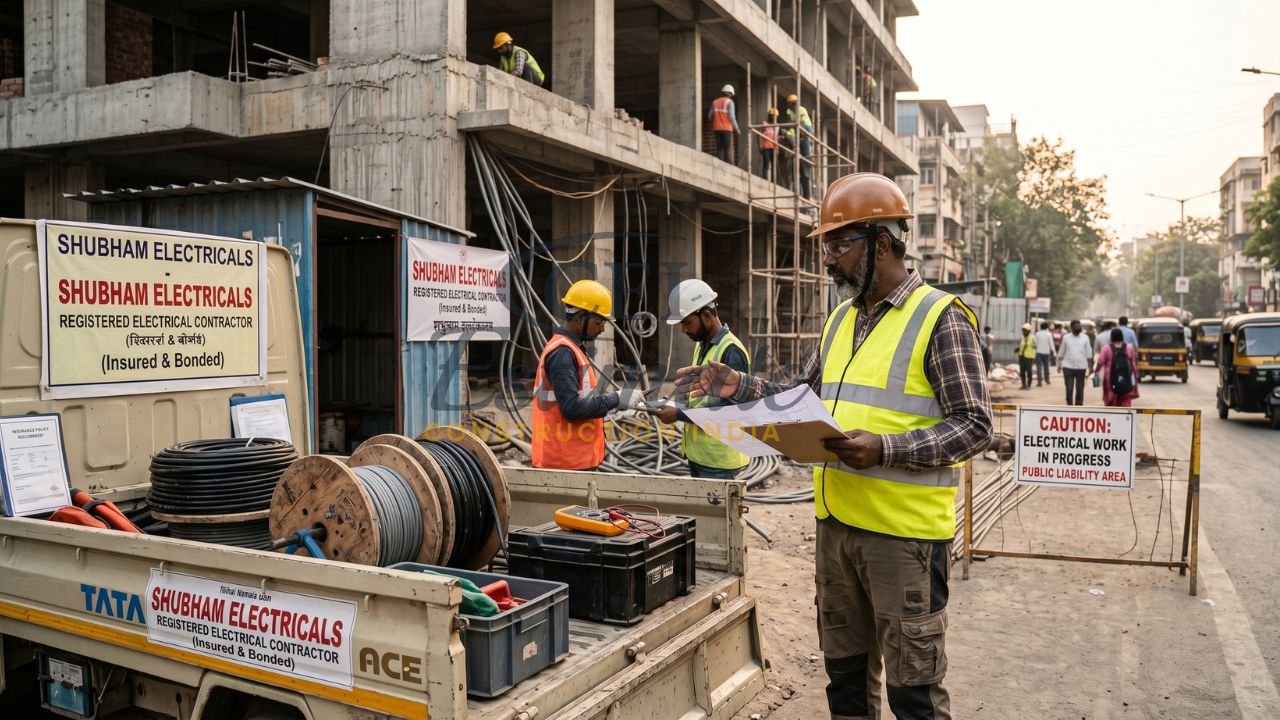
Why Electrical Contractors Need Specialized Insurance?
Electrical work is fundamentally different from general civil work. The risks are often invisible but potentially catastrophic. In 2026, with the rapid adoption of high-load industrial machinery and complex home automation, the margin for error has narrowed. A primary reason you need specialized coverage is the inherent risk of fire and electrocution. A faulty connection might not show signs for months, only to cause a devastating blaze later, leading to third-party liability claims that target your personal and business assets.
Furthermore, electrical contractors frequently face tool theft—a rising concern in tier-2 cities like Meerut where expensive multimeters, insulation testers, and power tools are prime targets on unsecured sites. There is also the significant risk of worker injuries. Whether it is a fall from a height or a flash burn during panel testing, your legal responsibility for your workforce is total under the Employees’ Compensation Act. Specialized insurance ensures that these financial burdens are transferred to an insurer, allowing you to focus on project execution rather than potential litigation or financial ruin.
1. Public Liability Insurance (Essential for All Electrical Contractors)
When asking what insurance does an electrical contractor need, Public Liability Insurance (PLI) is the non-negotiable first answer. This policy protects your business if your work causes accidental bodily injury or property damage to a third party (someone other than your employees). For an electrical contractor, the “third party” could be a client, a passerby, or a neighboring shop owner.
For instance, if a power surge caused by your team’s wiring error fries a client’s server room or a short-circuit leads to a fire in a neighboring unit in a Delhi mall, public liability insurance for electrical contractors will cover the compensation costs and legal defense fees. In the 2026 market, many clients and general contractors in North India will not even allow you to step onto a site without proof of a valid PLI policy with a substantial limit of indemnity.
2. Professional Indemnity (Errors & Omissions) Insurance
While public liability covers physical damage, Professional Indemnity (PI) insurance covers “financial” loss resulting from your professional advice or design errors. As electrical systems become more sophisticated—incorporating solar integration and smart grids—electrical contractors are increasingly acting as consultants.
If you provide a faulty design for a warehouse lighting system that leads to inadequate lux levels, forcing the client to redo the entire installation, they may sue you for the cost of the rework and lost business time. Professional indemnity for electrical contractors is your shield against claims of negligence, inaccurate advice, or failure to meet the promised specifications of a high-tech installation.
3. Workmen Compensation Insurance
In India, workmen compensation for electrical business operations is a statutory requirement. Under the Employees’ Compensation Act 1923 and the BOCW (Building and Other Construction Workers) Act, you are legally liable to provide financial compensation to any worker who suffers an injury, disability, or death while on duty.
Electrical sites are inherently risky due to the danger of electric shocks and falls. A Workmen Compensation Insurance (WCI) policy ensures that if a helper or technician is injured, the insurance company handles the medical expenses and the legally mandated compensation. In 2026, the IRDAI has made these policies more accessible for small teams, ensuring that even a contractor with just two or three helpers can stay legally compliant and financially protected.
4. CAR Insurance for Electrical Works
While Contractors’ All Risk (CAR) insurance is often associated with big civil projects, it is vital for electrical firms handling “supply and install” contracts. Often referred to as Erection All Risk (EAR) in a mechanical/electrical context, CAR insurance for electrical works protects the materials and the project itself while it is under construction.
If you have ₹20 lakhs worth of premium copper cables and switchgear stored on a site in Noida and they are damaged due to a fire or flood before the handover, a CAR/EAR policy will reimburse you for the loss. It covers the work-in-progress from the moment materials are unloaded until the final testing and commissioning phase is complete. This is particularly important for large commercial or industrial projects where the equipment value is high.
5. Tools, Plant & Machinery Insurance
Your tools are your livelihood. Modern electrical contracting requires expensive specialized equipment like thermal imaging cameras, high-end drill sets, and circuit analyzers. Tools and equipment insurance for electrical contractors provides coverage against theft, accidental damage, and even mechanical breakdown in some cases.
Given the mobility of electrical teams across different sites in cities like Meerut and Delhi, a “Portable Equipment” cover is recommended. This ensures that whether your tools are in your van, at the site office, or in use on the 10th floor, they are protected. In 2026, many insurers offer “All-Risks” tool insurance that includes protection against burglary—a must-have for contractors working in developing urban pockets.
6. Other Important Covers for Electrical Contractors
To build the best insurance for electrical contracting company resilience, you should consider these additional safeguards:
- Group Personal Accident (GPA): Provides 24/7 accident cover for your core team, including benefits for permanent or temporary disability.
- Commercial Vehicle Insurance: Mandatory for any vans or trucks you use to transport materials and labor to sites.
- Cyber Insurance: With the rise of IoT and smart building projects, protecting your digital data and client system access from hackers is becoming essential.
- Directors & Officers (D&O) Liability: For larger electrical firms, this protects the personal assets of the management from legal claims regarding corporate governance or management decisions.
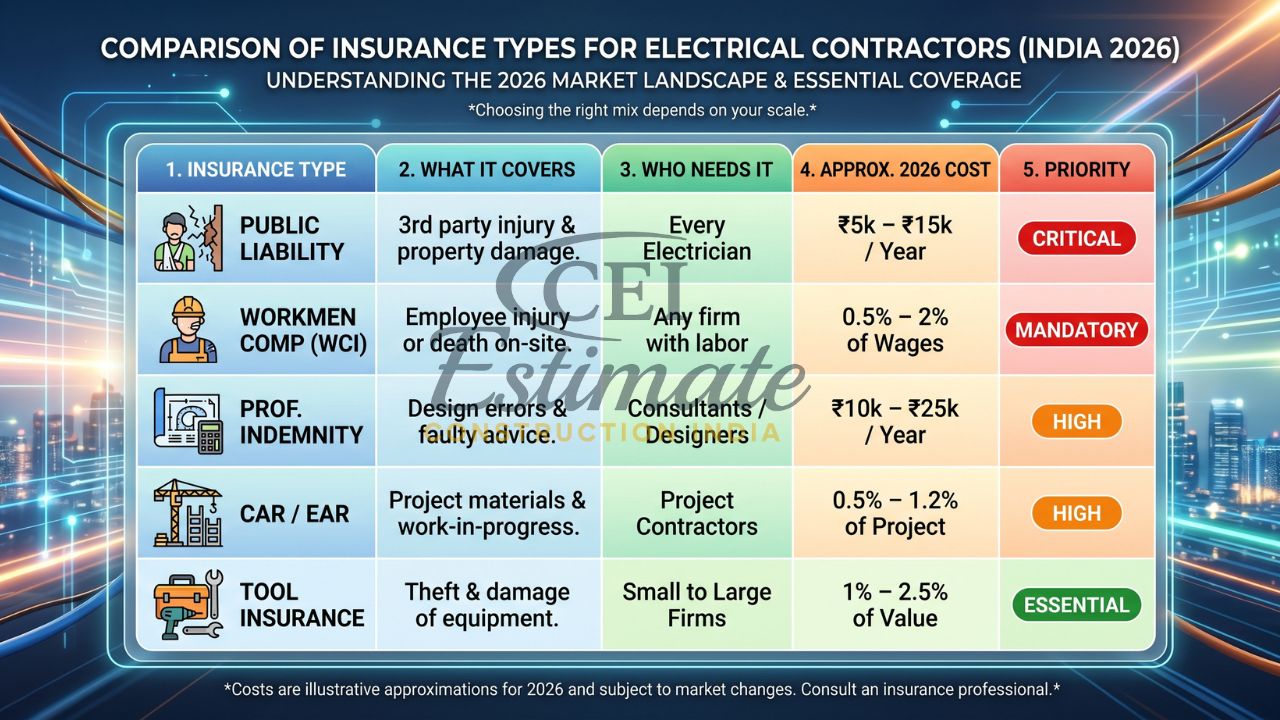
Comparison of Insurance Types for Electrical Contractors
Choosing the right mix depends on your scale. Use the following table to understand the 2026 market landscape for electrical contractor insurance India 2026.
| Insurance Type | What it Covers | Who Needs It | Approx. 2026 Cost | Priority |
|---|---|---|---|---|
| Public Liability | 3rd party injury & property damage. | Every Electrician | ₹5k – ₹15k / Year | Critical |
| Workmen Comp (WCI) | Employee injury or death on-site. | Any firm with labor | 0.5% – 2% of Wages | Mandatory |
| Prof. Indemnity | Design errors & faulty advice. | Consultants / Designers | ₹10k – ₹25k / Year | High |
| CAR / EAR | Project materials & work-in-progress. | Project Contractors | 0.5% – 1.2% of Project | High |
| Tool Insurance | Theft & damage of equipment. | Small to Large Firms | 1% – 2.5% of Value | Essential |
How Much Insurance Costs for an Electrical Contractor in 2026?
Budgeting for electrical contractor insurance India 2026 is vital for maintaining your profit margins. For a solo independent contractor in a city like Meerut, a basic liability and WCI package might cost as little as ₹12,000 to ₹18,000 per year. For a medium-sized firm with a ₹5 crore annual turnover, the total insurance spend—including CAR, PI, and tool cover—typically ranges between 1.5% and 3% of the total project or turnover value.
Factors affecting your premium include your safety track record (claims history), the nature of your projects (high-voltage vs residential), and the geographical location (e.g., higher premiums in seismic Zone IV areas like Delhi-NCR). Optimizing costs is possible by bundling multiple covers with a single insurer like ICICI Lombard or HDFC Ergo to avail of “package discounts.”
Step-by-Step Guide to Getting the Right Insurance
Determining what insurance does an electrical contractor need specifically for your business requires a methodical approach:
- Risk Audit: List your activities. Do you do high-rise wiring? Industrial panels? Home automation? Each has different risk levels.
- Define Sum Insured: For CAR, use the total contract value plus a 10% escalation for material price rises. For WCI, use the actual monthly wage bill.
- Compare Quotes: Get quotes from at least three reputable Indian insurers (New India Assurance, SBI General, Bajaj Allianz) to compare the “fine print” and claim settlement ratios.
- Check Subcontractors: Ensure that if you hire sub-labor, they are either covered under your policy or they provide their own WCI certificate.
- Review Annually: As your tool inventory grows and your projects become larger, update your sum insured to avoid “under-insurance” penalties.
How to Include Insurance Costs in Your Electrical Project Estimates?
At Construction Estimator India, we always emphasize that insurance is a project cost, not a profit deduction. For an electrical contractor, insurance should be a distinct line item in your Bill of Quantities (BOQ) under “Preliminaries” or “Project Overheads”.
Instead of hiding the cost in your per-point wiring rate, list the CAR and WCI premiums clearly. This transparency builds trust with professional clients in the Delhi-NCR region and ensures you don’t lose 2% of your profit margin because you forgot to account for the mandatory insurance. Use current 2026 quotes to ensure your estimation remains accurate and competitive.
Conclusion
Understanding what insurance does an electrical contractor need is the hallmark of a professional business owner. In the competitive landscape of Uttar Pradesh and North India, having a robust insurance portfolio—from Public Liability to Workmen Compensation—is your greatest competitive advantage. It allows you to bid for larger tenders, protects your skilled workforce, and ensures that one unfortunate accident doesn’t end your career.
Don’t leave your financial future to chance. Review your current coverage today and ensure your next project is as safe as it is profitable. For professional BOQ services and construction cost estimation that accurately factors in every insurance premium, contact Construction Estimator India. We help you build with confidence and precision.
FAQ Section
What insurance does an electrical contractor need in India?
At a minimum, you need Public Liability Insurance (PLI), Workmen Compensation Insurance (WCI), and Tool/Equipment Insurance. For larger projects, CAR/EAR and Professional Indemnity are also essential.
Is public liability insurance mandatory for electrical contractors?
While not a nationwide legal mandate like vehicle insurance, it is almost always contractually mandatory for any commercial, government, or bank-financed project in India.
What is the difference between public liability and professional indemnity for electricians?
Public liability covers physical damage (e.g., a fire you caused), while professional indemnity covers financial losses caused by your advice or design errors (e.g., wrong cable sizing).
How much does insurance cost for an electrical contractor?
In 2026, basic coverage for a small firm starts around ₹15,000–₹25,000 annually. For larger projects, it typically costs 1%–2.5% of the total contract value.
Do I need CAR insurance for electrical installation works?
Yes, especially if you are responsible for supplying expensive materials like transformers or high-end switchgear, as it protects them before the project handover.
How can I insure my electrical tools and equipment?
You can opt for a “Portable Equipment” or “All-Risks” policy that covers theft and damage across different site locations in India.
Is workmen compensation required if I have only one helper?
Yes. Under the Employees’ Compensation Act, you are liable for any worker under your supervision, regardless of the team size.
How do I include insurance costs in my electrical quotations?
List it as a separate line item under “Project Overheads” or “Preliminaries” in your BOQ to ensure the client covers the cost and your profit is protected.
Which insurance company is best for electrical contractors?
Top choices in 2026 include ICICI Lombard, HDFC Ergo, New India Assurance, and SBI General, known for their project-specific covers and high claim ratios.
Can small electrical contractors afford comprehensive insurance?
Absolutely. Micro-policies for small projects are very affordable and far cheaper than the cost of a single legal claim or a major tool theft.