
Building a home is perhaps the most significant emotional and financial investment an Indian family makes. Imagine a homeowner, let’s call him Rahul, standing on his newly purchased plot in a Tier-2 city like Lucknow. He has a beautiful 2BHK plan in hand, but as he visits the local material yard, he is met with a wall of different cement bags—some labeled OPC 53, others PPC, and some even designated as “Water Shield” or “Roof Special”. His contractor suggests one brand, his mason another, and a cousin who built a house last year swears by a third.
Rahul’s confusion is common. Most homeowners believe there is a single “best” bag of cement they can buy in bulk to handle everything from the deep foundation to the final decorative plaster. However, as a civil engineer, I can tell you that the best cement for complete house construction is rarely just one type. A house is a complex structure where different components face vastly different stresses. The cement in your foundation fights groundwater sulfates, while the cement on your roof fights the scorching Indian sun. To build a home that stays crack-free and strong for over 50 years, you must understand that the “best” choice depends entirely on the stage of construction.
Why Different Parts of a House Need Different Cement Properties?
If you look at a house through the eyes of an engineer, it isn’t just a stack of bricks; it’s a series of chemical and physical reactions. Each part of the structure has a unique “enemy.”
The foundation and plinth are the silent workers. They are buried in soil that might be rich in sulfates or chlorides, especially in regions like Rajasthan, Uttar Pradesh, or coastal Odisha. Here, you need cement with low permeability and high chemical resistance to prevent the steel reinforcement from rusting.
Columns, beams, and lintels are the skeletal spine. They carry the entire vertical load of the building. For these, “strength” and “speed” are the priorities. You need a grade that reaches its design strength quickly to allow for safe de-shuttering and upward construction.
The roof slab is the most exposed part of your home. It endures thermal expansion in the day and contraction at night. Using a high-heat cement here often leads to hairline cracks that turn into leaks during the first monsoon.
Finally, brickwork and plastering require “workability” rather than raw compressive strength. You need a creamy, sticky mortar that doesn’t shrink as it dries, ensuring your walls remain smooth and free of unsightly “spider-web” cracks.
Best Cement Recommendations for Each Stage of House Construction
To help Rahul and every other homeowner, we must break down the best cement for house construction in India by specific application.
1. Foundation and Plinth Beam
The foundation is the most critical stage where you cannot afford a mistake. In many Indian soils, groundwater contains aggressive chemicals that can eat through ordinary concrete.
- Recommendation: Portland Slag Cement (PSC) or Portland Pozzolana Cement (PPC).
- Why: PSC offers excellent sulfate and chloride resistance, making it the ideal choice for footings and plinth beams. It creates a very dense matrix that blocks water ingress. Reputed brands like Dalmia DSP or ACC Suraksha are engineered for this.
2. Columns and Beams (Structural Skeleton)
These are the load-bearing elements. For a G+1 or G+2 villa, the vertical pressure on columns is immense.
- Recommendation: OPC 53 Grade or PSC.
- Why: OPC 53 provides high early strength, which is vital for the “fast-track” construction of columns and beams. However, if you are building in a high-sulfate area, a premium PSC is often preferred for long-term durability.
3. Roof Slab and Lintel
The roof slab and lintels act as horizontal bridges. They need to be dense enough to be waterproof but flexible enough to handle temperature changes.
- Recommendation: PPC (Portland Pozzolana Cement).
- Why: PPC has a lower “heat of hydration.” This means it doesn’t get as hot during the chemical setting process, which significantly reduces the risk of thermal cracks in thin slabs. For these horizontal members, selecting the best cement for lintel in India ensures that the area above your doors and windows remains structurally sound without sagging.
- Engineer’s Tip: When casting the roof, consider a best cement for house construction in India variant that specifically mentions “Weather Plus” or “Water Shield” for added protection.
4. Brickwork and Masonry
For laying bricks or blocks, you need a mortar that binds well and doesn’t dry out too quickly.
- Recommendation: PPC or OPC 43 Grade.
- Why: PPC offers superior workability. Masons find it easier to spread, and it provides a better bond with the bricks, leading to less wastage and stronger walls.
5. Plastering (Internal and External)
Plastering is the “skin” of your house. It needs to be mirror-smooth and crack-resistant.
- Recommendation: PPC.
- Why: PPC contains fine fly ash particles that fill the micro-pores, providing a silk-smooth finish. It is widely considered the best cement for plaster in India because it reduces the “spider-web” shrinkage cracks that often ruin expensive paint jobs.
- Advanced Tip: For concrete surfaces like the underside of slabs or beams, you should choose the best plastering cement brand for concrete surfaces in India to ensure the plaster doesn’t peel off over time due to poor adhesion.
Cement Recommendation by Construction Stage
| Construction Stage | Best Cement Type | Key Property Needed | Recommended Mix Ratio |
|---|---|---|---|
| Foundation/Footing | PSC / PPC | Sulfate Resistance | M20 / M25 (1:1.5:3) |
| Columns & Beams | OPC 53 / PSC | High Early Strength | M25 (1:1:2) |
| Roof Slab / Lintel | PPC | Low Heat / Crack Resistance | M20 / M25 (1:1.5:3) |
| Brickwork | PPC / OPC 43 | Bonding / Workability | 1:4 to 1:6 Mortar |
| Internal Plaster | PPC | Smooth Finish | 1:4 to 1:6 Mortar |
| External Plaster | Water-Repellent PPC | Waterproofing | 1:4 Mortar |
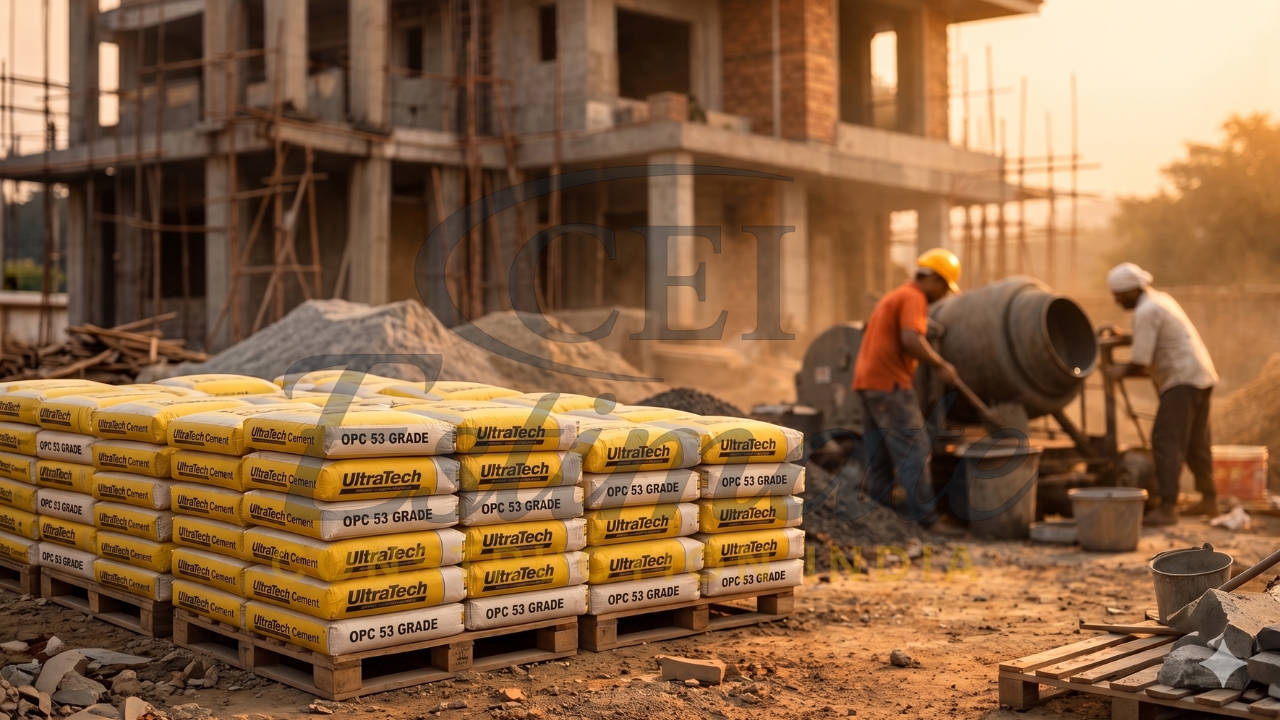
PPC vs OPC Cement for Complete House Construction
One of the oldest debates in Indian construction is PPC vs OPC for full house construction.
- Ordinary Portland Cement (OPC) is the traditional “raw” cement. It is made mostly of clinker and gypsum. It is very strong and sets quickly, which is why it’s great for commercial high-rises where time is money. However, for a standard residential villa, OPC can be “too strong” and “too hot,” leading to cracks if not cured aggressively for 21 days.
- Portland Pozzolana Cement (PPC) is a “blended” cement that includes fly ash. While it gains strength slightly slower than OPC in the first 7 days, its 28-day strength is comparable, and its long-term durability is actually higher. It is eco-friendly, cheaper, and far more resistant to the humid Indian climate.
- The Verdict: For most 1BHK, 2BHK, and villa construction projects in 2026, PPC is the superior choice for about 80% of the house. Use OPC 53 strictly for the skeletal columns and beams if you have an expert team for curing.
Comparison Table: PPC vs OPC for Residential Projects
| Feature | OPC (53 Grade) | PPC (Blended) |
|---|---|---|
| Setting Speed | Very Fast | Moderate |
| Heat Generation | High (High crack risk) | Low (Low crack risk) |
| Workability | Moderate | Excellent (Creamy) |
| Durability | High | Very High (Better corrosion resistance) |
| Price | Premium (Higher) | Economical (Lower) |
| Best For | High-rise RCC, fast track | Full house construction, plaster |
Top Cement Brands for House Construction in 2026
As we move through 2026, the Indian market is led by brands that have invested heavily in quality control and specific product variants. When looking for the best cement brand for residential construction 2026, consider these market leaders:
- UltraTech Cement: The national leader. Their “Weather Plus” and “Premium” variants are exceptional for RCC work and slabs. They offer unmatched consistency across all regions of India.
- ACC Cement: Known for their legacy of trust. Products like “ACC Gold Water Shield” are among the best for external plastering and foundations where water seepage is a concern.
- Ambuja Cement: Their “Roof Special” and “Plus” variants are highly regarded by contractors for their high compressive strength and low permeability.
- Dalmia Cement: A specialist in “RCF” (Roof, Column, Foundation). Their PSC and DSP variants are top-rated for foundations in sulfate-rich or coastal soils.
- JK Lakshmi / JK Cement: A very reliable choice for North and West India, offering great early strength and a strong dealer network for homeowners.
Complete House Construction Cement Checklist
Before you order your first truckload of cement, keep this checklist handy to ensure you are getting the best quality for your project:
- Check the ISI Mark: Ensure the bag has a clear ISI mark with a valid 7-digit license number.
- Manufacturing Date: Cement loses strength over time. Never use cement that is more than 3 months (90 days) old.
- Physical Condition: The bag should be intact. Open a bag and stick your hand in—it should feel “cool.” If there are hard lumps, reject the batch immediately.
- Storage: Always store bags on a raised wooden platform (at least 150mm off the ground) and away from walls to prevent moisture absorption.
- Batch Uniformity: Try to use the same brand and type for a single structural member (like all columns of one floor) to ensure uniform strength.
- Water-Cement Ratio: Maintain a ratio of 0.45 to 0.50. Do not let your masons add extra water just to make the mix easier to pour; it creates weak, porous concrete.
Frequently Asked Questions (FAQs)
- How many cement bags are required for a 1000 sq ft G+1 house?
Typically, a 1000 sq ft G+1 house requires between 400 to 550 bags, depending on the structural design and wall thickness. - Can I use different cement brands for foundation and roof?
Yes, you can. It is often recommended to use a sulfate-resistant PSC for the foundation and a crack-resistant PPC for the roof. Just avoid mixing two different brands in the same structural pour. - Is OPC 53 always better than PPC?
No. While OPC 53 has higher early strength, PPC is more durable, crack-resistant, and cost-effective for 80% of residential house work. - How many days should I cure my RCC slab?
For the best strength, you should cure the slab for at least 14 to 21 days using the “ponding” method. - Which cement is best for a coastal house in Odisha or Andhra?
In coastal areas, Portland Slag Cement (PSC) is the best choice because it provides the highest resistance to salt-water corrosion. - Does “Water Shield” cement actually work?
Yes, premium water-repellent cements contain hydrophobic additives that block capillary pores, significantly reducing dampness in walls and slabs. - Can I use white cement for plastering?
White cement is usually reserved for decorative finishes or tile grouting, not for structural plastering, due to its cost and different setting properties. - Why is my plaster developing hairline cracks?
This usually happens due to using high-heat OPC cement, a poor sand-to-cement ratio, or inadequate curing. Using PPC generally solves this. - Is 43 Grade cement still used?
Yes, it is excellent for non-critical work and general masonry where very high strength is not required immediately. - How can I get an exact cement quantity estimate for my plan?
You can consult a professional estimator or use a BOQ service to get a detailed breakdown based on your specific floor plan.
Conclusion
Choosing the best cement for complete house construction is not about finding one “magic brand.” It is about being a smart homeowner who matches the material to the task. Use PSC or PPC for a strong foundation, OPC 53 or PSC for your skeletal columns, and PPC for a leak-proof roof and smooth-as-silk plaster.
Remember, your house is only as strong as its weakest bag of cement. Don’t compromise on the foundation or the RCC members to save a few thousand rupees. By following this cement recommendation for 1BHK 2BHK and villa construction, you ensure that your dream home remains a source of pride and safety for generations to come.