Building a home in a rural setting is a dream for many—whether it’s an NRI constructing a comfortable retirement villa for parents or a local resident upgrading to a modern pucca house. However, the logistics of building in a village are vastly different from urban centers. In 2026, the construction landscape in India has shifted due to fluctuating material prices, new GST regulations, and the rising cost of skilled labor.
Understanding the Village House Construction Cost in India is the first step toward a successful project. While land is often cheaper or already owned, the “logistics of the last mile” can often surprise homeowners with unexpected expenses. This guide breaks down every rupee you will spend to turn your rural plot into a dream home.
1. Current Market Rates: Cost Per Square Foot in 2026
In 2026, rates are categorized by material quality. While these figures provide a ballpark, you should always cross-reference them with the latest construction cost per sq ft in India to account for monthly market shifts.
Cost at a Glance: 2026 Construction Rates
| Category | Quality Level | Estimated Cost (per sq. ft.) | Total for 1,000 sq. ft. |
| Economy | Basic (Load-bearing, local bricks, mosaic/basic tiles) | ₹1,200 – ₹1,350 | ₹12.0L – ₹13.5L |
| Standard | Standard (RCC Framed, branded cement/steel, vitrified tiles) | ₹1,400 – ₹1,600 | ₹14.0L – ₹16.0L |
| Premium | Luxury (Teak wood, Italian marble/premium granite, automation) | ₹1,700 – ₹2,200+ | ₹17.0L – ₹22.0L+ |
Note: These rates include both material and labor (With-Material Contract).
2. The “Village Factor”: Unique Variables in Rural Construction
Why does a house in a village cost differently than one in a city? It comes down to three specific “Village Factors”:
A. Narrow Road Access and Logistics
Urban sites allow for 10-wheeler trucks to unload bricks and sand directly at the gate. In many Indian villages, narrow lanes mean materials must be unloaded at a “drop point” 500 meters away and transported to the site via tractor or manual labor. This can add ₹20 to ₹50 per sq. ft. to your budget.
Choose Your Construction Services
Connect with verified experts for your project. We provide professional
General Contractors, Sub-contractors, Builders, and Material Suppliers.
Our network also includes specialized 3D Rendering Developers and Interior Experts.
B. Local Labor Availability
While unskilled labor is often cheaper in rural areas, skilled labor (plumbers, electricians, and false ceiling experts) usually travels from the nearest “urban hub.” Proper plumbing, electrical work planning in house construction is essential here to avoid paying for multiple “visit charges” from city-based technicians.
C. Material Sourcing
Branded rural building materials India wide (like TATA Tiscon or UltraTech) may not be stocked by small village traders. Ordering from city distributors involves high transportation fees and potential transit damage.
3. Comprehensive Material and Cost Breakdown
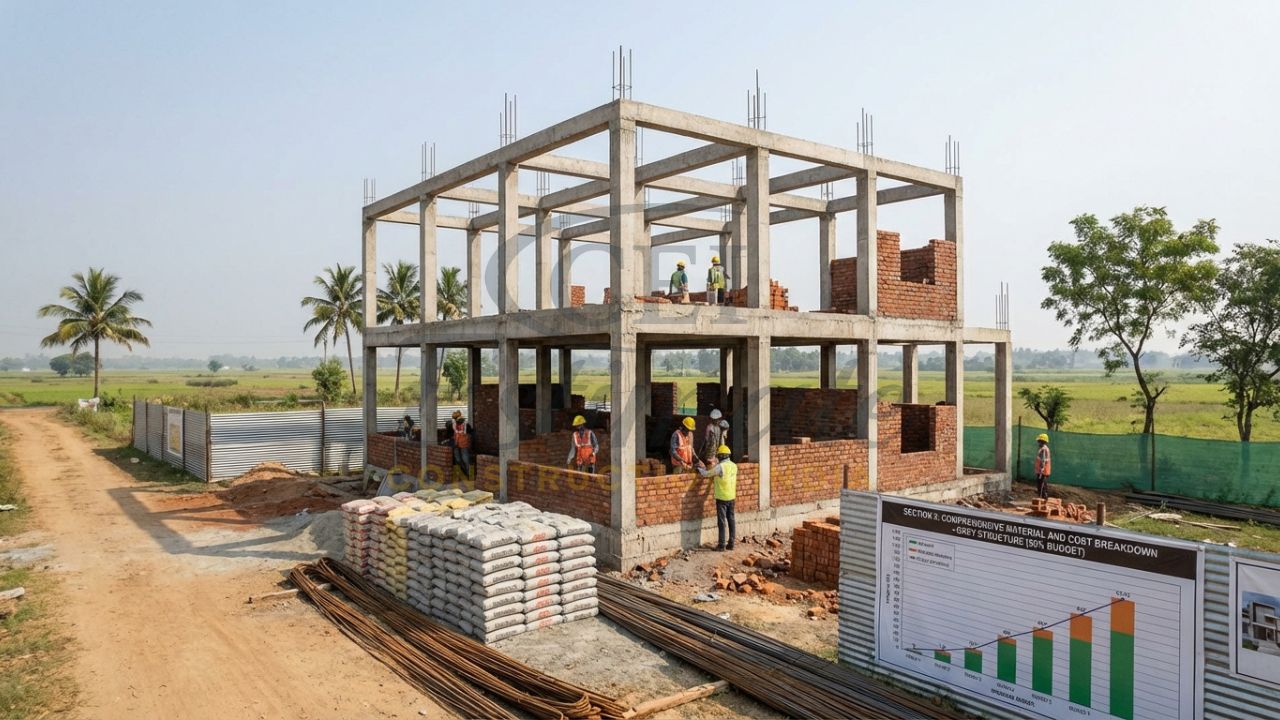
To budget effectively, you must see where the money goes. For a standard quality home, the expenditure is typically split 70:30 between the structure (Grey Structure) and the finishing.
Skeletal/Grey Structure (Approx. 45-50% of Budget)
- Cement: 12-14% of total cost.
- Steel (Rebar): 10-12% of total cost.
- Sand & Aggregate: 8-10% of total cost.
- Bricks/Blocks: 8-10% of total cost.
The strength of your home depends on the quality of your “bones.” It is vital to use top-rated cement for homes in India to protect against the harsh environmental conditions often found in rural areas.
Finishing Works (Approx. 25-30% of Budget)
- Flooring: 5-7% (Vitrified tiles are standard in 2026).
- Painting: 4-5% (Interior emulsion and weather-shield exterior).
- Plumbing & Electrical: 8-10% (Pipes, wires, and fixtures).
Labor Charges (Approx. 20-25% of Budget)
Labor rates in 2026 range from ₹250 to ₹350 per sq. ft. for a basic civil contract, depending on the state (higher in Kerala and Punjab, lower in Bihar and Odisha).
4. Hidden Costs: The “Forgotten” Expenses
When calculating the Village House Construction Cost in India, many homeowners forget these essentials:
- Borewell & Pump: In rural areas, a municipal water connection is rare. A deep borewell with a submersible pump can cost between ₹80,000 and ₹2,50,000, depending on the water table.
- Boundary Wall: Safety is paramount. A 5-foot boundary wall for a standard plot can add ₹1.5L to ₹3L to your total spend.
- Local Approvals: While rules are relaxed, many Gram Panchayats now require “Map Passing” fees or “NOCs,” especially for non-agricultural (NA) converted land.
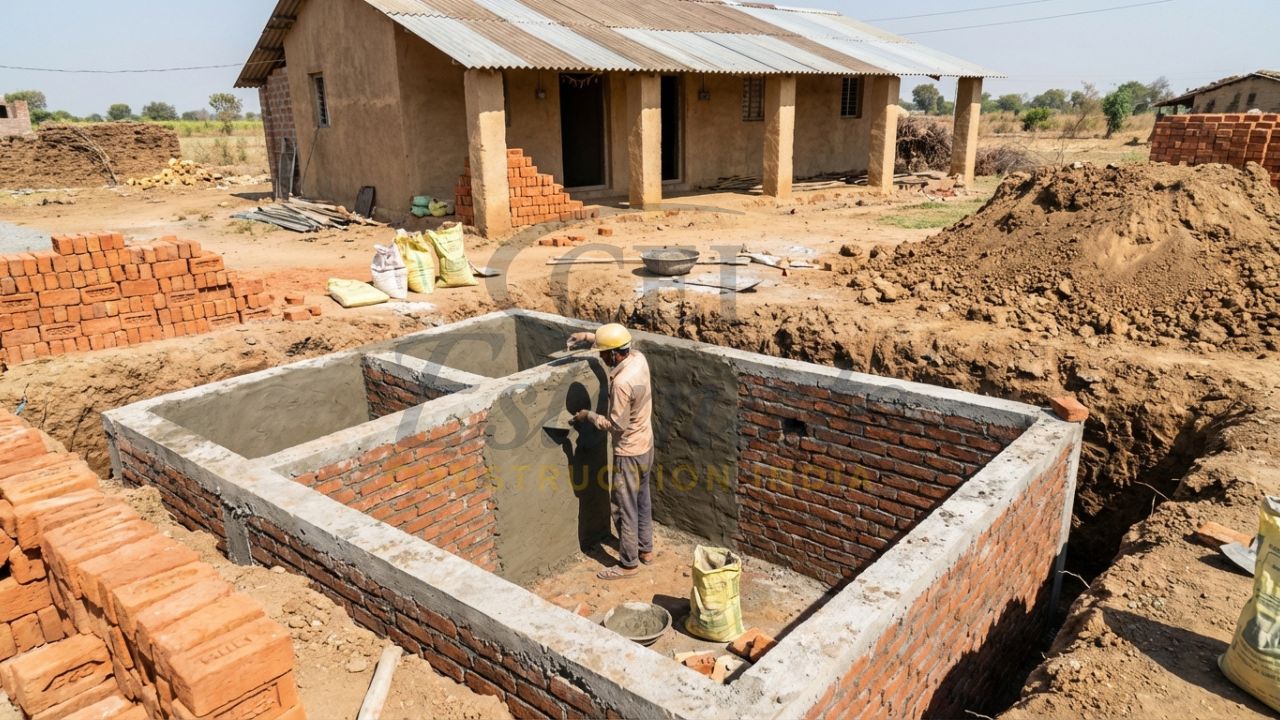
- Septic Tank: Unlike cities with sewage lines, villages require a dedicated septic tank (Soak pit), costing roughly ₹40,000 to ₹70,000.
5. Cost-Saving Tips: Building Smart in 2026
If you are looking for a low-cost house design for village living, consider these engineering strategies:
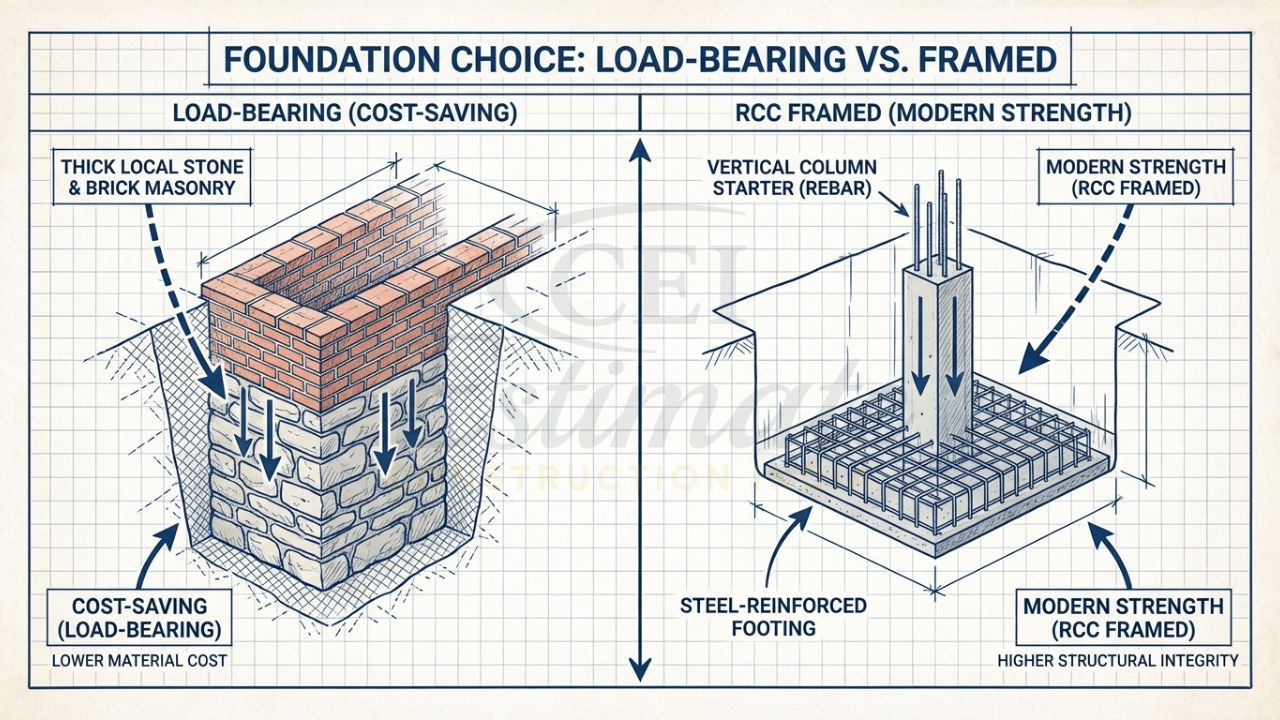
- Load-Bearing vs. Framed Structure: For a single-story (Ground floor only) house, a load-bearing structure (where walls carry the weight) can save you up to 15% compared to an RCC framed structure (columns and beams).
- Local Material Substitution: Use local stone for foundation work or fly-ash bricks if there is a thermal plant nearby.
- Square/Rectangular Designs: Simple shapes reduce the perimeter wall area and minimize waste in floor tiles and roofing. Complex “L” or “U” shaped designs increase costs by 10%.
- Pre-cast Elements: In 2026, pre-cast compound walls and window frames are widely available and significantly cheaper than cast-in-situ work.
6. Regional Variations Across India
The 2026 construction rates aren’t uniform.
- Southern India (Kerala/Karnataka): High labor costs and strict environmental norms for sand often push costs toward the ₹1,800/sq. ft. mark.
- Northern India (UP/Punjab): Proximity to brick kilns and flat terrain keeps costs lower, around ₹1,300 – ₹1,500/sq. ft.
- Hilly Regions: Building in Himachal or Uttarakhand involves massive excavation costs, often doubling the foundation budget.
Conclusion: The Power of a BOQ
Building a village home without a Bill of Quantities (BOQ) is like sailing a ship without a compass. A professional BOQ lists every single item—from the kilograms of binding wire to the liters of primer—ensuring your contractor cannot overcharge you for “unforeseen” expenses.
In 2026, data is your best tool. By knowing the current rates and the specific challenges of your rural site, you can ensure that your hard-earned money builds a legacy that lasts for generations.
Get a Professional Estimate for Your Dream Home
Avoid the common trap of budget overruns and material wastage. Construction Estimator India provides hyper-accurate, professional estimation services tailored to the unique challenges of rural building. Ensure your project stays on track with a detailed breakdown of every brick and bar of steel. Our expert Estimating Services start at just ₹10,000 INR, providing you with the roadmap to a stress-free build.
Contact Construction Estimator India Today:
- Phone/WhatsApp: +91 86306 76890
- Email: info@constructionestimatorindia.com