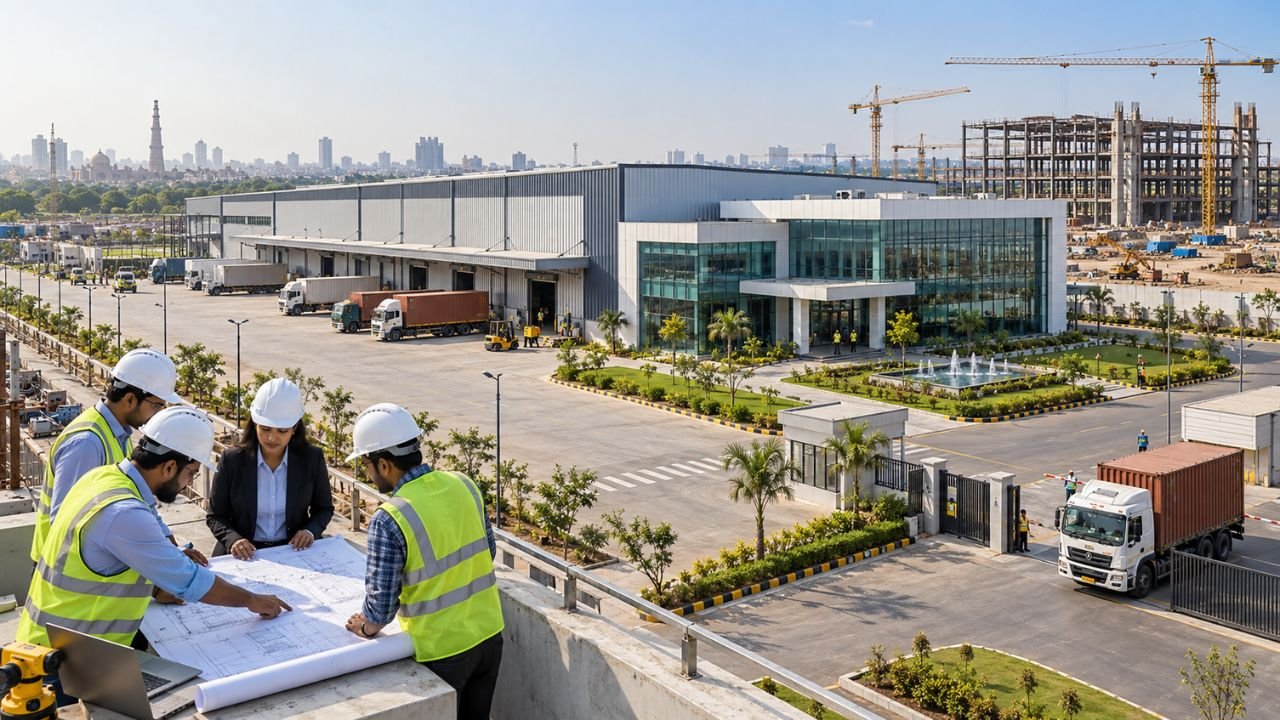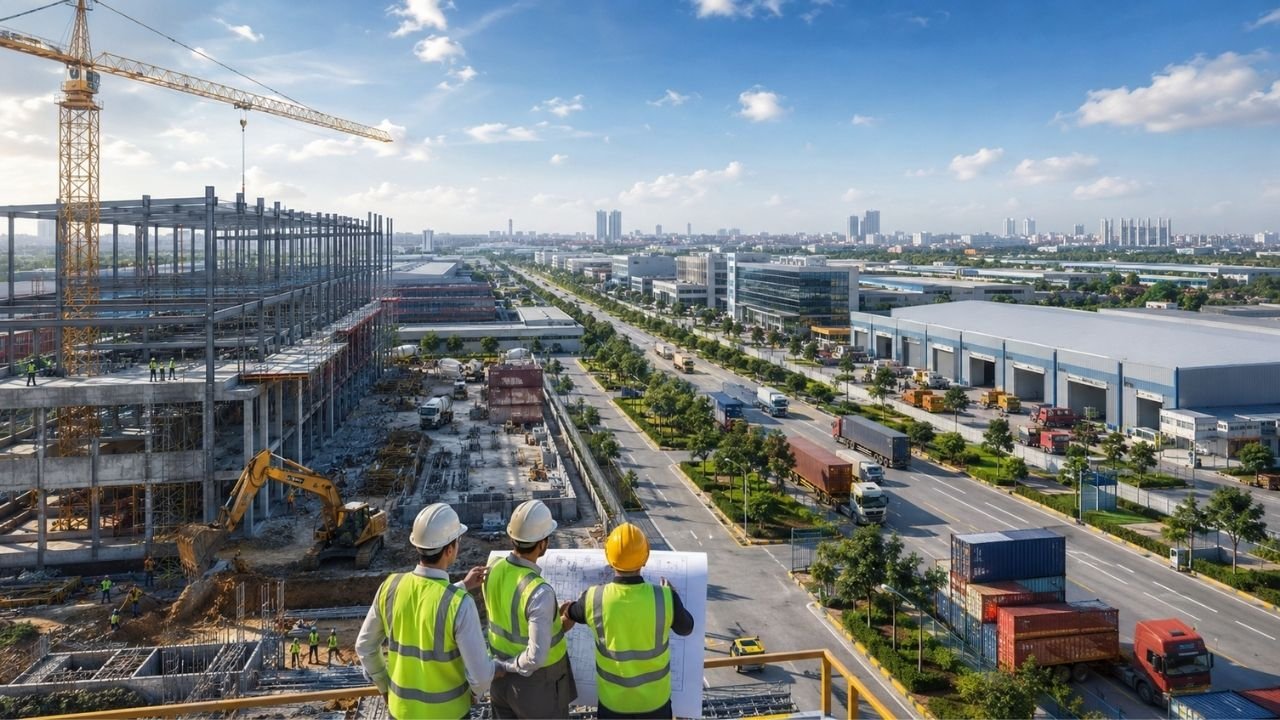
Starting a new production facility in India’s competitive industrial landscape is a high-stakes investment. Whether you are looking to secure a bank loan, apply for a government subsidy like PMEGP or MSME schemes, or pitch to private investors, your success begins with a single document: the Detailed Project Report (DPR). In 2026, knowing how to make dpr for manufacturing plant is no longer just a clerical task; it is a fundamental business strategy that determines whether your vision receives funding or faces rejection.
Many promising industrial projects in India fail before they even break ground because their DPRs are built on “rough guesses” rather than technical data. Banks and financial institutions are now more rigorous than ever, specifically looking for “Technical and Financial Viability”. A report with weak civil construction estimates or vague machinery costs is a major red flag that suggests a lack of planning. This guide provides a practical, step-by-step roadmap to help you prepare a robust, professional, and bankable detailed project report for manufacturing unit setup, ensuring that your capital requirements are justified and your project remains financially viable from day one.
What is a DPR for Manufacturing Plant and Why is it Important?
A Detailed Project Report (DPR) is the comprehensive blueprint of your entire business venture. Unlike a basic project summary, a DPR for manufacturing plant is a deep-dive document that covers everything from market demand and technical process flows to environmental impact and 10-year financial projections.
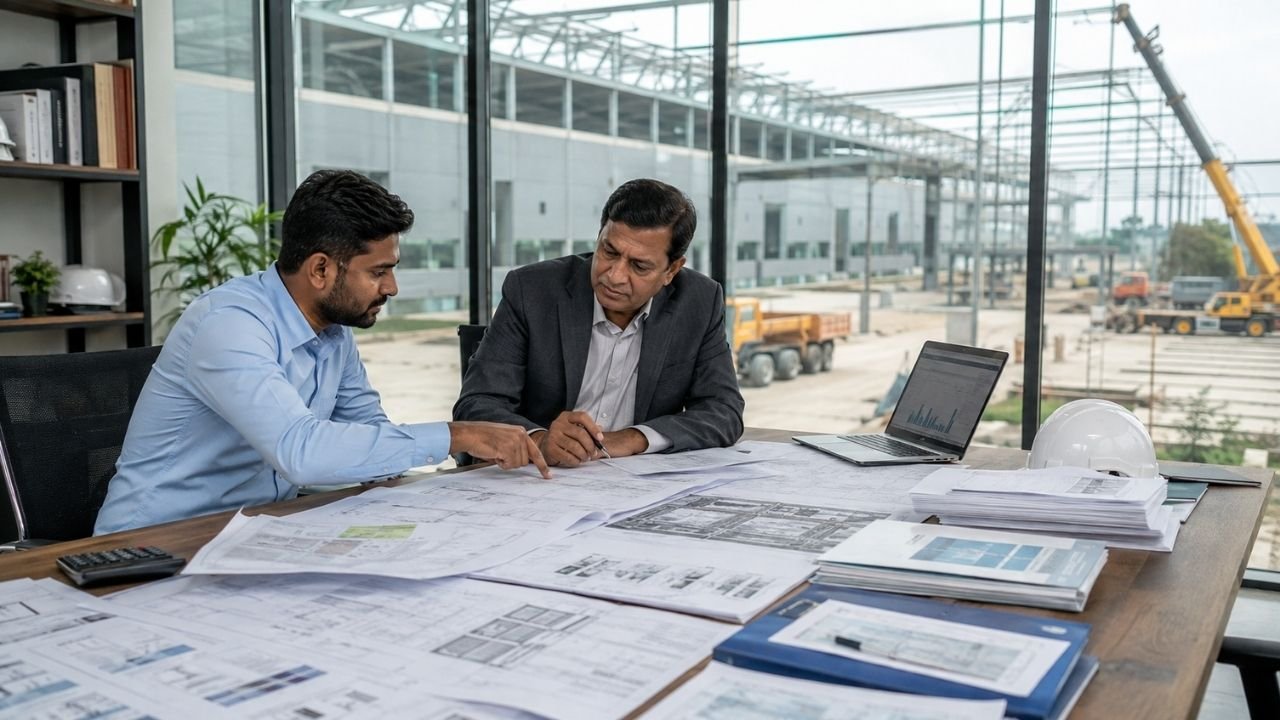
In the context of Indian manufacturing in 2026, the DPR serves three critical purposes:
- Loan Approval: Banks require a technical DPR to ensure the project can generate enough revenue to cover EMI payments (DSCR ratio).
- Operational Roadmap: It acts as the DNA of your facility, dictating how raw materials enter, how labor moves, and how finished goods are dispatched.
- Risk Mitigation: By calculating a detailed Bill of Quantities (BOQ) and project costs upfront, you avoid the “budget trap” where projects stall mid-way due to under-funding.
Key Sections of a Complete DPR for Manufacturing Plant
A professional manufacturing plant DPR sample typically follows a structured flow to provide clarity to stakeholders. Below is a breakdown of the essential components:
| DPR Section | What to Include | Why It Matters |
|---|---|---|
| Executive Summary | Brief overview of product, total cost, and promoter profile. | First impression for bank managers and investors. |
| Market Analysis | Demand-supply gap, competitor analysis, and target audience. | Proves there is a market for your product. |
| Technical Feasibility | Process flowchart, machinery specs, and power/water needs. | Shows how you will actually produce the goods. |
| Civil & Infrastructure | Factory layout (2D), construction costs, and land details. | Ensures the building supports the production flow. |
| Financial Projections | Balance sheets, P&L statements, and Break-Even Analysis. | Demonstrates the project’s profitability and repayment capacity. |
Step-by-Step Process – How to Make DPR for Manufacturing Plant
Learning how to prepare DPR for factory operations requires a systematic approach. Follow these steps to ensure nothing is missed:
- Define Your Product & Capacity: Clearly state what you are manufacturing and your installed vs. utilized capacity.
- Conduct Market Research: Validate your idea with real data. Get “Letters of Intent” from B2B clients if possible.
- Finalize Site & Location: Identify the industrial area and check for utilities like high-tension (HT) power lines.
- Select Machinery & Technology: Get formal quotations from suppliers to include as annexures.
- Calculate Total Project Cost: This includes land, civil construction, machinery, and working capital.
- Draft the Financial Statements: Project your sales, expenses, and cash flows for at least 5 to 7 years.
- Review Compliance & Licenses: List required permits like Pollution NOC (CTE/CTO), Fire NOC, and Factory License.
How to Prepare the Technical & Process Section
This section proves your technical competence. You must outline the step-by-step transformation of raw materials into finished products.
- Process Flowchart: A visual representation of each stage of production.
- Machinery Footprint: Detail the static and dynamic space required for each machine to ensure the factory layout is not congested.
- Quality Control: Explain your testing protocols and how you meet Indian or international standards (ISO, BIS).
- Utility Requirements: Be precise about your KVA load requirements and water consumption, as these impact your “Consent to Establish” from the Pollution Board.
How to Prepare the Cost Estimation & Financial Section (Most Critical Part)
This is where most entrepreneurs struggle. A bank will likely reject your application if they see a “lump sum” construction cost. At Construction Estimator India, we emphasize the BOQ Advantage.
To prepare a strong financial section, you need:
- Land & Site Development: Cost of plot and CLU (Change of Land Use) charges.
- Detailed Civil Cost: Don’t just guess ₹2,000 per sq ft. In 2026, factory construction costs vary based on whether you use PEB or RCC structures.
- Working Capital: Factor in at least 3–6 months of raw material and labor costs to avoid early-stage cash crunches.
- Contingency Fund: Always keep a 10–15% buffer for material price fluctuations (like steel or cement).
Common Mistakes to Avoid While Preparing Manufacturing Plant DPR
- Using Outdated Material Rates: Relying on 2024 or 2025 steel rates is a mistake. Prices for JSW/TATA steel have shifted significantly in 2026.
- Vague Civil Estimates: Submitting a single-line quote from a local contractor instead of an itemized Bill of Quantities (BOQ).
- Ignoring Future Expansion: Not designing a modular layout that allows for a second production line later.
- Underestimating Electrical/MEP Costs: Factoring in HT panels and transformers too late leads to massive budget overruns.
Documents and Data You Need Before Making the DPR
Before you begin writing, gather the following:
- Land Documents: Registry or lease deed.
- Quotations: At least three competitive quotes for major machinery.
- Professional Factory Layout: A technical 2D plan showing machinery placement and aisles.
- SBC Report: Soil Bearing Capacity report to justify foundation costs.
- Certified Cost Estimate: A professional estimate from an expert like Construction Estimator India to validate your construction budget.
How Accurate Civil Construction Cost Estimation Strengthens Your DPR
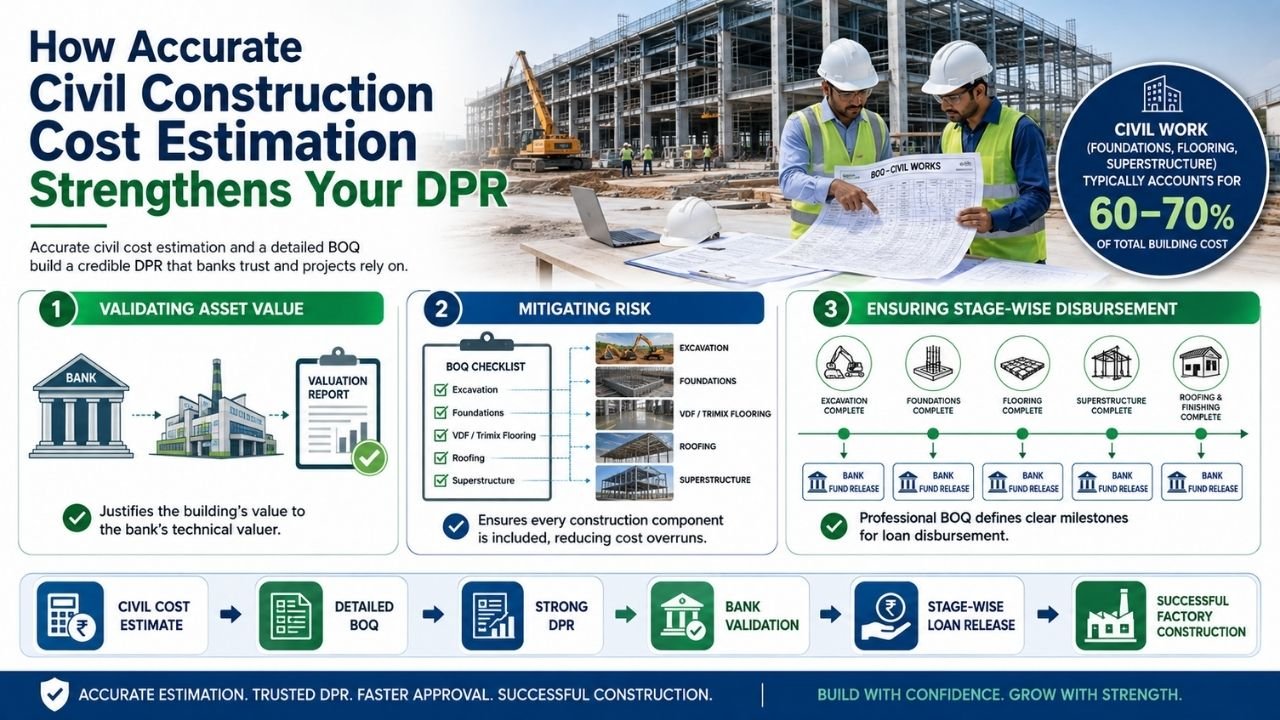
The civil work—including foundations, flooring (VDF/Trimix), and the superstructure—often accounts for 60-70% of the building’s cost. If your estimate is wrong, your loan amount will be wrong.
An accurate civil estimate strengthens your DPR by:
- Validating Asset Value: Justifies the building’s value to the bank’s technical valuer.
- Mitigating Risk: Proves that you have accounted for everything from excavation to roofing.
- Ensuring Stage-wise Disbursement: Banks release funds based on construction milestones; a professional BOQ sets clear triggers for these releases.
How Construction Estimator India Helps You Prepare a Strong DPR
At Construction Estimator India, we specialize in the most difficult part of the DPR: the Technical and Financial Costing. We bridge the gap between your vision and a bankable document.
- Bank-Ready BOQs: Our itemized Bill of Quantities meets the strict standards of major Indian banks.
- Realistic 2026 Pricing: We use current market rates for materials like TATA steel and Ultratech cement to ensure your budget is defensible.
- Layout Review: we analyze your 2D plans to optimize material flow and reduce waste.
- Technical Credibility: Our reports help position you as a serious, well-prepared industrialist.
Get DPR Guidance + Accurate Project Cost Estimate for Your Manufacturing Plant
Don’t risk your industrial investment with guesswork. A weak DPR can lead to years of delays or total project failure. Whether you are building a 5,000 sq ft small unit or a 50,000 sq ft automated plant, we provide the financial foundation you need.
Our Simple Process to Help You Succeed:
- WhatsApp Us: Share your manufacturing type (e.g., Plastic, Food Processing, Textiles, EV).
- Provide Details: Tell us your plot size, location, and desired production capacity.
- Get Results: Receive professional guidance on the DPR format for manufacturing industry plus a realistic project cost estimate/BOQ within 24–48 hours.
FAQ Section
- How long does it take to prepare a full DPR for a manufacturing plant?
A high-quality, professional DPR usually takes 7 to 15 days, depending on the complexity of the machinery and the level of technical detail required. - Can I prepare a DPR myself?
While you can draft the basic idea, a bank-ready DPR requires technical expertise in market research, financial forecasting, and civil engineering cost estimation. - What is the difference between a project profile and a DPR?
A project profile is a 2-3 page summary of the idea. A DPR is a 50-100 page technical and financial feasibility document. - Why do banks focus so much on the civil construction cost in the DPR?
Because the building is often the primary collateral. If the construction cost is over-inflated or under-estimated, it affects the bank’s security and the project’s viability. - Is a 2D factory plan mandatory for a DPR?
Yes, most banks require a professional 2D floor plan to understand the scale of operations and the technical logic of the facility. - Do I need to include a Pollution NOC in my DPR?
The DPR should include the plan for obtaining NOCs. The actual “Consent to Establish” is often required before the first loan disbursement. - How much does a factory construction cost per sq ft in 2026?
Standard PEB factory construction costs range from ₹1,400 to ₹2,400 per sq ft, while specialized units (like Pharma) can go much higher. - What is a BOQ and why is it essential for the DPR?
A Bill of Quantities (BOQ) is a line-item breakdown of every material (steel, cement, labor) needed. It prevents contractor overcharging and budget overruns.
Conclusion
Mastering how to make dpr for manufacturing plant is the first step toward turning your industrial dream into a physical reality. A strong DPR does more than just secure a loan; it provides a financial safety net and an operational roadmap for your success. In 2026, don’t rely on vague contractor quotes or outdated spreadsheets.
Are you ready to make your project bankable? Get the professional guidance and accurate civil cost estimation you need to protect your investment.
WhatsApp us now at +91 8630676890 for your custom DPR guidance and a realistic project cost estimate.