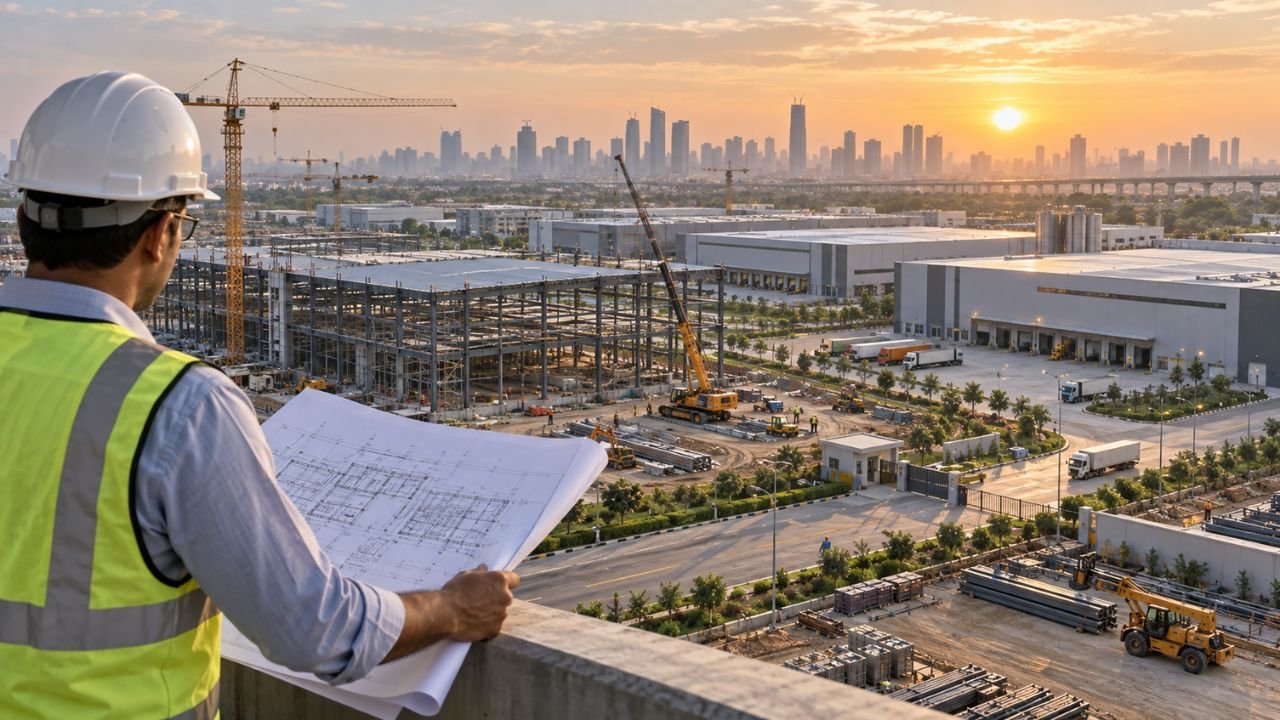
In many homes, workshops, and small factories across India—especially in cities like Agra, Lucknow, and Delhi NCR—garage floors often start showing damage within just a few years of construction. You might notice small cracks appearing on the concrete surface, pieces of concrete breaking off, or even powder-like dust forming whenever a vehicle moves in or out.
For homeowners and workshop owners, this can be frustrating.
Your garage floor is supposed to be strong enough to handle heavy loads, whether it’s a car, SUV, tractor, or even small commercial vehicles. But when the concrete begins to fail, the floor not only looks bad but can also become unsafe and difficult to maintain.
Some of the most common problems seen in Indian garages include:
- Surface cracks spreading across the floor
- Concrete spalling or flaking
- Oil and grease stains penetrating the surface
- Tyre abrasion damaging the concrete
- Dusting or powdering of the surface
- Expansion joints widening over time
Many homeowners attempt quick fixes such as applying plain cement slurry or basic cement mortar over the damaged surface. Unfortunately, these repairs often fail within months.
Why does this happen?
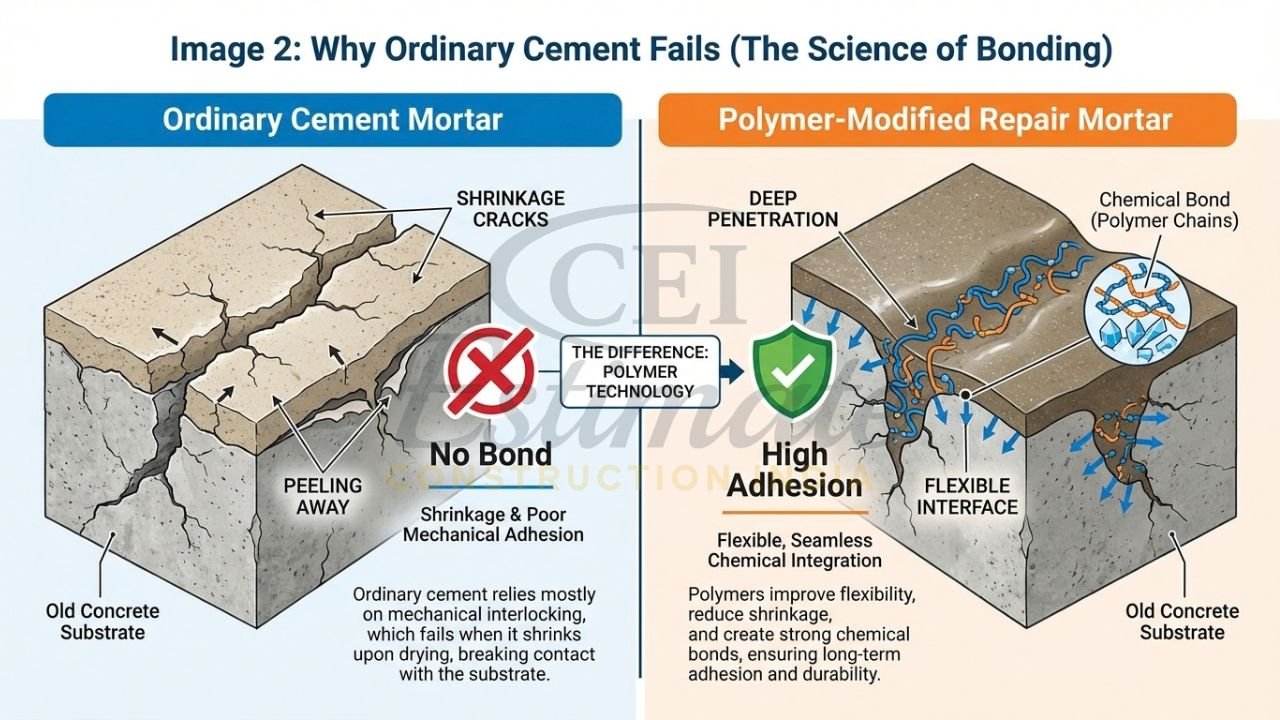
The reason is simple: ordinary cement is not designed for concrete repair applications. When used directly for patching old concrete floors, it often:
- Does not bond properly with the existing surface
- Shrinks during drying
- Cracks again under vehicle load
That is why modern construction professionals use specialized repair materials such as polymer modified repair mortars, epoxy repair mortars, and micro concrete repair systems.
Choosing the best cement for garage floor repair is the most important decision you can make if you want a repair that lasts 10–15 years instead of a few months.
In this detailed expert guide, we will explain everything you need to know about garage floor repair cement in India.
You will learn:
- The main causes of garage floor damage in Indian conditions
- Why ordinary cement repair fails
- The best concrete repair mortar for garage floors
- Top repair product brands available in India
- The step-by-step professional repair method
- Common mistakes that cause repairs to fail
Whether you are a homeowner repairing your garage floor, a contractor handling repair projects, or a workshop owner looking for long-lasting flooring, this guide will help you choose the best repair mortar for garage floors in India.
Why Garage Floors Fail in India?
Garage floors in India face a unique combination of mechanical stress, environmental exposure, and chemical damage. Many floors are constructed using basic concrete mixes without considering the heavy loads and abrasion they will face over time.
Let’s look at the main reasons garage floors deteriorate.
Heavy Vehicle Loads
Concrete garage floors must withstand the weight of vehicles and equipment.
For example:
- A typical SUV weighs 1800–2200 kg
- A commercial pickup vehicle can weigh 3000–3500 kg
- Workshops may handle tractors or machinery
If the concrete floor was originally constructed with a weak mix like M15 or M20, it may not have sufficient strength to handle repeated loads.
Over time, the concrete surface begins to crack and break down.
Tyre Abrasion
Vehicle tyres constantly move across the garage floor surface. This causes abrasion and friction, especially when vehicles turn while stationary.
This is common in:
- residential garages
- mechanic workshops
- parking basements
Tyre abrasion gradually removes the top layer of concrete, causing surface scaling and wear.
Oil and Chemical Spills
Garage floors frequently come in contact with:
- engine oil
- brake fluid
- diesel or petrol
- grease and lubricants
These chemicals penetrate the concrete pores and weaken the surface over time.
Oil contamination also makes it difficult for new repair materials to bond properly.
Poor Original Concrete Mix
Many residential garage floors in India are built using improper mix proportions.
Common mistakes include:
- excessive sand in the mix
- low cement content
- poor aggregate quality
- high water content
These mistakes lead to weak and porous concrete, which deteriorates faster.
Improper Curing
Concrete must be cured properly to achieve full strength.
Unfortunately, in many small construction projects, curing is neglected.
Without adequate curing:
- concrete becomes brittle
- cracks develop easily
- surface strength remains low
Temperature Changes in North India
Cities like Agra and Lucknow experience extreme temperature variations.
- Summers: 45°C heat
- Winters: cold nights
These temperature fluctuations cause thermal expansion and contraction, which can widen cracks in the concrete floor.
Monsoon Water Penetration
During monsoon season, water often enters garages due to poor drainage.
Repeated wetting and drying cycles cause:
- surface scaling
- cracking
- weakening of concrete
Common Types of Garage Floor Damage
Garage floor deterioration typically appears in the following forms:
Cracks
Small hairline cracks that gradually expand.
Spalling
Chunks of concrete breaking off.
Scaling
Surface layer peeling off.
Delamination
Repair layers separating from old concrete.
Dusting
Powder formation due to weak surface concrete.
These problems require the right garage floor repair materials in India to restore the floor properly.
Why Ordinary Cement Fails for Garage Floor Repair
Many homeowners assume that repairing a garage floor is as simple as mixing cement and sand and applying it over damaged areas.
However, using plain OPC or PPC cement mortar for repair rarely produces long-lasting results.
Here’s why.
Poor Bonding with Old Concrete
Old concrete surfaces become smooth and contaminated over time.
Ordinary cement mortar does not have the chemical bonding capability required to attach strongly to the existing surface.
As a result, the repair layer may separate or peel off within months.
High Shrinkage
Cement mortar tends to shrink during drying.
Shrinkage causes:
- cracks in repair patches
- separation from the original surface
This is one of the main reasons DIY garage floor repairs fail quickly.
Low Abrasion Resistance
Garage floors must resist constant friction from tyres and movement.
Ordinary cement mortar has lower abrasion resistance, so the repaired surface may wear out quickly.
Low Chemical Resistance
Oil, grease, and chemicals can easily penetrate ordinary cement mortar.
This weakens the repair material over time.
Slow Strength Gain
Many repair situations require quick strength gain, especially in garages where vehicles need to be parked again within a day or two.
Standard cement mortar takes longer to reach full strength.
Why Professionals Use Specialized Repair Mortars
To overcome these issues, engineers and contractors now use advanced repair materials.
These materials contain:
- polymer additives
- bonding agents
- shrinkage control chemicals
- high strength cement blends
As a result, they provide:
- superior bonding
- higher strength
- better durability
- improved chemical resistance
This is why professional contractors prefer polymer modified repair mortar for concrete floors instead of plain cement.
Best Materials for Garage Floor Repair in India 2026
Modern construction practice offers several advanced materials for repairing damaged garage floors.
Let’s explore the most effective repair systems used in India today.
Polymer Modified Repair Mortar
Polymer modified repair mortars are among the best repair mortar for garage floors in residential and commercial projects.
These mortars contain cement blended with polymer additives, which significantly improve performance.
Advantages
- excellent bonding to old concrete
- low shrinkage
- high compressive strength
- improved flexibility
- good abrasion resistance
Best Applications
- crack repair
- patching damaged areas
- spalling repair
- resurfacing small sections
Polymer modified mortars are widely used for garage floor repair cement in India.
Epoxy Repair Mortar
Epoxy repair mortars are used in heavy duty garages, factories, and workshops.
These materials are based on epoxy resins combined with aggregates.
Advantages
- extremely high strength
- excellent chemical & oil resistance
- fast curing
Best Applications
- industrial garages
- mechanic workshops
- parking areas with heavy vehicles
Epoxy mortars provide the strongest repair solution for concrete floors.
Micro Concrete / Flowable Repair Concrete
Micro concrete is a high-flow repair material used for larger repair areas.
It contains:
- high strength cement
- graded aggregates
- flow enhancing additives
Advantages
- self leveling
- excellent filling ability
- suitable for deep repairs
- high durability
Best Applications
- large floor resurfacing
- structural repairs
- deep void filling
Micro concrete is commonly used for industrial floor repair mortar in India.
Cementitious Overlay Screeds
This is a more economical repair option.
Overlay screeds involve applying a thin layer of cement-based topping over the existing floor.
Advantages
- relatively low cost
- easy to apply
- suitable for minor repairs
Limitations
- lower durability
- not suitable for heavy loads
- may crack if not properly bonded
Overlay screeds are suitable for light residential garages only.
Comparison Table of Garage Floor Repair Materials
| Material | Strength | Oil Resistance | Shrinkage | Best Use | Cost Level |
| Polymer Modified Mortar | High | Good | Low | Crack repair & patching | Medium |
| Epoxy Repair Mortar | Very High | Excellent | Very Low | Industrial garages | High |
| Micro Concrete | High | Moderate | Low | Large repairs | Medium |
| Cementitious Overlay | Moderate | Low | Moderate | Minor resurfacing | Low |
Top Repair Product Brands in India 2026
Several reliable brands supply high quality concrete repair products in India.
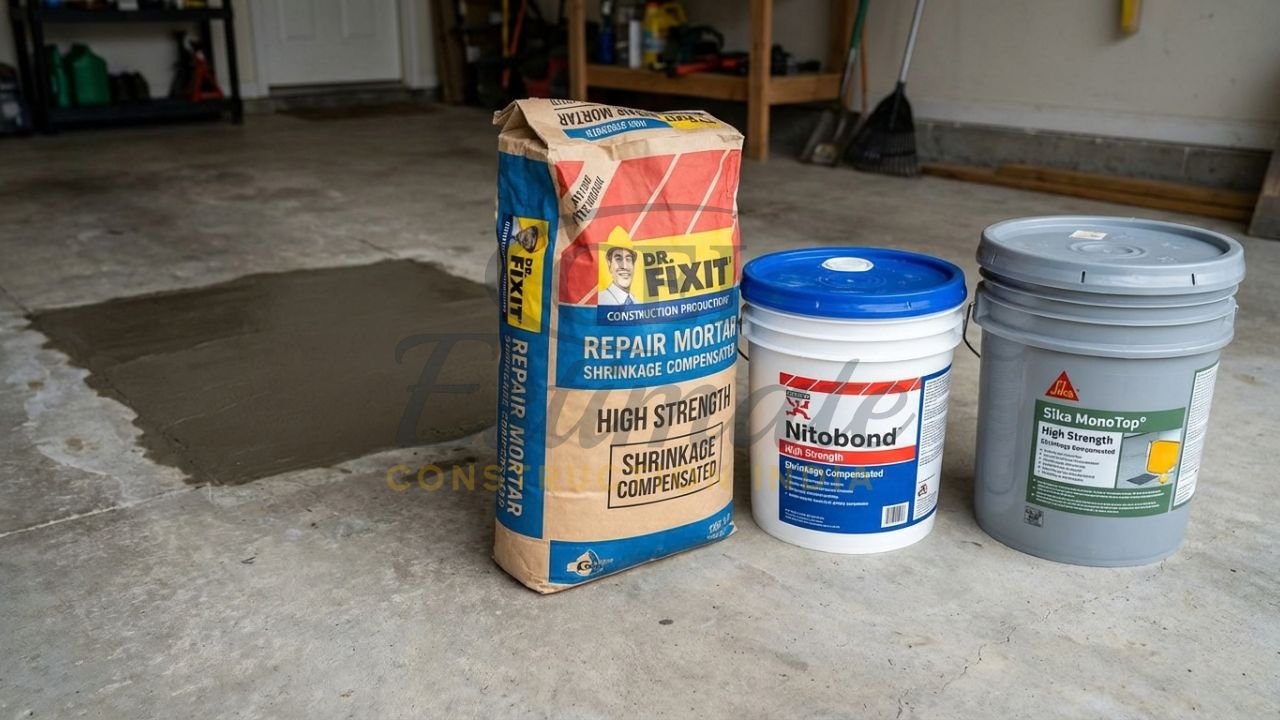
Dr Fixit (Pidilite)
Popular products include:
- Dr Fixit Repair Mortar
- Dr Fixit Polymer Mortar
Advantages:
- widely available
- easy to use
- good bonding strength
Approx price: ₹500–₹800 per bag.
Fosroc
Fosroc is widely used in professional construction projects.
Popular products:
- Renderoc repair mortars
- Nitobond bonding agents
Advantages:
- excellent durability
- trusted in infrastructure repairs.
Ardex Endura
Ardex Endura offers high performance flooring products.
Popular products:
- Ardex repair mortar
- Ardex floor leveling compounds
These are ideal for garage floor resurfacing cement in India.
Sika
Sika repair systems are used in major construction projects.
Popular products:
- Sika MonoTop repair mortars
- Sika epoxy repair systems
MYK Laticrete
MYK provides advanced repair mortars.
Advantages:
- strong bonding
- high durability.
UltraTech Repair Products
UltraTech also offers cement-based repair mortars for concrete repair.
BASF MasterEmaco
MasterEmaco repair mortars are used in heavy industrial repairs.
Advantages:
- extremely high strength
- superior durability.
Step-by-Step Garage Floor Repair Method Used by Professionals
Proper repair requires following a systematic process.
Step 1 – Inspection
Check the floor for:
- cracks
- spalling
- oil contamination
- loose concrete.
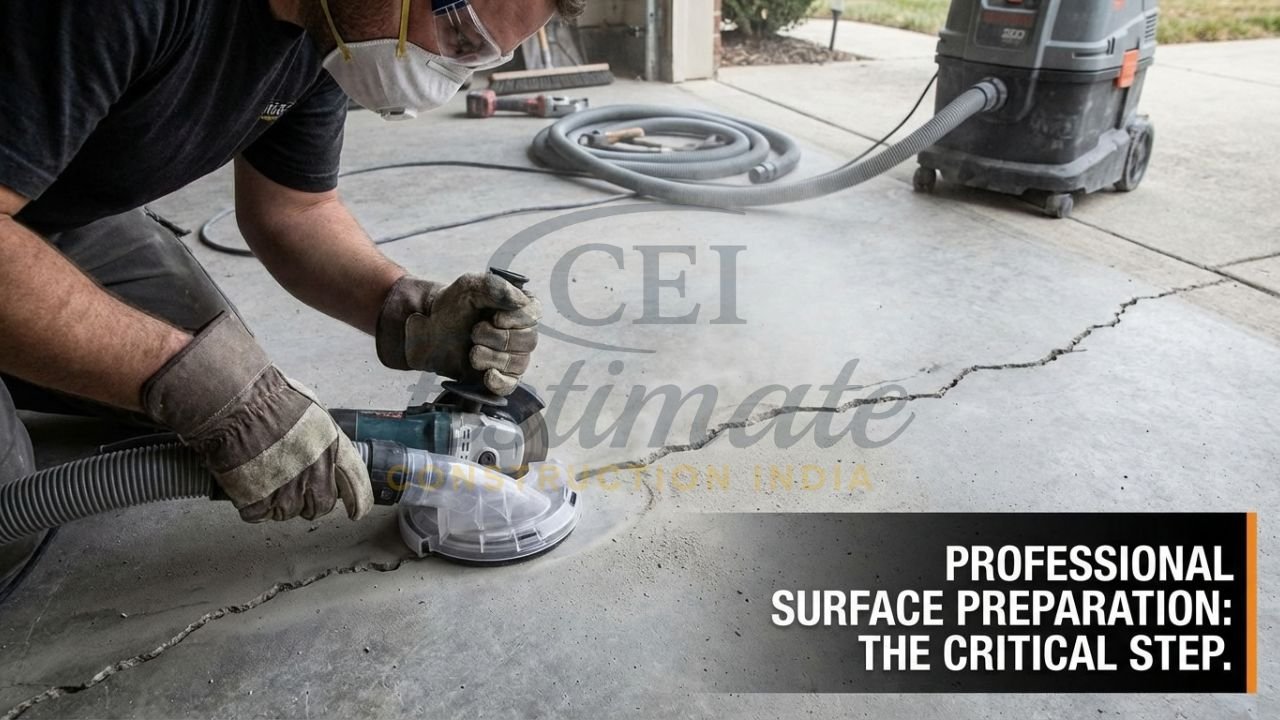
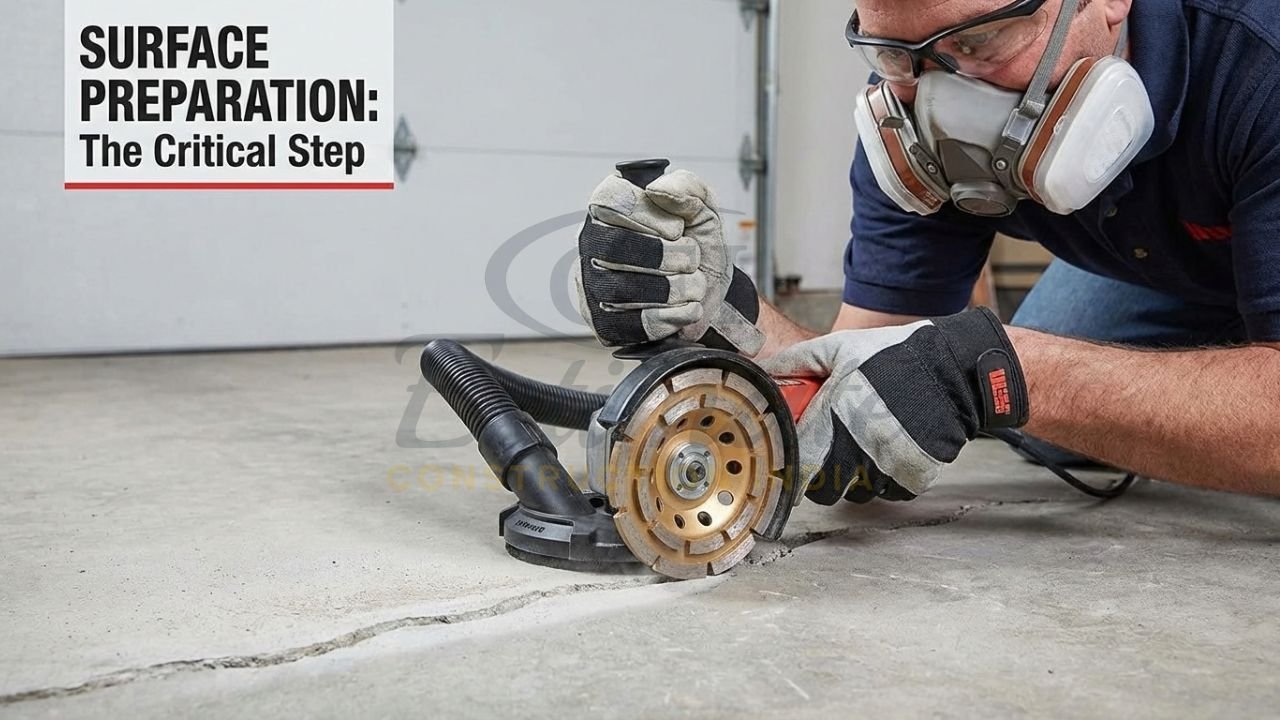
Step 2 – Surface Preparation
Remove weak concrete using:
- grinder
- chipping hammer
- wire brush.
Surface preparation is the most important step in concrete repair.
Step 3 – Crack Routing
Open cracks slightly using a grinder to allow repair material to penetrate.
Step 4 – Cleaning and Degreasing
Remove oil stains using:
- detergent
- degreasing chemicals.
Step 5 – Apply Bonding Primer
Apply bonding agents such as polymer bonding slurry.
This improves adhesion.
Step 6 – Mixing Repair Mortar
Follow manufacturer instructions carefully.
Avoid adding extra water.
Step 7 – Apply Repair Material
Fill cracks and damaged areas using repair mortar.
Compact properly.
Step 8 – Finishing and Leveling
Use trowels to smooth the surface.
Step 9 – Curing
Proper curing ensures strength development.
Keep repaired area moist for 3–7 days.
Step 10 – Apply Protective Coating
For better durability, apply:
- epoxy coating
- floor hardener
- sealant.
Common Mistakes That Cause Repair Failure
Many repairs fail due to basic mistakes.
Poor Surface Preparation
Repair material cannot bond to loose concrete.
Applying Repair on Oily Surface
Oil contamination prevents bonding.
Adding Too Much Water
Excess water reduces strength.
Skipping Bonding Primer
Bonding agents are essential for adhesion.
Inadequate Curing
Without curing, repair mortar becomes weak.
FAQs
Can I repair garage floor using OPC cement?
It is not recommended. Specialized repair mortars provide better bonding and durability.
Which repair mortar is best for garage floors?
Polymer modified repair mortars are generally the best option.
How long does garage floor repair last?
Proper repairs can last 10–15 years or more.
Is epoxy repair better than cement repair?
Epoxy repairs are stronger but more expensive.
What is the cost of garage floor repair in India?
Typically ₹80–₹300 per square foot depending on material and damage.
Can cracks in garage floors be permanently fixed?
Yes, using proper repair mortars and correct preparation.
Is resurfacing better than patch repair?
Resurfacing is better when the entire floor surface is damaged.
How long before vehicles can be parked after repair?
Usually 24–48 hours depending on material used.
What is the best repair mortar for garage floor cracks?
Polymer modified repair mortars work best.
Do garage floors need protective coating after repair?
Yes, coatings improve durability and chemical resistance.
Conclusion
Garage floors are exposed to heavy loads, chemical spills, and continuous abrasion, which makes them one of the most stressed surfaces in any building.
When damage occurs, using ordinary cement for repairs rarely works. Plain cement mortar does not provide the bonding strength, abrasion resistance, or durability required for garage environments.
Modern repair systems such as polymer modified repair mortars, epoxy repair mortars, and micro concrete repair materials provide far better results.
For most residential garages, polymer modified repair mortar is the best cement for garage floor repair in India because it offers strong bonding, low shrinkage, and long-lasting performance.
For heavy-duty workshops and industrial garages, epoxy repair systems provide the highest durability.
By selecting the right repair material and following proper repair techniques, garage floors can be restored to strong, durable, and long-lasting condition.
Need expert guidance for garage floor repair material selection, exact quantity calculation, or complete repair cost estimate?
WhatsApp: +91 8630676890