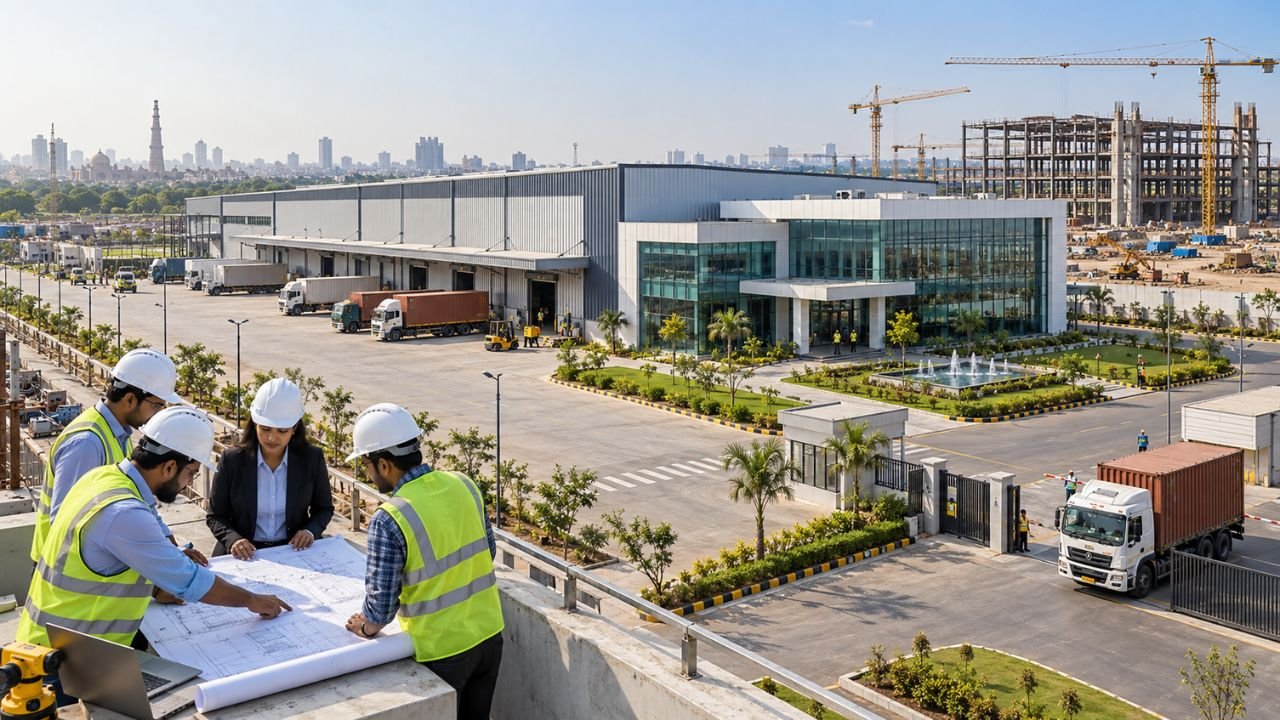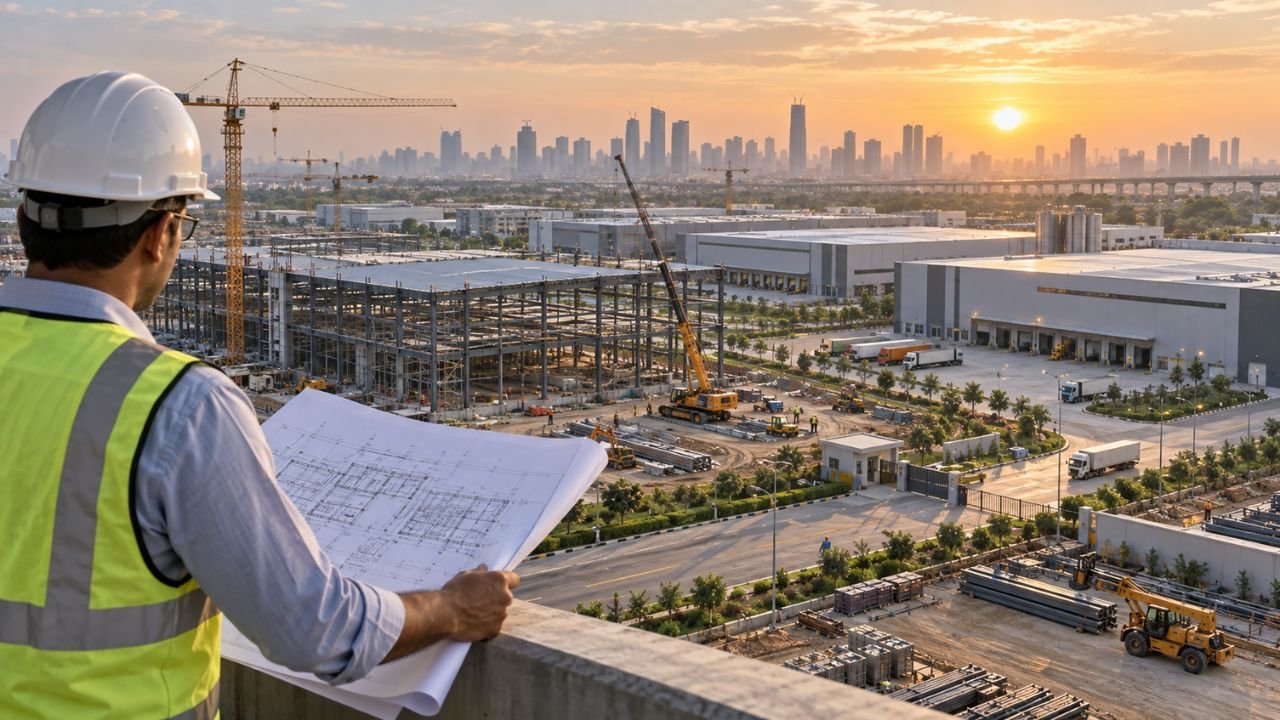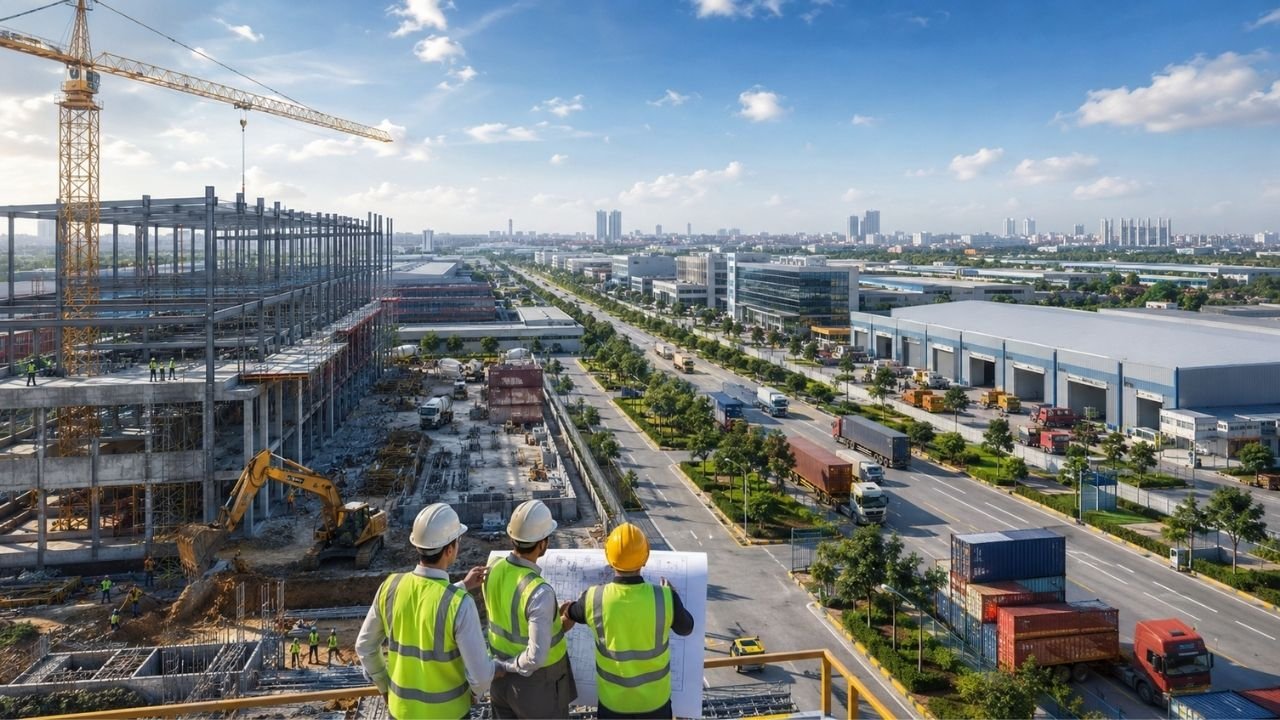
India is rapidly transforming into a global manufacturing powerhouse. For entrepreneurs and industrial investors, the dream of setting up a factory often begins with a piece of land. However, most available land in India is classified as “Agricultural,” and you cannot simply start construction on it without legal authorization. Learning how to change agricultural land to industrial is the first and most critical hurdle you will face. Failing to follow the proper agricultural land to industrial conversion process can lead to severe legal penalties, demolition orders, and project stalling.
In 2026, the demand for industrial space is at an all-time high, but the legal framework remains complex and varies significantly across different states. Whether you are planning a small MSME unit or a massive manufacturing plant, understanding the land use conversion agricultural to industrial pathway is essential for your project’s viability. This guide provides a comprehensive roadmap for how to convert agri land to industrial, covering authorities, documentation, and the subsequent construction planning.
At Construction Estimator India, we bridge the gap between land acquisition and physical reality. Once you understand the conversion process, your next step is a bankable construction estimate. We specialize in providing the “BOQ Advantage”—a detailed Bill of Quantities that prevents budget overruns. If you are ready to plan your industrial setup, you can share your land details with us via WhatsApp at +91 8630676890 for an expert estimate within 24–48 hours.
Why Agricultural Land Needs Official Conversion for Industrial Use
In India, land is a state subject, and its usage is strictly regulated to balance food security with industrial growth. By default, land not designated for other purposes is considered agricultural. Using it for any other intent—known as NA conversion for industrial purpose (Non-Agricultural)—without approval is illegal.
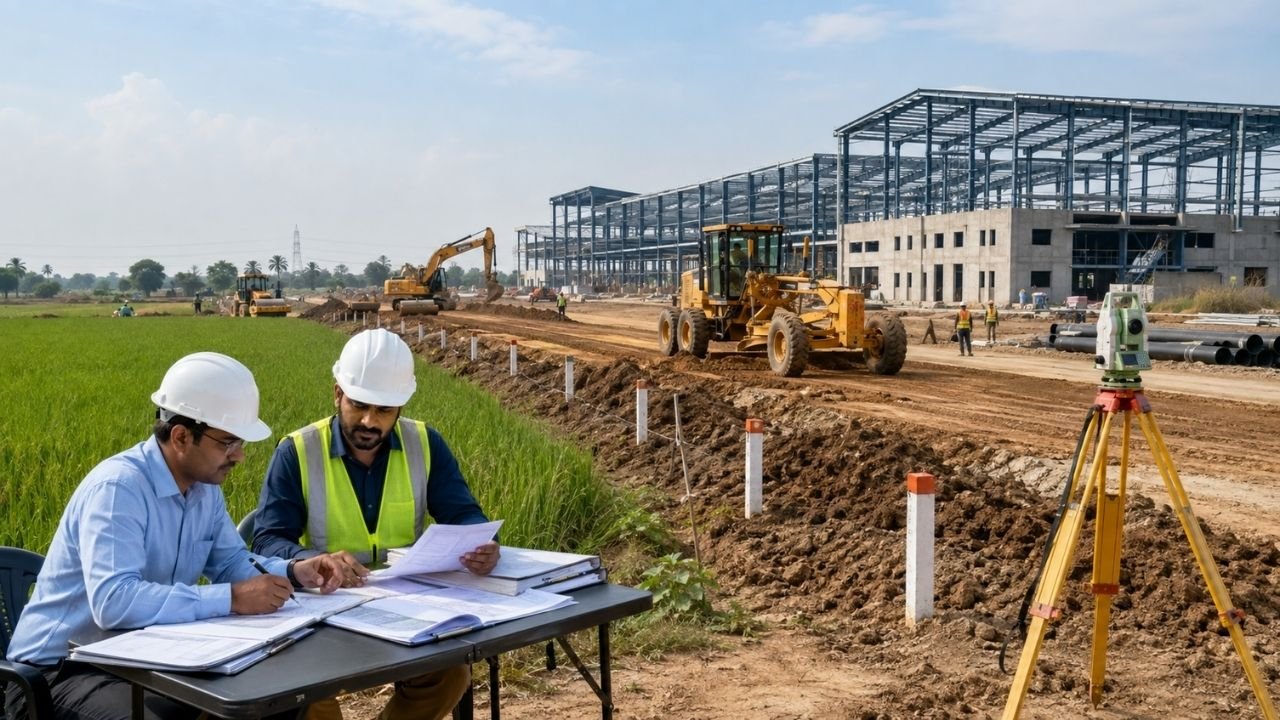
There are three primary reasons why an official conversion is mandatory:
- Legal Compliance: Operating an industrial unit on agricultural land violates the State Land Revenue Code. This can result in the government reclaiming the land or imposing heavy fines.
- Financing and Loans: Banks and financial institutions will never release industrial loans or MSME financing unless the land has a clear “Industrial Use” title or a Change of Land Use (CLU) certificate.
- Infrastructure Access: Official conversion is often a prerequisite for obtaining industrial-grade electricity, water connections, and pollution control board (NOC) clearances.
General Process to Change Agricultural Land to Industrial
The agricultural to industrial land conversion process India follows a structured administrative path. While the specific names of forms may change between states (like “7/12 extract” in Maharashtra or “Khata” in Karnataka), the core logic remains the same.
The process generally involves:
- Checking the Master Plan/Zoning of the area.
- Filing a formal application for Change of Land Use (CLU).
- Obtaining No Objection Certificates (NOCs) from various departments.
- Paying the mandatory conversion fees and premiums.
- Receiving the final conversion order or “Sanction Letter.”
It is important to note that you must verify whether the land falls within a “Controlled Area,” “Urban Area,” or “Industrial Zone” defined by the state’s Town and Country Planning department before purchasing, as some agricultural lands are strictly protected and cannot be converted.
Key Authorities Involved in Land Conversion
Navigating the bureaucracy requires knowing which office to visit. Depending on the state and the size of the land, multiple authorities may be involved.
| Stage | Authority | Key Requirement |
|---|---|---|
| Primary Application | District Collector / Sub-Divisional Magistrate (SDM) | Verified land ownership and intent of use. |
| Verification | Tehsildar / Revenue Department | Verification of land records and absence of disputes. |
| Technical Approval | Town and Country Planning (TCP) | Alignment with the district master plan and zoning laws. |
| Industrial Clearance | State Industrial Development Corporation (e.g., UPSIDC, MIDC, RIICO) | Specific industrial feasibility and utility planning. |
| Environmental NOC | State Pollution Control Board (SPCB) | Assessment of the industrial impact on the environment. |
Documents Required for Agricultural to Industrial Land Conversion
Before you ask how to convert agri land to industrial, you must ensure your paperwork is flawless. Missing a single document can lead to months of delays.
The standard document checklist includes:
- Original Sale Deed: Proof of ownership and the title of the land.
- Record of Rights and Tenancy (RTC) / 7/12 Extract: To verify current land usage and owners.
- Mutation Entry: Proof that the land transfer has been recorded in the government’s revenue records.
- Zoning Certificate: Issued by the Town Planning authority to show the land’s current zone.
- No-Dues Certificate: From the local Gram Panchayat or Municipality.
- Site Plan and Layout: A detailed map showing the boundaries and the proposed industrial setup.
- Project Report: A brief overview of the manufacturing activity you intend to conduct.
- ID and Address Proof: Of the applicant or the company directors.
Step-by-Step Process to Apply for Land Use Conversion
Follow these steps to successfully navigate the land use conversion agricultural to industrial pathway:
- Zoning Verification: Visit the local Town Planning office to confirm the land can be used for industrial purposes according to the Master Plan.
- Submit the Application: File the application form (often Form A or similar) with the District Collector or the designated Revenue Authority.
- Revenue Department Verification: The Tehsildar will conduct a field visit to check the boundaries and ensure there are no legal disputes or encroachments.
- Obtain NOCs: You will need clearances from the Fire Department, Health Department, and the State Pollution Control Board.
- Technical Scrutiny: The Town and Country Planning department reviews your site layout to ensure it meets setbacks, road width requirements, and utility access.
- Payment of Fees: Once the preliminary approval is granted, you must pay the conversion fee, which is often calculated as a percentage of the land’s circle rate.
- Issuance of CLU/NA Certificate: After all conditions are met, the authority issues the formal order converting the land to industrial status.
Important Points & State-wise Variations to Keep in Mind
Land laws in India are diverse. Land conversion rules vary significantly from state to state (and even within states). You must verify the latest process with the local Revenue Department or Industrial Development Corporation of your specific state.
- Maharashtra: Focuses heavily on the “Collector’s Permission” and the 7/12 extract.
- Uttar Pradesh: Uses the “Section 143” (now replaced by new codes) process for conversion through the SDM.
- Gujarat: Known for more streamlined “Impact Fee” systems but has strict environmental zones.
- Karnataka: Requires a “Conversion Fine” and has specific rules for land within the BMDA or similar urban limits.
Note: Always check if your industry falls under the “Green,” “Orange,” or “Red” category, as this dictates the difficulty of obtaining conversion and environmental clearances.
Common Challenges and How to Avoid Delays
The journey of how to change agricultural land to industrial is often fraught with administrative hurdles.
- Title Disputes: Ensure the land has a “Clear and Marketable Title.” Hire a lawyer to perform a 30-year search.
- Inadequate Road Width: Many states require a minimum road width (often 9 to 12 meters) for industrial conversion. If your land is on a narrow village path, conversion may be rejected.
- Environmental Restrictions: Lands near forests, rivers, or heritage sites may have “No Development Zone” restrictions.
- Incomplete Documentation: Ensure all names on land records match your ID exactly to avoid “clerical error” rejections.
Cost Factors Involved in Land Conversion + Factory Construction
Understanding the total project cost is vital for manufacturing entrepreneurs. The expenses are split into two major phases:
1. Land Conversion Costs
- Conversion Fee: Paid to the government, varying by state (often 1% to 10% of the land value).
- Professional Fees: For consultants, surveyors, and legal experts.
- Infrastructure Charges: Fees for road access, drainage, and external electricity connection.
2. Factory Construction Costs
Once the land is converted, the civil construction becomes your largest expense. In 2026, average factory construction cost in India ranges between ₹1,400 and ₹3,200 per sq ft.
| Structure Type | Estimated Cost (per Sq Ft) |
|---|---|
| Basic PEB Industrial Shed | ₹1,400 – ₹1,800 |
| Standard Factory Building | ₹1,800 – ₹2,400 |
| RCC Industrial Building | ₹2,200 – ₹3,200 |
Note: These are civil costs only. Industrial flooring like Trimix or VDF and specialized MEP (Mechanical, Electrical, Plumbing) systems will add to these totals.
How Construction Estimator India Helps After Land Conversion
Securing your land conversion is only half the battle. The real challenge for manufacturing owners is managing cash flows and avoiding the “unforeseen expenses” trap. Most investors rely on “lump sum” quotes from local contractors, which often lead to 20-30% budget overruns halfway through the build.
At Construction Estimator India, we help you plan the entire construction budget with precision:
- Detailed Quantity Takeoff: We calculate exactly how many tons of steel and bags of cement your factory needs.
- Customized BOQ: We provide a Bill of Quantities that helps you negotiate with contractors from a position of strength.
- Bankable Estimates: Our professional documentation is designed to satisfy bank requirements for industrial loans.
- Cost Control: We identify areas where you can optimize the structure (like choosing PEB over RCC where appropriate) to save costs without sacrificing quality.
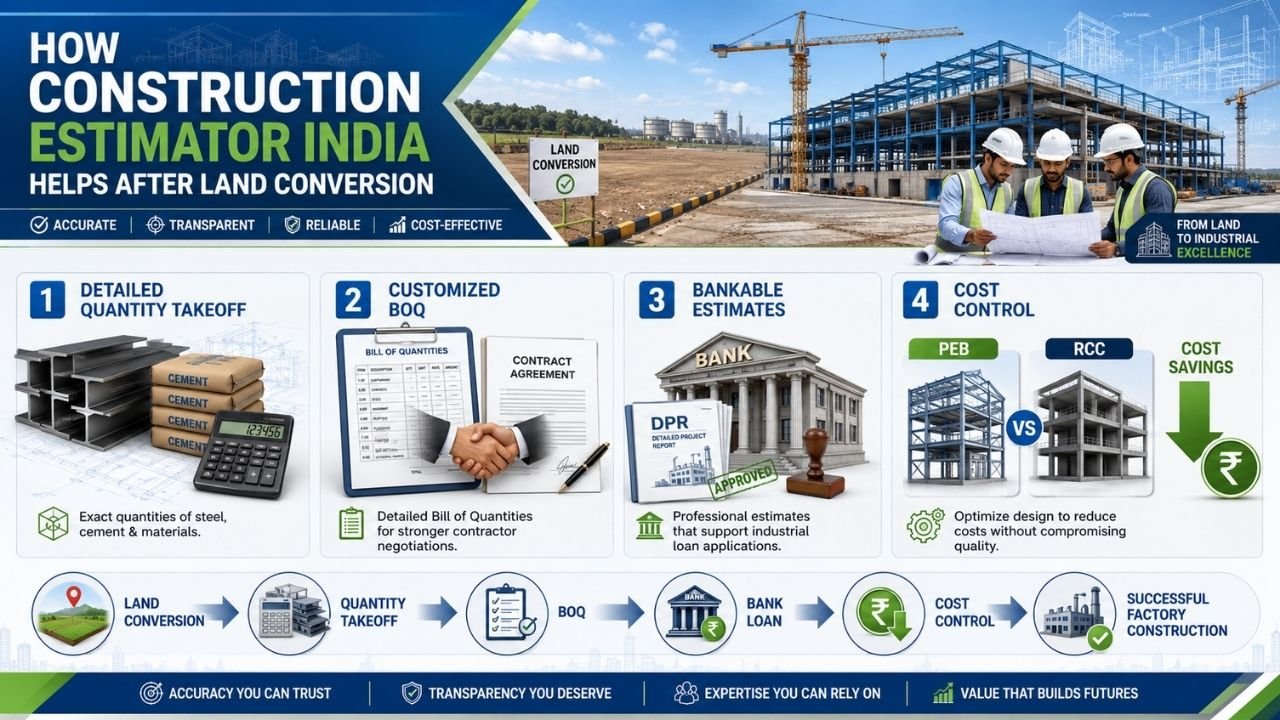
Get Land Conversion Guidance + Accurate Factory Construction Cost Estimate
Don’t let your industrial dream get stuck in paperwork or bankruptcy. Whether you are in the early stages of land selection or have just received your conversion certificate, we are here to help.
Our Simple 3-Step Process:
- Connect with our industrial experts on WhatsApp at +91 8630676890.
- Share your land location, size, and intended industrial use (e.g., food processing, textile, warehouse).
- Receive land conversion process guidance and a realistic construction cost estimate within 24–48 hours.
Contact Construction Estimator India Today
- WhatsApp / Call: +91 8630676890
- Service: Accurate Industrial BOQ & Cost Estimation
- Expertise: Helping investors transition from agricultural land to functional factories.
FAQ: Real Questions Landowners and Entrepreneurs Ask
Q1: How long does the agricultural to industrial land conversion process take?
Typically, it takes 3 to 6 months, depending on the state and the efficiency of the local revenue department. However, environmental clearances can extend this timeline.
Q2: Can I start construction while the conversion application is pending?
No. Starting construction without a formal CLU or NA certificate is illegal and can result in demolition orders and heavy penalties.
Q3: Is the conversion fee a one-time payment?
Yes, the conversion fee or premium is usually a one-time payment to the state government. However, there might be annual non-agricultural taxes thereafter.
Q4: Can I convert any agricultural land to industrial?
No. Land designated as “Primarily Agricultural” or located in protected ecological zones, or land without adequate road access, may be ineligible for conversion.
Q5: What is the difference between PEB and RCC for my new factory?
PEB (Pre-Engineered Buildings) are generally 20-30% cheaper and faster to build for large-span sheds. RCC (Reinforced Concrete) is better for multi-story or high-fire-risk industries.
Q6: Does the cost per sq ft for construction include GST?
Most construction estimates are quoted excluding GST. You should factor in an additional 18% GST on construction services.
Q7: Do I need a separate license for the manufacturing industry?
Yes, land conversion is just the physical compliance. You will also need factory licenses, GST registration, and MSME certificates to operate.
Q8: Why do I need a professional BOQ?
A professional BOQ ensures you don’t overpay for materials and prevents contractors from hitting you with “hidden costs” later.
Conclusion
Understanding how to change agricultural land to industrial is the foundation of your manufacturing success in India. While the legal journey through revenue departments and town planning offices can be daunting, following the systematic agricultural land to industrial conversion process ensures your investment is secure and bankable.
Once the legalities are in place, the focus shifts to execution. Don’t leave your factory’s budget to chance. By partnering with Construction Estimator India, you gain the clarity of a professional BOQ and a realistic roadmap for your construction costs.
Ready to start?
WhatsApp your land details and project requirements to +91 8630676890 for a professional estimate now!