In 2026, India is no longer just “emerging” as a manufacturing powerhouse; it has firmly established itself as a global industrial hub under the “Make in India” 2.0 initiative. For any entrepreneur, the journey from a vision to a functional factory floor begins with two critical pillars: legal compliance and structural planning. At the heart of this legal framework is the GST registration for manufacturing unit setup. Whether you are building a small MSME unit or a massive industrial plant, obtaining a Goods and Services Tax (GST) number is the “identity card” your business needs to operate legally, claim input tax credits, and supply goods across state borders.
Failing to secure your GST registration on time can lead to more than just legal penalties; it can stall your entire project. Without a GSTIN, you cannot apply for industrial electricity connections, open a current bank account, or even procure raw materials and machinery without losing a significant chunk of money to non-refundable taxes. At Construction Estimator India, we understand that while you are navigating the complexities of the GST portal, you are also likely worried about rising material costs and construction timelines. This guide is designed to simplify the GST registration for manufacturing business owners, providing a clear roadmap for compliance while ensuring you have the data-backed project cost estimates needed to build your dream facility.
Is GST Registration Mandatory for Manufacturing Units?
The short answer is: Yes, for almost every manufacturing business in 2026, mandatory GST registration for manufacturing is a reality. The Indian government has integrated GST into every facet of industrial growth. Even if your initial turnover is low, the nature of manufacturing—which involves purchasing raw materials from various vendors and potentially selling across state lines—makes registration essential.
Registration is not just a burden; it is a strategic advantage. It allows you to claim Input Tax Credit (ITC) on the GST you pay for your factory’s machinery, raw materials, and even certain construction services. Without this, your production cost would be 18% to 28% higher than your registered competitors. If you are currently in the planning phase, you can connect with our experts via WhatsApp at +91 8630676890 to get a head start on your project cost estimation while you process your GST application.
GST Registration Threshold for Manufacturing Businesses
Understanding the financial limits is crucial to avoid penalties. In 2026, the following threshold limits apply for the GST registration for factory setups:
- Standard Limit for Goods: For most states in India, if your annual aggregate turnover exceeds ₹40 Lakhs, registration is mandatory.
- Special Category States: In north-eastern and hilly states (like Uttarakhand, Himachal Pradesh, etc.), the threshold is often reduced to ₹20 Lakhs.
- Inter-State Supply: This is the “Manufacturer’s Trap.” If you intend to sell even one unit of your product outside your home state, GST registration is mandatory from day one, regardless of your turnover.
- E-commerce Supply: If you plan to sell your manufactured goods through platforms like Amazon, Flipkart, or your own website, you must have a GST registration.
Documents Required for GST Registration of Manufacturing Unit
To ensure a smooth GST registration process for manufacturers India, you must have your documentation ready. Errors in documents are the leading cause of application rejection.
| Document Category | Required Items | Purpose |
|---|---|---|
| Identity Proof | PAN Card of the Business & Aadhar Card of Promoters | Primary identification of the entity and owners. |
| Constitution Proof | Partnership Deed / Incorporation Certificate / MOA & AOA | Defines the legal structure of the manufacturing unit. |
| Address Proof (Factory) | Electricity Bill / Property Tax Receipt / Rent Agreement | Proof of the physical location of the manufacturing unit. |
| Authorization Proof | Board Resolution or Letter of Authorization | Designates the person responsible for GST compliance. |
| Bank Details | Cancelled Cheque or Bank Statement | Required for future GST refunds and financial tracking. |
Step-by-Step Process to Apply for GST Registration
If you are wondering how to register GST for manufacturing unit, the process is now entirely digital. Follow these steps for 2026 compliance:
- Generate TRN (Temporary Reference Number): Visit the GST Portal, enter your PAN, mobile number, and email. You will receive an OTP to generate your TRN.
- Submit Part-B of Application: Log in with your TRN and fill in the detailed information. This includes your business name, place of business (factory address), and the HSN codes for the goods you manufacture.
- Upload Documents: Upload clear, scanned copies of the documents mentioned in the table above. Ensure the factory address matches your electricity bill exactly.
- Verification & ARN: Once submitted, the application is verified via EVC or Digital Signature (DSC). You will receive an Application Reference Number (ARN).
- Site Inspection (Optional): In some industrial categories, a GST officer may conduct a physical verification of your manufacturing unit before approving the registration.
- Grant of Registration Certificate: If all is in order, you will receive your GST Certificate (Form REG-06) within 7–10 working days.
Types of GST Registration Relevant for Manufacturers
Not all registrations are the same. Choosing the wrong type can impact your cash flow:
- Regular Scheme: Most manufacturers choose this. You can collect GST from customers and claim ITC on all your inputs.
- Composition Scheme: Available for small manufacturers with turnover up to ₹1.5 Crores. You pay a lower fixed rate (typically 1%) but cannot claim ITC and cannot perform inter-state sales.
- Casual Taxable Person: If you are setting up a temporary manufacturing stall at an industrial expo in another state, this short-term registration is required.
Common Mistakes to Avoid During GST Registration
Many factory owners face delays because of simple errors. Avoid these to stay on track:
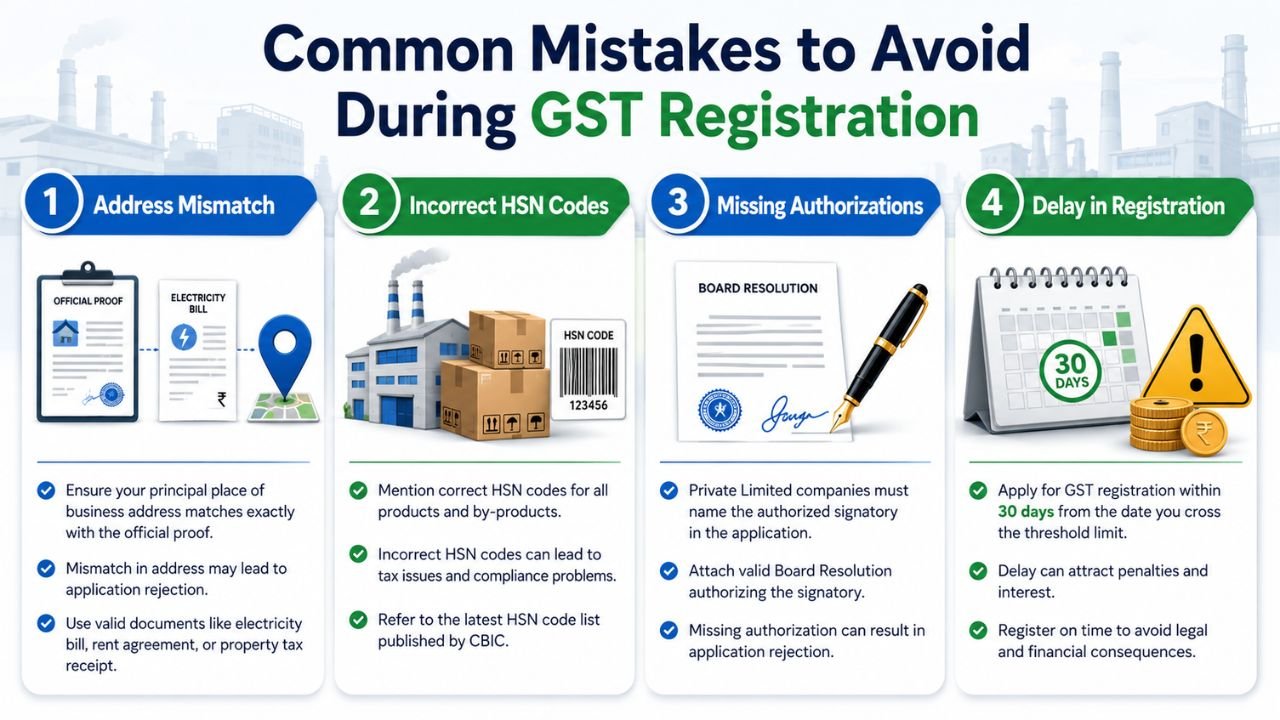
- Address Mismatch: The address on your GST application must be an exact match with your electricity bill or NOC from the landlord. Even a minor typo can lead to a “Notice for Clarification.”
- Incorrect HSN Codes: Manufacturing units often produce multiple by-products. Ensure every product is mapped to the correct HSN code to avoid future tax disputes.
- Missing Authorizations: If your business is a Private Limited company, ensure the Board Resolution specifically names the authorized signatory.
- Delay in Registration: If you cross the threshold, you must apply within 30 days. Penalties for late registration can be as high as 10% of the tax due or ₹10,000, whichever is higher.
How GST Registration Connects with Factory Setup & Project Costing
This is where your legal paperwork meets your physical construction. For a manufacturing unit, the industrial factory building cost per sq ft is a major capital expenditure. Interestingly, GST plays a huge role here:
- ITC on Capital Goods: When you buy heavy machinery or PEB (Pre-Engineered Building) structures, you pay 18% GST. With a valid registration, you can claim this back, effectively reducing your setup cost by 18%.
- BOQ for Bank Loans: Banks require a professional Bill of Quantities (BOQ) and a valid GSTIN before releasing industrial loans.
- Construction Material Planning: GST rates on cement (28%) and steel (18%) are high. Accurate project costing ensures you buy the right quantities, preventing tax wastage on unused materials.
How Construction Estimator India Helps Manufacturing Units During Setup
While you handle the legalities of GST registration for manufacturing unit setup, we handle the technical precision of your budget. Construction Estimator India bridges the gap between your factory floor plan and a bankable reality.
- Accurate Quantity Takeoff: We calculate the exact kg of steel and cubic meters of concrete required, so your GST invoices from vendors match your actual needs.
- 2026 Market Pricing: Our estimates reflect the current 5-8% annual increase in labor and material rates.
- Cost Control: We help you optimize your factory design (like span width or flooring type) to save 10-15% on total civil costs.
Get GST Registration Guidance + Accurate Project Cost Estimate
Don’t let your manufacturing dream get buried in paperwork or unexpected construction bills. We offer a dual-support system to get your unit running.
Our Simple Process:
- Connect: Message us on WhatsApp at +91 8630676890.
- Share: Tell us your manufacturing type, factory location, and plot size.
- Receive: Get expert guidance on your GST requirements and a realistic project cost estimate (BOQ) within 24–48 hours.
WhatsApp Construction Estimator India at +91 8630676890 for a free preliminary consultation today!
FAQ: Real Questions Manufacturing Owners Ask
Q1: Can I apply for GST before my factory construction is complete?
Yes. You can (and should) apply using your land documents or rent agreement for the plot to claim ITC on the construction materials and machinery you purchase during the setup phase.
Q2: Is GST mandatory for MSME manufacturing units?
MSME is a categorization for subsidies and loans. GST is a tax requirement. If your MSME unit crosses the turnover threshold or sells inter-state, GST is mandatory regardless of MSME status.
Q3: Can I use agricultural land for my factory GST address?
No. You must first obtain a CLU (Change of Land Use) certificate. GST registration requires proof of “Place of Business,” which must be legally authorized for industrial use.
Q4: What is the GST rate on factory construction services?
As of 2026, the standard GST on construction services for industrial buildings is 18%.
Q5: How much does a professional BOQ for a 10,000 sq ft factory cost?
The cost varies based on complexity. However, getting an estimate from Construction Estimator India is a small investment that often saves lakhs in material wastage. WhatsApp us at +91 8630676890 for a quote.
Q6: Can I claim GST back on the cement and steel used in my factory building?
Under Section 17(5) of the CGST Act, ITC on “immovable property” is generally blocked. However, ITC is available for “Plant and Machinery.” Professional guidance is needed to categorize these costs correctly in your BOQ.
Q7: How long does the GST registration process take in 2026?
Typically, it takes 7 to 10 working days, provided there are no queries from the tax department.
Q8: What happens if I provide the wrong HSN code?
Using the wrong HSN code can lead to paying the wrong tax rate, resulting in penalties, interest, and potential seizure of goods during transit.
Conclusion
Securing your GST registration for manufacturing unit is more than a legal hurdle; it is the foundation of your industrial financial health. In 2026, staying compliant while managing your factory construction cost India requires a dual focus on legal paperwork and technical estimation. By obtaining your GSTIN early, you unlock the power of Input Tax Credit, and by partnering with Construction Estimator India, you ensure that every rupee spent on your facility is accounted for.
Ready to build with precision? Don’t start with a rough guess. Contact us today for your bank-ready BOQ and industrial setup guidance.