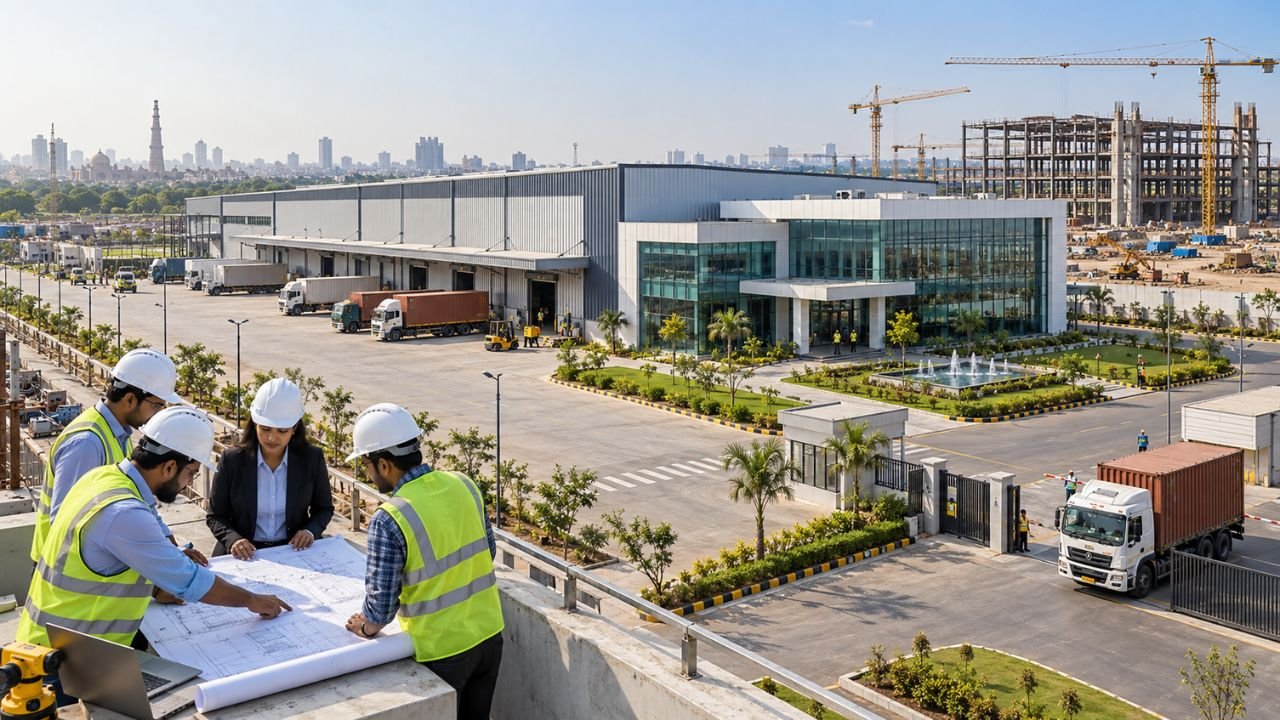
Setting up a factory floor is one of the most capital-intensive journeys an entrepreneur can undertake. In 2026, the Indian industrial landscape is booming, but the bridge between a “great idea” and a “fully operational unit” is paved with financial precision. Securing an MSME loan for manufacturing sector operations is no longer just about filling out a bank form; it is about presenting a bulletproof technical and financial roadmap. Many aspiring factory owners face immediate rejection not because their business idea is poor, but because their funding request lacks a data-driven foundation.
With India’s manufacturing PMI showing consistent expansion and massive investments pouring into the sector, the government and banks have introduced several specialized manufacturing sector MSME loan schemes. However, the sheer variety of options—from PMEGP to CGTMSE—can be overwhelming. Whether you are scaling an existing textile unit or starting a high-tech EV component facility, you need a clear path through eligibility, interest rates, and the most critical document of all: an accurate project cost estimate. This guide provides a practical roadmap to help you navigate MSME financing for manufacturing sector India with control and confidence. At Construction Estimator India, we specialize in ensuring your loan application is backed by professional Bill of Quantities (BOQ) and construction estimates that banks trust.

Why MSME Loans are Critical for the Manufacturing Sector
The manufacturing sector is the backbone of India’s “Make in India” 2.0 vision. Unlike service-based startups, manufacturing units require heavy upfront capital expenditure (CAPEX) for land, factory construction, and sophisticated machinery.
- Infrastructure Demands: Modern factories in 2026 favor Pre-Engineered Buildings (PEB) and solar-ready roofing, which require significant initial investment.
- Working Capital: Manufacturing involves long production cycles and credit periods, making a loan for manufacturing business MSME essential to maintain cash flow.
- Technology Adoption: To remain competitive, units must invest in automation and sustainable materials, often requiring specialized financing.
- Economic Growth: With industrial output rising at record paces, having the right finance allows you to scale rapidly and meet high domestic demand.
Top MSME Loan Options for Manufacturing Sector in India 2026
Choosing the right manufacturing sector MSME loan schemes depends on your project size, social category, and the nature of your product. Here are the most prominent options available today:
| Scheme Name | Loan Amount Range | Best Suited For |
|---|---|---|
| PMEGP | Up to ₹50 Lakhs | New micro-manufacturing units |
| CGTMSE | Up to ₹5 Crores | Collateral-free loans for SMEs |
| Mudra (Shishu/Kishore/Tarun) | Up to ₹10 Lakhs | Small-scale household manufacturing |
| Stand-Up India | ₹10 Lakhs to ₹1 Crore | SC/ST and Women entrepreneurs |
| SIDBI Schemes | ₹10 Lakhs to ₹25 Crores | High-growth industrial scaling |
1. PMEGP (Prime Minister’s Employment Generation Programme)
This is a flagship credit-linked subsidy scheme specifically designed for new projects.
- Eligibility: Individuals above 18 years, SHGs, and societies.
- Loan Amount: Up to ₹50 Lakhs for manufacturing units.
- Interest Rate: Standard bank rates (approx. 8.5% – 11%).
- Best For: First-time entrepreneurs setting up micro-manufacturing facilities in rural or urban areas.
2. CGTMSE (Credit Guarantee Fund Trust for Micro and Small Enterprises)
The biggest hurdle for most manufacturers is providing collateral. CGTMSE solves this by providing a guarantee to the bank.
- Eligibility: New and existing MSMEs in the manufacturing sector.
- Loan Amount: Up to ₹5 Crores.
- Key Feature: No collateral or third-party guarantee required.
- Best For: Scalable businesses that have strong cash flow projections but lack physical assets to pledge.
3. SIDBI (Small Industries Development Bank of India)
SIDBI offers various specialized schemes like SMILE (SIDBI Make in India Soft Loan Fund) and ARISE.
- Loan Amount: Can go as high as ₹25 Crores for established units.
- Interest Rate: Highly competitive, often lower than commercial banks.
- Best For: Mid-sized units looking for technology upgrades or expansion into export markets.
4. Mudra Loan
Under the Pradhan Mantri Mudra Yojana (PMMY), small manufacturing units can access funds under three categories: Shishu, Kishore, and Tarun.
- Loan Amount: Up to ₹10 Lakhs.
- Best For: Tiny manufacturing units, such as food processing, artisanal goods, or small workshops.
Eligibility Criteria for MSME Loans in Manufacturing Sector
To qualify for an MSME loan for manufacturing industry benefits, you must meet the following criteria in 2026:
- Udyam Registration: You must have a valid Udyam Registration Certificate. This is the primary proof of your MSME status.
- Investment & Turnover: Your unit must fall within the revised MSME definitions (Micro: Investment < ₹1Cr, Turnover < ₹5Cr; Small: Investment < ₹10Cr, Turnover < ₹50Cr; Medium: Investment < ₹50Cr, Turnover < ₹250Cr).
- Credit Score: A CIBIL score of 700+ is generally required for faster approval and better interest rates.
- Business Vintage: For existing units, a minimum of 2-3 years of operational history with audited financials is typically needed. For new units, a robust “Detailed Project Report” (DPR) is mandatory.
- Technical Viability: Banks look for a professional government loan for manufacturing unit application that includes a valid factory layout and civil cost estimates.
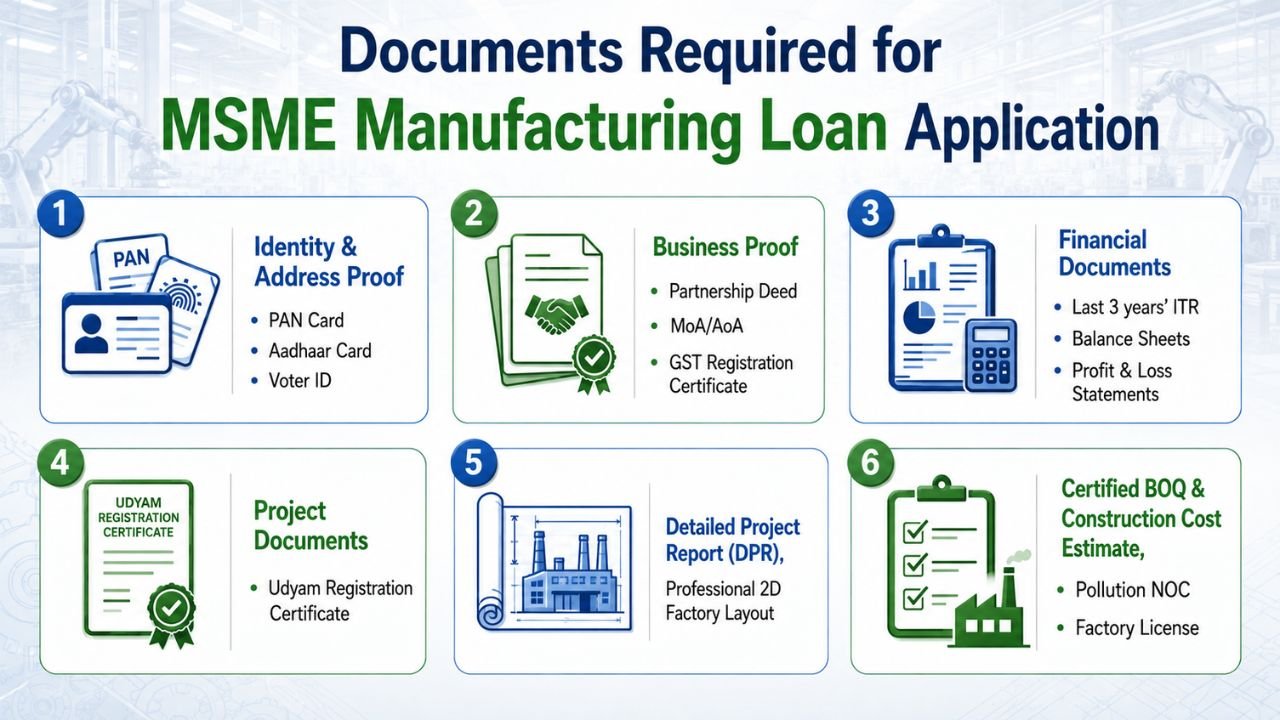
Documents Required for MSME Manufacturing Loan Application
Preparation is key to avoiding delays. Ensure you have the following “Bank-Ready” documents:
- Identity & Address Proof: PAN Card, Aadhaar Card, and Voter ID.
- Business Proof: Partnership Deed, MoA/AoA, and GST Registration certificate.
- Financial Documents: Last 3 years’ ITR, Balance Sheets, and Profit & Loss statements (for existing units).
- Project Documents (Crucial):
- Udyam Registration Certificate.
- Detailed Project Report (DPR).
- Professional 2D Factory Layout.
- Certified Bill of Quantities (BOQ) and Construction Cost Estimate.
- Pollution NOC and Factory License.
How to Apply for MSME Loan for Your Manufacturing Unit
- Finalize Your Product: Validate your manufacturing idea and ensure there is a market gap.
- Select Your Land: Ensure the plot is in an industrial zone with “Industrial Land Use” (CLU) permits.
- Create a Technical Roadmap: Hire experts to draft a 2D floor plan that optimizes workflow (Linear, U-shaped, or L-shaped).
- Get a Bankable Cost Estimate: Obtain a detailed BOQ for your factory construction. This is where many fail by providing “rough guesses.”
- Register on Portals: Apply through the Jan Samarth portal or Udyami Mitra for government schemes, or directly via bank MSME portals like SIDBI 59 Minutes.
- Submit and Track: Upload your documents. Ensure your mobile number is linked to your Aadhaar for e-verification.
How Accurate Project Cost Estimation Strengthens Your Loan Application
Banks do not fund “vague ideas.” When you apply for a manufacturing sector MSME loan, the credit officer looks at the “Technical and Financial Viability” of the project. If you tell a bank that your factory will cost “around 50 lakhs,” your application is likely to be flagged or rejected.
Why a professional BOQ matters:
- Precision: A detailed Bill of Quantities breaks down every kilogram of steel and cubic meter of concrete.
- Trust: When a bank sees a certified estimate from Construction Estimator India, they know the numbers are based on 2026 market rates for materials like JSW/TATA steel.
- Funding Accuracy: It prevents “under-funding,” where you run out of money mid-construction, or “over-borrowing,” which leads to unnecessary interest burdens.
- Collateral Justification: If the loan is based on the value of the building, a professional estimate justifies the asset value to the bank’s technical valuer.
Common Mistakes to Avoid When Applying for MSME Manufacturing Loans
- Inaccurate Costing: Using “Lump Sum” quotes from local contractors instead of a line-item BOQ. This often leads to 40% budget overruns.
- Ignoring Compliance: Applying for a loan without having your Pollution NOC (CTE/CTO) or Building Plan Sanction ready.
- Poor DPR Quality: Submitting a Project Report that lacks technical details like machinery footprints, electrical loads, and workflow optimization.
- Mismatch in Projections: Ensuring your projected sales revenue can comfortably cover the EMI (DSCR ratio).
- Underestimating Working Capital: Only borrowing for machinery but forgetting the funds needed to buy raw materials for the first 6 months.
How Construction Estimator India Helps Manufacturing Entrepreneurs
At Construction Estimator India, we bridge the gap between your industrial vision and a realistic, bankable budget. We don’t just provide drawings; we provide financial documents that secure your future.
- Practical Layout Review: We analyze your production sequence to suggest improvements that reduce construction waste.
- Accurate 2026 BOQs: We provide detailed quantity takeoffs based on current market rates, ensuring your loan amount is exactly what you need.
- Bank-Ready Estimates: Our reports meet the standards required by major Indian banks for industrial loan processing.
- Material Optimization: We help you select cost-effective yet high-strength materials (like Grade 345 MPa steel) to reduce structure weight.
Get Guidance on MSME Loans + Accurate Project Cost Estimate
Don’t leave your industrial investment to guesswork. A single mistake in your factory setup cost estimation can cost lakhs in rework and loan delays.
Our Simple Process to Help You Succeed:
- Message Us: Share your manufacturing type (e.g., plastic molding, food processing, textiles).
- Provide Details: Tell us your plot size, location, and desired loan amount.
- Get Results: Receive professional guidance on suitable MSME loans + a realistic construction cost estimate/BOQ within 24–48 hours.
Contact Us Now
WhatsApp or Call: +91 8630676890
Website: www.constructionestimatorindia.com
FAQ Section
- Can I get an MSME loan for buying land?
Generally, most MSME schemes (like PMEGP) focus on construction and machinery. However, certain bank-specific term loans allow land purchase as part of the total project cost, provided it’s in an industrial zone. - Is collateral mandatory for a ₹2 Crore manufacturing loan?
No. Under the CGTMSE scheme, you can avail of collateral-free loans up to ₹5 Crores, though the bank will charge a small guarantee fee. - How much time does it take for MSME loan approval in 2026?
With digital platforms like SIDBI 59 Minutes, “In-principle” approval can happen in an hour. Final disbursement usually takes 3-6 weeks depending on document verification. - What is the average interest rate for a manufacturing unit loan?
In 2026, interest rates for MSME manufacturing loans typically range from 8.25% to 12%, depending on your credit score and the chosen scheme. - Do I need a professional BOQ for a bank loan?
Yes. Banks require a certified cost estimate and Bill of Quantities to verify the “Project Cost” mentioned in your application. - Can I apply for an MSME loan if I am a woman entrepreneur?
Absolutely. Schemes like Stand-Up India and specialized bank offerings provide lower interest rates and easier terms for women-led manufacturing units. - Does the clear height of my factory affect my loan amount?
Yes. Increasing height above 30ft increases steel weight and construction cost, which must be reflected in your BOQ for the bank to fund the extra cost. - What is the role of Udyam Registration in the loan process?
It is your “MSME Identity Card.” Without it, you cannot access government subsidies, interest subvention, or collateral-free benefits. - Can I get a loan for a used manufacturing machine?
Some banks offer finance for imported second-hand machinery, but they require a “Residual Life Certificate” from a chartered engineer. - How much “margin money” do I need to contribute?
Most banks fund 75% to 90% of the project cost. You are expected to bring in 10% to 25% as your own contribution (Promoter’s Margin).
Conclusion
Securing an MSME loan for manufacturing sector success is a balance of right-timing, right-scheme, and right-data. In 2026, banks are eager to lend to the manufacturing industry, but they demand transparency and technical accuracy. By preparing a professional factory layout and a detailed Bill of Quantities (BOQ), you not only secure your finance but also ensure your construction stays on budget.
Ready to turn your industrial vision into a precision-built reality? Get the professional guidance and accurate cost estimate you need to protect your investment.
WhatsApp us now at +91 8630676890 for your factory setup guidance and a realistic loan-ready estimate.