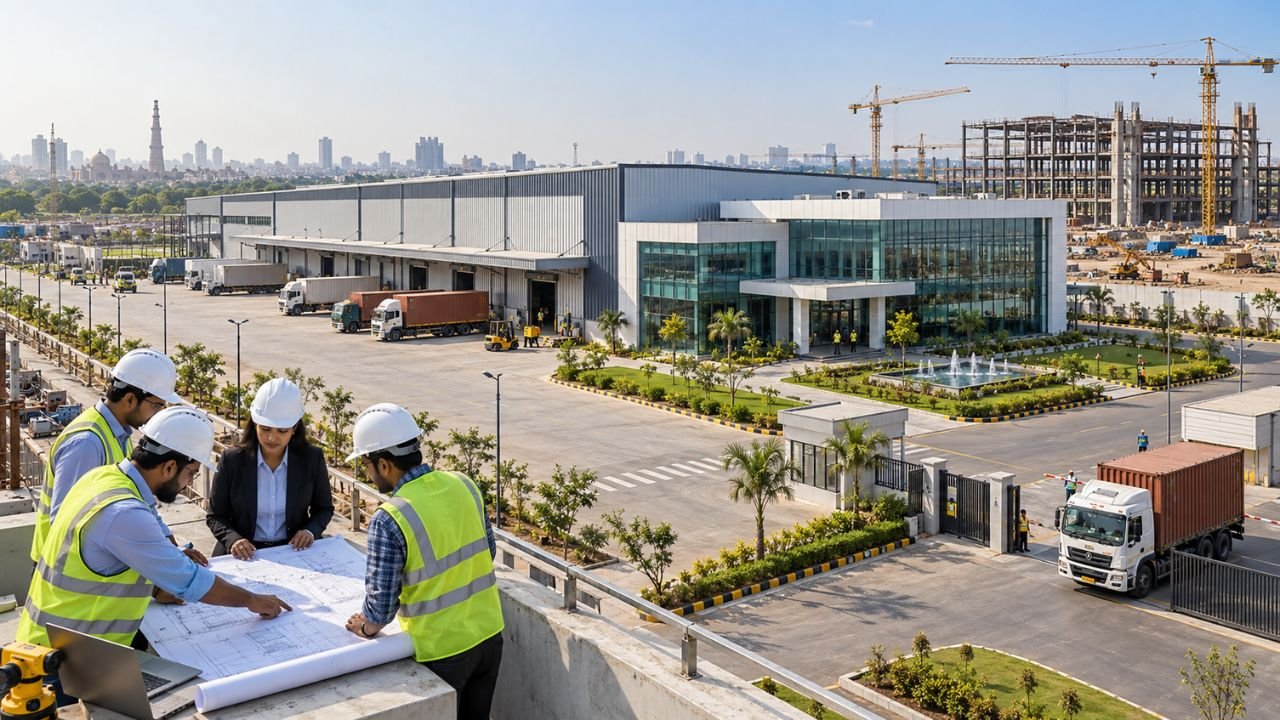
Setting up a manufacturing unit in India is a high-stakes investment that requires significant capital for land, building construction, machinery, and working capital. As an industrial entrepreneur in 2026, the challenge isn’t just having a great product idea; it is securing the right financing to bring that vision to life without exhausting your personal savings. Navigating the landscape of an MSME loan scheme for manufacturing company setup can feel overwhelming due to the variety of government initiatives, varying interest rates, and strict documentation requirements.
In 2026, the Indian government has intensified its support for “Make in India” 2.0, offering specialized MSME loan schemes India 2026 tailored for factory setup and expansion. However, many MSME owners face rejection or delays because they lack a professional project report or a realistic cost estimate. Without a detailed Bill of Quantities (BOQ), banks often view your funding request as a “rough guess” rather than a bankable project.
This guide provides a comprehensive roadmap to the best MSME loan for manufacturing unit operations, covering eligibility, application steps, and the critical role of accurate cost estimation. At Construction Estimator India, we help you bridge the gap between your factory floor plan and a sanctioned loan by providing the technical documentation banks demand.

Why MSME Loan Schemes are Important for Manufacturing Companies
For a manufacturing business, capital is the engine of growth. Here is why choosing a dedicated MSME loan scheme for manufacturing company growth is vital:
- Subsidies and Incentives: Many government schemes, like PMEGP, offer significant subsidies (up to 35%) on the total project cost, reducing your debt burden.
- Collateral-Free Options: Schemes like CGTMSE allow manufacturing units to access credit without the need for third-party guarantees or tangible collateral, which is often the biggest hurdle for new entrepreneurs.
- Lower Interest Rates: MSME-specific loans generally offer more competitive interest rates compared to standard commercial loans, improving your long-term ROI.
- Moratorium Periods: Manufacturing involves a “curing period” where the factory is being built but not yet producing. MSME loans often include a grace period before repayments start.
- Structured Repayment: Loans are designed to match the cash flow cycles of industrial production, preventing liquidity crunches.
Top MSME Loan Schemes for Manufacturing Companies in India 2026
Choosing the right loan for manufacturing business MSME depends on your project size and specific needs. Below are the most prominent schemes available in 2026:
1. PMEGP (Prime Minister’s Employment Generation Programme)
This is a credit-linked subsidy scheme specifically designed to generate employment through new micro-enterprises.
- Best Suited For: New manufacturing units in rural or urban areas.
- Loan Amount: Up to ₹50 Lakhs for manufacturing projects.
- Subsidy: 15% to 35% based on location and category.
- Interest Rate: Standard bank rates apply.
2. CGTMSE (Credit Guarantee Fund Trust for Micro and Small Enterprises)
This scheme provides a guarantee to the lender, allowing entrepreneurs to get an MSME loan for manufacturing unit without collateral.
- Best Suited For: Startups and existing units with strong business plans but no assets to pledge.
- Loan Amount: Up to ₹5 Crores.
- Key Feature: No collateral or third-party guarantee required.
3. MUDRA Loan (PMMY)
Mudra focuses on “funding the unfunded” for smaller manufacturing operations.
- Best Suited For: Small-scale workshops and food processing units.
- Categories: Shishu (up to ₹50,000), Kishore (up to ₹5 Lakhs), and Tarun (up to ₹10 Lakhs).
- Interest Rate: Varies by bank but is generally highly competitive.
4. Stand-Up India
This scheme promotes entrepreneurship among SC/ST and women entrepreneurs.
- Best Suited For: Greenfield manufacturing projects led by women or SC/ST individuals.
- Loan Amount: ₹10 Lakhs to ₹1 Crore.
- Eligibility: At least one SC/ST or woman borrower per bank branch.
5. SIDBI Schemes (SMILE & ARISE)
SIDBI offers specialized MSME financing for manufacturing companies to encourage growth and technological upgrades.
- SMILE: SIDBI Make in India Soft Loan Fund for Micro Small and Medium Enterprises.
- ARISE: Assistance to Re-energize Indian SME Sectors.
- Key Focus: Long-term loans with lower promoter contribution requirements.
MSME Loan Comparison Table 2026
| Scheme Name | Max Loan Amount | Primary Benefit | Best For |
|---|---|---|---|
| PMEGP | ₹50 Lakhs | Up to 35% Subsidy | New Rural/Urban Units |
| CGTMSE | ₹5 Crores | No Collateral Required | Growth-stage MSMEs |
| Mudra (Tarun) | ₹10 Lakhs | Low Interest/No Collateral | Micro-manufacturing |
| Stand-Up India | ₹1 Crore | Targeted Social Support | Women/SC/ST Leaders |
| SIDBI SMILE | Project Based | Soft Loan/Low Promotors’ Contribution | High-growth Tech Units |
Eligibility Criteria for MSME Loans for Manufacturing Units
To qualify for an MSME loan scheme for manufacturing company support in 2026, you generally need to meet these criteria:
- Udyam Registration: Your business must be registered on the Udyam portal to be classified as an MSME.
- Entity Type: Can be a proprietorship, partnership, LLP, or Private Limited Company.
- Credit Score: While some schemes are lenient, a CIBIL score of 700+ is usually preferred by banks.
- Business Vintage: For expansion loans, banks usually look for 2-3 years of profitable operations. New units require a solid “Bankable Project Report”.
- Age: The primary applicant should be between 18 and 65 years of age.
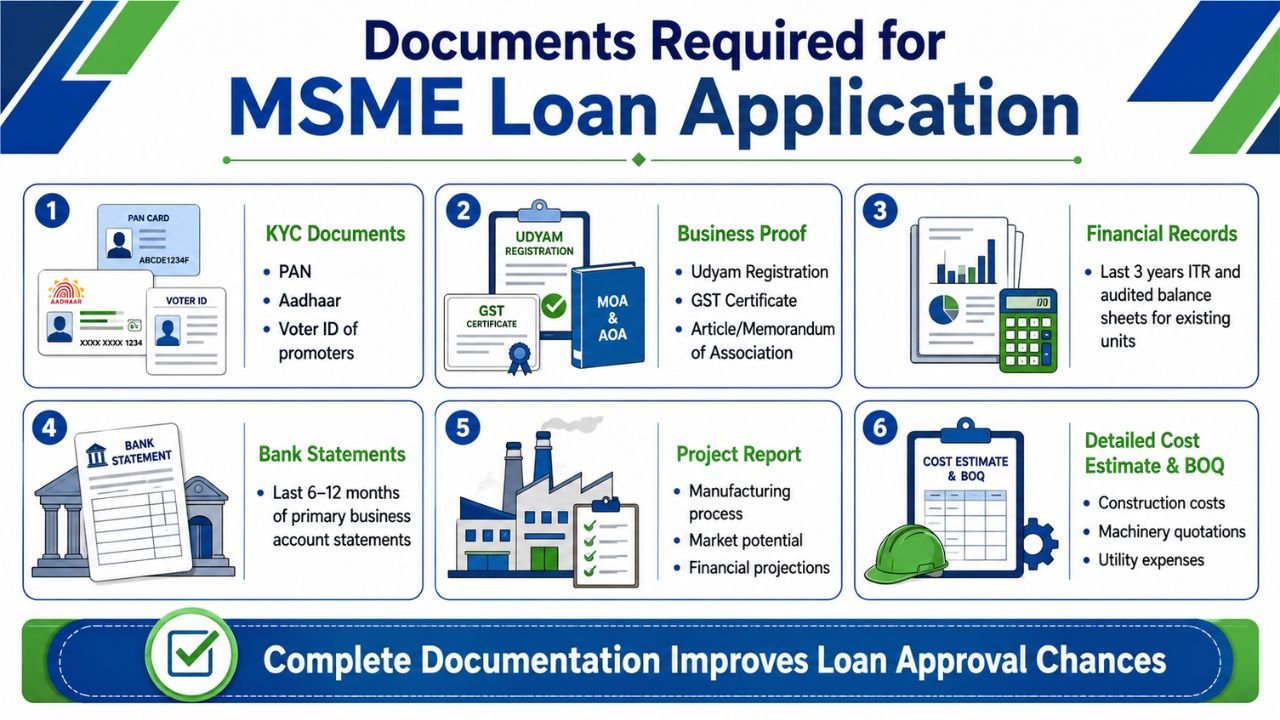
Documents Required for MSME Loan Application
Preparation is key to avoiding rejection. Ensure you have the following documents ready:
- KYC Documents: PAN, Aadhaar, and Voter ID of the promoters.
- Business Proof: Udyam Registration, GST Certificate, and Article/Memorandum of Association.
- Financial Records: Last 3 years of ITR and audited balance sheets (for existing units).
- Bank Statements: Last 6 to 12 months of primary business account statements.
- Project Report: A detailed report explaining the manufacturing process, market potential, and financial projections.
- Detailed Cost Estimate & BOQ: A technical breakdown of construction costs, machinery quotes, and utility expenses.
How to Apply for MSME Loan for Your Manufacturing Company
The application process for government loan schemes for factory setup has become increasingly digital:
- Preparation: Define your project scope and get a professional factory civil construction cost India estimate.
- Online Portals: Visit portals like Jan Samarth or Udyamimitra to check your eligibility for multiple schemes at once.
- Registration: Complete your Udyam registration if not already done.
- Documentation Upload: Upload the required financials and your detailed project report (DPR).
- Bank Interaction: Once your application is pre-approved, a bank official will likely visit your site and review your Bill of Quantities (BOQ).
- Sanction & Disbursement: After technical and financial appraisal, the loan is sanctioned and disbursed in stages (e.g., foundation, structure, machinery installation).
How Accurate Project Cost Estimation Helps in Loan Approval
Banks do not lend money based on “approximate” figures. They require technical certainty. This is where accurate project cost estimation becomes your greatest asset.
- Validation of Loan Amount: A detailed BOQ proves to the bank that you aren’t over-borrowing or under-borrowing. In 2026, a standard PEB factory might cost ₹1,800–₹2,400 per sq ft; having this backed by data prevents delays.
- Risk Mitigation: Banks feel more secure when they see a breakdown of costs—from foundations (20-25%) to structural steel (35-40%).
- Technical Credibility: Providing a professional estimate shows you have done your homework, positioning you as a serious industrialist.
- Stage-wise Disbursement: Most loans are disbursed based on construction milestones. A professional estimate allows the bank to set clear triggers for fund release.
Common Mistakes to Avoid When Applying for MSME Manufacturing Loans
- Using Outdated Rates: Relying on 2024 or 2025 construction figures is a mistake. Steel, labor, and transport rates have shifted significantly for 2026.
- Underestimating Civil Costs: Many entrepreneurs focus only on machinery and forget that civil work (flooring, roofing, foundations) is often 60-70% of the building’s cost.
- Incomplete Documentation: Missing NOCs (Pollution, Fire) or building plan sanctions can stall your application.
- Lump Sum Quotes: Submitting a single-page quote from a local contractor instead of a detailed, itemized BOQ is a major red flag for banks.
How Construction Estimator India Helps You Strengthen Your Loan Application
At Construction Estimator India, we specialize in making your project “Bank-Ready.” We don’t just provide numbers; we provide the technical foundation for your loan.
- Bank-Ready BOQs: Our estimates are formatted to meet the technical requirements of major Indian banks and financial institutions.
- Precision 2D/3D Analysis: We analyze your factory floor plan to ensure the estimated costs align perfectly with the proposed structure.
- Updated 2026 Market Data: We use real-time rates for steel (TATA/JSW), cement (Ultratech), and industrial labor to ensure your budget is realistic.
- Material Optimization: We help you select cost-effective options (like PEB over RCC for large spans) that improve your project’s financial viability.
Get Guidance on MSME Loan Schemes + Accurate Project Cost Estimate
Don’t leave your manufacturing dream to guesswork. Whether you are building a 5,000 sq ft workshop or a 50,000 sq ft automated plant, we provide the clarity you need.
Simple 3-Step Process:
- Share Details: Tell us your manufacturing type (e.g., Pharma, Plastic, Food, Logistics).
- Provide Plot Info: Share your approximate built-up area and location.
- Get Results: Receive a realistic MSME loan for manufacturing unit guidance and a detailed project cost estimate within 24–48 hours.
Contact Us Today:
- WhatsApp/Call: +91 8630676890
- Website: www.constructionestimatorindia.com
FAQ Section: What Manufacturing Entrepreneurs Ask
Q1: What is the best MSME loan scheme for a new manufacturing company in 2026?
For new units, the PMEGP is often best due to the high subsidy, while CGTMSE is ideal if you lack collateral for
Q2: Can I get an MSME loan for factory construction?
Yes, most MSME loans cover the “Civil Construction” of the factory building, which includes the foundation, structure, and flooring.
Q3: How much does it cost to construct a factory per sq ft in 2026?
In India, the cost ranges from ₹1,200 for basic sheds to over ₹4,000 for high-spec automated units.
Q4: Is Udyam registration mandatory for these loans?
Yes, Udyam registration is the primary document required to prove your status as an MSME and access government benefits.
Q5: How long does the loan approval process take?
While “PSB Loans in 59 Minutes” offers in-principle approval quickly, the full disbursement process usually takes 4 to 8 weeks, depending on documentation.
Q6: Does the loan cover the cost of industrial flooring (VDF)?
Yes, industrial flooring like VDF or FM2 is considered a core part of the civil construction cost and is covered under the loan.
Q7: Why do banks ask for a Bill of Quantities (BOQ)?
A BOQ provides a detailed breakdown of materials and labor, ensuring the bank that your requested loan amount is technically justified.
Q8: Can I apply for an MSME loan for a multi-storey factory?
Yes, though multi-storey units typically require RCC structures, which cost between ₹2,400 and ₹3,800 per sq ft in 2026.
Q9: What is the maximum loan amount under CGTMSE for manufacturing?
As of 2026, you can avail of collateral-free credit of up to ₹5 Crores under the CGTMSE scheme.
Q10: How can I get a project report for my loan application?
Construction Estimator India provides the technical cost estimation part of the project report. WhatsApp us at +91 8630676890 to get started.
Conclusion
Securing an MSME loan scheme for manufacturing company setup is the most critical financial step you will take in 2026. By leveraging government subsidies, opting for collateral-free guarantees, and presenting a data-backed project report, you significantly increase your chances of success.
Remember, a bank’s confidence in your project starts with the accuracy of your numbers. Don’t rely on “rough guesses” that lead to rejection. Partner with Construction Estimator India to get a professional, bank-ready estimate that reflects the realistic costs of building your factory in today’s market.
Ready to start? WhatsApp your project details to +91 8630676890 for expert guidance now!