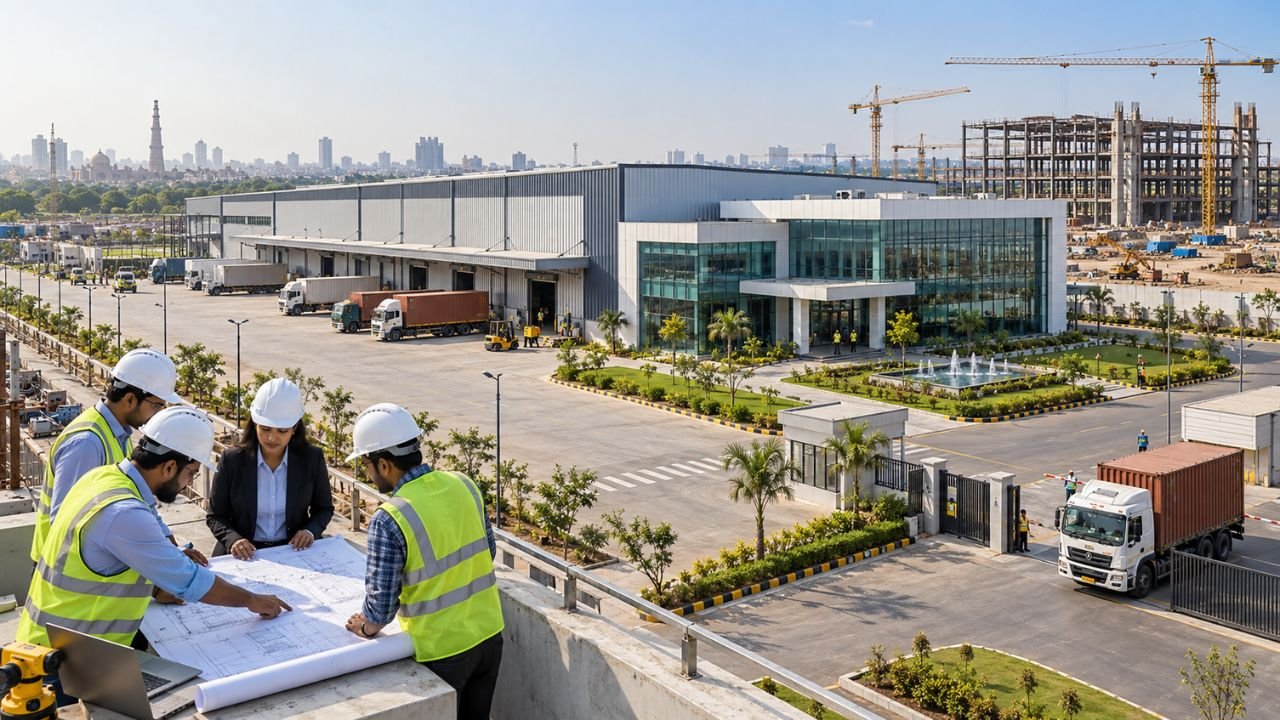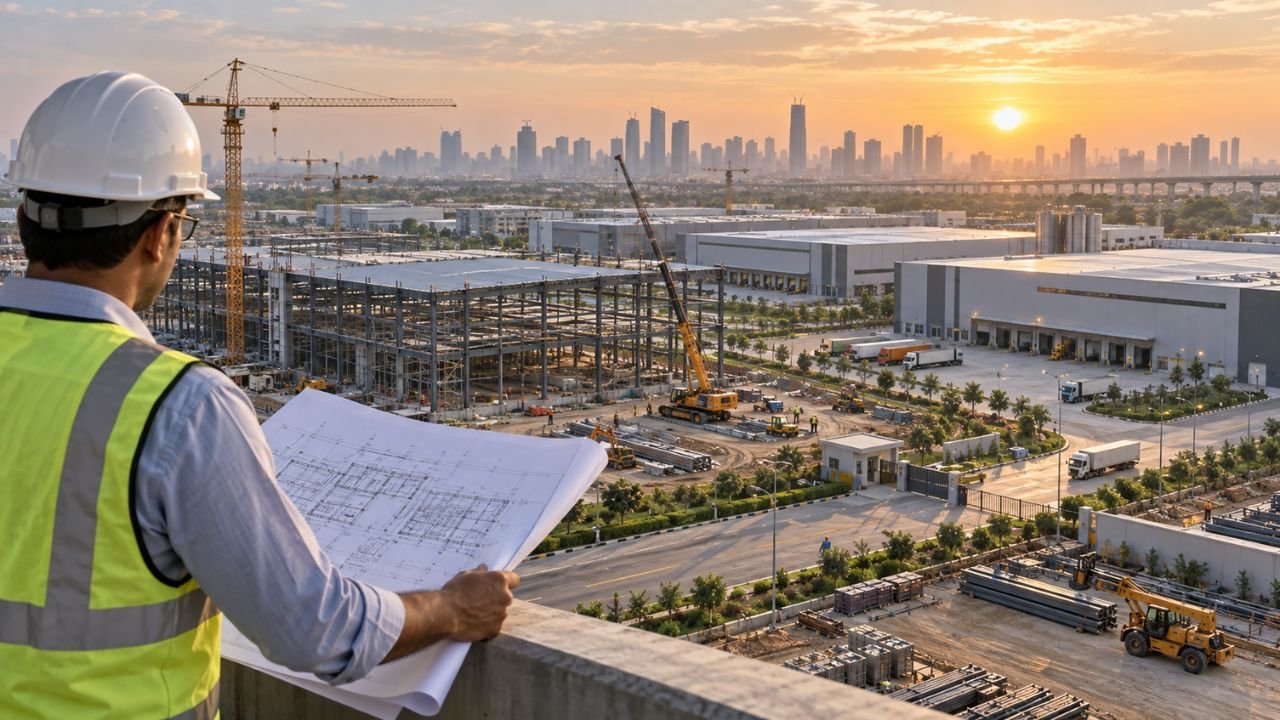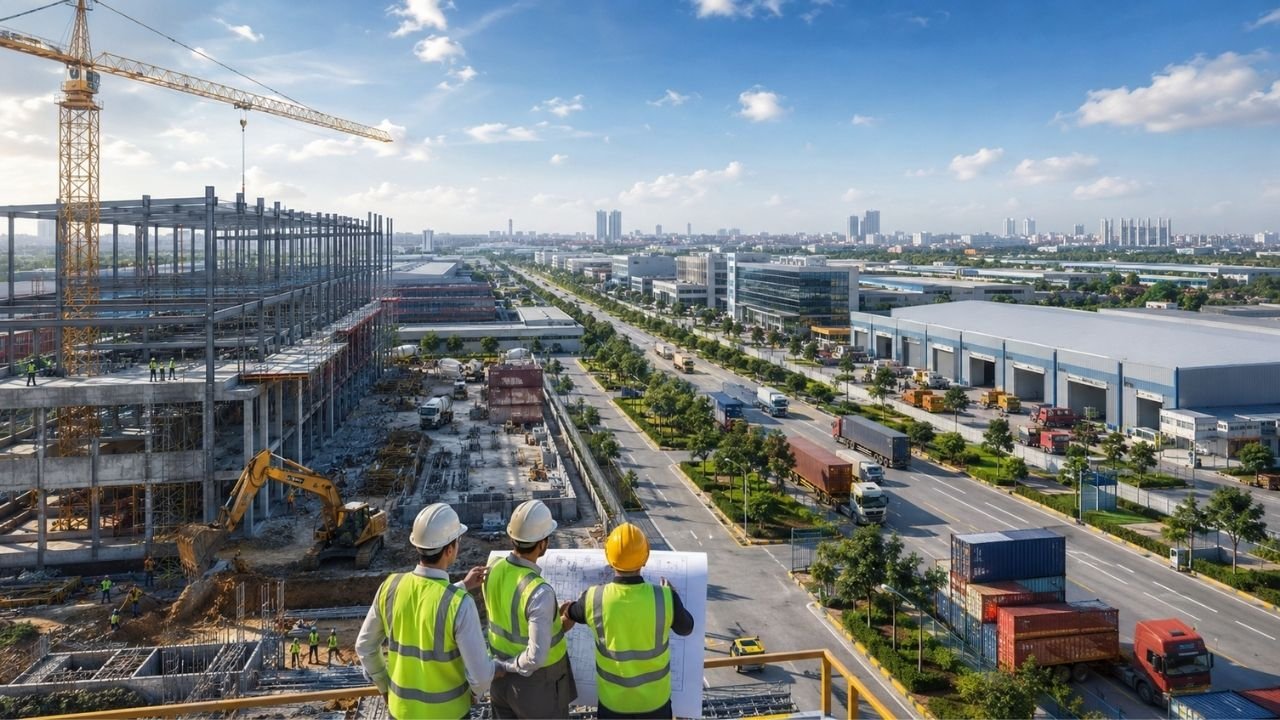
Setting up a manufacturing facility in 2026 is a massive capital investment that requires data-backed precision. As an industrial entrepreneur or MSME owner in India, you are likely facing the ultimate construction dilemma: Should you opt for a modern Pre-Engineered Building (PEB) or stick with a conventional civil construction (RCC) structure? This choice will dictate your project’s ROI, construction speed, and long-term maintenance costs.
The Indian industrial landscape has shifted dramatically. Under the “Make in India” 2.0 initiative, the demand for rapid execution and flexible factory spaces has made the PEB vs civil construction cost for factory comparison the most critical part of any feasibility study. While traditional RCC structures offer a sense of permanence, PEB systems are dominating the market due to their speed and engineering efficiency. However, “cheaper” doesn’t always mean “better” if the system doesn’t align with your specific machinery loads or industrial category.
In this expert guide, we provide an unbiased, realistic 2026 cost comparison between PEB and conventional factory systems. At Construction Estimator India, we specialize in high-accuracy industrial BOQs and quantity takeoffs, helping you navigate these complexities with bankable budgets. Whether you are planning a 10,000 sq ft workshop or a 1,00,000 sq ft automated plant, understanding these cost drivers is your first step toward success.
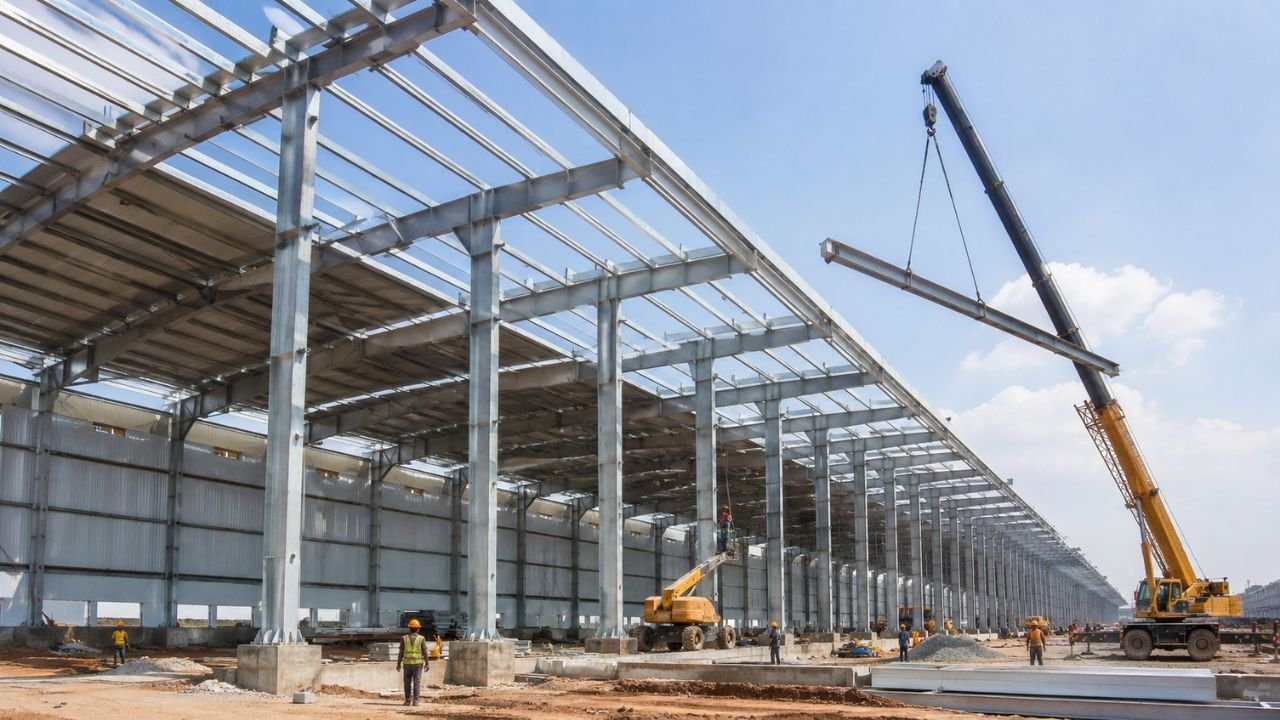
What is PEB Construction for Factories?
Pre-Engineered Buildings (PEB) are structural systems where the components (columns, rafters, purlins) are designed and fabricated in a controlled factory environment using high-strength steel (typically 345 MPa). These components are then transported to your site and bolted together like a giant assembly kit.
In 2026, PEB is the gold standard for industrial sheds because it minimizes on-site labor and material wastage. The design is optimized using advanced software to ensure maximum strength with minimum steel weight. This system is ideal for factories requiring large, column-free spaces (clear spans) and rapid business commencement.
What is Conventional Civil (RCC) Construction for Factories?
Conventional civil construction, often referred to as RCC (Reinforced Cement Concrete), involves in-situ casting. Columns, beams, and slabs are built on-site using steel reinforcement bars and wet concrete. This traditional method is widely understood by local contractors but is significantly more labor-intensive and slower than PEB.
RCC is typically preferred for multi-storey industrial units, chemical plants where corrosive environments are present, or facilities with extreme fire-safety requirements. However, for large-span single-storey manufacturing units, it is often viewed as an over-engineered and expensive solution in 2026.
PEB vs Civil Construction Cost Comparison for Factories in 2026
When comparing the PEB vs civil construction cost for factory projects, the gap is often significant. In 2026, material prices for steel have stabilized, but labor costs for RCC work have risen by 12% across major hubs like Delhi-NCR and Maharashtra.
| Factory Type | PEB Cost Range (₹/sq ft) | Civil (RCC) Cost Range (₹/sq ft) | Construction Time |
|---|---|---|---|
| Standard Industrial Shed | ₹1,200 – ₹1,900 | ₹2,100 – ₹2,800 | PEB: 4–8 Months |
| Heavy Manufacturing Unit | ₹1,850 – ₹2,600 | ₹2,600 – ₹3,500 | RCC: 12–18 Months |
| High-Spec/Multi-Storey | ₹2,800 – ₹3,800+ | ₹3,400 – ₹4,500+ | PEB is ~50% faster |
Rates include core civil works, primary structure, roofing, and standard industrial flooring. GST (18%) and land costs are excluded.
Realistic 2026 data shows that for a standard 20,000 sq ft factory, PEB is generally 20-30% cheaper than conventional RCC. The primary cost saving comes from reduced foundation requirements (as PEB is 30% lighter) and minimal labor-days on site.
Detailed Cost Breakdown – PEB vs Civil Construction
Understanding the weightage of different components is vital for accurate budgeting. For a typical 20,000 sq ft industrial project in 2026, the budget allocation follows these distinct patterns:
PEB Factory Cost Breakdown:
- Primary Structure (Columns/Rafters): 35% – 40% (High-strength steel)
- Secondary Structure (Purlins/Girts): 10% – 12%
- Roofing & Cladding (Galvalume): 15% – 18%
- Foundations & Civil Work: 20% – 25% (Lighter foundations required)
- Industrial Flooring (VDF): 8% – 12%
Civil (RCC) Factory Cost Breakdown:
- RCC Columns & Beams: 40% – 45% (Cement, Sand, Rebars)
- Slabs & Masonry: 20%
- Foundations: 15% – 20% (Heavier sections to support concrete weight)
- Roofing (Trusses or RCC Slab): 10% – 15%
- Finishing & Labor: 15%
The PEB factory construction cost comparison India reveals that while the “shell” of a PEB might seem steel-heavy, the cumulative savings in labor and foundation concrete often tilt the scales in favor of steel.
Pros & Cons of PEB Construction for Factories
Pros:
- Speed of Erection: A 20,000 sq ft PEB factory can be ready for machinery installation in 4-6 months.
- Large Clear Spans: Up to 100m+ without internal columns, maximizing your operational floor space.
- Flexibility: Easier to expand or even dismantle and relocate.
- Cost Predictability: Factory-fabricated components lead to fewer “hidden” site expenses.
Cons:
- Corrosion Sensitivity: Requires high-grade galvanized coatings in coastal or chemical environments.
- Fire Rating: Requires specialized fire-retardant paint/insulation to match RCC’s natural fire resistance.
Pros & Cons of Conventional Civil Construction for Factories
Pros:
- Superior Fire Resistance: RCC is naturally resistant to high temperatures, making it ideal for high-risk zones.
- Rigidity: Excellent for multi-storey units with heavy stationary machinery that causes high vibrations.
- Local Availability: Can be built by almost any local contractor without specialized PEB machinery.
Cons:
- High Cost for Spans: Very expensive to achieve clear spans over 30 meters.
- Slow ROI: Long curing times for concrete delay the start of your manufacturing operations.
- Heavier Structure: Increases the cost of foundations and seismic reinforcement.
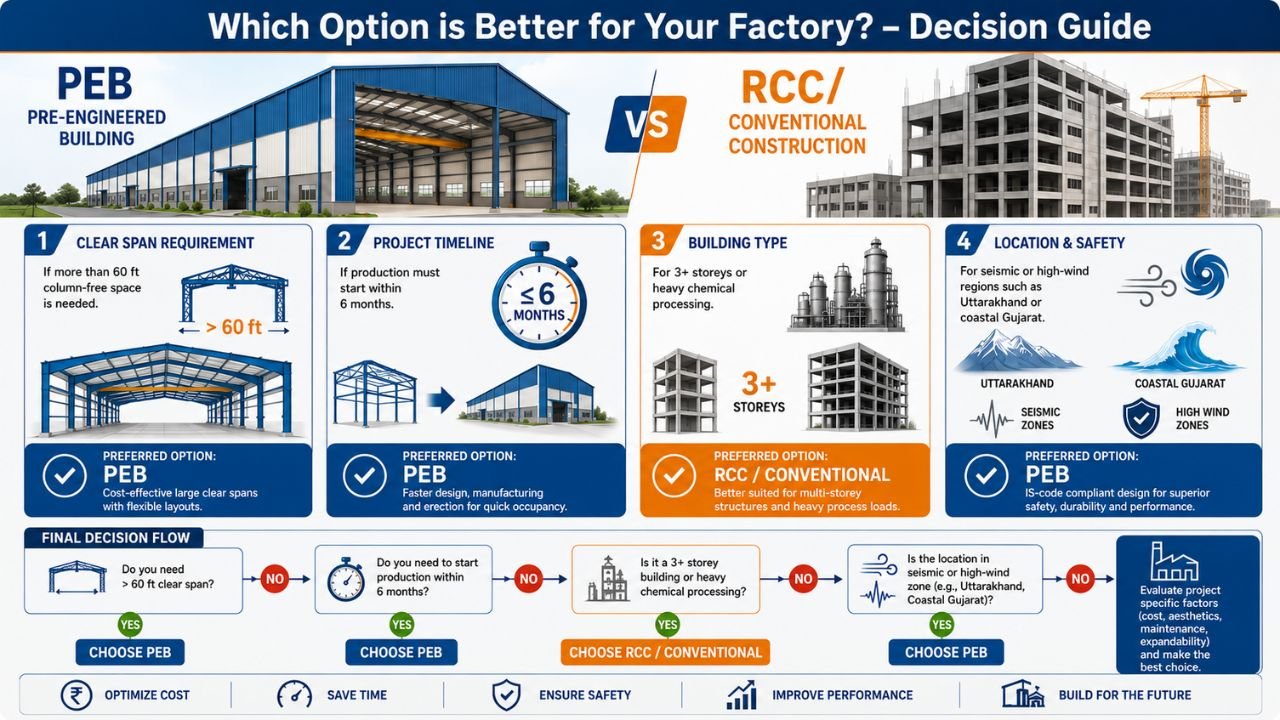
Which Option is Better for Your Factory? (Decision Guide)
Choosing between pre-engineered building vs civil construction cost is not just about the initial bill. Ask yourself these four questions:
- What is your clear span requirement? If you need more than 60 ft of column-free space for your machinery flow, PEB is the only viable choice.
- How fast do you need to start production? If your business depends on starting within 6 months, PEB wins.
- Are you building a multi-storey unit? For units with 3+ floors or heavy chemical processing, RCC/Conventional is often safer and more practical.
- Is your factory in a seismic or high-wind zone? In Uttarakhand or coastal Gujarat, PEB’s light weight and IS-code-compliant design offer better safety at a lower cost.
How Construction Estimator India Helps You Compare PEB vs Civil Costs Accurately
The biggest risk in industrial construction is relying on a “lump sum” quote that hides material grades or labor shortcuts. At Construction Estimator India, we eliminate this guesswork.
We don’t just give you a number; we give you a bank-ready BOQ (Bill of Quantities). Our experts analyze your 2D plans or machinery layout to provide a side-by-side PEB vs civil construction cost for factory analysis. This allows you to see exactly how many tons of TATA/JSW steel or bags of Ultratech cement you will need for either system.
Our detailed estimation services ensure you only pay for what is used, preventing contractor overcharging and material wastage.
Get PEB vs Civil Construction Cost Comparison for Your Factory
Don’t let “rough guesses” stall your industrial project. Get a professional, 2026-market-updated cost comparison that protects your capital.
Start Your Estimate in 3 Simple Steps:
- Share Details: Tell us your built-up area and location (e.g., 20,000 sq ft, Pune).
- Provide Requirements: Specify clear height (e.g., 30ft) and machinery load or crane needs.
- Get Results: Receive your realistic PEB vs Civil cost comparison + preliminary BOQ within 24–48 hours.
FAQ Section: What Factory Owners Ask
Q1: Is PEB actually cheaper than RCC in 2026?
Yes, for large-span industrial buildings, PEB is typically 20-30% more cost-effective due to lighter foundations and faster erection.
Q2: What is the life span of a PEB factory vs RCC?
Both systems are designed for 30-50 years. PEB requires periodic painting/coatings, while RCC may require structural repairs for cracks over time.
Q3: Can I install a heavy crane in a PEB shed?
Absolutely. PEB sheds are regularly designed with “gantry girders” for cranes up to 100+ tons. This adds roughly ₹250–₹400 per sq ft to the cost.
Q4: Which system is better for cold storage?
PEB is preferred as it easily integrates with PUF panels and insulation, reducing heat gain significantly.
Q5: Does the per sq ft rate include GST?
No. Standard professional estimates are “Ex-GST.” An 18% GST on construction services is standard in India 2026.
Q6: Can I build a multi-storey factory using PEB?
Yes, multi-storey PEBs are common for garment units or electronic assembly. However, for 3+ floors, the cost advantage over RCC may decrease.
Q7: How does clear height impact the budget?
Increasing height from 20ft to 40ft increases steel weight by 10-15% due to wind load requirements, raising the per sq ft cost.
Q8: Why do I need a BOQ for an industrial bank loan?
Banks require a technical cost estimation and a detailed BOQ to ensure the project’s financial viability before releasing funds.
Conclusion
The PEB vs civil construction cost for factory setup is a debate where PEB clearly leads in 2026 for speed, cost-efficiency, and large clear spans. However, the “right” choice depends on your specific industrial process, location, and fire-safety needs.
The single biggest mistake you can make is starting without a detailed Bill of Quantities (BOQ). Avoid “lump sum” traps and ensure your project stays within budget from day one.
Stop guessing. Start building. WhatsApp Construction Estimator India at +91 8630676890 today for your realistic PEB vs civil construction cost comparison and expert guidance.