In the rapidly growing Indian construction sector, technical knowledge alone is not enough to run a successful business. Whether you are bidding for a government tender or executing a private commercial project, your profitability relies entirely on how well you estimate costs and manage your paperwork.
For civil contractors, quantity surveyors, and billing engineers, mastering the CPWD norms, rate analysis, and Microsoft Excel formatting is the ultimate key to success. In this guide, we will break down the essential components of construction estimation, from drafting a standard BOQ to understanding exactly how your profit margins are calculated in India.
Introduction: Why BOQ, Rate Analysis & Profit Margins Matter in Indian Civil Construction
A Bill of Quantities (BOQ) is the financial heartbeat of any construction project. It is the document that lists every single item of work, along with its unit and quantity. Without a precise BOQ, contractors are left guessing their material requirements, which inevitably leads to budget overruns and disputes.
Furthermore, in India, government bodies like the CPWD (Central Public Works Department) and state PWDs have strict guidelines on how a BOQ should be formatted and how rates should be analyzed. If your documents do not align with these standards, your tender bids will be rejected. Understanding the relationship between precise rate analysis and your final profit margin is what separates struggling contractors from highly successful construction firms.
Understanding CPWD BOQ Format for Civil Work
The CPWD sets the benchmark for construction documentation in India. Even private developers often request that their BOQs be modeled after the CPWD style due to its clarity and transparency.
A standard CPWD BOQ is structured in a clear, tabular format containing the following columns:
-
Item No. / DSR Code: A unique reference number. If it is a standard item, it matches the code in the Delhi Schedule of Rates (DSR).
-
Description of Item: A highly detailed specification of the work (e.g., “M25 RCC work in columns”).
-
Unit: The standard metric of measurement (Cubic Metres, Square Metres, Kilograms, etc.).
-
Quantity: The total volume or area calculated from the architectural drawings.
-
Rate: The cost per unit.
-
Amount: The total cost (Quantity × Rate).
For government tenders, sticking to this exact layout is mandatory. To see practical examples and learn how to implement these official guidelines, reviewing a comprehensive guide on CPWD BOQ format & DSR rate analysis for civil work will help you structure your tender documents flawlessly.
Basics of DSR / DAR Rate Analysis for Civil Items
You might wonder: How does the CPWD decide the standard rate for a cubic metre of concrete? The answer lies in the Delhi Analysis of Rates (DAR).
Rate analysis is the process of breaking down a single construction activity into its basic cost components. The DAR provides a standardized formula for this. A standard composite rate is built upon four main pillars:
-
Materials: The cost of basic raw materials (cement, sand, aggregate, steel) including wastage.
-
Labour: The cost of masons, helpers, bar-benders, and carpenters required to complete one unit of that work.
-
Tools & Plants (T&P): A percentage (usually 1% to 1.5%) added for the wear and tear of machinery like concrete mixers and vibrators.
-
Contractor’s Profit and Overhead (CP&OH): As per standard CPWD norms, a 15% markup is added to the total cost of materials, labour, and T&P to cover the contractor’s site overheads and profit. (An additional 1% water charge is also often included).
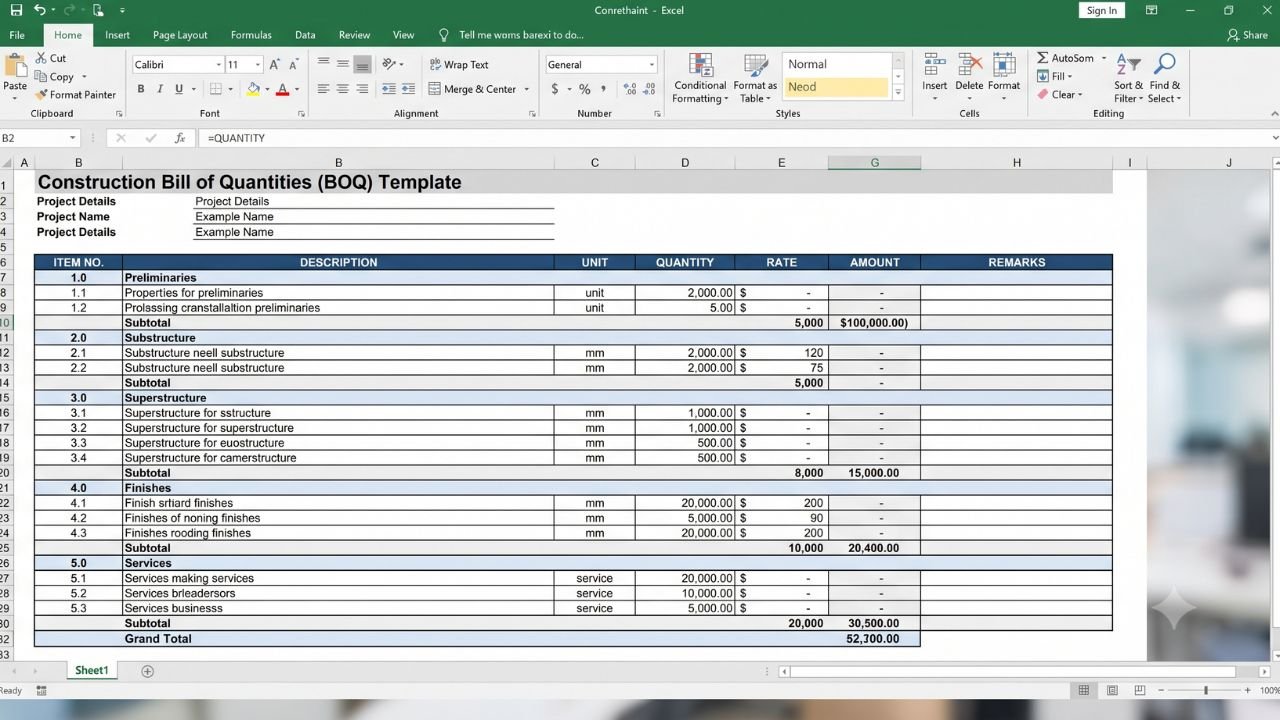
BOQ Format in Excel for Construction Projects
While understanding the theory is important, the actual preparation of a BOQ happens in Microsoft Excel. Excel allows quantity surveyors to manage thousands of line items efficiently, update rates instantly, and generate automatic summaries.
A professional Excel BOQ should be divided into separate sheets: a Measurement Sheet (for raw L×B×H calculations), an Abstract of Quantities (summarizing the totals), and the final priced BOQ. Never use manual calculations; rely entirely on
=SUM() and =PRODUCT() formulas. To ensure your formulas are locked in correctly and your presentation is professional, utilizing a ready-made BOQ format in Excel for construction will save you hours of administrative work and prevent costly mathematical errors.BOQ Preparation of Civil Work in India: Step-by-Step
Preparing a flawless BOQ is a systematic process. If you are a site engineer or QS, you must follow a strict workflow:
-
Study the Drawings: Thoroughly review the Good For Construction (GFC) architectural and structural drawings.
-
Take-Off Quantities: Extract the dimensions of every element (footings, columns, brickwork, plastering) and enter them into your measurement sheet.
-
Group and Code Items: Organize the items according to the CPWD structure (Earthwork, Concrete, Masonry, Finishes) and assign the correct DSR codes.
-
Apply Rates: Input the DAR-approved rates for schedule items, and conduct market rate analysis for non-schedule (NS) items.
Mastering this workflow takes practice. For an in-depth look at quantity take-offs, deduction rules, and compilation, check out our complete tutorial on BOQ preparation of civil work in India.
Profit Margin in Construction Business in India
One of the most common questions fresh contractors ask is, “How much profit can I actually make?”
As mentioned earlier, the CPWD standard rate analysis includes a 15% allowance for Contractor’s Profit and Overheads. However, this 15% is not pure net profit. It must cover your indirect costs: site office expenses, engineer salaries, travel, insurance, and financing costs.
In the Indian civil construction business, a well-managed project typically yields a net profit margin of 8% to 12%. In highly competitive item-rate contracts, margins might be tighter, whereas turnkey or design-and-build contracts can occasionally offer higher returns. To explore pricing strategies, risk management, and how to protect your bottom line from material price hikes, read our detailed breakdown on profit margin in construction business in India.
Roadmap: How to Become a Civil Contractor in India
If you understand estimation, rate analysis, and BOQ preparation, you already possess the core technical skills needed to run a contracting business. But transitioning from an engineer to a business owner requires fulfilling specific legal and financial criteria.
To bid for government tenders or take on large private projects, you must:
-
Register a legal business entity (Proprietorship, LLP, or Pvt Ltd).
-
Obtain a GST Registration, PAN, and a current bank account.
-
Secure a Bank Solvency Certificate to prove your financial capacity.
-
Apply for contractor empanelment/licensing with departments like the state PWD, CPWD, or local municipal corporations (starting usually at Class V or Class IV and upgrading with experience).
If you are ready to take the leap into entrepreneurship, follow our comprehensive, step-by-step guide on how to become a civil contractor in India to navigate the registration and licensing process smoothly.
Conclusion
Succeeding in the Indian civil construction industry requires a perfect balance of engineering knowledge and financial discipline. By understanding the CPWD BOQ format, mastering DSR rate analysis, organizing your data flawlessly in Excel, and rigorously protecting your profit margins, you set a strong foundation for your business. Equip yourself with the right templates and standardized workflows, and you will not only win more tenders but execute them profitably.