Selecting the right house nameplate design is a small but critical milestone in the journey of building or renovating an Indian home. It serves as the primary point of identification for visitors, delivery personnel, and emergency services, ensuring your residence is easily located in often complex urban layouts. Beyond its functional role, a nameplate acts as the “visual handshake” of your home, creating a lasting first impression. Unfortunately, many homeowners focus solely on ornamental value and overlook essential factors such as readability, material durability, and how the design complements the overall entrance architecture.
👉 Design a House Nameplate That Reflects Your Style and Personality.
In this guide, we explore the nuances of effective house nameplate design, ranging from material selection to placement strategies that enhance the entrance experience. To ensure your design aligns with your financial plan, Construction Estimator India provides expert assistance in calculating realistic costs and quantities for various nameplate options and entrance treatments. If you are looking to understand the budget impact of your choices before finalising your house nameplate design, feel free to contact Construction Estimator India on WhatsApp / Call +91 8630676890 for a detailed estimate.
What a House Nameplate Really Does?
Identification, Wayfinding, and First Impression
A house nameplate is the fundamental bridge between a public street and a private residence. In the context of Indian cities and towns, where house numbering systems can be irregular, a well-designed nameplate is the most reliable tool for wayfinding. It ensures that guests spend less time searching and more time feeling welcomed. Furthermore, in an era of rapid e-commerce, a clear nameplate prevents delivery delays and lost packages.
From a design perspective, the nameplate introduces the personality of the household. A sleek, metallic finish might suggest a modern, minimalist interior, while a hand-carved wooden plate signals traditional values and warmth. It is the first detail people interact with, and its quality reflects the care taken in the construction of the home itself.
Relationship Between Nameplate, Gate, and Main Door
The entrance of an Indian home is usually a layered experience involving a boundary wall, a main gate, and finally, the main door. The house nameplate design should not exist in isolation; it must harmonize with these elements. For instance, if your gate features heavy wrought-iron patterns, a very delicate glass nameplate might look out of place. Conversely, a massive stone nameplate could overwhelm a small apartment entrance.
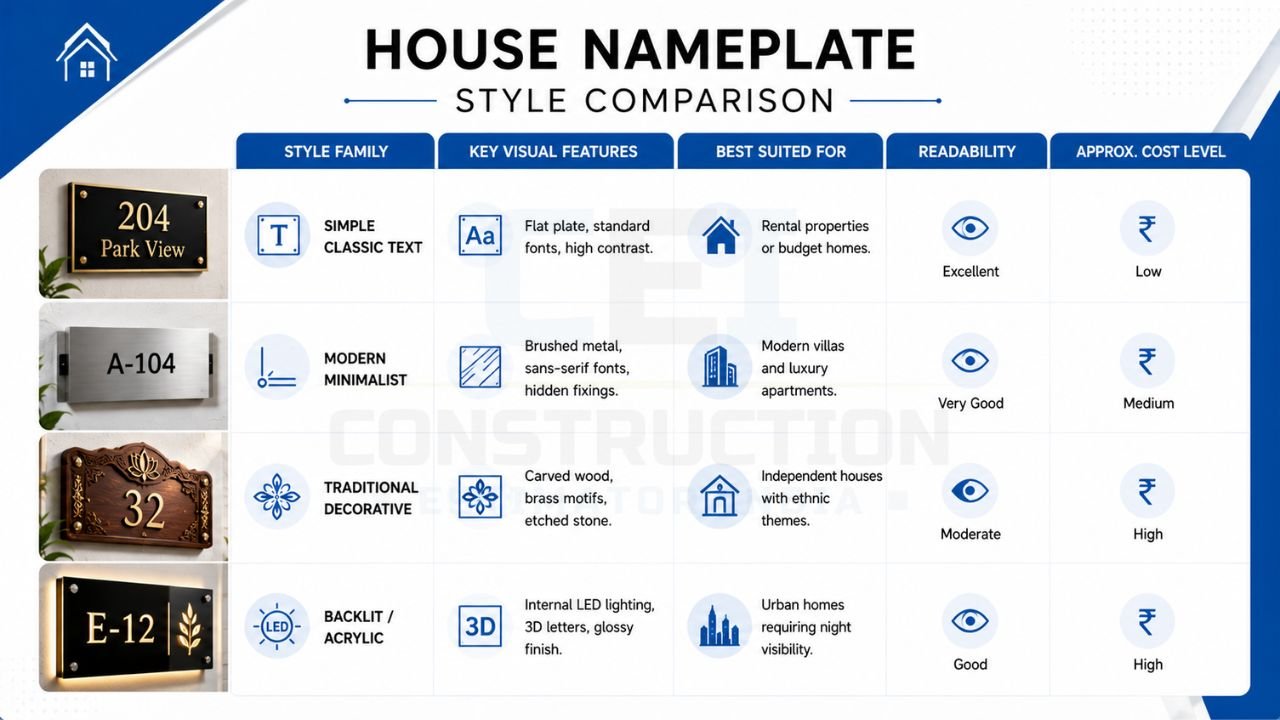
Coordination involves matching materials or finishes—using the same wood polish as the main door or the same metal finish as the gate handles. This creates a “design thread” that guides the eye naturally. To help you categorize these aesthetic directions, the table below compares common style families used in contemporary Indian residences.
| Style Family | Key Visual Features | Best Suited For | Readability | Approx. Cost Level |
|---|---|---|---|---|
| Simple Classic Text | Flat plate, standard fonts, high contrast. | Rental properties or budget homes. | Excellent | Low |
| Modern Minimalist | Brushed metal, sans-serif fonts, hidden fixings. | Modern villas and luxury apartments. | Very Good | Medium |
| Traditional Decorative | Carved wood, brass motifs, etched stone. | Independent houses with ethnic themes. | Moderate | High |
| Backlit / Acrylic | Internal LED lighting, 3D letters, glossy finish. | Urban homes requiring night visibility. | Good | High |
The table above illustrates that while aesthetic preferences vary, there is a direct correlation between design complexity and cost. When choosing a style, consider your home’s exterior “elevation.” A modern glass-and-concrete building benefits most from the Modern Minimalist or Backlit styles, whereas a traditional bungalow with a porch is the perfect canvas for Stone or Traditional Decorative plates.
👉 Get Customized House Nameplate Designs for Your Dream Home.
Content, Size, and Readability of House Nameplate
What to Show on the Nameplate
Clutter is the enemy of a good house nameplate design. The most effective plates are concise. The essential information usually includes the house number (which should be the most prominent element) and the family name or house name. In some cases, adding a small street name or the apartment block number is helpful, but only if space permits without reducing the font size of the primary identifiers. Avoid adding long quotes or overly large religious symbols that compete with the text for attention.
Choosing Size, Font, and Letter Height
Size is often dictated by viewing distance. If your nameplate is fixed on a boundary wall that is 15 feet away from the road, the letters need to be at least 3 to 4 inches tall to be legible for a person in a moving vehicle. For apartment corridors, where the viewer is only 3 feet away, 1-inch letters are sufficient.
Font choice is equally vital. While script or cursive fonts look elegant, they are notoriously difficult to read from a distance or in low light. Architects generally recommend clean serif or sans-serif fonts. Construction Estimator India can help you determine the exact quantity of materials needed if you decide to go with individual 3D letters instead of a flat plate, ensuring you don’t over-order expensive metals like brass or stainless steel.
Contrast, Colour, and Daytime Visibility
High contrast is the secret to daytime readability. A dark brown wooden plate with black lettering might look sophisticated up close, but from the street, it becomes an unreadable blur. The most reliable combinations are white or silver text on a dark background (black, navy, or dark grey) or dark text on a light background (cream, white, or light wood). Consider how the sun hits your entrance; a very glossy nameplate might reflect light in a way that makes the text disappear at certain times of the day.
Materials and Construction of House Nameplate
Popular Nameplate Materials in Indian Homes
Material selection is where most homeowners spend their time, as it dictates both the look and the longevity of the design.
- Stainless Steel (SS): Popular for its rust resistance, especially in grades like SS304 or SS316 for coastal areas. It offers a professional, modern look.
- Wood: Teak or Sheesham provides a warm, organic feel. However, in India’s harsh monsoons and summers, wood requires periodic polishing to prevent cracking.
- Stone and Granite: These are incredibly durable. Etched granite or marble nameplates are traditional favorites because they withstand heat and rain without any degradation.
- Acrylic and Glass: These materials allow for modern treatments like backlighting. Acrylic is more shatter-resistant than glass and offers a similar premium finish.
Fixing Methods, Backing, and Edges
How the plate is attached to the wall affects its aesthetic. “Stand-off” mounts involve small metal spacers that hold the plate an inch away from the wall, creating a beautiful floating effect and allowing for easy cleaning behind the plate. Flat-mount fixing is simpler but requires a perfectly flat wall surface. Always ensure that the edges of the material—especially metal or glass—are smoothed and rounded to prevent injury.
Weathering, Fading, and Cleaning
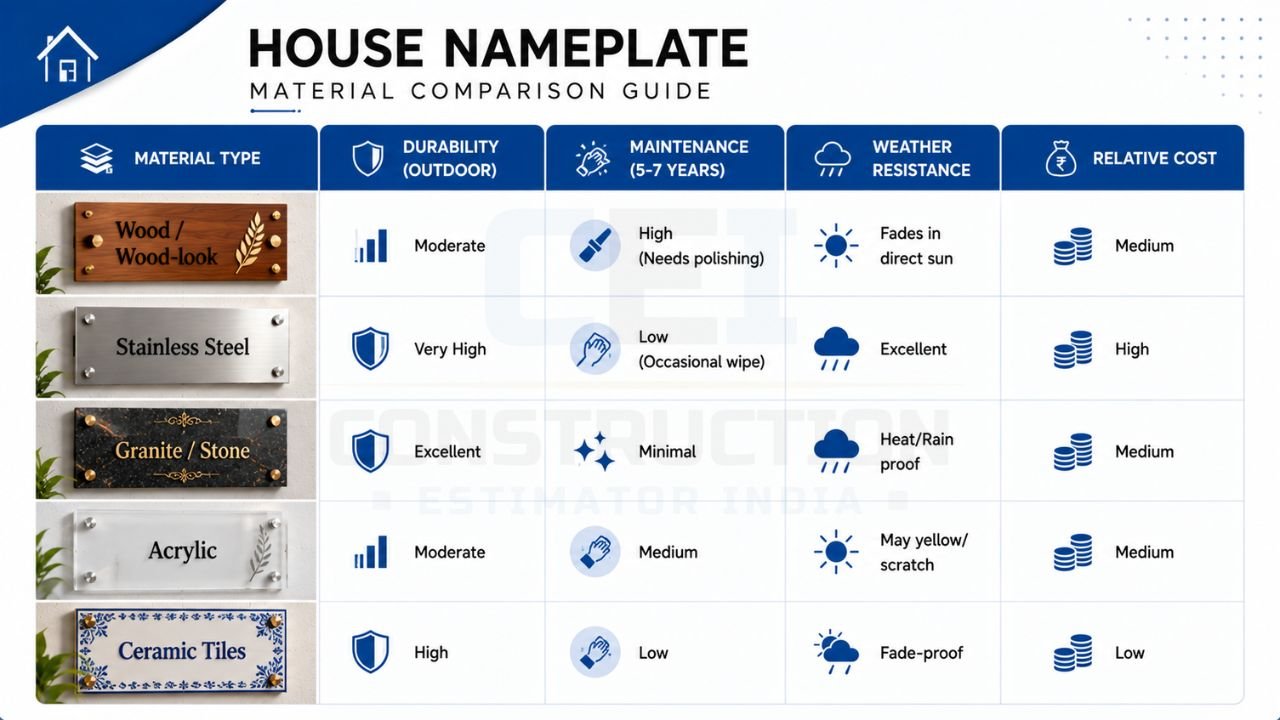
Every material reacts differently to the Indian climate. Dust is a major factor; nameplates with deep grooves or complex carvings will trap dirt and require frequent scrubbing. UV radiation from the sun can fade printed nameplates within a year, whereas laser-engraved or embossed plates remain legible for decades. Construction Estimator India can assist you in comparing the long-term maintenance costs of these materials, helping you decide if a higher upfront investment in stone or high-grade steel is more economical than a cheaper acrylic option that may need replacement.
| Material Type | Durability (Outdoor) | Maintenance (5-7 Years) | Weather Resistance | Relative Cost |
|---|---|---|---|---|
| Wood / Wood-look | Moderate | High (Needs polishing) | Fades in direct sun | Medium |
| Stainless Steel | Very High | Low (Occasional wipe) | Excellent | High |
| Granite / Stone | Excellent | Minimal | Heat/Rain proof | Medium |
| Acrylic | Moderate | Medium | May yellow/scratch | Medium |
| Ceramic Tiles | High | Low | Fade-proof | Low |
This comparison highlights that for a low-maintenance, long-term solution, stone and stainless steel are superior. If you are planning a renovation, you can contact Construction Estimator India to understand the cost difference between basic printed plates vs engraved, backlit, or premium material nameplates. This ensures your house nameplate design doesn’t become a recurring maintenance headache.
👉 Make Your Home Stand Out with a Modern and Elegant Nameplate Design.
Design Priorities: Readability, Style, and Night Visibility
Making the Nameplate Easy to Read from the Road
A successful house nameplate design prioritizes “at-a-glance” recognition. This is achieved by balancing the text size with the “negative space” around it. If the nameplate is too small for the amount of text, the letters will look cramped and become hard to distinguish. A good rule of thumb is to leave at least 20-30% of the plate as empty margin space.
Matching Nameplate Style with Elevation and Gate
The architectural style of your home should dictate the nameplate’s aesthetic. A “Contemporary” elevation with straight lines and large windows pairs perfectly with a minimalist steel or acrylic plate. On the other hand, an “Indo-Saracenic” or “Colonial” style home might benefit from a heavy brass plate or a ceramic tile design featuring traditional patterns. Mixing a very futuristic backlit nameplate with a rustic, raw-brick wall often creates a visual clash that distracts from the home’s beauty.
Lighting and Night-Time Visibility
In many Indian residential colonies, street lighting can be inadequate. A nameplate that is invisible at night fails its primary purpose. You can integrate lighting in three ways:
- External Spotlights: Small LED focus lights mounted above the plate.
- Backlit Designs: LED strips placed behind the plate or inside a box, causing the letters to glow.
- Reflective Vinyl: A cost-effective way to make text “pop” when hit by vehicle headlights.
When planning for lighting, remember that you will need to run electrical conduits through the boundary wall. Construction Estimator India can help you check the quantity and cost of plates, fixing hardware, and small civil/finishing work around the nameplate area, including the electrical wiring requirements for illuminated designs.
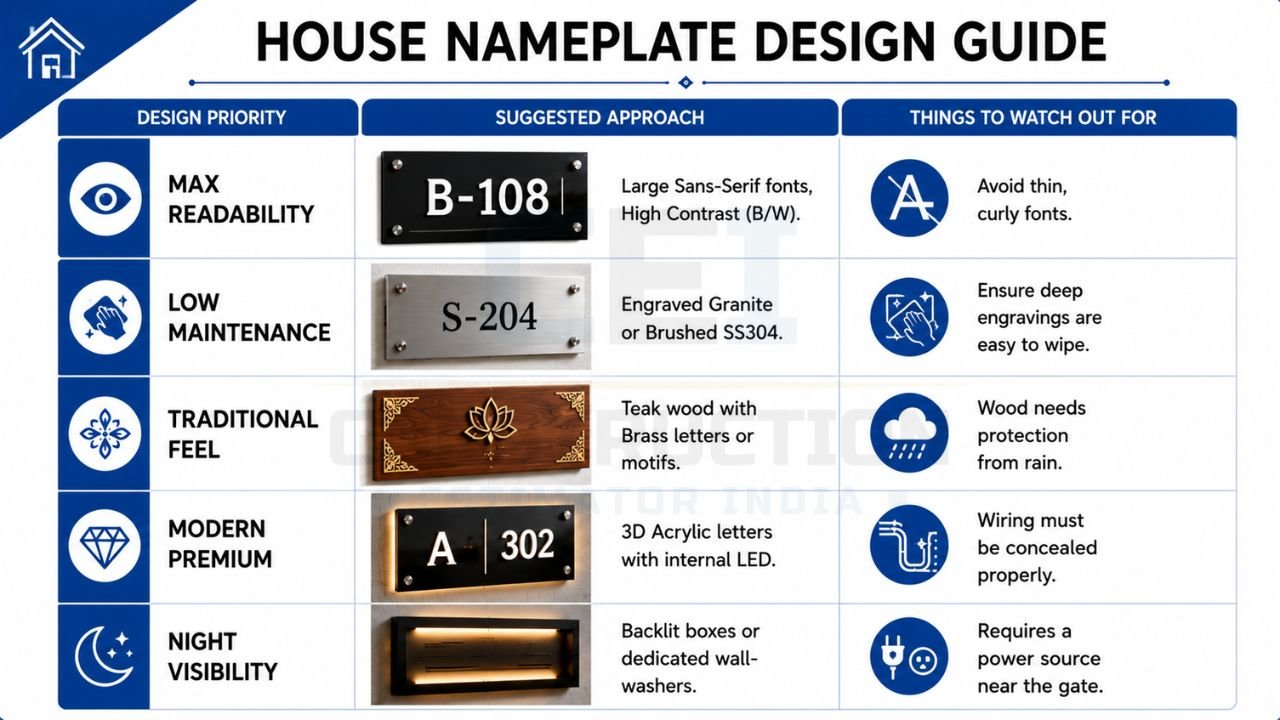
| Design Priority | Suggested Approach | Things to Watch Out For |
|---|---|---|
| Max Readability | Large Sans-Serif fonts, High Contrast (B/W). | Avoid thin, curly fonts. |
| Low Maintenance | Engraved Granite or Brushed SS304. | Ensure deep engravings are easy to wipe. |
| Traditional Feel | Teak wood with Brass letters or motifs. | Wood needs protection from rain. |
| Modern Premium | 3D Acrylic letters with internal LED. | Wiring must be concealed properly. |
| Night Visibility | Backlit boxes or dedicated wall-washers. | Requires a power source near the gate. |
As seen in the table, your primary goal (whether it’s beauty or functionality) will change your material and lighting choices. Use this table to narrow down your priorities before speaking with a fabricator or architect.
👉 Design a House Nameplate That Adds Beauty and Character to Your Entrance.
Placement: Where and How to Install the House Nameplate
On Boundary Wall or Gate Pillar
For independent houses and villas, the gate pillar is the most logical location for a house nameplate design. It is the closest point to the road and is usually at eye level. If your gate is set back from the road, placing the nameplate on the outer boundary wall is even better. Ensure the plate is mounted at a height of 4.5 to 5.5 feet from the ground—this is the natural “eye-line” for most people.
Near Main Door or Porch
If you live in a gated community or an apartment, the nameplate is typically placed on the wall adjacent to the main door or directly on the door frame. In these cases, the design can be more detailed and delicate, as the viewer will be standing directly in front of it. You can afford to use smaller fonts and more intricate materials like glass or polished wood since the environment is sheltered from rain and direct sun.
Special Situations: Apartments and Corner Plots
Corner plots are unique because they have two frontages. It is often wise to have a primary nameplate at the main entrance and a smaller “number-only” plate on the secondary wall for clarity. For apartment corridors, consistency is key. Ensure your nameplate doesn’t protrude too far into the common walkway, as this can be a safety hazard.
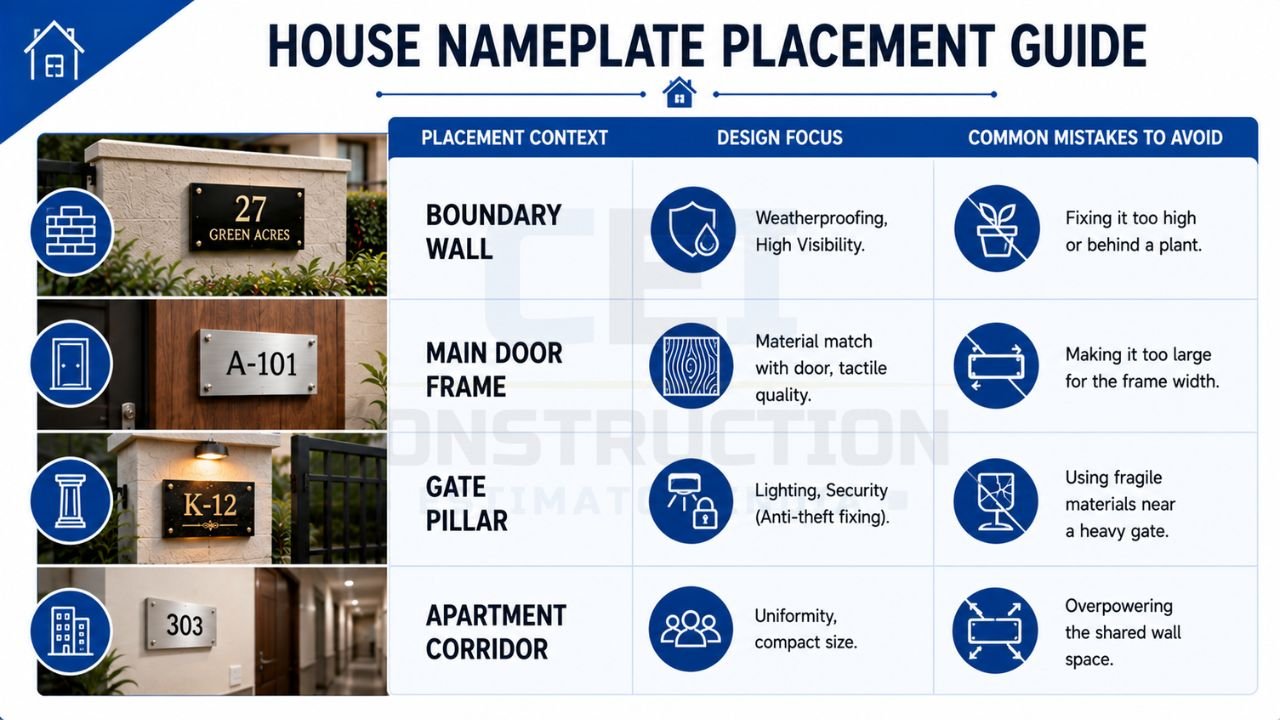
| Placement Context | Design Focus | Common Mistakes to Avoid |
|---|---|---|
| Boundary Wall | Weatherproofing, High Visibility. | Fixing it too high or behind a plant. |
| Main Door Frame | Material match with door, tactile quality. | Making it too large for the frame width. |
| Gate Pillar | Lighting, Security (Anti-theft fixing). | Using fragile materials near a heavy gate. |
| Apartment Corridor | Uniformity, compact size. | Overpowering the shared wall space. |
Choosing the right location is as important as the design itself. A beautiful plate hidden behind a gate pillar or a overgrown bush is useless. Always walk the approach to your home as if you were a stranger to see where your eyes naturally land.
👉 Bring Your Dream House Nameplate to Life with Professional Design Support.
Cost Planning for House Nameplate Design
What Drives Nameplate Cost the Most?
The price of a house nameplate is rarely just about the material. It is a combination of:Material Grade: SS316 is much costlier than SS202.
- Processing: Laser cutting and CNC routing are more expensive than simple printing or hand-painting.
- Thickness: A 5mm thick acrylic plate costs significantly more than a 2mm one.
- Hardware: High-quality brass stand-offs or concealed LED modules add to the bill.
Getting a Good Nameplate Within a Normal Budget
You don’t need to spend a fortune to have a stylish entrance. A simple black granite slab with gold-painted engraving is both timeless and affordable. Alternatively, using high-quality vinyl lettering on a thick glass plate can mimic the look of expensive etching at a fraction of the cost. The key is to spend money on the “visibility” factors—size and contrast—rather than just the “luxury” factors like exotic woods.
How Construction Estimator India Helps with Nameplate Costing?
Many homeowners find that individual fabricators quote wildly different prices for the same design. Construction Estimator India services provide clarity by preparing detailed quantity and cost estimates for different nameplate options—comparing basic printed plates vs engraved, backlit, or premium material nameplates. We empower you to make an informed decision, ensuring that the cost of the plate doesn’t balloon and take away from other essential entrance features like lighting or gate automation.
Common Mistakes in House Nameplate Design
Stylish but Hard-to-Read Fonts and Low Contrast
One of the most frequent errors is prioritizing “style” over the basic function of reading. Intricate script fonts may look like art, but they fail during a rainy night when a delivery driver is searching for your home. Similarly, low contrast (like dark grey text on a charcoal background) might look “moody” and modern, but it effectively makes your house anonymous from a distance.
Choosing Materials That Do Not Suit Local Climate
In coastal cities like Mumbai or Chennai, using anything less than SS304 grade steel will result in rust within months. In North Indian cities with extreme heat, low-quality acrylic can warp or develop fine cracks. Wood, if not treated with exterior-grade PU (polyurethane) coating, will rot or lose its color. Always match your material choice to your specific local environment.
Cluttered Layout and Wrong Placement Height
Trying to fit the names of all family members, the full address, and a religious verse onto a 12-inch plate makes the text too small to read. Keep it simple. Additionally, placing the nameplate too high (above 6 feet) makes it hard for people to see without straining their necks, especially if they are inside a car.
FAQs: House Nameplate Design for Indian Homes
Which material is best for a long-lasting house nameplate in Indian weather?
For the best balance of longevity and aesthetics, Stainless Steel (Grade 304 or 316) and Granite are the top choices. They do not rust, fade, or warp under the intense Indian sun or heavy monsoon rains. If you prefer a wooden look, consider High-Pressure Laminate (HPL) or WPC (Wood Polymer Composite), which mimic wood but offer superior weather resistance.
How big should a house nameplate be for a typical independent house?
For a standard bungalow or villa, a nameplate size of 12″ x 18″ or 15″ x 24″ is ideal for boundary walls. The house number should be at least 3-4 inches high, while the names can be 1.5-2 inches high. This ensures legibility from a distance of 15-20 feet.
Is a backlit or lighted nameplate worth the extra cost?
Yes, if you expect visitors or deliveries after sunset. A backlit nameplate not only aids in navigation but also adds a “luxury” feel to the entrance. However, it does require a dedicated electrical point and occasional LED replacement, so it is slightly higher on maintenance.
How to match nameplate design with gate and main door style?
Try to find a common element. If your door has brass hardware, use brass letters on your nameplate. If your gate is a modern charcoal grey slat design, a sleek silver stainless steel plate will look excellent. Contact Construction Estimator India to help you estimate the total cost of these coordinated materials to ensure they fit within your finishing budget.
When to involve Construction Estimator India for nameplate and entrance cost and quantity checks?
It is best to involve us during the “finishing stage” of your construction or renovation. Before you finalize a contract with a signage fabricator, we can help you understand the realistic material quantities and market rates for different house nameplate design options, helping you avoid overpaying.
Conclusion: Choose a House Nameplate Design That Is Clear, Durable, and Welcoming
In conclusion, your house nameplate design is much more than a decorative plaque; it is a vital functional component of your home’s exterior. By focusing on high contrast, legible fonts, and weather-appropriate materials like stainless steel or stone, you ensure that your home is both welcoming and easy to find. Remember to consider night visibility and the architectural style of your gate and main door to create a cohesive entrance experience.
A well-planned nameplate saves time for visitors and adds to the curb appeal of your property. Before you finalise your house nameplate design, feel free to contact Construction Estimator India on WhatsApp / Call +91 8630676890. Whether you need help estimating the cost of a premium backlit acrylic design or want to check the material quantities for a stone-engraved plate, we provide the data you need to build with confidence and stay within budget.