A south facing house plan refers to a residential layout where the primary entrance or the front side of the plot faces the southern direction. In the Indian context, such plots often carry a mix of hesitation and curiosity due to deeply rooted cultural beliefs and the practical challenges of managing the intense tropical sun. Many homeowners fear that a south-facing home might be inherently inauspicious or excessively hot during the long summer months, yet architectural experts know that these plots offer unique opportunities for bright, airy, and well-ventilated spaces. By implementing smart design choices like strategic window placement, deep shading projections, and thoughtful room zoning, a south-facing house can be transformed into a comfortable and highly efficient family home. Learning how to plan home construction in India from day one ensures you navigate these nuances with confidence.
👉 Planning a South-Facing House? Get Expert Guidance for Design, Vastu, and Construction.
At Construction Estimator India, we specialize in helping plot owners navigate these complexities by providing realistic cost estimations and detailed material quantities tailored to specific plot orientations. We believe that a successful home begins with a clear understanding of how the layout interacts with the environment and the budget. If you are currently in the early stages of planning and want to understand the financial implications of your design choices, you can contact Construction Estimator India via WhatsApp or Call at +91 8630676890 to get a professional ballpark estimate before finalizing your blueprints.
Understand South Facing Plots and Orientation
What Does “South Facing House” Actually Mean?
Determining whether your property requires a south facing house plan begins with identifying the orientation of the plot relative to the road. When you stand inside your plot or at the location of your future front door and look outward toward the main access road, the direction you are facing defines the orientation. If you are looking toward the south, your house is south facing. This orientation is significant in India because it dictates how the sun will travel across your home from dawn until dusk. While many buyers mistakenly think only the front door matters, the entire southern frontage is subject to the most consistent and intense daylight throughout the year. Understanding this orientation is the first step in planning a layout that maximizes natural light without making the interiors uncomfortable.
Sunlight, Heat, and Comfort in South Facing Homes
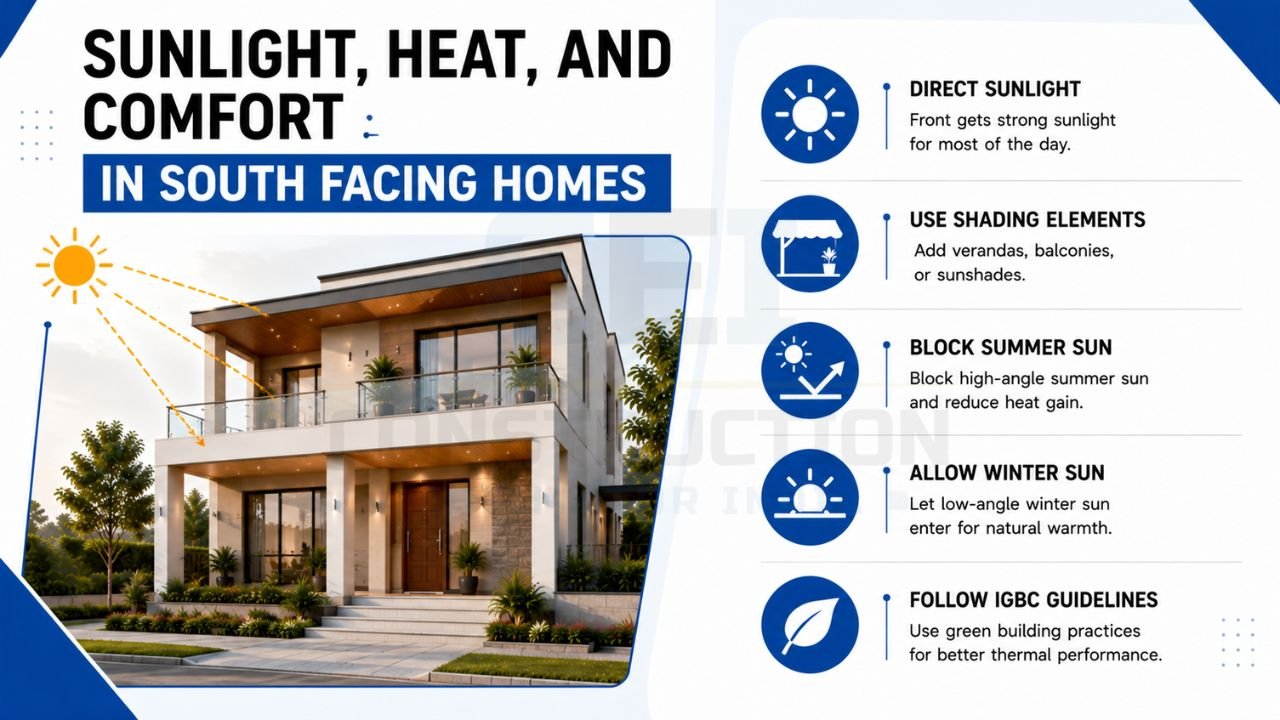
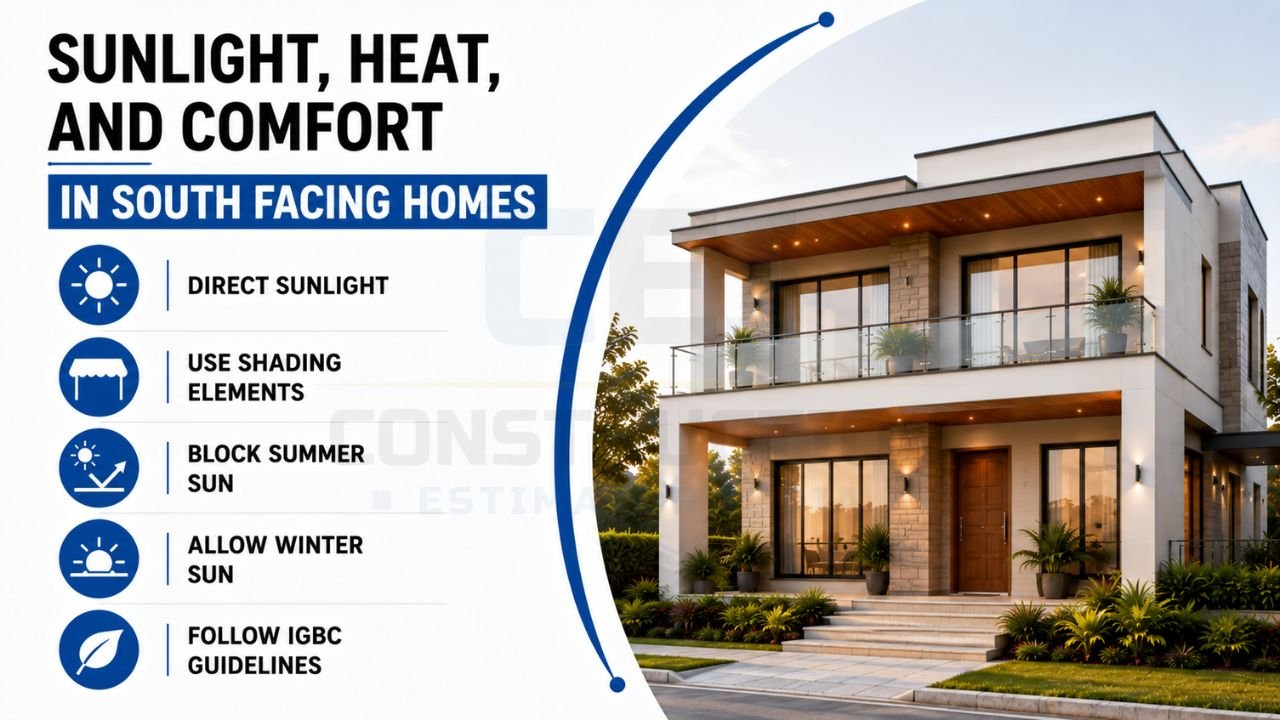
In the northern hemisphere, particularly across the Indian subcontinent, the sun remains in the southern part of the sky for the majority of the day. This means that a south facing house plan will receive direct sunlight on its front facade for several hours. While this is a blessing in the winter as it keeps the house naturally warm, it can lead to significant heat gain and glare during the scorching summer months if the design is careless. Following guidelines endorsed by the Indian Green Building Council (IGBC) can drastically improve this thermal performance.
To maintain comfort, top architects and architecture firms often recommend using deep verandas, balconies, or sunshades that block the high-angle summer sun while allowing the lower-angle winter sun to penetrate the home.
South Facing House in Simple Vastu Terms (Non-technical)
From a practical perspective, traditional Indian spatial planning often views the south with a degree of caution, but it is by no means considered bad for everyone. In simple terms, the key to a successful south facing house plan lies in the placement of the main entrance and the distribution of weight and height within the building. It is generally preferred to place the entrance in specific sections of the southern wall to ensure a positive flow of energy. Furthermore, keeping the northern and eastern sides of the plot more open and light, while making the southern and western sides heavier or more built-up, helps in creating a balanced living environment. Homeowners are encouraged to discuss these preferences with Construction Estimator India to understand how Vastu-related structural changes might impact the overall construction cost.
👉 Build a South-Facing Home That Combines Smart Design with Vastu Principles.
Study Plot Size, Shape, and Basic Regulations
Common Plot Sizes and Frontages for South Facing Houses
Indian residential colonies often feature standard plot sizes such as 30 by 40 feet, 40 by 60 feet, or smaller 20 by 50 feet configurations. For a south facing house plan, the width of the front facade greatly influences the “curb appeal” and the functional layout of the ground floor.
A wider frontage allows for a more majestic entrance and easier integration of parking and landscaping. Establishing a solid baseline understanding of your house construction per sq ft rate helps frame your possibilities early on.
Setbacks, Road Width, and Parking Constraints
Municipal regulations in most Indian cities mandate specific setbacks, aligned with rules set by the Town and Country Planning Organisation (TCPO). On a south-facing plot, the front setback is usually where the parking and main garden are located.
The width of the road in front of your house can also dictate the permissible height of the building. These rules impact the footprint of your south facing house plan and determine how much space remains for essential features like a ramp for car access or a small green belt.
How Plot Shape Influences South Facing House Layout?
While rectangular plots are the most common and easiest to plan, many Indian homeowners find themselves with L-shaped or slightly irregular plots. An L-shaped plot offers opportunities for unique private corners. One could place the main living block facing south while the secondary wing stays shielded from the direct sun. Specific structural needs for irregular plots involve varying foundation types for house construction in India.
Entrance, Parking, and Frontage Planning
Main Gate and Entry Path for South Facing Plots
The entrance is the most critical element of a south facing house plan. The main gate should be positioned to allow for a smooth turning radius for vehicles while providing a separate, clear path for pedestrians. Ideally, the entry path should be slightly elevated to prevent rainwater from the road from entering the premises during the monsoon, in line with Central Public Works Department (CPWD) standards.
Parking and Porch in a South Facing House Plan
In most modern Indian homes, the parking area doubles as a porch or a transition zone between the outside world and the private interior. For a south facing house plan, a covered parking area is highly beneficial as the roof of the porch provides an immediate shield against the southern sun. Understanding what is RCC construction allows you to leverage robust concrete slabs for structural shading above your vehicles.
Front Landscape, Steps, and Shading Elements
Landscaping plays a vital role in the thermal performance of a south facing house plan. Planting tall, leafy trees or installing vertical gardens on the southern side can provide natural shade and significantly reduce the ambient temperature around the entrance. Additionally, architectural elements like pergolas or decorative sun-breakers can be integrated into the facade to create interesting patterns of light and shadow. These features not only enhance the aesthetic value of the home but also serve as functional tools to keep the harsh glare away from the main windows, making the front rooms more livable throughout the day.
Planning Key Rooms in a South Facing House
Living Room and Dining Placement
The living room is often the heart of the home, and in a south facing house plan, it is frequently placed toward the front of the house to take advantage of the southern light. However, to avoid the heat, it is wise to set the living room slightly back from the main facade or protect it with a deep balcony. The dining area usually follows the living room, acting as a central hub that connects the kitchen and the bedrooms. Placing the dining area near a window that opens into a side setback can ensure that the space remains bright and breezy without being exposed to the direct intensity of the southern sun.
👉 Start Your South-Facing House Project with Professional Planning and Cost Analysis.
Kitchen Placement in a South Facing Plan
For many Indian families, the kitchen’s location is non-negotiable and often follows simple traditional preferences. In a south facing house plan, the southeastern corner is generally favored as it catches the early morning sun, which is considered healthy and helps in keeping the space dry and hygienic. Practical considerations include ensuring that the kitchen has a dedicated service entry or is close to the utility area for easy movement of groceries and waste. Proper exhaust systems and large windows for cross-ventilation are essential to prevent the kitchen from becoming a heat trap, especially given its location in a sun-drenched part of the house.
Bedroom Placement (Master, Children, Guest)
The master bedroom in a south facing house plan is ideally suited for the southwestern or southern side, provided there is adequate insulation and shading. This placement allows the room to remain private and away from the noise of the entrance. Children’s bedrooms are often better suited for the eastern or northern sides, where the light is softer and more conducive to studying and rest. Guest bedrooms can be placed near the entrance on the ground floor for convenience. By distributing the bedrooms across different orientations, you can ensure that each family member enjoys a comfortable environment tailored to their specific daily routines.
Stairs, Toilets, and Service Areas
Staircase Position in a South Facing Layout
The staircase serves as the vertical spine of the home and its placement in a south facing house plan can impact both the elevation and the internal airflow. A staircase located on the southern or western wall can act as a thermal buffer, absorbing the heat and preventing it from reaching the living areas. From a design perspective, an internal staircase with a skylight or large windows can become a stunning architectural feature, while an external staircase might be more practical if the upper floors are intended for rental purposes. Construction Estimator India can help you calculate the additional costs involved in complex staircase designs, such as those involving cantilevered steps or premium stone finishes.
Toilet and Bathroom Placement
In a south facing house plan, these service rooms are often relegated to the western or northern sides. This keeps the primary southern frontage free for living spaces and bedrooms. Grouping bathrooms vertically across different floors can significantly reduce the cost of plumbing pipes and labor. Utilizing proper sealants (and knowing how to use white cement for waterproofing for minor touch-ups) ensures long-term durability.
Utility, Store, and Service Areas
Utility areas, where washing and heavy cleaning occur, are best tucked away in a corner that is easily accessible from the kitchen but hidden from the main view. In a south facing house plan, the northern or eastern setbacks are often used for these functions. A small store room near the kitchen or under the staircase can provide much-needed storage without occupying prime real estate in the house. Planning these service areas early ensures that the main living spaces remain clutter-free and functional, contributing to a more organized and peaceful home environment.
Managing Heat, Light, and Ventilation
Shading, Projections, and Window Design for South Sun
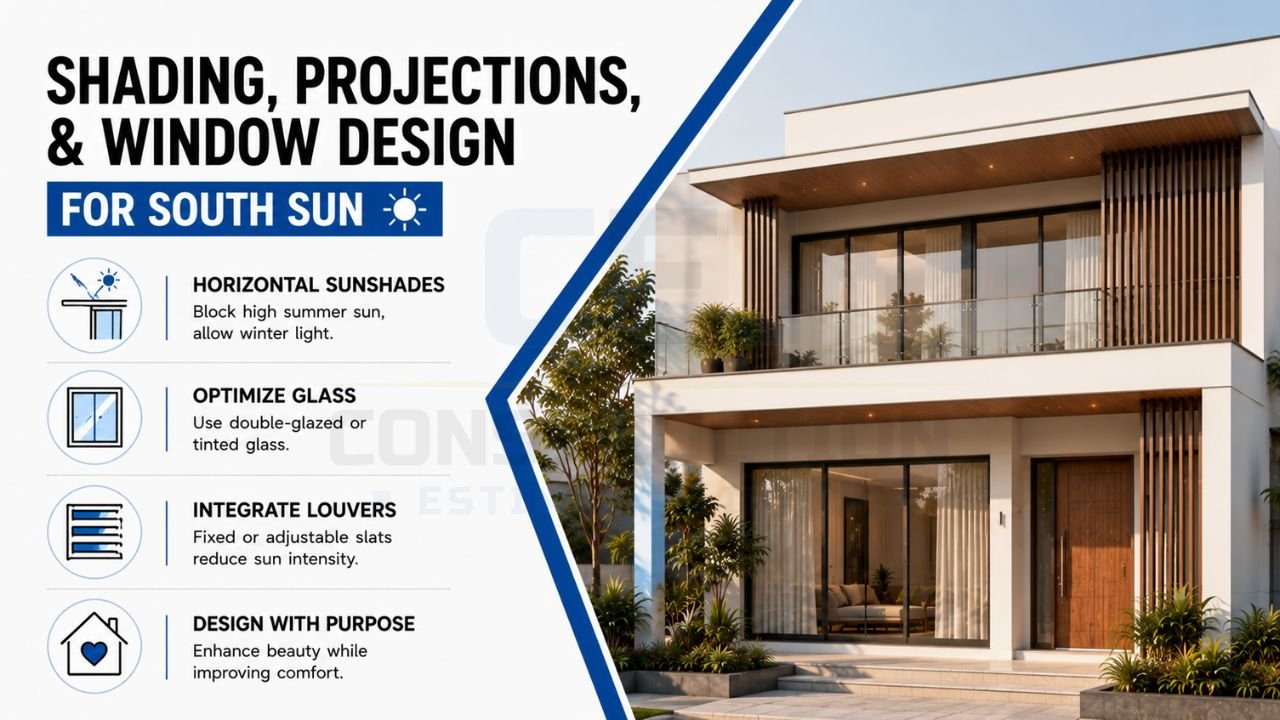
Managing the southern sun is the most critical technical challenge of a south facing house plan. Deep horizontal projections above windows, often referred to as sunshades, are a standard and effective solution in India. For larger glass surfaces, using double-glazed units or tinted glass can reduce heat transmission while still allowing light into the rooms. Louvers—fixed or adjustable slats—can also be used on the facade to break the sun’s intensity. These elements should be designed as part of the overall architectural language of the house, ensuring they add beauty while performing their primary task of temperature control.
👉 Build Smarter with Expert South-Facing House Design and Construction Solutions.
Cross Ventilation and Room Depth
A well-ventilated home feels larger and more comfortable. In a south facing house plan, it is important to have windows on opposite walls to encourage the flow of air. Since the breeze in many parts of India often comes from the south or southwest, having large openings on the south side and corresponding smaller openings on the north side creates a natural “chimney effect” that flushes out hot air. Keeping the rooms from being too deep ensures that natural light reaches every corner, reducing the reliance on artificial lighting during the day and lowering electricity bills.
Material and Color Choices That Help With Heat
Using light-colored paints on the exterior walls helps reflect a large portion of the sun’s rays. On the roof, applying reflective tiles or specialized heat-resistant coatings can prevent the top floor from becoming uncomfortably hot. Inside, using natural stone flooring like marble or kota stone provides a cool surface underfoot. Monitoring your plaster cost per square foot with material in India ensures high-quality thermal coatings don’t overstretch your budget.
Simple Vastu-Friendly Approach for South Facing Homes
Basic Vastu Ideas Without Overcomplication
While many people are intimidated by complex rules, a simple approach to Vastu for a south facing house plan focuses on balance and common sense. The primary goal is to ensure that the house is “anchored” in the south and west while remaining open and inviting in the north and east. This usually means keeping the heavy structures, such as the master bedroom and the overhead water tank, in the southwestern zone. The entrance should be positioned carefully within the southern wall, avoiding the extreme corners, to ensure that the home feels welcoming and prosperous for the inhabitants.
Balancing Vastu with Practical Design and Budget
It is important to remember that Vastu is a guide, not a rigid set of rules that should override structural safety required by the Bureau of Indian Standards (BIS) or your budget. If a kitchen cannot be placed in the exact corner suggested, a slight shift while maintaining good ventilation and light is often acceptable.
When to Talk to Architect/Estimator About Vastu Adjustments
The best time to address Vastu concerns and cost implications is during the conceptual design phase. Making changes on paper is free, but making them after the foundation is laid is incredibly expensive. Before you finalize your drawings, you should have a thorough discussion with your architect about your layout requirements. Simultaneously, you should reach out to an expert service like Construction Estimator India to get a detailed Bill of Quantities. This document will tell you exactly how much cement, steel, and bricks you will need, allowing you to see if your Vastu-compliant features fit within your financial plan.
Cost Planning and Budgeting for a South Facing House
What Really Affects Cost (Orientation vs Size, Materials, Features)
Contrary to popular belief, the orientation of a house does not inherently make it more expensive. Whether you have a north or a south facing house plan, the primary drivers of cost remain the total built-up area and the quality of finishes you choose. However, a south-facing home might require a slightly higher investment in shading devices, premium glass, or extra insulation to manage the heat. These costs are usually offset by the reduced need for artificial heating in the winter and the long-term energy savings from a well-lit home. Understanding the breakdown of these costs is essential for any first-time builder.
Built-up Area vs Budget: Simple Thinking
Every square foot you build adds to your total expenditure. When planning your south facing house plan, it is tempting to add extra balconies, larger rooms, or multiple floors. However, it is vital to align your “wish list” with your actual budget. A smaller, well-finished house is often more comfortable and valuable than a large, poorly constructed one. By prioritizing the rooms you use most and being disciplined about the total built-up area, you can ensure that you don’t run out of funds before the house is completed.
How Construction Estimator India Helps With Quantity and Cost Estimation?
By taking your south facing house plan and performing a detailed quantity takeoff, we provide you with a precise list of materials required. This prevents wastage and helps you negotiate better rates with local building contractors. Contact Construction Estimator India on WhatsApp or Call +91 8630676890 to get a professional cost estimate tailored to your specific project needs.
Common Mistakes in South Facing House Plans
Ignoring Sun and Heat Control on the South Side
One of the most frequent errors in a south facing house plan is failing to account for the sun’s intensity. Homeowners often install large glass windows on the southern facade without any shading, resulting in “greenhouse” rooms that are impossible to cool even with air conditioning. This mistake leads to high electricity bills and physical discomfort. Always ensure that your south-facing openings are protected by balconies, deep overhangs, or external screens to maintain a pleasant indoor temperature.
Over-Focusing on Direction and Ignoring Basic Comfort
Some builders become so obsessed with following directional rules that they forget the basic principles of livability. They might place a room in a specific corner even if it means the room will have no windows or poor ventilation. A house should, first and foremost, be a comfortable place to live. If a specific rule makes your south facing house plan feel dark, cramped, or illogical, it is usually better to prioritize light, air, and functional flow.
Poor Entrance and Parking Planning
A common practical mistake is not leaving enough space for a vehicle to turn or for people to walk comfortably around a parked car. On a south-facing plot, where the entrance is often the main focus, a cramped parking area can make the whole house feel congested. Additionally, failing to plan for proper slope and drainage at the entrance can lead to water logging. Taking the time to visualize the daily movement of your family and your vehicles will help you create a more functional and stress-free entry experience.
👉 Need a Custom South-Facing House Plan? Consult Our Construction Experts Today.
FAQs: South Facing House Plan in India
Is a south facing house bad according to Vastu?
Not at all. While there are myths surrounding the direction, a south-facing house can be highly prosperous if the entrance is placed in the correct “pada” or section of the south wall. Many successful business families and individuals in India live in south-facing homes that have been designed with balance in mind.
How can I reduce the heat in a south facing house?
The best way to reduce heat is through structural shading. Use deep balconies, sunshades, and pergolas on the south side. Additionally, using heat-reflective paint on the roof and choosing insulating building materials like hollow blocks can keep the interiors significantly cooler.
Can I have a good south facing house plan on a small plot?
Yes, small plots often benefit from the abundant light of a southern orientation. By using an open floor plan and placing large windows with proper shading, even a 1000 square foot south-facing home can feel spacious and bright.
Are the construction costs higher for a south facing house?
The basic construction cost remains the same as any other orientation. Any additional cost usually comes from specialized shading elements or premium glazing used to control heat, but these are small investments compared to the total budget.
When should I contact an estimator like Construction Estimator India?
You should contact us as soon as you have a preliminary floor plan or sketch. Knowing the cost early allows you to make adjustments to the size or materials before you commit to the construction phase, saving you from future financial stress.
Conclusion: Design Your South Facing House for Comfort, Light, and Budget
Building a home is a once-in-a-lifetime journey, and a south facing house plan offers a wonderful canvas to create a bright and energetic living space. While the challenges of heat and traditional myths may seem daunting, they are easily managed through thoughtful architecture and strategic planning. By focusing on deep shading, cross-ventilation, and a sensible room layout, you can enjoy all the benefits of a sun-drenched home while keeping the interiors cool and peaceful.
Remember that orientation is just one piece of the puzzle. The true success of your home depends on how well you plan your space and manage your budget. To ensure that your dream home stays within your financial reach and is built with the right amount of materials, professional guidance is indispensable. Before you take the final step and start the foundation of your south facing house plan, reach out to the experts. Contact Construction Estimator India on WhatsApp or Call +91 8630676890 to get your detailed cost and quantity estimate today.