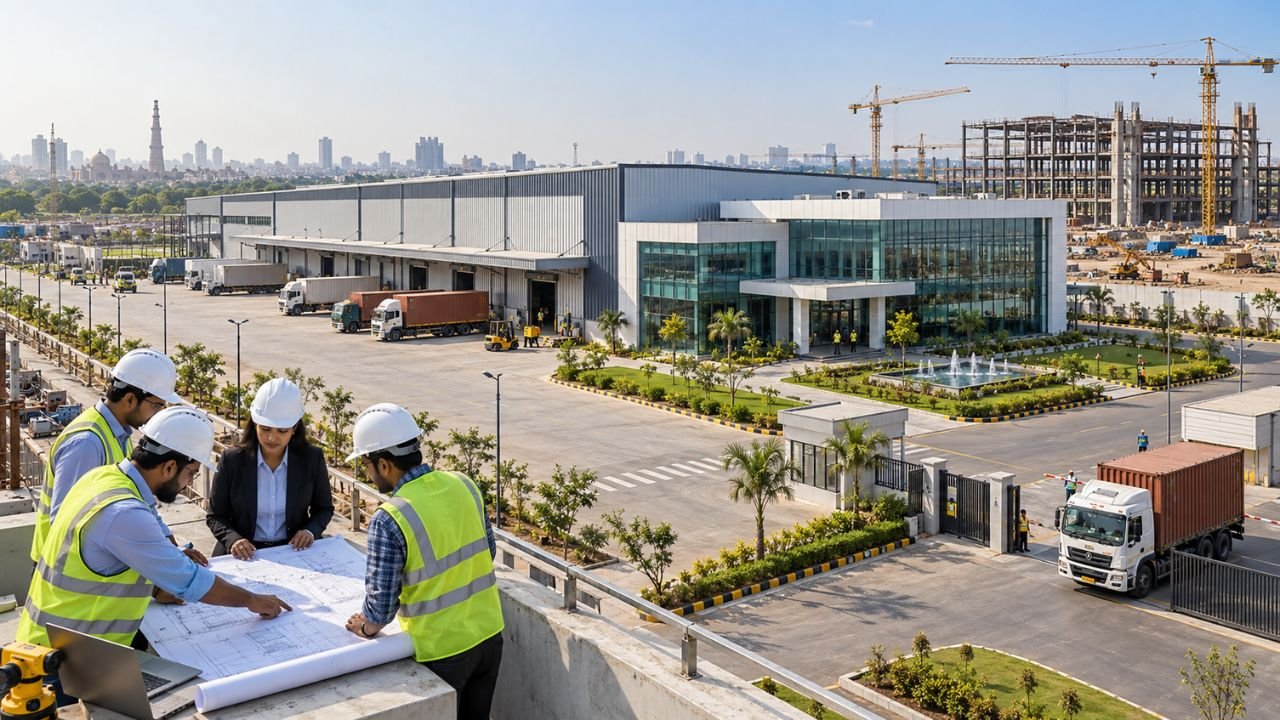
Building your first home in India is a monumental milestone, representing years of hard-earned savings and the fulfillment of a lifelong dream. Whether you are constructing a G+1 independent house on a small plot in a Tier-2 city like Agra or planning a modern villa in Delhi NCR, the process is both exhilarating and daunting. However, because most people build a home only once in their lifetime, they often lack the technical and financial expertise required to navigate the complex construction landscape. This lack of experience frequently leads to a series of mistakes first-time home builders make India that can result in massive budget overruns, legal disputes, and structural compromises.
In the Indian context, “self-construction” is the norm for many. Families typically hire a local contractor, manage the materials themselves or through a petty-contractor, and rely on family members for site supervision. While this offers control, it also creates a high risk for predictable errors in planning, approvals, and execution. Without a professional roadmap, many projects stall midway due to funds running dry or face quality issues like seepage and cracks within just two years of completion.
👉 Building Your First Home? Get Expert Guidance Before You Begin.
Construction Estimator India understands these challenges intimately. Our mission is to bridge the gap between a builder’s dream and the harsh reality of construction costs and logistics. We specialize in helping first-time builders plan realistic budgets, providing detailed quantity takeoffs, and offering guidance to ensure every rupee is spent effectively. By identifying pitfalls before the first brick is laid, we save families from the mental and financial stress of “unexpected” expenses.
If you are planning your first home and want to avoid common money and planning mistakes, you can contact Construction Estimator India on WhatsApp / Call +91 8630676890 before you start construction. Our expert team provides the professional construction cost estimation services you need to keep your project on track.
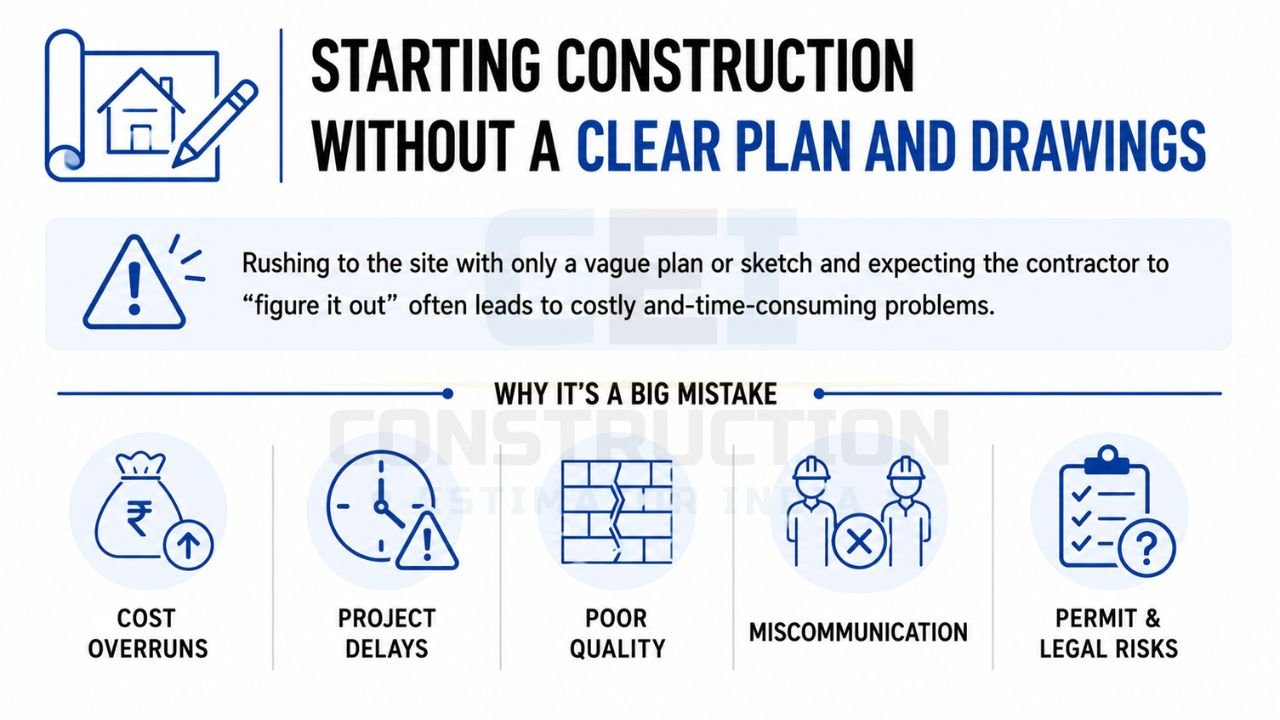
Mistake 1: Starting Construction Without a Clear Plan and Drawings
One of the most frequent mistakes first-time home builders make in India is rushing to the site with only a vague floor plan or, worse, a hand-drawn sketch. Many believe that an experienced local contractor can “figure it out” as they go. This approach is a recipe for disaster.
Why Incomplete Planning Is Dangerous?
Incomplete planning leads to “on-the-spot” decision-making, which is always more expensive. When you don’t have detailed drawings, you cannot calculate the exact quantities of steel, cement, or bricks required. This leads to massive material wastage and constant “extra work” charges from the contractor. In the Indian construction climate, where material prices fluctuate weekly, not having a locked-down plan means you are at the mercy of market volatility. Furthermore, making changes once the structure is already built—like moving a wall or adding a window—costs three times as much as planning it on paper.
👉 Turn Your Dream Home into Reality with Smart Construction Decisions.
What “Clear Plan” Really Means in India (Architectural, Structural, MEP)
A “clear plan” is not just a floor layout. It consists of three critical components developed by professional architects and architecture firms:
- Architectural Drawings: These define the aesthetics, room sizes, window placements, and exterior elevations.
- Structural Drawings: These are the most important for safety. They specify the depth of foundations, the thickness of slabs, and the exact diameter of steel bars (TMT) needed. Skipping this often leads to over-engineering (wasting money) or under-engineering (risking collapse).
- MEP (Mechanical, Electrical, and Plumbing) Drawings: These show where every pipe and wire goes. Without these, you will likely end up with poorly placed sockets or plumbing lines that leak into your living room.
How to Avoid This Mistake?
To avoid this, never let a contractor start work until you have a full “Good for Construction” (GFC) drawing set. Invest in a professional architect or structural engineer. While their fees might seem like an added expense, they typically save you 10-15% of the total construction cost by optimizing the design. Before finalizing these plans, you can share your plot size, city, and basic plan with Construction Estimator India to get a rough construction budget and guidance on what to watch out for as a first-time home builder.
Mistake 2: Underestimating the Real Construction Budget
Nearly 80% of residential projects in India exceed their initial budget by at least 20-30%. This happens because first-time builders often calculate costs based on a simple “per square foot” rate they heard from a neighbor, which is rarely accurate for their specific needs. Understanding how to plan home construction in India from a financial perspective is paramount.
Hidden Costs First-Time Builders Often Forget
The “per square foot” rate usually only covers the gray structure (bricks, cement, steel). Builders often forget:
- Government Approvals: Map sanction fees, water connection charges, and electricity board deposits.
- Site Development: Leveling the plot, building a temporary shed for cement, and securing a water source for construction.
- Soil Testing: Crucial for foundation design but often ignored.
- Finishing Touches: Premium tiles, modular kitchens, and lighting fixtures can double the cost of the basic structure.
Why Budget Overruns Happen in Indian Home Projects?
In India, budget overruns are often caused by “scope creep”—adding a balcony or an extra room halfway through. Another major factor is the lack of a Bill of Quantities (BOQ). Without a BOQ, you don’t know how many bags of cement or tons of steel you should be buying. This allows for pilferage at the site and overcharging by vendors.
How Construction Estimator India Helps With Realistic Budgeting?
Before you finalize your contractor or start construction, Construction Estimator India can help you estimate realistic costs tailored to your localized house construction per sq ft rate. Reach out on WhatsApp / Call +91 8630676890. We provide detailed home construction budgeting guidance by breaking down every single item of work. This transparency allows you to see exactly where your money is going and where you can afford to splurge or save.
Mistake 3: Ignoring Soil Testing and Site Conditions
Many first-time builders think soil testing is only for high-rise buildings. In reality, the soil in regions like the Indo-Gangetic plain (Agra, Delhi, Lucknow) varies significantly and can be highly unstable or sandy.
Why Soil and Site Matter for Foundation and Dampness?
If the soil is weak and you build a standard foundation, the house will eventually settle, leading to deep structural cracks. Conversely, if your soil is very strong and you build a massive foundation, you are throwing money away. Soil testing dictates your specific foundation types for house construction in India. It also reveals the water table level; a high water table requires specialized waterproofing for the foundation to prevent dampness (seepage) from rising into your walls.
Typical Site Issues Across Indian Cities and Towns
In many Indian towns, plots are often located in low-lying areas that flood during the monsoon. Builders often fail to raise the “Plinth Level” (the height of the ground floor) sufficiently above the road level. This results in rainwater entering the house every year.
Practical Steps to Avoid This Mistake
Always hire a geotechnical lab to perform a basic soil test (Borelog or SPT). It usually costs between ₹18,000 to ₹30,000 but can save you lakhs in foundation repairs. Ensure your structural engineer designs the foundation specifically for your soil report. You can contact Construction Estimator India team to help you understand how soil conditions will impact your total material quantities and costs.
Mistake 4: Overlooking Legal Approvals and Documentation
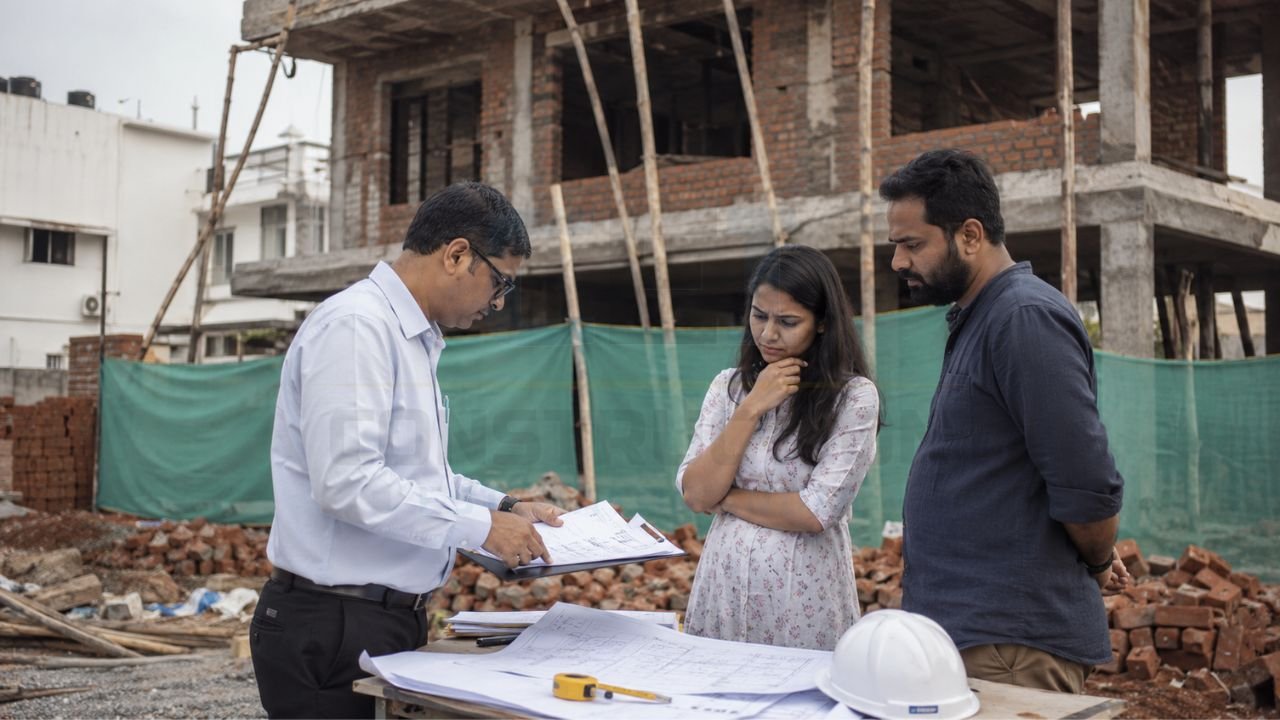
In the excitement to build, legalities are often treated as a secondary thought. However, unauthorized construction is a major risk in India, where local authorities (like DDA, ADA, or Municipal Corporations) have become increasingly strict about building bylaws as outlined by the Town and Country Planning Organisation (TCPO).
Common Approval-Related Problems Indian Builders Face
The most common issues include violating “setback” rules (the mandatory open space around the house) or building more floors than the Floor Area Ratio (FAR) allows. These violations can lead to heavy fines, demolition orders, or the inability to get a permanent electricity or water connection.
👉 Build with Confidence Through Expert Planning, Budgeting, and Project Support.
Basic Types of Permissions a Home Builder Should Know
- Building Map Sanction: Approval of your architectural plan by the local authority.
- NOCs: No Objection Certificates from fire, sewerage, or traffic departments if required.
- Completion/Occupancy Certificate: Proof that the house was built according to the plan.
How to Stay Legally Safe and Organised?
Never start construction on a “verbal promise” from a local politician or contractor that “everything will be managed.” Ensure your architect has a valid license to submit plans. Keep a digital and physical folder for all your property papers and sanctioned maps. This documentation is vital if you ever plan to take a home loan or sell the property in the future.
Mistake 5: Choosing Contractors Only on Lowest Price
The “L1” (Lowest Bidder) syndrome is perhaps the most dangerous mistakes first-time home builders make in India. Many builders interview three building contractors and simply pick the one who quotes the lowest per-square-foot rate.
Risks of Going With the Cheapest Contractor
A contractor quoting significantly below market rates is likely doing one of three things:
- Using Substandard Materials: Using low-grade steel or local-brand cement.
- Cutting Corners: Skipping curing (watering the concrete) or using less cement in the mortar.
- Hiding Costs: They will start the work and then stop, demanding more money for “extras” that should have been included.
What to Check Before Selecting a Contractor?
Always check their previous work. Visit a site they completed 2-3 years ago—not just a brand-new one—to see if the house shows signs of cracks or seepage. Ask for a written contract that specifies the brand of materials to be used and the payment milestones aligned with standard Bureau of Indian Standards (BIS) construction practices.
How Cost Estimation Supports Better Contractor Decisions?
If you have a professional estimate from Construction Estimator India, you have a benchmark. If a contractor quotes ₹2,400 per sq ft but our report shows the actual cost of materials and labor is ₹2,640, you know that contractor is lying or planning to cheat you later. Use our home construction quantity takeoff support to verify every quote you receive.
Mistake 6: Compromising on Material Quality to Save Short-Term Money
When the budget gets tight, builders often try to save money on “hidden” materials like the grade of steel or the quality of plumbing pipes.
Long-Term Impact of Poor Cement, Steel, and Waterproofing Choices
Using local, non-branded TMT bars can lead to early rusting, which expands and cracks the concrete from within. Learning what is RCC construction proves why structural integrity is paramount. Similarly, cheap PVC pipes can burst inside the walls, requiring you to break your expensive tiles to fix a leak. These “savings” usually result in repair costs that are 10 times higher than the initial savings.
How to Balance Budget and Quality?
Invest in the “bones” of the house. Never compromise on cement (PPC/OPC), steel (Fe500/550D), or waterproofing. You can always save money later by choosing slightly cheaper floor tiles or a simpler paint brand, which are easy to change in the future.
Where Construction Estimator India Can Guide on Budget vs Quality?
Construction Estimator India can provide you with a list of recommended brands and grades for your specific budget. We help you distinguish between “luxury” expenses and “structural” necessities, ensuring your house remains safe for generations.
Mistake 7: Poor Design for Ventilation, Sunlight, and Daily Use
Many Indian homes are built as “matchboxes”—four walls with little thought given to the direction of the sun or wind.
Why Design Is About Comfort, Not Just Looks?
A house that lacks natural light will always feel gloomy and lead to higher electricity bills for lighting and air conditioning. In the Indian heat, cross-ventilation is essential to keep the indoor temperature manageable.
Common Layout and Ventilation Mistakes in Indian Homes
- Small Windows: To save on wood or aluminum costs, builders often make windows too small.
- Ignoring Vastu: While subjective, many Indian builders ignore Vastu and then struggle to sell or live in the house due to psychological stress or family pressure.
- Poor Kitchen Layout: Not leaving enough space for modern appliances or ventilation.
How to Think About Future Lifestyle, Elderly Parents, Home Office, etc.
Always design with the future in mind. If you have elderly parents, ensure there is a bedroom on the ground floor. If you work from home, plan for a dedicated, quiet corner with extra power sockets and data points.
Mistake 8: Not Planning for Future Needs and Expansion
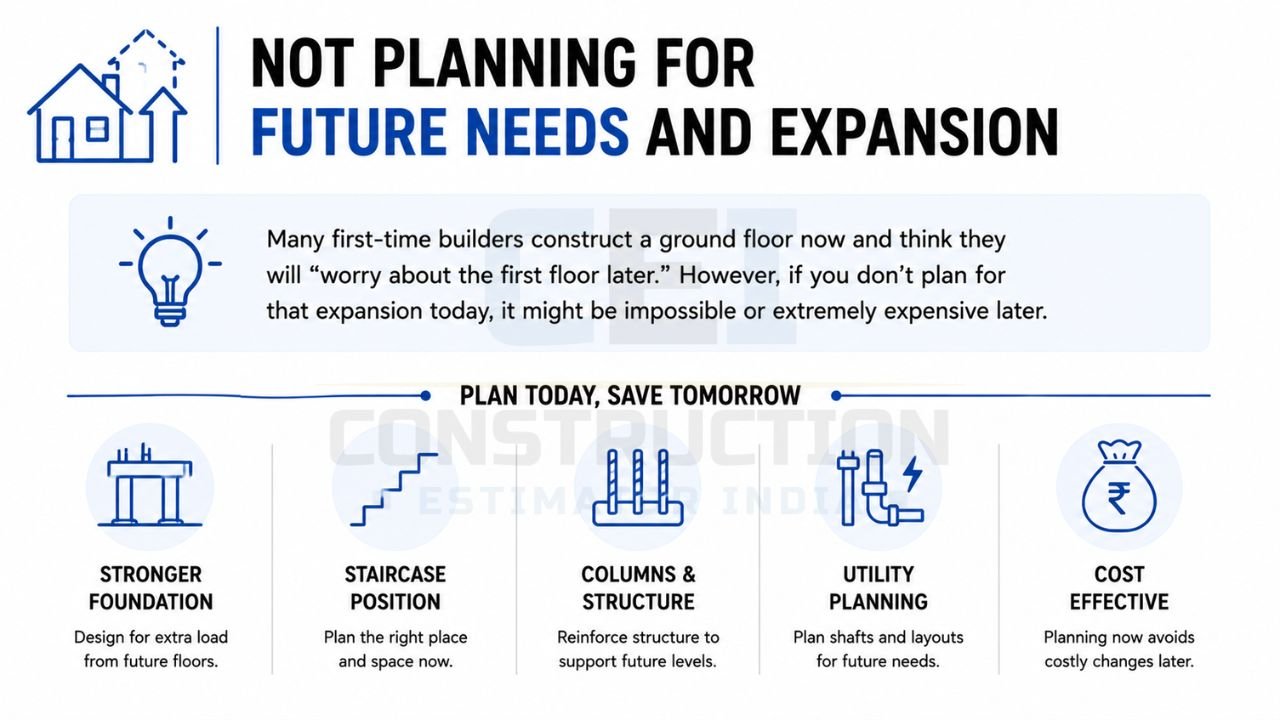
Many first-time builders construct a ground floor now and think they will “worry about the first floor later.” However, if you don’t plan for that expansion today during your initial house renovation or build, it might be impossible or extremely expensive later.
Short-Term Thinking vs Long-Term Life Needs
If your foundation and columns are not designed to carry the load of additional floors, you will be stuck with a single-story house forever.
👉 Make Every Construction Decision with Confidence and Professional Guidance.
Structural and Layout Provisions for Future Floors or Rooms
Ensure your structural engineer designs for the ultimate height you want (e.g., G+2). Leave “starter bars” (steel rods protruding from the columns) on the roof so that new columns can be joined easily later. Also, plan the staircase location so it doesn’t require breaking your existing living room.
How Early Estimation Helps Plan Future-Ready Homes?
Construction Estimator India can help you calculate the cost of “phased construction.” We can show you how much it costs to build the foundation for three floors now, even if you are only finishing the ground floor today. This strategic planning prevents future rework.
Mistake 9: Lack of Regular Site Supervision and Quality Checks
Even with the best materials and plans, poor workmanship can ruin a house. In India, most masonry and RCC (Reinforced Cement Concrete) work is done by semi-skilled laborers who need constant supervision.
How Absence From Site Leads to Hidden Problems?
If you are not at the site, laborers might add too much water to the concrete (making it weak) to make it easier to pour, or they might skip the critical “curing” process (keeping the concrete wet for 7-14 days).
Simple Supervision and Checklists for Homeowners
You don’t need to be an engineer. Check for basic things:
- Is the steel being tied correctly with binding wire?
- Are the bricks being soaked in water before use?
- Is the contractor using “spacers” to ensure steel doesn’t touch the outer surface of the concrete?
When to Involve Professionals for Key Stages
Always have your structural engineer visit during the foundation pouring and the slab casting. These are the most critical days in a house’s life. If you are an NRI building a home remotely, Construction Estimator India can help you set up reporting systems to track progress from afar.
Mistake 10: Ignoring Waterproofing, Drainage, and Maintenance Planning
Water is the biggest enemy of Indian homes. Seepage from the terrace or bathrooms is the number one complaint of homeowners within 24 months of construction.
Why Waterproofing and Drainage Are Not “Extra”?
Many builders view waterproofing as an “extra” expense. However, once dampness enters a wall, it destroys the paint, the plaster, and eventually the structural integrity of the bricks and steel. Knowing how to use white cement for waterproofing in India is a baseline defense.
Typical Waterproofing and Leak Issues in Indian Homes
The most common failure points are the “sunken slabs” in bathrooms and the joints where the terrace meets the parapet wall. Poorly sloped terraces that allow water to “pool” are also a major cause of leaks.
How to Budget and Plan These Items From Day One?
Budget for high-quality waterproofing membranes or chemicals (like crystalline systems). Ensure that all external walls have a “drip mold” on the sunshades to prevent rainwater from running back toward the walls. Construction Estimator India includes these critical items in our detailed estimates, so you aren’t surprised by the cost later.
Mistake 11: Rushing Finishes and Interiors
By the time builders reach the finishing stage (flooring, painting, woodwork), they are often exhausted—both mentally and financially. This leads to a rush to finish, which ruins the final look of the house.
Problems With Speed-Over-Quality in Finishing Stage
Applying paint on damp plaster or laying tiles on a surface that hasn’t settled properly leads to peeling paint and hollow-sounding tiles that crack easily.
How to Sequence Painting, Flooring, and Fixtures Smartly
Never start the final coat of paint until all the electrical and plumbing work is 100% complete. If you break a wall for a forgotten wire after painting, the patch will always be visible.
Where Cost Estimation Helps Set Priorities
If you know your budget is running low, use your Construction Estimator India report to prioritize. It’s better to have high-quality flooring and wait six months for the designer wardrobes than to buy cheap versions of both. Knowing your plaster cost per square foot with material in India helps pace these final finishes.
Mistake 12: Not Documenting Decisions, Drawings, and Bills
The final mistake is a lack of record-keeping. In the 6-12 months it takes to build a house, thousands of decisions are made, and lakhs of rupees change hands.
Why Poor Documentation Creates Confusion and Disputes?
Without a written record of what you paid the contractor, disputes are inevitable. Without a “As-Built” drawing, you won’t know where the electrical conduits are five years later when you want to drill a hole to hang a picture.
Simple Ways to Keep Records of Your Home Project
Maintain a simple ledger for all payments. Take photos of the electrical and plumbing lines before the walls are plastered. Store all your material bills—they are necessary for warranty claims on items like pumps, wires, and fixtures.
How Documentation Supports Estimation, Changes, and Future Repairs?
Good records make future maintenance easy. If you ever decide to renovate, having the original estimates from Construction Estimator India will help the new team understand the structure of your home.
FAQs: First-Time Home Builders in India
How much budget cushion should a first-time home builder keep?
You should always keep a contingency fund of 10-15% of your total estimated cost. Construction prices in India can rise due to sudden hikes in fuel or raw material prices, and there are always minor “unforeseen” site requirements.
Do I really need soil testing for a small residential plot?
Yes. Even for a 1,000 sq ft house, soil testing is vital to ensure your foundation is neither unsafe nor wastefully expensive.
When should I contact an estimator like Construction Estimator India in my planning process?
The best time is right after you have your first architectural draft. This allows you to check if the design fits your budget before you spend money on detailed structural drawings.
How do I know if my contractor’s quote is realistic?
Compare it with a professional BOQ. If the contractor’s quote for materials is much lower than current market rates, they are likely using low-quality items.
What are the most expensive mistakes that first-time home builders make?
Skipping waterproofing, ignoring soil conditions, and not having a detailed budget. These mistakes can cost you lakhs in repairs within the first five years.
How can I break my home construction into stages if my budget is limited?
You can build the “Gray Structure” (foundation, walls, roof) first and move in with basic flooring and one functional bathroom, completing the luxury interiors as you save more money. Construction Estimator India specializes in planning these stages.
Conclusion: Build Smart, Not Just Fast
Building your first home in India doesn’t have to be a series of expensive lessons. By avoiding the common mistakes first-time home builders make in India, you can ensure that your dream project is completed on time and within budget. Remember: never start without a full set of drawings, respect the legal requirements governed by the Real Estate Regulatory Authority (RERA), choose quality over the “lowest price,” and never compromise on the structural health of your building.
A house is more than just bricks and mortar; it is a sanctuary for your family. Planning it with precision is the greatest gift you can give to your future self.
If you are a first-time home builder in India and want help estimating your construction budget, comparing options, and avoiding common costly mistakes, you can contact Construction Estimator India on WhatsApp / Call +91 8630676890 before you begin construction.