In the diverse and demanding climate of India, your roof is not just a structural cap; it is a vital shield against relentless monsoons and scorching summers. Moisture is the silent enemy of Indian masonry, and for many homeowners, roof leakage is a recurring nightmare that threatens both structural integrity and health. Whether you are dealing with a flat RCC terrace or a complex sloped structure, finding the right roof waterproofing solutions is essential during any extensive house renovation project.
Ignoring minor dampness can lead to catastrophic expenses. In 2026, homeowners who skip proper treatment during construction or renovation often face repair bills ranging from ₹60,000 to over ₹2,40,000 within just a few years. At Construction Estimator India, we believe that professional planning and grasping the localized house construction per sq ft rate are the first steps toward a leak-free home. We specialize in providing technical, data-driven solutions for dampness and leakage, moving beyond the guesswork that often plagues the Indian construction market.
👉 Protect Your Roof from Leaks with Expert Waterproofing Solutions.
If you are seeing damp patches on your ceiling or terrace, you can contact Construction Estimator India on WhatsApp / Call +91 8630676890 to understand how much a proper roof waterproofing solution may cost for your home.
This comprehensive handbook serves as your definitive guide to navigating the complex world of waterproofing chemicals, membranes, and application methods. We will walk you through the process of inspecting your roof, selecting the most suitable technology—be it cementitious, liquid-applied, or bituminous—and ensuring your contractor follows high-quality application standards set by the Bureau of Indian Standards (BIS).
Understand Why Roofs Leak and How Waterproofing Helps
Common Reasons for Roof Leakage in Indian Homes
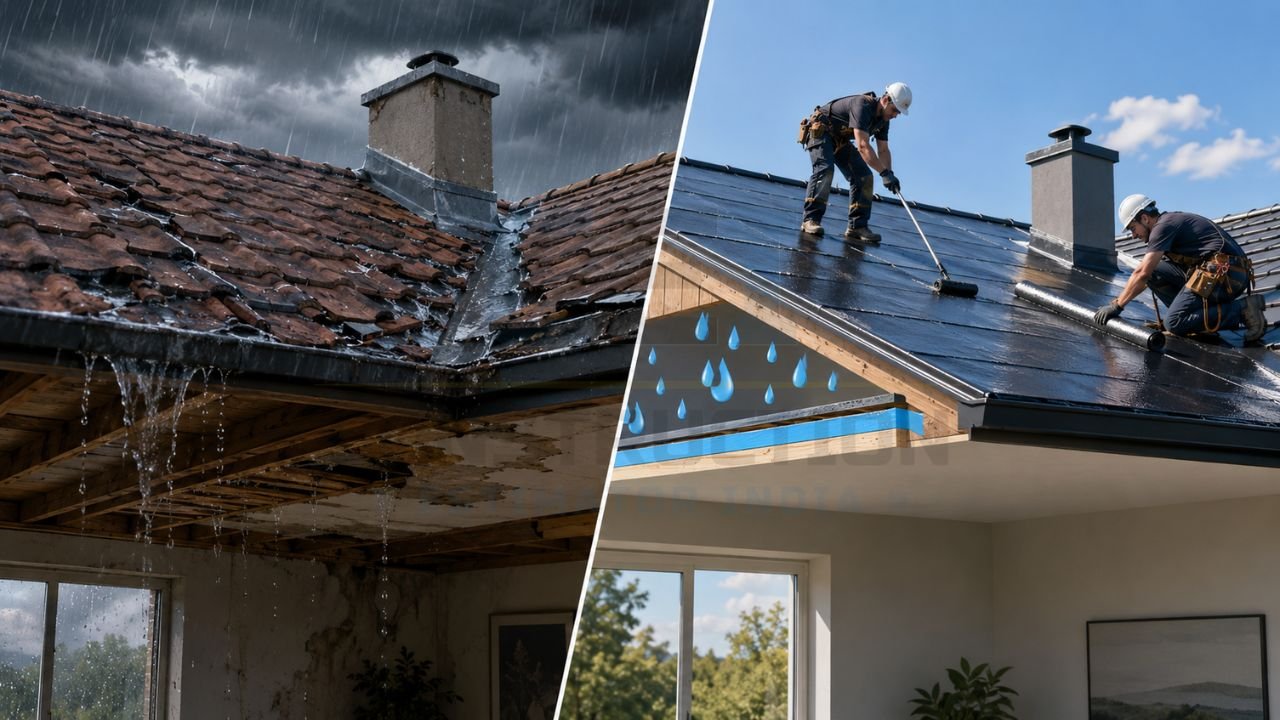
Roof leakage in India is rarely caused by a single factor. It is usually a combination of environmental stress and construction flaws. Understanding what is RCC construction helps you realize why flat slabs are the biggest source of leakage. One primary cause is thermal expansion; in many regions, temperatures can hit 45°C in summer and drop significantly in winter, causing concrete slabs to expand and contract, leading to thermal cracks.
Furthermore, improper slope management leads to “ponding water,” where standing water sits on the roof for days after rain, eventually penetrating micro-cracks via hydrostatic pressure. Clogged drains and poor “filleting” at the junction where the roof meets the parapet wall also create vulnerable entry points for moisture. Understanding these root causes is vital before choosing any roof waterproofing solutions.
- Practical Action: Inspect your roof after a heavy rain. Mark areas where water stays for more than 2 hours. These are your “ponding” zones that need slope correction.
- Common Mistake: Applying a new coating over a roof with standing water issues without fixing the slope first. The water will eventually “push” through the new chemical.
👉 Give Your Roof Long-Lasting Protection with Professional Waterproofing Guidance.
Impact of Roof Leakage on Structure and Health
A leaking roof is far more than an aesthetic nuisance. When water enters the RCC slab, it reaches the internal steel reinforcement (rebar). Corrosion causes the rebar to expand, leading to “spalling,” where chunks of concrete fall away, catastrophically weakening the building. This degradation of your investment can be avoided with timely roof waterproofing solutions.
Beyond structural risks, moisture trapped in ceiling cavities and insulation creates ideal conditions for mold and mildew growth. Mold poses serious health risks, particularly for family members with respiratory conditions or allergies. By addressing leakage early, you protect your home’s structure and your family’s health.
- Practical Action: Check for “Shorra” or white powdery efflorescence on your top-floor ceilings. This is a sign of active mineral leaching due to water ingress.
- Common Mistake: Thinking that a new coat of interior paint will solve the problem. Interior paint only masks the symptom; it does not stop the water at the source.
How Waterproofing Solutions Protect Your Home
Waterproofing should be viewed as a preventative solution that protects your home’s structure, value, and comfort for years to come. Effective roof waterproofing solutions create a durable, seamless barrier that stops water penetration at the surface, protecting the timber framing, steel, and concrete beneath.
Modern systems also offer secondary benefits, such as improved energy efficiency. Many reflective “cool roof” coatings can reduce surface temperatures by up to 10°C, keeping your top floor cooler and reducing air conditioning bills. For help estimating your roof waterproofing cost and material quantities, you can contact Construction Estimator India on WhatsApp / Call +91 8630676890.
- Practical Action: When planning home construction in India, treat waterproofing as a “structural” item, not a “finishing” item.
- Common Mistake: Opting for the cheapest possible fix. A poor waterproofing job often fails within a single monsoon, leading to wasted money and double the repair effort.
Types of Roof Waterproofing Solutions Used in India
Cementitious Waterproofing
Cementitious systems are the most “user-friendly” and widely available roof waterproofing solutions in the Indian market. These are polymer-modified powders mixed with a specialized liquid to form a slurry that bonds exceptionally well with concrete. They are typically used for indoor wet areas like bathrooms but can be used for small terraces or balconies.
- Pros: Cost-effective (₹60–₹120 per sq ft), easy to apply by brush, and breathable.
- Cons: Lack flexibility. If your building undergoes significant thermal expansion and develops cracks, a rigid cementitious layer will crack along with it.
- Common Mistake: Using a rigid cementitious coating on a large, exposed terrace that gets direct sunlight. It will inevitably crack during the first summer.
Liquid Membrane Waterproofing (Acrylic / Elastomeric)
Acrylic liquid coatings are the “elastomeric” workhorses of the industry. These are liquid-applied membranes that cure to form a rubber-like seamless layer over the surface. Premium acrylics are often fiber-reinforced to bridge minor cracks.
- Pros: High “elongation” (the ability to stretch), UV resistant, and creates a joint-free seal.
- Cons: Requires a perfectly clean substrate; applying it on a dusty or damp roof leads to peeling.
- Cost: Approximately ₹60–₹150 per sq ft.
- Common Mistake: Diluting the product with too much water to “increase coverage.” This results in a thin film that lacks the required tensile strength to stop leaks.
Bituminous Membrane and APP Membrane Systems
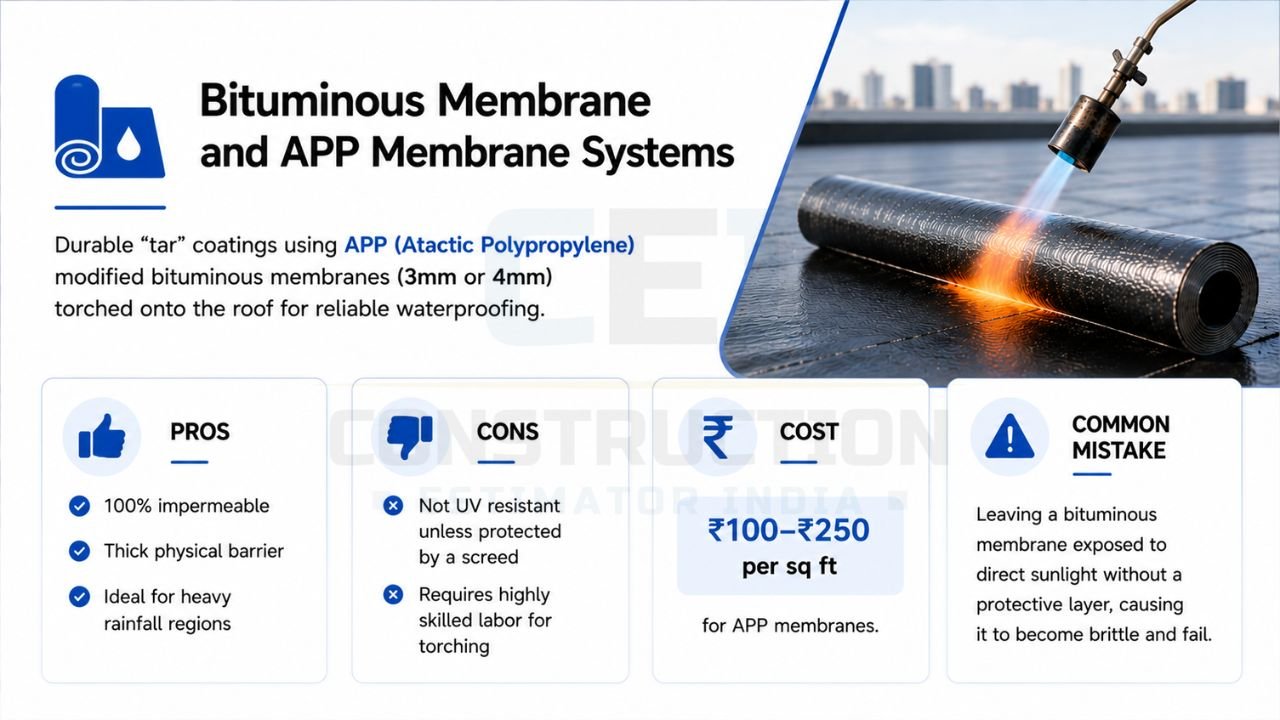
Often called “Tar” coatings, these are among the oldest and most reliable forms of waterproofing. In modern Indian construction, we use APP (Atactic Polypropylene) modified bituminous membranes that come in 3mm or 4mm thick rolls and are “torched” onto the roof surface.
- Pros: 100% impermeable, thick physical barrier, ideal for heavy rainfall regions.
- Cons: Not UV resistant unless protected by a screed; requires highly skilled labor for torching.
- Cost: ₹100–₹250 per sq ft for APP membranes.
- Common Mistake: Leaving a bituminous membrane exposed to direct sunlight without a protective layer, causing it to become brittle and fail.
Polyurethane (PU) and Hybrid Systems
PU coatings are the premium, “gold-standard” roof waterproofing solutions for 2026. These high-performance chemicals offer extreme durability and can bridge significant structural cracks due to their 400%+ elongation properties.
- Pros: Extreme lifespan (10-15 years), joint-free, and handles complex architectural shapes easily.
- Cons: Expensive and requires highly skilled labor; sensitive to moisture during the curing phase.
- Cost: ₹150–₹300 per sq ft.
- Common Mistake: Rushing the application process. Each layer of PU needs specific curing time; rushing it can trap moisture and cause bubbling.
👉 Need the Right Roof Waterproofing Solution? Consult Our Experts Today.
Traditional Methods (Brick Bat Coba)
Many older Indian homes use “brick-bat coba,” a traditional method involving broken bricks and lime/cement mortar. While once popular, it often eventually cracks and absorbs water, becoming a source of weight and leakage itself.
- Pros: Provides some thermal insulation; traditional knowledge is widely available.
- Cons: Heavy, rigid, and prone to cracking; very difficult to repair once it starts leaking.
- Common Mistake: Applying a modern liquid membrane directly over old, hollow, or cracked brick-bat coba without removing the hollow portions first.
If you are confused between different roof waterproofing systems, Construction Estimator India can guide you step by step. Reach out on WhatsApp / Call +91 8630676890 for detailed construction estimating services.
Assess Your Roof Condition Before Choosing a Waterproofing System
Visual Inspection of Roof and Terrace
Before choosing a product, a thorough inspection is mandatory. Look for structural cracks, especially at the corners. Check the condition of old tiles or coatings. Inspect the “parapet junction”—the corner where the horizontal roof meets the vertical wall—as this is a notorious leak point.
- What to check: Tap the surface with a hammer. A “hollow” sound indicates that the existing plaster—which directly impacts your baseline plaster cost per square foot with material in India—or coba has detached from the slab and must be removed.
- Decision Process: If cracks are hairline, an acrylic coating may suffice. If cracks are wide (>2mm), a high-build PU system or membrane is required.
Structural and Construction Factors
The age and type of your roof dictate the solution. An old brick terrace has different expansion properties than a new RCC slab. You must also consider the load capacity; adding a heavy layer of new concrete (screed) for slope correction might be too much for an old structure.
- Action: Determine if your roof has many protrusions like AC stands, tank bases, or solar panel mounts. These areas require liquid-applied systems because membranes cannot be easily rolled around them.
- Common Mistake: Ignoring the height of the door threshold. Adding too many layers of waterproofing and protection can sometimes make the roof higher than the room floor.
When to Consult a Professional Estimator or Engineer
DIY judgment often fails when dealing with repeated leakage or structural cracks. If your roof has leaked for multiple seasons despite “patch repairs,” it’s time for a professional assessment. Construction Estimator India offers free primary site assessment advice via photos and videos to help you understand the scale of your problem.
- Why it matters: An expert can identify if the leak is actually coming from a hidden plumbing pipe or a neighboring wall rather than the roof itself.
- Support: Reach out for roof waterproofing cost estimation support to ensure you aren’t overcharged by contractors.
Step-by-Step Roof Waterproofing Process
Surface Preparation and Crack Repair
Ninety percent of waterproofing failures are due to poor cleaning, not poor chemicals. The surface must be ground to remove old paint, moss, and loose debris, opening the “pores” of the concrete.
- Process: Use high-pressure water jets or mechanical grinders. For cracks, “V-groove” them and fill with specialized non-shrink grouts or PU sealants like Dr. Fixit Crack-X.
- Common Mistake: Skipping the cleaning phase and applying expensive chemicals over dust or moss.
Priming and Base Treatment
A primer is a bonding agent that ensures the main waterproofing layer sticks perfectly to the slab. Without a primer, the waterproofing layer will eventually peel off like a sticker.
- Process: Apply the primer evenly. At the parapet junctions, create a “coving” or “fillet”—a curved cementitious edge—so water doesn’t sit in the sharp 90-degree corners.
- Common Mistake: Diluting the primer excessively to save money.
Application of Waterproofing Layer
Apply the chosen liquid membrane or torch the APP membrane. For liquid systems, the standard is usually two or three coats applied in a “cross-hatch” pattern (the second coat perpendicular to the first) to eliminate pinholes.
- Process: For added strength, lay a glass fiber mesh between the first and second coats while the material is still wet.
- Quality Check: Ensure the “spread rate” matches the manufacturer’s specification (e.g., 10 sq ft per kg).
Protection Screed, Tiles, and Final Finish
Most waterproofing membranes need protection from physical damage (foot traffic) and UV rays. A layer of cement screed or tiles is often applied over the membrane.
- Action: If using tiles, ensure the joints are filled with epoxy grout, which is 100% waterproof unlike standard applications (though knowing how to use white cement for waterproofing in India is useful for minor fixes).
- Common Mistake: Using sharp tools or walking on the fresh membrane before it has fully cured.
Testing, Curing, and Quality Checks
The most critical step is the “flood test.” Block the drains and fill the roof with 2-3 inches of water for 24-48 hours. Check the ceiling below for any signs of dampness.
- Verification: Only proceed with tiling or final finishing if the flood test is successful.
- Support: Before you finalize a contractor, you can share your roof details with Construction Estimator India to get a realistic waterproofing cost estimate.
Cost, Material Selection, and Contractor Issues
Factors That Decide Roof Waterproofing Cost
The cost per square foot varies widely based on several factors:
- System Type: PU is 3x more expensive than acrylic but lasts much longer.
- Roof Condition: Extensive crack repair or removal of old coatings adds to the labor cost.
- Access: High-rise buildings or roofs with difficult access may see higher labor rates.
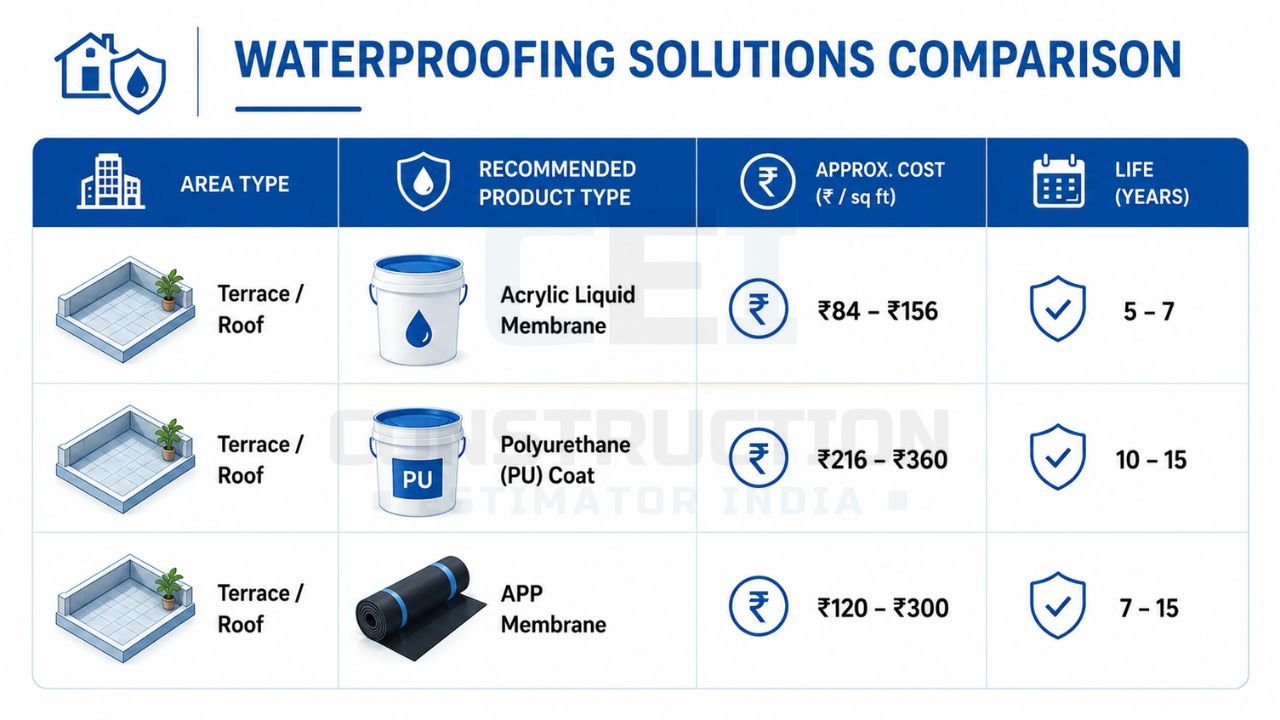
| Area Type | Recommended Product Type | Approx. Cost (₹/sq ft) | Life (Years) |
|---|---|---|---|
| Terrace / Roof | Acrylic Liquid Membrane | ₹84 – ₹156 | 5 – 7 |
| Terrace / Roof | Polyurethane (PU) Coat | ₹216 – ₹360 | 10 – 15 |
| Terrace / Roof | APP Membrane | ₹120 – ₹300 | 7 – 15 |
Note: Prices are inclusive of labor and basic preparation in the 2026 Indian market.
👉 Eliminate Roof Seepage and Water Damage with Proven Waterproofing Solutions.
Choosing Reliable Materials and Brands
In India, brands like Dr. Fixit, Asian Paints (SmartCare), Sika, and Fosroc are the industry leaders. Always ask for the technical datasheet. Check the “elongation” and “tensile strength.”
- Advice: Don’t just go by the brand name; ensure the specific product is meant for your application (e.g., don’t use a bathroom coating on a roof).
- Common Mistake: Using unbranded or “local mix” chemicals to save 20% on costs, which leads to 100% failure later.
Choosing Contractors and Avoiding Poor Workmanship
Many local building contractors in India are unskilled applicators who do not follow manufacturer or Central Public Works Department (CPWD) guidelines. Insist on a written scope of work. Check their previous references and ask about their curing and testing process.
- Red Flag: A contractor who says they can “finish the whole job in one day.” Proper waterproofing requires multiple days for cleaning, priming, and multi-coat curing.
- Support: Reach out to the contact Construction Estimator India team to verify if your contractor’s quote is technically sound.
Roof Waterproofing in the Context of Home Repair & Renovation
Integrating Waterproofing with Other Repairs
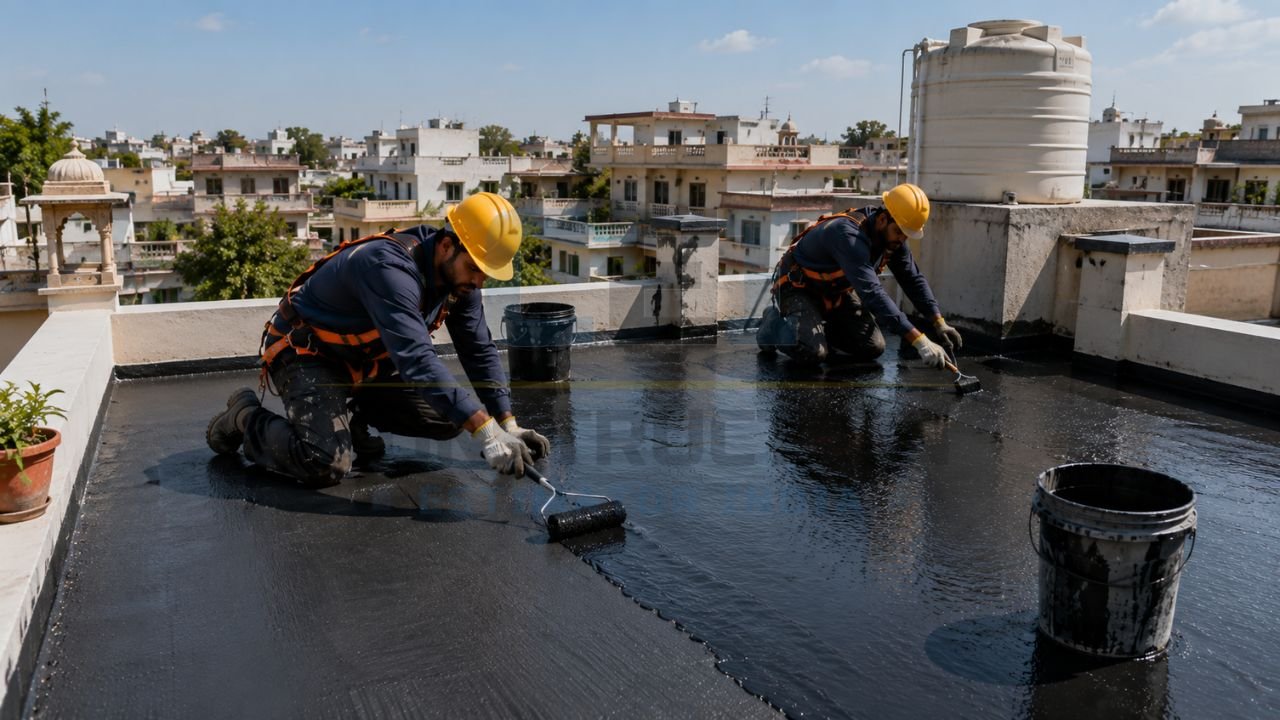
Roof repair is often part of a larger home renovation. If you are painting your exterior walls or fixing plumbing, coordinate these with the waterproofing. For instance, finish all plumbing and AC ducting on the roof before applying the final waterproofing layer to avoid puncturing the membrane later.
- Support: For home renovation quantity takeoff services, contact Construction Estimator India to get a holistic budget for your project.
👉 Protect Your Home from Rain, Moisture, and Structural Damage with Expert Waterproofing.
Planning Renovation Timing
The best time for waterproofing in India is between October and March. Avoid the peak monsoon as high humidity and rain will ruin the chemical bonding. Also, avoid the peak heat of May/June if using certain fast-drying chemicals that might “flash dry” and crack.
Role of Cost Estimation and Quantity Takeoff
Accurate quantity takeoff ensures you don’t over-order expensive chemicals. Construction Estimator India helps homeowners and small builders estimate roof waterproofing costs and quantities (sq.ft, material brands, labor cost ranges). Knowing exactly how many buckets of chemical you need prevents contractor fraud and waste.
Maintenance, Inspection, and Long-Term Care
Regular Roof Maintenance Checklist
Even the best roof waterproofing solutions require maintenance.
- Every 6 Months: Clean your drain pipes. Leaves and debris cause water ponding.
- Post-Monsoon: Inspect for any new hairline cracks that may have developed due to building settlement.
Early Signs of Waterproofing Failure
Keep an eye out for bubbling or peeling of the coating. If you see “blistering,” it means moisture was trapped under the coating during application. Early intervention—patching a small bubble—is much cheaper than re-doing the whole roof.
When to Re-Coat or Replace Waterproofing
Acrylic systems generally need a “refresh” coat every 5-7 years, while premium PU systems can last 10-15 years if maintained well. If the leakage has reached the interior and caused paint to peel, it’s usually a sign that the existing system has failed completely and needs replacement.
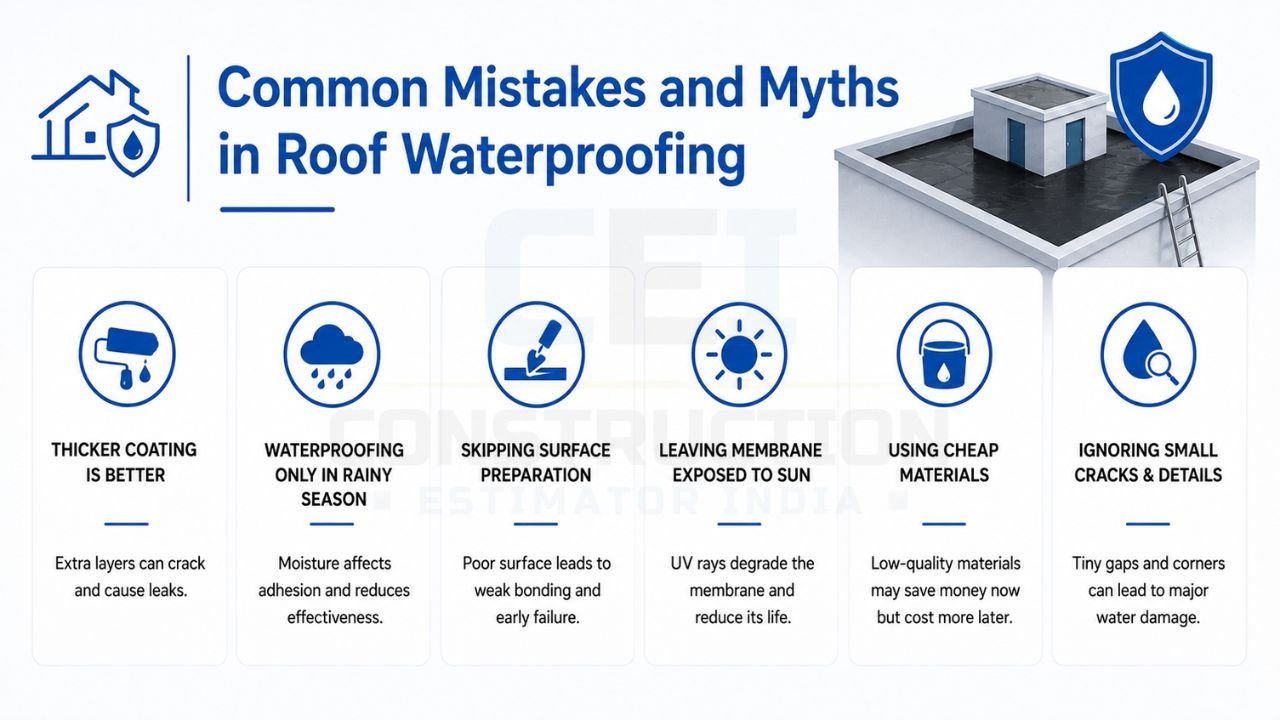
Common Mistakes and Myths in Roof Waterproofing
👉 Get Expert Roof Waterproofing Solutions Today.
Using Cheapest Material Without Checking Specification
A basic cementitious coat on a large roof will crack within one summer because it cannot handle thermal expansion. Always match the material’s flexibility with your roof’s size and exposure.
Waterproofing Over Dirty or Wet Surface
Applying expensive chemicals over old, loose paint or moss is a waste of money. The bond will never be structural, and the layer will eventually lift off.
Ignoring Slope and Drainage
Waterproofing is not a substitute for drainage. If your roof doesn’t have a 1:100 slope toward the drains, even the most expensive chemical will eventually fail due to constant water pressure.
Expecting Waterproofing to Fix Structural Defects
Waterproofing is a skin, not a skeleton. If your roof slab has deep structural cracks or is sagging, you need a structural engineer to fix the concrete before you apply any waterproofing solution.
FAQs: Roof Waterproofing for Indian Homes
Which roof waterproofing solution is best for Indian homes?
For most residential roofs, a fiber-reinforced hybrid acrylic or PU coating (like Asian Paints SmartCare Damp Proof or Dr. Fixit Newcoat) is best due to its balance of cost and flexibility.
How long does roof waterproofing usually last?
Acrylic systems last 5-7 years, while premium PU systems can last 10-15 years if the surface was prepared correctly.
Can I do roof waterproofing myself, or should I hire a professional?
Small crack repairs can be DIY. However, full terrace waterproofing requires mechanical cleaning and professional layering to ensure a 100% seal.
What is the approximate cost per square foot for roof waterproofing?
In 2026, expect to pay between ₹70 and ₹250 per sq ft depending on the material and roof condition.
How do I know if my old waterproofing needs replacement?
If you see recurring dampness, hollow sounds when tapping the terrace, or visible peeling of the old coating, it’s time for a replacement.
Can I install solar panels on a waterproofed roof?
Yes, but ensure the mounts are grouted and waterproofed separately before the main coating is applied to prevent leaks at the anchor points.
Who can help me estimate the budget for roof waterproofing and related repairs?
Construction Estimator India provides practical guidance and accurate cost estimation for roof repairs and home renovations. WhatsApp / Call +91 8630676890.
Conclusion: Plan Roof Waterproofing Properly Before Home Repair and Renovation
The “best” waterproofing product for your Indian home isn’t necessarily the most expensive one—it’s the one that matches the technical requirements of your specific problem. Successful roof waterproofing depends on a clear decision flow: understand the root cause of the leak, choose a suitable system (Acrylic, PU, or Membrane), and insist on meticulous surface preparation and testing.
Good waterproofing is an investment that pays for itself by reducing long-term maintenance and protecting your family’s health. Don’t wait for the next monsoon to discover a leak.
If you are planning roof waterproofing as part of home repair or renovation, and want help with cost estimation, material planning, and scope definition, you can contact Construction Estimator India on WhatsApp / Call +91 8630676890 for practical guidance before you start.