In the world of Indian construction, the difference between a house and a home often lies in the “finish.” As an expert civil engineer with over 15 years on site, I can tell you that understanding plastering types and materials you need to know is fundamental to ensuring your structure is not just beautiful, but also durable. Plastering is the technical process of applying a mortar coat to raw walls and ceilings to achieve a smooth, protective, and durable surface. It acts as the “skin” of your building, shielding the skeleton of bricks or concrete from the harsh elements of the Indian climate.
👉 Choose the Right Plastering Solution for a Stronger and Better-Finished Home.
Quality plastering matters for several reasons. Primarily, it provides an aesthetic surface finish that is ready for paint. Secondly, it offers critical protection against weather, moisture, and chemical attacks. It serves as a uniform base for subsequent layers like wall putty and paint, and when executed correctly, it helps in crack control. Throughout my career, I have seen five main families of plasters dominate the landscape: cement, gypsum, lime, mud/clay, and specialized architectural plasters. Choosing the wrong type or suffering from poor workmanship often leads to disastrous results, including spider-web cracks, hollow sounds (debonding), flaking, and persistent dampness.
At Construction Estimator India, we specialize in bridging the gap between raw construction and professional finishing. Understanding how to plan home construction in India means getting your material quantities right from the start to save costs. If you want a professional plaster cost per square foot with material in India estimate, reach out to Construction Estimator India on WhatsApp / Call +91 8630676890.
Basics of Plastering: Purpose, Layers and Key Materials
Plastering is often misunderstood as a simple cosmetic layer, but its functional role is far more significant. In the Indian context, where humidity and temperature fluctuations are extreme, the plaster must act as a thermal and moisture barrier.
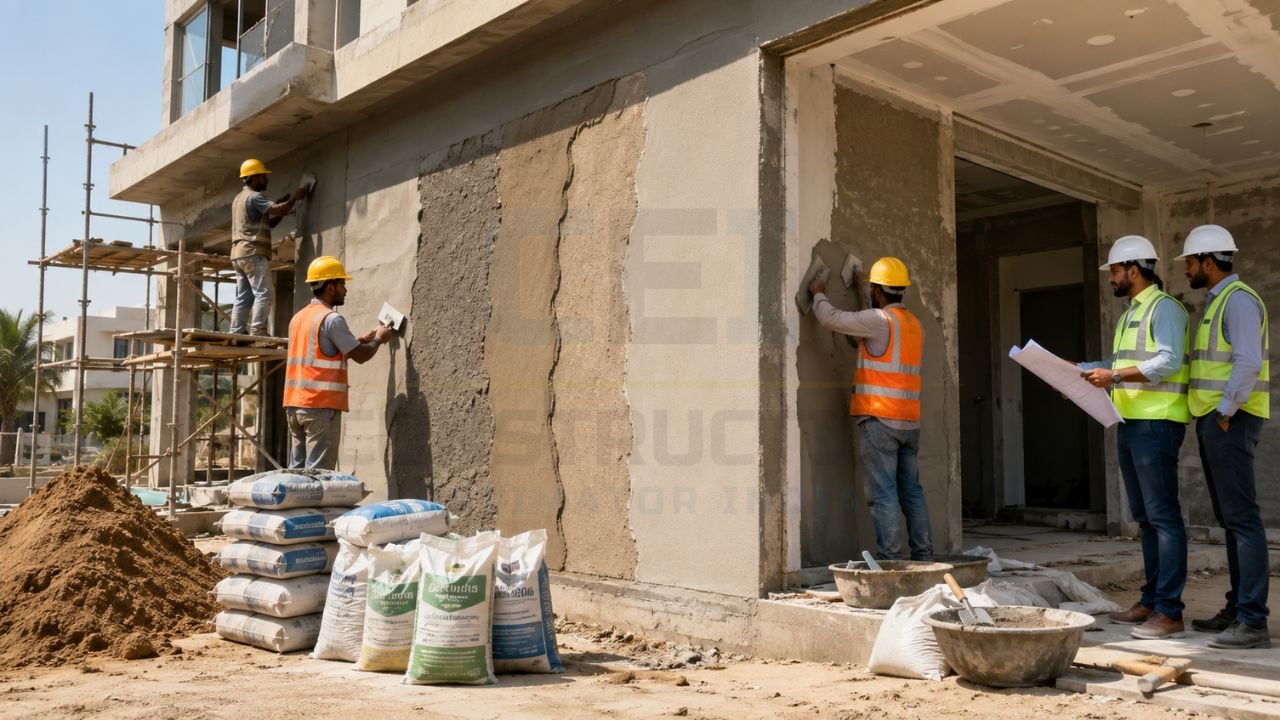
What Is Plastering and Why Is It Done?
From a functional perspective, plastering levels out the undulations inherent in masonry work. Even the best bricklayer cannot produce a perfectly flat wall; plastering fills these gaps and creates a plumb surface. Aesthetically, it provides a canvas for interior design. It is important to differentiate between plaster, putty, and paint. Plaster is the thick base layer (typically 12mm to 20mm) that provides structural smoothness. Putty is a very thin, white-cement-based layer (1mm to 2mm) that fills microscopic pores in the plaster. Paint is the final decorative film.
Plastering is also crucial for fire resistance and acoustic insulation. A well-plastered wall can significantly reduce the transfer of sound between rooms, a feature often overlooked in budget constructions. For help in choosing the right plaster and estimating quantities for your project, you can contact Construction Estimator India on WhatsApp / Call +91 8630676890.
👉 Need Help Selecting the Best Plastering Type? Consult Our Construction Experts.
Plaster Layers and Typical Thickness
In professional site practice, plaster is rarely applied in a single thick glob. It is often a system of layers. The “Base Coat” or “Undercoat” is the first layer applied to the masonry. It is usually left slightly rough to provide a “key” or grip for the next layer. The “Finish Coat” is the final layer that is troweled to a smooth finish.
Typical thickness ranges in India are standardized as follows:
- Internal Walls: Usually 12mm thick. If the brickwork is uneven, it might go up to 15mm.
- External Walls: Generally 18mm to 20mm, often applied in two coats (12mm base + 8mm finish) to ensure maximum waterproofing.
- Ceilings: Typically 6mm to 10mm. Because of gravity, we keep ceiling plaster thin to prevent it from sagging or falling.
Core Materials Used in Plaster
The quality of your materials defines the lifespan of your wall. Adhering to the material guidelines set by the Bureau of Indian Standards (BIS) ensures safety. The core ingredients include:
- Cement: Usually OPC (Ordinary Portland Cement) or PPC (Portland Pozzolana Cement). PPC is widely preferred in India for plastering due to its finer particles and lower heat of hydration.
- Sand: This must be clean, free from silt, and properly graded. In many parts of India, river sand is replaced by M-Sand (Manufactured Sand). Excessive silt in sand is the #1 cause of cracks.
- Water: It must be potable. Salty or “hard” water can lead to efflorescence (white patches) on the walls.
- Additives: These include waterproofing compounds (like Dr. Fixit), bonding agents for concrete surfaces, and polymers to improve flexibility.
Major Types of Plastering Types and Materials You Need to Know
Selecting the right type of plaster depends on the location (internal vs. external), budget, and the desired finish. Each type has unique chemical properties and application methods.
Cement Plaster
This is the most common type used across India. It consists of cement, sand, and water. It is incredibly strong, durable, and weather-resistant, making it the default choice for external walls and wet areas like bathrooms. However, it requires a significant amount of water curing (7–10 days) to gain strength.
Gypsum Plaster
Known as “Plaster of Paris” (POP) in a refined form, gypsum plaster is the gold standard for luxury interiors. It is applied directly to the brickwork and yields a mirror-smooth, white finish. The biggest advantage is that it requires zero water curing and dries within hours. However, it cannot be used outdoors as it dissolves in water over time.
Lime Plaster
A traditional choice now seeing a resurgence in “eco-friendly” and heritage projects. It consists of lime and sand. It is highly breathable, preventing moisture from getting trapped inside the walls. While it is more expensive and requires skilled labor, it is far more flexible than cement and resists cracking.
Mud / Clay Plaster
The most sustainable and low-cost option, predominantly used in rural or eco-conscious builds. It uses local clay, sand, and often organic fibers like straw or cow dung. It offers excellent thermal insulation, keeping houses cool in Indian summers.
Special Purpose Plasters
These include:
- Waterproof Plaster: Enhanced with chemicals to prevent seepage.
- Stucco: A decorative plaster used for textured facades.
- Ready-Mix Plaster: Pre-mixed bags of cement and graded sand that ensure consistent quality on site.
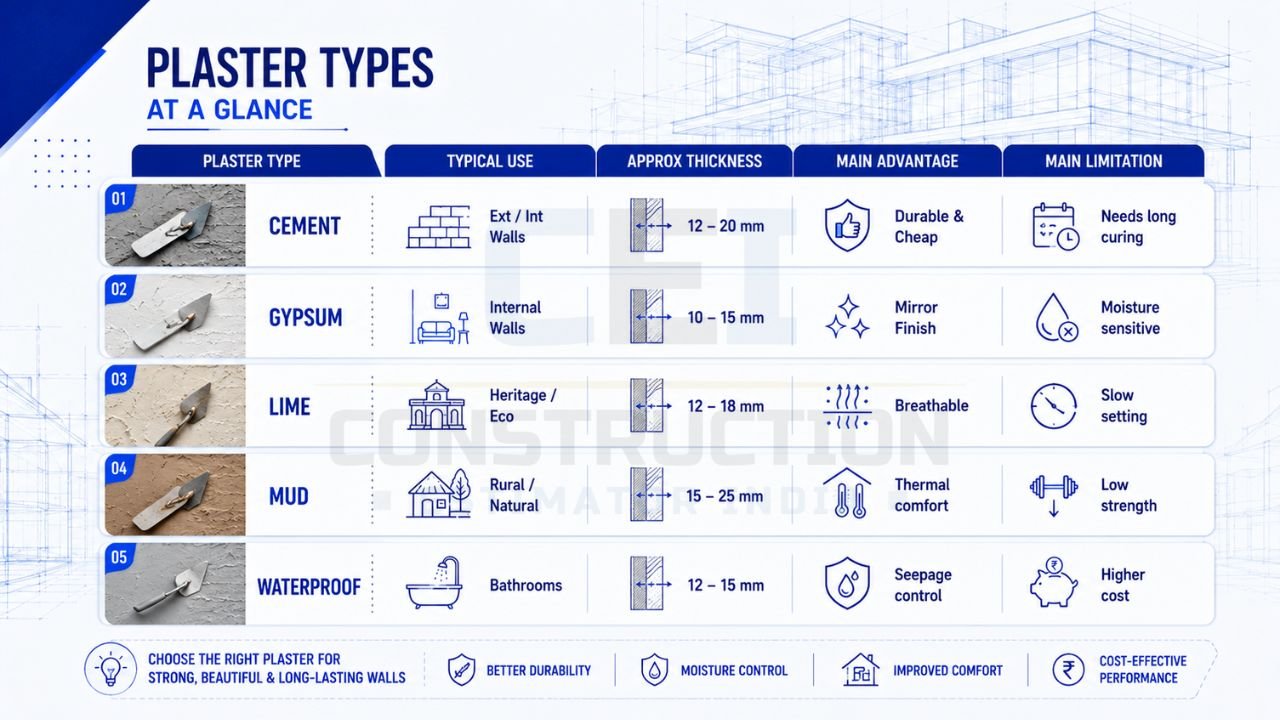
| Plaster Type | Typical Use | Approx Thickness | Main Advantage | Main Limitation |
|---|---|---|---|---|
| Cement | Ext/Int Walls | 12-20 mm | Durable & Cheap | Needs long curing |
| Gypsum | Internal Walls | 10-15 mm | Mirror Finish | Moisture sensitive |
| Lime | Heritage/Eco | 12-18 mm | Breathable | Slow setting |
| Mud | Rural/Natural | 15-25 mm | Thermal comfort | Low strength |
| Waterproof | Bathrooms | 12-15 mm | Seepage control | Higher cost |
Cement Plaster in Detail
As an engineer, I can confirm that cement plaster is the workhorse of the Indian construction industry. If you walk onto 90% of sites in Delhi, Mumbai, or Bangalore, this is what you will see. Knowing which grade cement is best for plastering in India separates amateur builds from professional executions.
👉 Get Professional Advice on Plastering Materials for Long-Lasting Performance.
Typical Mix Ratios and Thickness for Cement Plaster
The mix ratio is the proportion of cement to sand. A common mistake is thinking “more cement equals more strength.” Actually, too much cement causes excessive shrinkage and cracking.
- Internal Walls: A 1:4 or 1:5 ratio (1 part cement to 4 parts sand) is standard.
- External Walls: A 1:4 or 1:6 ratio is common, often with a richer 1:3 ratio for the first “scratched” coat to ensure bonding.
- Ceilings: We use a rich 1:3 mix because the layer is thin and needs high adhesion.
Construction Estimator India helps homeowners and contractors on choosing suitable plaster types for different areas and calculating these ratios accurately.
Step-by-Step Cement Plastering Process
- Surface Preparation: The masonry must be cleaned of dust. If it’s a concrete surface (like a column), “hacking” or “chipping” (creating small dents) is mandatory for grip.
- Bonding: A “cement slurry” (neat cement and water) is applied to the wall just before plastering.
- Application: The mortar is dashed against the wall with force to ensure it enters the gaps.
- Leveling: Masons use a “straight edge” (aluminum bar) to ensure the surface is flat.
- Finishing: A wooden or steel “float” is used to smooth the surface.
- Curing: The most critical step. The wall must be kept wet for at least 7 to 10 days.
Advantages, Disadvantages and Common Defects
The main pros are cost-effectiveness and high strength. It is resistant to pests and moisture. The cons include a heavy weight and the tendency to develop “hairline cracks” if the curing is neglected or the sand has too much silt. Common defects include “blooms” (white salt patches) and “hollowness,” where the plaster detaches from the wall.
For a detailed BOQ and estimation for plaster and related finishes, reach out to Construction Estimator India on WhatsApp / Call +91 8630676890.
Gypsum Plaster (Plaster of Paris) for Smooth Interiors
Gypsum has revolutionized interior finishing in India. If you are aiming for a high-end look without the long wait times of cement, this is your answer.
What Is Gypsum Plaster and Where It Is Used
Gypsum plaster is made from the mineral gypsum and is chemically processed to set quickly when mixed with water. In India, brands like Saint-Gobain Gyproc have made it immensely popular. It is strictly for internal use—bedrooms, living rooms, and dry areas. It is particularly effective on the underside of RCC construction slabs (ceilings) because it is much lighter than cement.
Application Method, Thickness and Surface Preparation
Gypsum is applied in a single coat, usually 10mm to 12mm thick. The surface preparation is similar to cement, but the wall must be dry. Because gypsum is white and smooth, you can skip the “putty” stage and apply paint directly after a primer coat. This saves both labor costs and material time.
Pros, Cons and When to Prefer Gypsum
Pros:
- Speed: No curing required. You can paint within 72 hours.
- Finish: Perfect “level 5” finish.
- Fire Resistance: Gypsum is naturally fire-resistant.
Cons:
- Moisture: Cannot be used in bathrooms or external walls.
- Softness: It is easier to dent than cement plaster.
- Cost: The raw material is more expensive than cement and sand.
Lime and Mud Plaster: Traditional and Eco-Friendly Options
While modern construction relies on cement, traditional methods are making a comeback for their health and environmental benefits.
Lime Plaster: Composition, Use Cases and Benefits
Lime plaster is a mixture of lime putty and sand. Its greatest benefit is breathability. It allows moisture to move through the wall rather than trapping it. This makes it ideal for the restoration of old Indian buildings (Havelis) and for new “green” buildings. It also has natural anti-fungal properties, preventing mold in humid climates.
Mud / Clay Plaster: Low-Cost Natural Option
Used for centuries in Indian villages, mud plaster is the ultimate sustainable material. It is composed of local soil, sand, and natural binders. While it requires more frequent maintenance (re-coating), it provides a “living” wall that regulates temperature beautifully. In modern eco-resorts across Rajasthan and Kerala, mud plaster is being used for its unique aesthetic and carbon-neutral footprint.
Special Purpose Plasters and Decorative Finishes
Sometimes, standard plaster isn’t enough. Special situations require engineered solutions.
Stucco and Textured Plaster
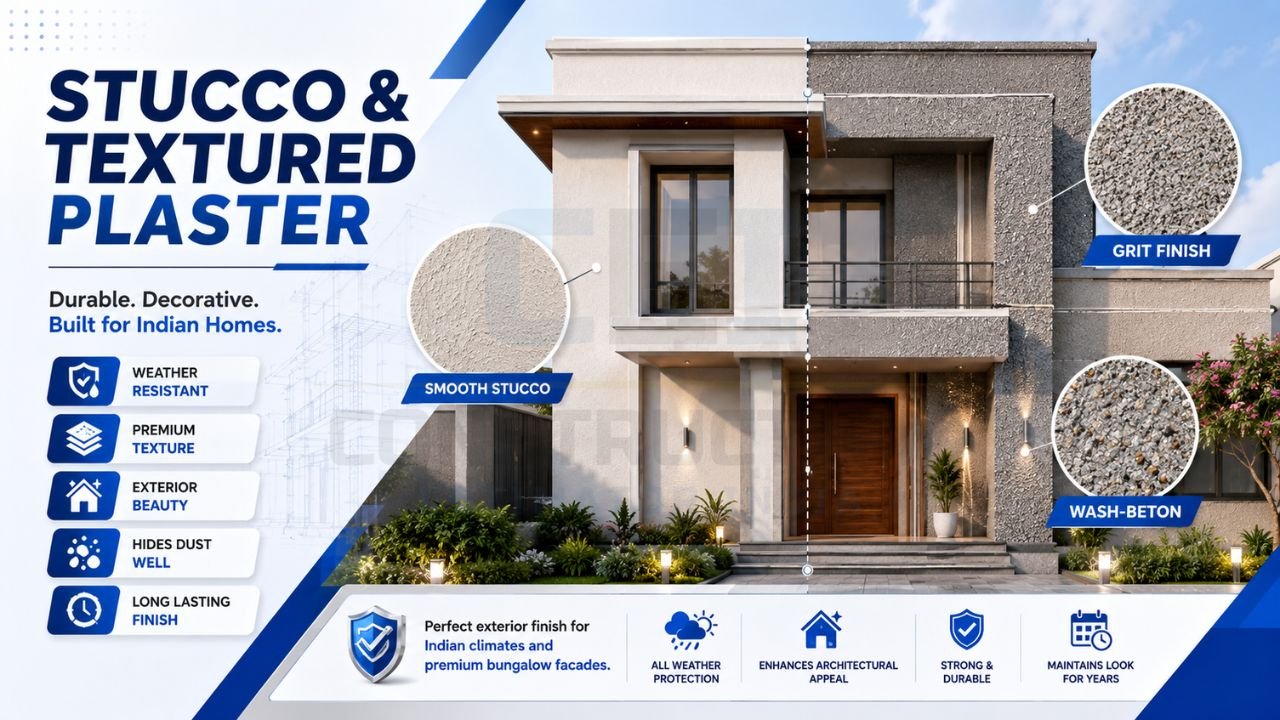
Stucco is a durable, weather-resistant plaster used primarily for exterior decorative finishes. It can be molded into various shapes and textures. In India, “Grit” or “Wash-beton” finishes are popular for bungalow facades, providing a rugged, premium look that hides dust and age well.
Waterproof / Water-Resistant Plasters
In areas like Mumbai or the coastal belts of Kerala, standard cement plaster often fails against the monsoon. Waterproof plaster involves adding hydrophobic chemicals (like LWC polymers) to the cement mix. This creates a dense, non-porous layer that prevents capillary action of water.
Ready-Mix and Polymer-Modified Plasters
Ready-mix plasters (like those from UltraTech Cement or ACC) come in pre-packed bags. You only add water. They are engineered with graded sand and polymers that reduce cracking and increase “workability” for the mason. While the per-bag cost is higher, the reduction in wastage and superior quality often makes them cheaper for large-scale projects.
👉 Build Stronger, Smoother, and More Durable Walls with the Right Plastering System.
How to Choose the Right Plaster Type for Different Areas?
Choosing the right plaster is a strategic decision. You don’t need the same material everywhere.
Internal Walls and Ceilings
For internal walls, I usually recommend Gypsum Plaster if the budget allows, as it eliminates the need for putty and curing. For ceilings, gypsum is almost always better because it reduces the “dead load” on the structure and provides a better finish for lighting.
Bathrooms, Kitchens and Wet Areas
Never use gypsum here. Stick to a Cement Plaster with a 1:4 ratio and include a waterproofing additive. The kitchen area behind the stove also benefits from cement plaster as it handles high temperatures better than gypsum.
External Walls and Exposed Surfaces
Cement Plaster is the only choice. Use a double-coat system (12mm + 8mm) with a 1:4 or 1:5 ratio. For the final finish, consider a “sponge” finish rather than a steel-trowel smooth finish; a slightly grainy surface hides minor cracks better and provides better adhesion for exterior-grade paints.
Contact Construction Estimator India on WhatsApp / Call +91 8630676890 to discuss project details and get plaster suggestions with estimates.
Common Plastering Defects: Causes, Prevention and Basic Repair Ideas
Even with the best materials, defects can occur. Identifying them early saves huge repair costs later.
Cracks in Plaster
- Appearance: Hairline web-like cracks or deep structural cracks.
- Causes: Excessive silt in sand, lack of curing, or applying plaster in direct hot sunlight.
- Prevention: Use “Chicken Mesh” at the junctions of concrete and brick. Ensure at least 7 days of taraai (curing).
Hollow Sound / Debonding
- Appearance: A hollow sound when the wall is tapped.
- Causes: Poor surface preparation, skipping the hacking of concrete, or the wall being too dry when plaster was applied.
- Repair: The hollow section must be chipped off and re-plastered after applying a bonding agent.
Flaking, Peeling and Powdering
- Appearance: Plaster surface turning into dust or falling off in thin layers.
- Causes: Using “dead” cement (older than 3 months) or using salty water.
- Prevention: Always check the manufacture date of cement bags.
Uneven, Wavy or Undulated Surfaces
- Appearance: Walls look “wavy” when light hits them from the side.
- Causes: Poor skill of the mason or not using a straight edge aluminum bar.
- Prevention: Frequent checks with a 2-meter straight edge during the application phase.
Practical Tips for Homeowners and Site Supervisors
As an engineer, I always tell my clients: “You can’t fix bad plaster with good paint.”
What to Check Before Plastering Starts?
- Masonry: Ensure all electrical and plumbing pipes (concealed) are installed and the grooves are filled with rich mortar.
- Cleanliness: Remove all loose mortar and dust from the wall.
- Wetting: The wall should be “saturated surface dry”—wet but not dripping.
How to Inspect Plaster Work While It Is Going On?
- Plumb Bob: Use a plumb bob to check verticality.
- Right Angles: Check corners with a “Gunia” (Square) to ensure furniture like wardrobes will fit perfectly later.
- Thickness: Use a small nail or probe to check if the thickness matches the specification (e.g., 12mm).
What to Observe After Plastering Is Completed
Once the plaster is dry (usually after 24 hours), tap the surface with a small hammer. Any hollow sound means the plaster hasn’t bonded. Look for “grittiness”—if you rub your hand and sand falls off, the mix was too weak.
Construction Estimator India guides homeowners and contractors on choosing suitable plaster types and performing these quality checks.
👉 Make Informed Decisions on Plastering Materials and Construction Quality.
FAQs: Plastering Types and Materials
Which plaster is best for external walls?
Cement plaster is the most suitable for external walls in India. Given our monsoon season, a two-coat cement plaster with a waterproofing additive is the industry standard. It provides the necessary strength to withstand UV radiation and heavy rain. For a professional plaster quantity and cost estimate for your external walls, reach out to Construction Estimator India on WhatsApp / Call +91 8630676890.
Which plaster is better for interior walls: cement or gypsum?
If speed and finish are your priorities, gypsum is better. It gives a superior finish and saves time. However, if you are on a tight budget and have plenty of time for curing, cement plaster followed by putty is cheaper. Gypsum is generally preferred for high-end residential interiors.
What is the ideal plaster thickness for walls and ceilings?
Internal walls should ideally have 12mm thickness. External walls require 18mm to 20mm. Ceilings must be kept between 6mm and 10mm to ensure they do not peel off due to their own weight.
Do I still need putty if the plaster finish is very smooth?
If you use gypsum plaster, you do not need putty. If you use cement plaster, even a “smooth” finish has pores that will soak up too much paint; therefore, 2 coats of putty are highly recommended.
How long should plaster be cured?
Cement-based plaster needs a minimum of 7 days of curing, with 10 days being ideal. Gypsum plaster needs zero curing—it just needs to dry naturally.
How can I estimate plaster quantity for my house?
You need to calculate the total wall area in square meters and multiply it by the thickness. Understanding the local house construction per sq ft rate allows you to budget this phase properly. Construction Estimator India can support you with a full BOQ and estimation.
When should I contact a professional estimator like Construction Estimator India?
You should contact an estimator before you buy materials. An accurate estimate prevents material theft, wastage, and ensures your contractor isn’t overcharging you for “extra” materials.
Conclusion: Making the Right Plastering Choices
Understanding the various plastering types and materials you need to know is the first step toward a high-quality building finish. From the rugged reliability of cement to the sophisticated smoothness of gypsum, your choice should be dictated by the specific needs of the area—be it moisture resistance for a bathroom or aesthetic perfection for a living room. Hiring an expert plastering contractor ensures these elements are applied perfectly.
Don’t leave your building’s finish to chance. For help in choosing the right plaster and estimating quantities for your project, you can contact Construction Estimator India on WhatsApp / Call +91 8630676890. Whether it’s a small home renovation or a large commercial project, our team is ready to guide you with accurate BOQs and professional cost planning.