
Building or buying a home in India is a milestone achievement, but it is not legally complete until you hold the Occupancy Certificate (OC) in your hands. Many homeowners move into their properties as soon as the paint is dry, unaware that they are technically squatting in their own homes in the eyes of the law. As an expert civil engineer and construction legal consultant at Construction Estimator India, I have seen countless families face eviction notices or struggle with loan rejections simply because they overlooked this one document.
👉 Need an Occupancy Certificate? Get Expert Guidance for a Smooth and Hassle-Free Process.
An Occupancy Certificate (OC) is a legally valid document issued by the local municipal committee or planning authority that authenticates a building has been constructed according to the approved plans and is ready for occupancy. It serves as the final “green light” from the government, confirming that the structure adheres to local building regulations, fire safety standards, and various other bylaws. If you haven’t mastered how to plan home construction in India, ignoring this step could mean your dream home is essentially an unauthorized structure, and you can be evicted or hit with heavy municipal penalties.
At Construction Estimator India, we believe every homeowner deserves peace of mind. We provide free occupancy certificate assistance, free document verification, and a free property legal check to ensure your transition from construction to occupancy is seamless. Whether you are a first-time buyer or an independent builder, this guide will walk you through everything you need to know about the OC in 2026. For immediate help, you can WhatsApp or Call us at +91 8630676890.
What Is Occupancy Certificate: Definition & Purpose?
Definition of Occupancy Certificate
The Occupancy Certificate is much more than a piece of paper; it is the official certification that your building is safe and fit for human habitation. In India, once the construction of a building is finished, the developer or the property owner must apply for this certificate from the local development authority or municipal corporation. It effectively states that the government has inspected your property and found it to be compliant with the initial permits and safety codes. If the Building Plan is the “promise,” the Occupancy Certificate is the “proof” that the promise was kept.
Purpose 1: Verify Compliance with Approved Plans
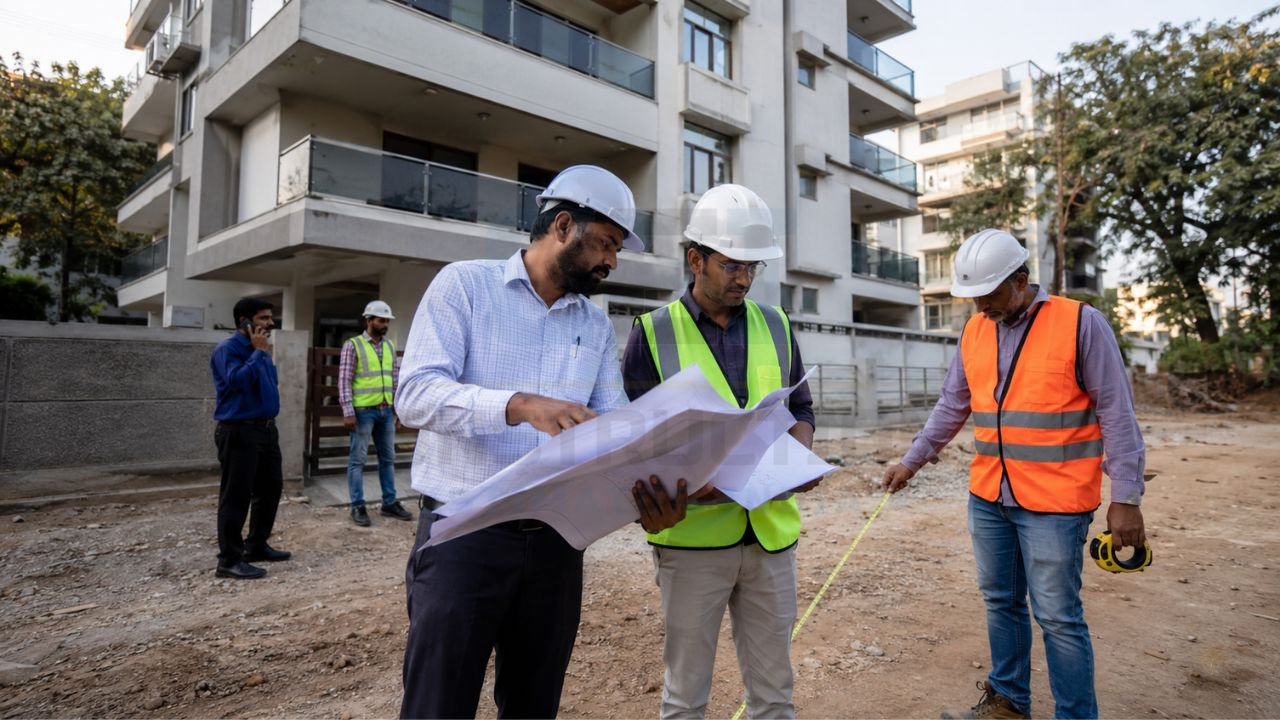
One of the primary functions of the OC is to ensure that what was built matches what was approved. Municipal authorities check the built area, the height of the building, and the setbacks (the distance between the building and the boundary). For example, if you obtained a permit for a Ground + 2 floors structure but decided to build a Ground + 3 floors building, you will likely be denied an OC until the unauthorized portion is rectified or a penalty (compounding charge) is paid. This prevents uncontrolled and dangerous urban growth. Ensure you use reputable building contractors to prevent these deviations.
👉 Ensure Your Property Is Ready for Legal Occupancy with Professional Support.
Purpose 2: Ensure Safety Standards Met
Modern buildings are complex systems. The OC process verifies that your home meets critical fire safety standards, structural stability requirements, and electrical codes. The authority won’t issue an OC unless they see a structural stability certificate from a chartered engineer and, for larger buildings, a Fire NOC from the state fire department. This ensures that you and your family are moving into a space that won’t collapse or become a fire hazard.
Purpose 3: Authorize Legal Occupancy
This is the most critical purpose for any resident. The OC is the official permission to move in. Without it, it is illegal to occupy the building. While it is common for people in some cities to move in before the OC is issued, they do so at great risk. Local authorities have the power to disconnect utilities and even seal the building if residents move in without this legal authorization.
Who Issues Occupancy Certificate
The issuing authority varies depending on your location. In major cities, it is usually the Municipal Corporation (like the BMC in Mumbai or BBMP in Bangalore) or the Development Authority (like DDA in Delhi or HMDA in Hyderabad). These agencies are the gatekeepers of urban safety, and they provide the document only after a thorough verification of adherence to all applicable local legislation.
Difference Between OC and Completion Certificate (CC)
Many people confuse the Completion Certificate (CC) with the Occupancy Certificate (OC), but they serve different stages of the process.
- Completion Certificate (CC): This confirms that the building is finished according to the building bye-laws. It focuses purely on the physical completion of the structure.
- Occupancy Certificate (OC): This indicates that no construction standards have been broken and the facility is safe for residents to occupy.
Usually, you must apply for the CC first, and once it is granted, you apply for the OC. At Construction Estimator India, we help you navigate both of these milestones. Reach out at +91 8630676890 for guidance on which one you need right now.
Why Occupancy Certificate Is Mandatory: 7 Critical Reasons?
Reason 1: Legal Compliance Proof
The OC is your shield against legal action. It proves that your building is a recognized legal entity that conforms to all government-approved plans. Without this proof, your home can be classified as an “unauthorized construction.” In an era where municipal authorities are increasingly aggressive about demolishing illegal structures, having an OC is the only way to guarantee the long-term safety of your investment.
Reason 2: Required for Property Registration
If you want the property to be legally registered in your name at the sub-registrar’s office, the OC is often a mandatory document. While some states allow registration with just the sale deed, the lack of an OC can create a “title defect.” This means that while you might “own” the house, you don’t have the legal right to use it for its intended purpose.
Reason 3: Guarantees Basic Amenities
In most Indian cities, you cannot get permanent electricity, water, or sewage connections without an OC. Builders often provide “temporary” construction-line connections while you wait for the OC, but these are significantly more expensive and can be cut off at any time. The municipal authority guarantees these basic amenities only after the building is certified as habitable.
Reason 4: Avoids Legal Problems
Living without an OC is an invitation for trouble. It can lead to eviction notices, heavy fines, and even demolition orders from the municipal authority. Furthermore, if there is a dispute with a neighbor or a tenant, the absence of an OC can be used against you in court. Having an OC saves you from the mental and financial stress of future legal battles.
Reason 5: Required for Resale
When you decide to sell your property, the first thing a smart buyer or their lawyer will ask for is the Occupancy Certificate. A property without an OC is significantly harder to sell and often commands a lower market price because it is seen as a “risky” asset. If your property is registered under your state’s RERA portal, an OC instantly validates the marketability and value of your home.
Reason 6: Essential for Home Loans
Banks are incredibly cautious about the properties they fund. Most financial institutions require an occupancy certificate before they offer or finalize a home loan for a buyer. If you already have a loan, the bank may withhold the final disbursement until you submit the OC. For resales, a bank will almost never sanction a loan if the building lacks this certificate.
Reason 7: Safety for Occupants
Ultimately, the OC is about your safety. It ensures that the building is legally safe for occupancy, meaning it has been checked for structural integrity (especially if you utilized advanced foundation types for house construction in India) and fire hazards. It gives you the confidence that the roof over your head won’t collapse. At Construction Estimator India, we prioritize your family’s safety above all else. Contact us at +91 8630676890 for a free property legal check.
Documents Required for Occupancy Certificate Application
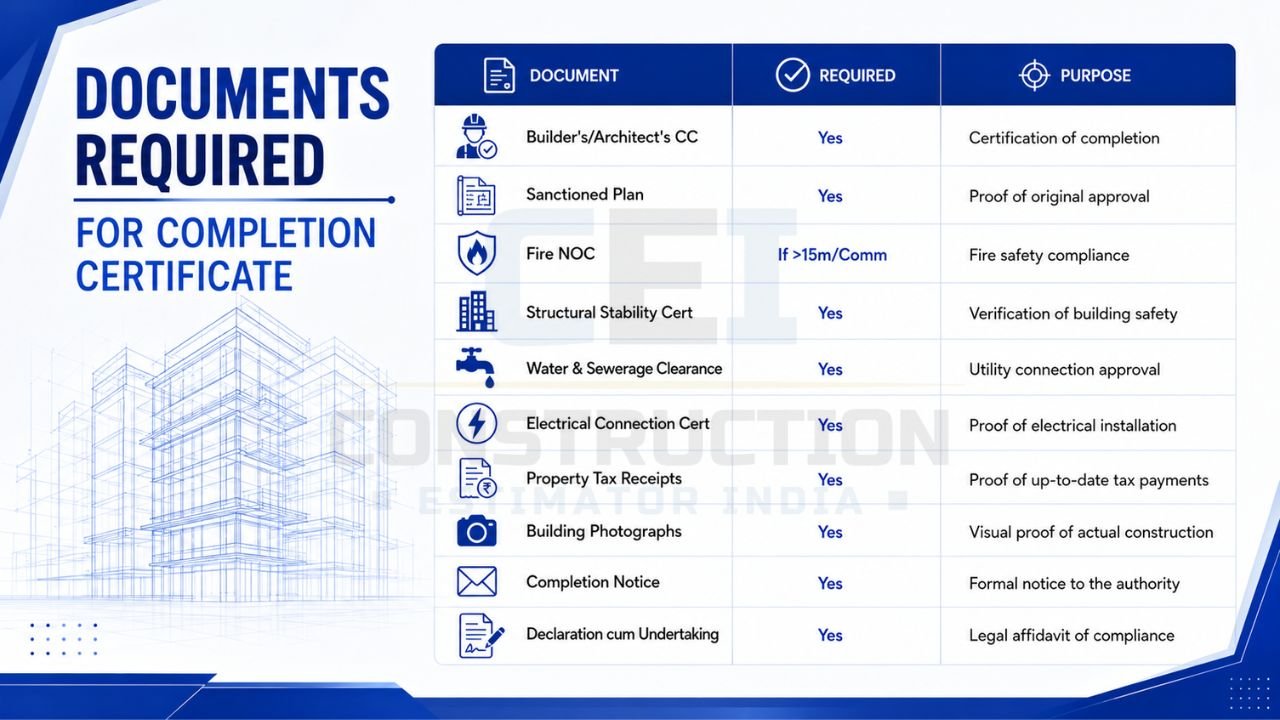
Applying for an OC requires a meticulous gathering of paperwork. Missing even one document can lead to delays or rejection. Here is the standard checklist for 2026:
Document 1: Builder’s/Architect’s Completion Certificate (CC)
This is the foundational document where your empanelled architect certifies that the construction has been completed according to the sanctioned plans. It includes details about the built-up area and the materials used.
Document 2: Sanctioned Plan and Building Design
You must provide the original plan that was stamped and approved by the municipal authority before construction began. The inspectors will compare this plan against the actual structure during their site visit.
Document 3: Fire No Objection Certificate (NOC)
Required primarily for buildings taller than 15 meters (usually G+4 and above) or commercial properties. It confirms that the building has adequate fire extinguishers, hydrants, and clear escape routes.
👉 Get Expert Assistance with Occupancy Certificate Requirements and Approvals.
Document 4: Structural Stability Certificate
A chartered structural engineer must inspect the building and issue a certificate stating that the structure is sound and capable of withstanding loads (including seismic loads if in an earthquake-prone zone). A firm grasp on what is RCC construction proves invaluable during this phase.
Document 5: Water and Sewerage Clearance
This shows that the water and sewage lines have been properly laid out and are ready to be connected to the city’s main grid. It is issued by the local water supply and sewerage board.
Complete Document Checklist Table
| Document | Required | Purpose |
|---|---|---|
| Builder’s/Architect’s CC | Yes | Certification of completion |
| Sanctioned Plan | Yes | Proof of original approval |
| Fire NOC | If >15m/Comm | Fire safety compliance |
| Structural Stability Cert | Yes | Verification of building safety |
| Water & Sewerage Clearance | Yes | Utility connection approval |
| Electrical Connection Cert | Yes | Proof of electrical installation |
| Property Tax Receipts | Yes | Proof of up-to-date tax payments |
| Building Photographs | Yes | Visual proof of actual construction |
| Completion Notice | Yes | Formal notice to the authority |
| Declaration cum Undertaking | Yes | Legal affidavit of compliance |
Step-by-Step Process to Get Occupancy Certificate
Getting your OC in 2026 involves navigating a 10-step municipal workflow. Construction Estimator India can act as your representative to fast-track this process. Call us at +91 8630676890.
Step 1: Complete Construction Fully
You cannot apply for an OC if the building is “mostly” done. All plumbing, electrical wiring, flooring, and external finishes must be complete. The building must be 100% ready for a person to move in.
Step 2: Obtain CC from Architect
Hire your architect to do a final inspection. Top architects and architecture firms will compare the actual construction with the sanctioned plan and issue the Completion Certificate. This usually costs between ₹5,000 and ₹20,000 depending on the project size.
Step 3: Get Structural Stability Certificate
A structural engineer must certify the building’s integrity. This is a critical safety check that authorities take very seriously.
Step 4: Prepare All Required Documents
Collect all 10 documents mentioned in the checklist above. Ensure all tax receipts are for the current financial year and all certificates are signed by licensed professionals.
Step 5: Submit Application Online or Offline
Most major cities like Hyderabad, Bangalore, and Delhi have moved to online portals (e.g., HMDA’s LRS portal or BBMP’s portal). You will need to create an account, fill out the OC form, and upload scanned copies of all documents.
Step 6: Site Inspection by Authority
Once your application is submitted, a Technical Officer or Municipal Engineer will visit your property. They will measure setbacks, check for unauthorized floors, and verify fire safety measures matching the National Building Code (NBC) via BIS.
Step 7: Pay Compounding Charges (If Deviations)
If the inspector finds minor deviations (usually up to 10% of the sanctioned plan), you won’t be rejected immediately. Instead, the authority will calculate “compounding charges” or fines that you must pay to “regularize” the deviation.
Step 8: Final Approval and OC Issuance
After the inspection report is filed and fees are paid, the file moves through a chain of command (Technical Officer → Planning Officer → Director) for final approval.
Step 9: Receive Occupancy Certificate
Once approved, the OC is issued, often digitally. In most cases, the authority is required to issue the OC within 30 days of the application date if everything is in order.
👉 Secure Your Occupancy Certificate with Confidence and Complete Compliance.
OC Timeline & Fees: Cost Breakdown by City
Timeline for OC Issuance
Under the Right to Service acts in many states, municipal authorities are supposed to grant an OC within 30 days of the application date. However, if there are deviations or missing documents, this can stretch to 60 or 90 days. Taking into account your initial house construction per sq ft rate ensures you have adequate budget buffers for these administrative steps.
Fee Structure by City
| City | Application Fee | Total Estimated Cost |
|---|---|---|
| Hyderabad | ₹5,000–₹10,000 | ₹30,000–₹70,000 |
| Delhi | ₹10,000–₹20,000 | ₹50,000–₹1,00,000 |
| Bangalore | ₹8,000–₹15,000 | ₹40,000–₹80,000 |
| Mumbai | ₹15,000–₹25,000 | ₹60,000–₹1,20,000 |
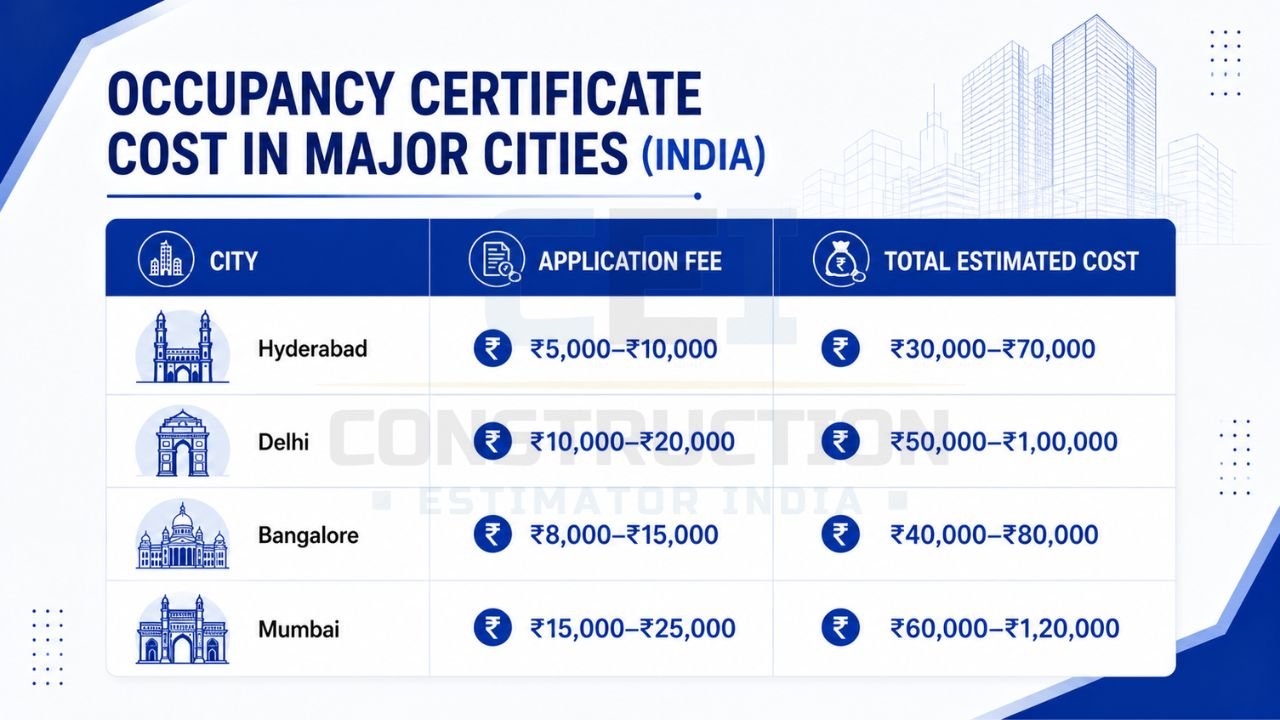
(Note: Total cost includes architect fees, structural certificates, and administrative charges. Major metropolitan authorities like the Brihanmumbai Municipal Corporation (BMC), [suspicious link removed], and Bruhat Bengaluru Mahanagara Palike (BBMP) manage their fees via structured online portals.)
👉 Need Help with Property Approvals? Consult Our Experts Today.
What Happens if You Don’t Have Occupancy Certificate
Consequence 1: Illegal Occupation
Without an OC, your stay in the house is illegal. This gives the government the right to issue an eviction notice at any time.
Consequence 2: No Utility Connections
You may be stuck with expensive temporary electricity and water connections. Permanent, subsidized domestic rates are only available with an OC.
Consequence 3: Loan and Resale Hurdles
Banks frequently request an OC for resales and loan sanction. You will find it nearly impossible to sell your home or take a top-up loan for a future house renovation without this document.
When to Contact Construction Estimator India for OC Help?
The paperwork for an OC can be overwhelming. Construction Estimator India offers specialized services to take the burden off your shoulders. Working alongside expert civil engineers general contractors ensures compliance at every stage. You should contact us if:
- You are unsure if your construction matches the sanctioned plan.
- You need help coordinating with architects and fire departments.
- You have received a notice from the municipal authority regarding a lack of OC.
We offer:
- Free occupancy certificate assistance
- Free document verification
- Free property legal check
Contact our experts today via WhatsApp or Call at +91 8630676890.
FAQs
Q1: What is occupancy certificate (OC) in India?
It is a legal document from the municipal authority stating the building is safe to live in and built as per plan.
Q2: Why is OC mandatory for property?
It is required for legal residency, permanent utility connections, and home loans.
Q3: Can I occupy a house without OC?
No, it is technically illegal and can lead to eviction or fines.
Q4: How long does it take to get OC?
Typically 30 days from the date of application.
Q5: What is the cost of OC in India?
The total cost, including professional certificates, usually ranges from ₹25,000 to ₹1,00,000.
Q6: Can I check OC status on RERA portal?
Yes, if the project is registered under RERA, builders must update the OC status on the portal.
Q7: How do I contact Construction Estimator India for OC help?
You can reach us at +91 8630676890 for free assistance.
Conclusion: Get OC for Legal, Safe Property Ownership
An Occupancy Certificate is the final and most crucial step in your home-building journey. It transforms a physical structure into a legal, safe, and bankable home. Remember, without an OC, you are living in a building that doesn’t “exist” legally.
Don’t take risks with your biggest investment. Ensure you complete your construction, obtain your certificates, and file your application promptly. If the process seems daunting, Construction Estimator India is here to help with free document verification and legal checks.
Ensure your home is truly yours in 2026. Contact Construction Estimator India at +91 8630676890 and get your Occupancy Certificate today.