Building a home is often the most significant financial investment a person makes in their lifetime. In the Indian context, where the construction industry is highly fragmented and often operates on informal trust, the role of supervision cannot be overstated. You may have heard the phrase: “Trust your builder.” And while trust is important, blind trust is dangerous. Construction supervision is the ongoing monitoring, inspecting, and coordinating of every activity on a home-building site to ensure quality, safety, and schedule adherence. Without a rigorous eye on the ground, your dream home can quickly turn into a structural nightmare riddled with hidden costs and poor workmanship. Understanding how to plan home construction in India from day one includes planning for strict oversight.
Many homeowners mistakenly believe that supervision is the builder’s job alone. This is a fundamental error. While a contractor is responsible for execution, their primary motivation is often speed and profit margin, which can lead to “cutting corners” that you won’t notice until years later when cracks appear or seepage begins. Supervision isn’t optional, it’s foundational. It ensures that projects are built according to design and specification, takes care of the quality of construction, and oversees the safety of workers. Even the best builders can miss things unintentionally; a missed stirrup in a beam or an incorrect water-cement ratio isn’t always malice—it’s often just human error in a chaotic environment.
This in-depth guide, presented by Construction Estimator India, is created to make self-supervision of house construction easier for homeowners who do not have access to a full-time site engineer. We will walk you through every critical checkpoint, from the first shovel in the ground to the final coat of paint. If you feel overwhelmed, remember that Construction Estimator India offers free construction supervision consultation and site inspections. You can reach our experts via WhatsApp or Call at +91 8630676890.
The cost of professional supervision in India is generally 5% to 10% of the total project cost. For those looking for monthly consulting, fees can range anywhere from ₹5,000–₹25,000 per month depending on the scope and location. To evaluate this against your overall budget, referencing a localized house construction per sq ft rate roorkee (or your respective city) is highly beneficial. Whether you choose to do it yourself or hire a professional like Construction Estimator India, the principles of “Trust, but verify” remain the same. Let’s dive into the practical, actionable tips to ensure your home stands strong for generations.
Who Should Supervise Your Home Project? Options & Best Practices
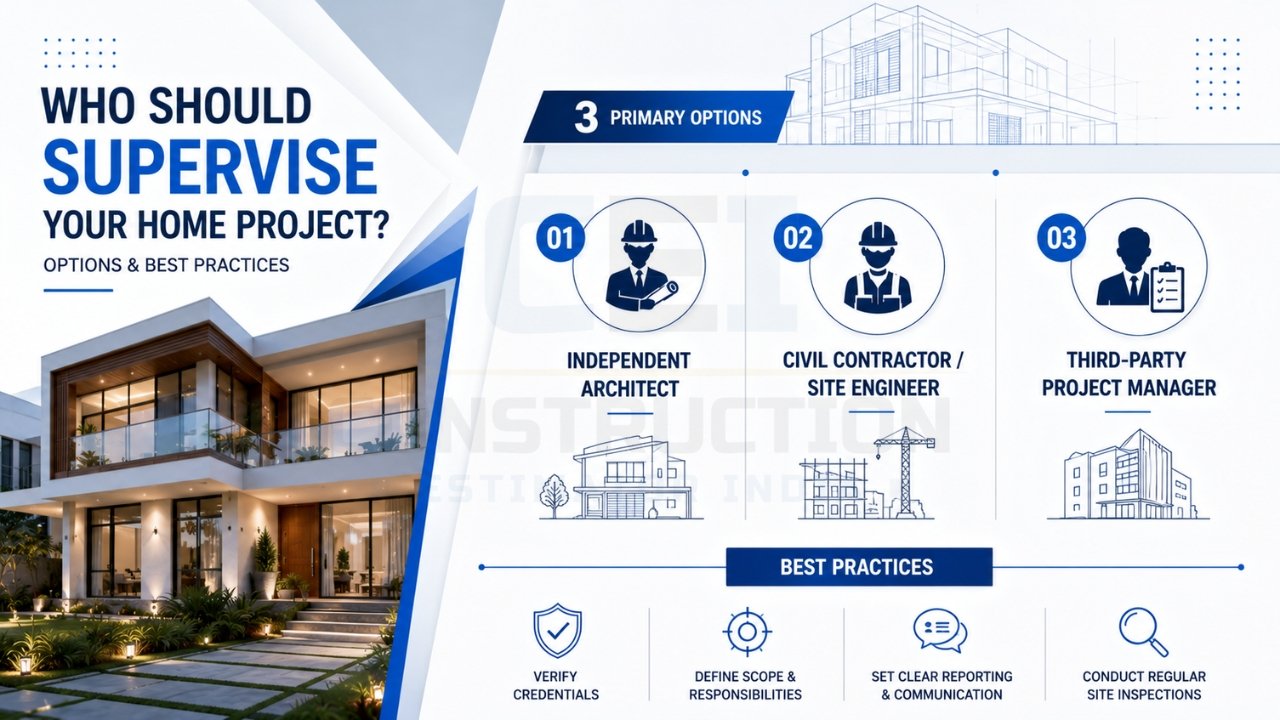
Selecting the right person to watch over your site is the first major decision you will make. This choice impacts the structural integrity, the final aesthetic, and your peace of mind. Here are the three primary options available in the Indian market.
You (The Homeowner)
Choosing to supervise the project yourself is the most common path for middle-class homeowners in India. The primary “pro” is the significant saving on supervision costs (5-10% of the project). You gain direct control over every purchase, learn the intricacies of construction, and ensure that your personal preferences are followed to the letter. However, the “cons” are heavy. Construction is a technical field; if you cannot distinguish between 500 Grade and 550 Grade steel, or don’t understand the curing requirements of an RCC slab, you might miss critical flaws. Furthermore, it is incredibly time-intensive. You must ask yourself: Are you able to find time to gather materials at unconventional hours? Do you have employment that allows you to visit the site 2–3 times weekly minimum? If you are a layperson, self-supervision requires a steep learning curve and the discipline to follow a guide like this one religiously.
👉 Build with confidence by making informed decisions at every stage of construction.
Architect or Site Engineer
Ideally, an architect, project manager, or engineer should supervise the site. Their expertise helps in guiding workers, maintaining accuracy, and ensuring the structural drawings are translated correctly into reality. The biggest advantage is professional accountability. A qualified professional, such as those among the top architects and architecture firms in roorkee, understands how to read a structural plan and can identify if a contractor is using too much sand in a mortar mix. The “con” is the added professional fee, which typically ranges from ₹5,000 to ₹25,000 per month. For luxury homes or complex designs, this is not an expense—it is insurance against catastrophic failure.
Independent Construction Supervisor
Independent supervisors are third-party consultants who act as your “eyes and ears” on-site without being affiliated with the contractor. Companies like Construction Estimator India provide site supervisors for construction supervision and monitoring. Site supervisors or erection personnel are required during the construction phase to ensure that the material quality matches the Bill of Quantities (BOQ). The advantage is a neutral third party with zero contractor bias. They focus solely on quality and safety. While there is a cost involved, they often pay for themselves by preventing material wastage and expensive re-work. Can I hire someone to supervise? Yes, freelance supervisors or third-party consultants are available in most major Indian cities.
Best Practice: The Hybrid Model
The most effective strategy for most homeowners is a hybrid model. You should engage as much as you can, even if you bring in professionals. For instance, you handle the financial approvals and material brand selections, while a professional from Construction Estimator India handles the technical inspections (reinforcement, concrete pouring, plumbing pressure tests). This “optimal middle ground” strikes a balance between cost-effectiveness and technical safety. Ultimately, the extent of your involvement is a personal choice, but having a professional on-call for critical stages like slab casting is highly recommended.
What If the Contractor Resists Supervision?
If a contractor resists your presence or the presence of a third-party supervisor, it is a massive red flag. Reputable building contractors in roorkee or in any major hub welcome accountability because it protects them from later claims that the work was poor. By collaborating with a contractor early on, you can detail the specifications and preferred material brands in a formal contract. If they push back on you checking the steel spacing or the concrete mix, they are likely trying to hide something. Address this immediately; if the resistance persists, consider replacing the contractor before the structure is complete.
Supervision During Monsoon is Twice as Critical
In India, the monsoon brings unique and often devastating challenges to a construction site. Supervision during monsoon is twice as critical. Heavy rain can wash away the cement paste from freshly poured concrete, cause landslides in excavation pits, and rust exposed reinforcement bars. You must check that the contractor has adequate plastic covering for materials and that the curing period is adjusted. Concrete takes longer to set in high humidity, and the drainage on-site must be managed to prevent water-logging around the foundation.
Pre-Construction Supervision Checklist (Before Breaking Ground)
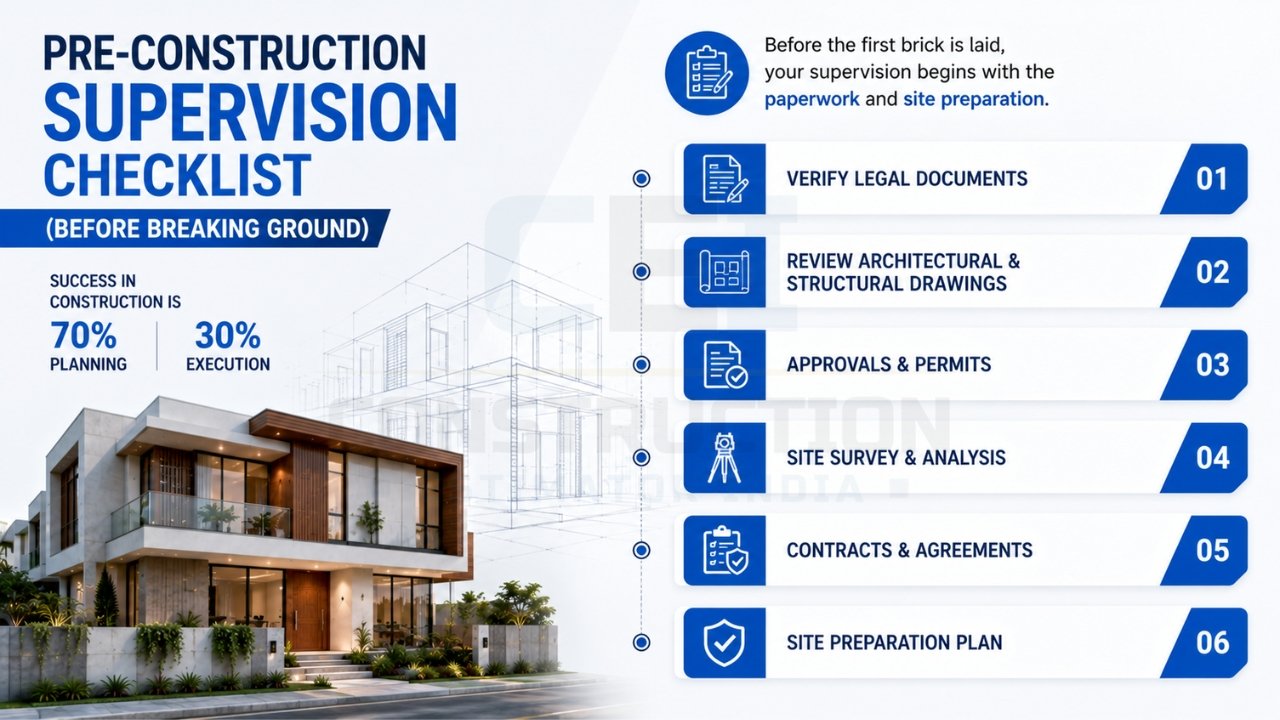
Success in construction is 70% planning and 30% execution. Before the first brick is laid, your supervision begins with the paperwork and site preparation.
Verify Site Measurement Before Starting
- What to Check: Ensure the physical plot dimensions match the survey documents and architectural drawings.
- Why It’s Important: Encroaching even an inch on a neighbor’s property or the government road can lead to legal demolition orders years later.
- How to Check: Use a 100-foot steel tape. Measure the length, width, and importantly, the diagonals (to ensure the plot is “in-square” or Guniya).
- What If Wrong: If the site is smaller than the plan, the entire architectural design must be scaled down. If you build first and measure later, you face fines or neighbor disputes.
👉 Avoid construction delays, material wastage, and workmanship issues with expert support.
Confirm All Drawings Are Approved
- What to Check: Verify that you have the latest, municipality-approved versions of architectural, structural, electrical, and plumbing drawings.
- Why It’s Important: Building without approved plans is illegal. Furthermore, structural drawings (centerline, footing, column details) are the “bible” for your site.
- How to Check: Match the seal on the blueprints with the latest revision date. Ensure copies are laminated or kept in a dry folder on-site for the workers to see daily.
- What If Wrong: Using an older revision can lead to columns being placed in the wrong spot, causing structural instability or room sizes that don’t match the final design.
Review & Sign Detailed Contract
- What to Check: A formal contract detailing material brands, timelines, and payment milestones.
- Why It’s Important: Verbal agreements are the root of 90% of construction disputes in India. A contract streamlines the process and ensures everything is clearly outlined.
- How to Check: Does the contract specify “Ultratech/ACC Cement” or just “Cement”? Does it specify “Tata Tiscon/Jindal Steel” or just “Steel”? Ensure the BOQ is attached.
- What If Wrong: Without a contract, the contractor may switch to “local” brands to save money, and you will have no legal recourse to stop them.
Check Soil Testing Report
- What to Check: A geotechnical report specifying the Safe Bearing Capacity (SBC) of the soil.
- Why It’s Important: The soil determines how deep your foundation needs to go. Black cotton soil, for example, requires much deeper piling than rocky soil.
- How to Check: Hire a soil testing lab before designing the foundation. The report should tell you the water table depth and soil type.
- What If Wrong: Skipping this leads to “guesswork” foundations. This causes uneven settlement, resulting in massive cracks in walls and floors within 2-3 years.
Verify Material Delivery Schedule
- What to Check: Ensure vendors for cement, sand, and steel are sourced and delivery timelines are set.
- Why It’s Important: Delays in material delivery lead to idle labor costs. Conversely, over-ordering cement without proper storage leads to “caking” and wastage.
- How to Check: Ensure everything is ready and accessible a day prior to commencement. Check that there is a dry, raised platform for cement storage.
-
What If Wrong: Skipping this leads to “guesswork” foundations. Understanding the correct foundation types for house construction in india prevents uneven settlement, which results in massive cracks in walls and floors within 2-3 years.
Foundation Stage Quality Checks (Critical for Structural Safety)
The foundation is the most critical part of your home. Mistakes here are permanent and often impossible to fix. For expert guidance at this stage, contact Construction Estimator India at +91 8630676890.
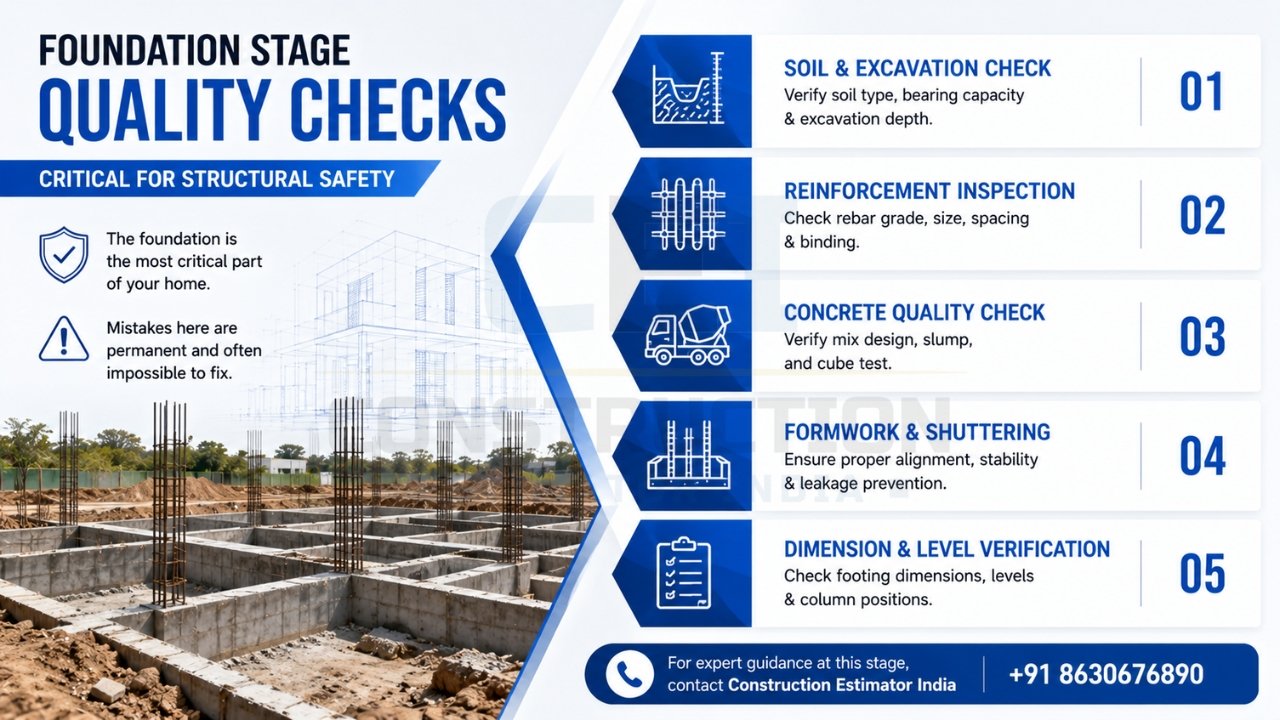
Check Excavation Depth & Width
- What to Check: The depth and width of the trenches/pits.
- Why It’s Important: If the foundation doesn’t reach “hard strata” (firm soil), the house will sink.
- How to Check: Measure against the structural drawing. Typically, residential foundations are 4–6 feet deep. Ensure the bottom is leveled and compacted (durmus).
- What If Wrong: Shallow foundations lead to structural collapse. Excessively wide excavations lead to wasted concrete and higher costs.
👉 Need help supervising your house construction? Connect with our construction experts today.
Verify Reinforcement (Steel) Quality & Quantity
- What to Check: Diameter, grade, and spacing of the TMT bars in the footing.
- Why It’s Important: Steel provides the tension strength. If the spacing is too wide, the concrete will crack under the building’s weight.
- How to Check: Look for the brand stamp on the bars (e.g., Fe 500). Use a tape to check the spacing (e.g., 6 inches center-to-center). Only the best builders can miss things unintentionally—count the rods yourself.
- What If Wrong: Insufficient steel leads to “shearing” of the footing, which can cause the building to tilt or collapse.
- Check Concrete Mix Ratio & Quality
- What to Check: The ratio of Cement:Sand:Aggregate.
- Why It’s Important: A weak mix results in porous, weak concrete that absorbs water and rusts the steel inside.
- How to Check: For foundations, use M20 (1:1.5:3) or M25 mix. Use a “Batching Box” (Farmi) rather than a basket (Tagari) to measure. Ensure a mechanical mixer is used, not hand-mixing on the ground.
- What If Wrong: Hand-mixed concrete on dirt introduces mud into the foundation, reducing its strength by up to 50%.
Ensure Proper Curing Period
- What to Check: Continuous wetting of the concrete for 7–10 days.
- Why It’s Important: Concrete gains strength through a chemical reaction with water. If it dries too fast, it becomes brittle.
- How to Check: Visit the site at 8 AM and 5 PM. The concrete should be damp to the touch. Use wet gunny bags to wrap columns.
- What If Wrong: Lack of curing leads to “shrinkage cracks” and a foundation that cannot support the weight of the upper floors.
- Check Damp Proof Course (DPC) Installation
- What to Check: A 2-4 inch layer of concrete mixed with waterproofing compound at the plinth level.
- Why It’s Important: DPC prevents “capillary action,” where ground moisture travels up the walls, ruining your expensive paint and plaster.
- How to Check: Ensure the DPC is applied on all walls before the first course of bricks. Check for a smooth, continuous layer with no gaps.
- What If Wrong: Your walls will have “dampness” or Sillan forever, leading to health issues (mold) and peeling paint.
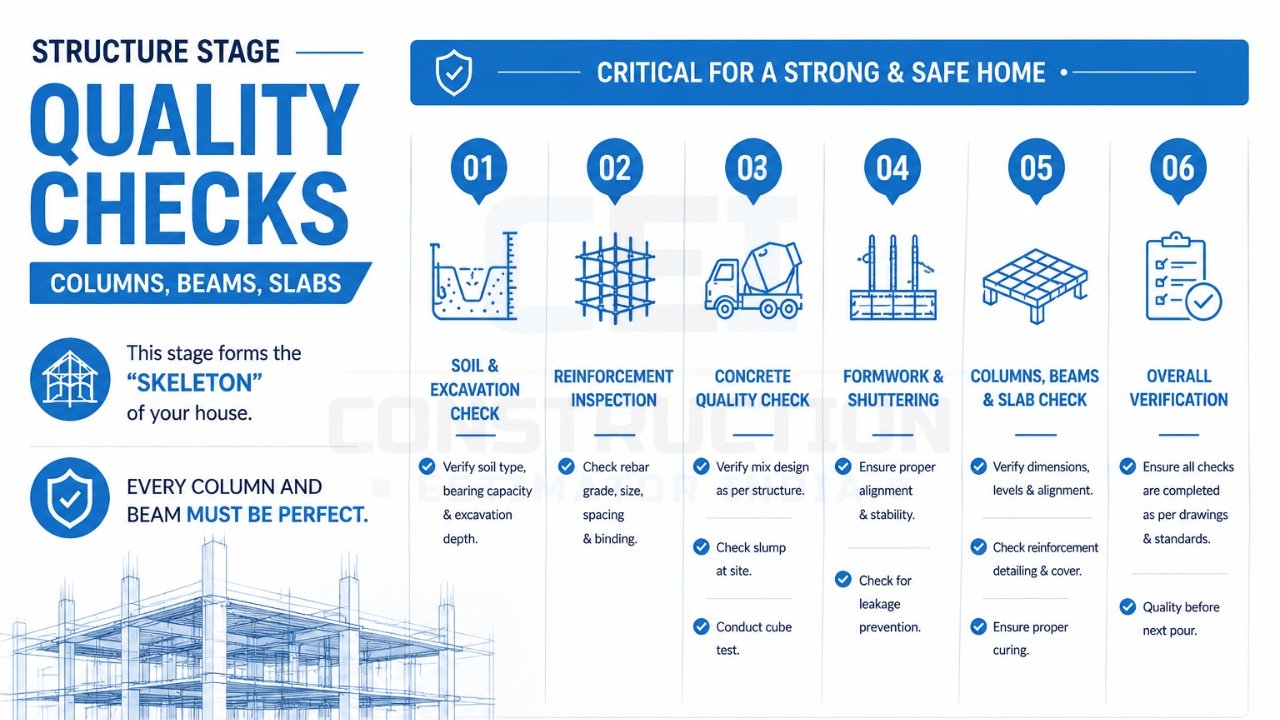
Structure Stage Quality Checks (Columns, Beams, Slabs)
This stage forms the “skeleton” of your house. Every column and beam must be perfect.
Verify Column Size & Alignment
- What to Check: Dimensions of the columns and their verticality.
- Why It’s Important: Columns carry the entire load to the foundation. If they are tilted, they create “eccentric loading.”
- How to Check: Check column size (e.g., 9″x12″). Use a Plumb Bob (Sahul) to ensure they are 100% vertical. Verify that the “starter” is correctly placed.
- What If Wrong: Even a 1-inch tilt in a 10-foot column significantly reduces its carrying capacity, leading to structural danger.
👉 Build your dream home the right way with expert construction supervision insights.
Check Beam Depth & Reinforcement
- What to Check: The depth of the beams and the placement of “Stirrups” (Rings).
- Why It’s Important: Beams prevent the slabs from sagging. The stirrups hold the main steel in place during earthquake forces.
- How to Check: Measure the spacing of the rings. They should be closer together near the columns (4 inches) and further apart in the middle (6-8 inches).
- What If Wrong: Incorrect stirrup spacing is the leading cause of beam failure during seismic activity or heavy loading.
Inspect Slab Thickness & Reinforcement
- What to Check: The thickness of the RCC slab (usually 4.5 to 5 inches) and the chair-reinforcement.
- Why It’s Important: Thin slabs will vibrate when you walk and develop cracks. “Chairs” keep the top and bottom steel mesh separated.
- How to Check: Insert a small rod or stick into the wet concrete during pouring to measure thickness. Check that “cover blocks” (20mm) are used to keep steel from touching the shuttering.
- What If Wrong: Without cover blocks, the steel will be exposed to air, rust, and eventually cause the concrete to fall off (Spalling).
Monitor Concrete Curing for Structure
- What to Check: Ponding on the slab and wrapping of columns.
- Why It’s Important: Structure curing is vital for the 28-day characteristic strength.
- How to Check: Create small mud boundaries (Kiari) on the slab and fill them with 2 inches of water for 14 days.
- What If Wrong: Premature drying leads to structural cracks that allow water to reach the reinforcement, causing “cancer” in the RCC.
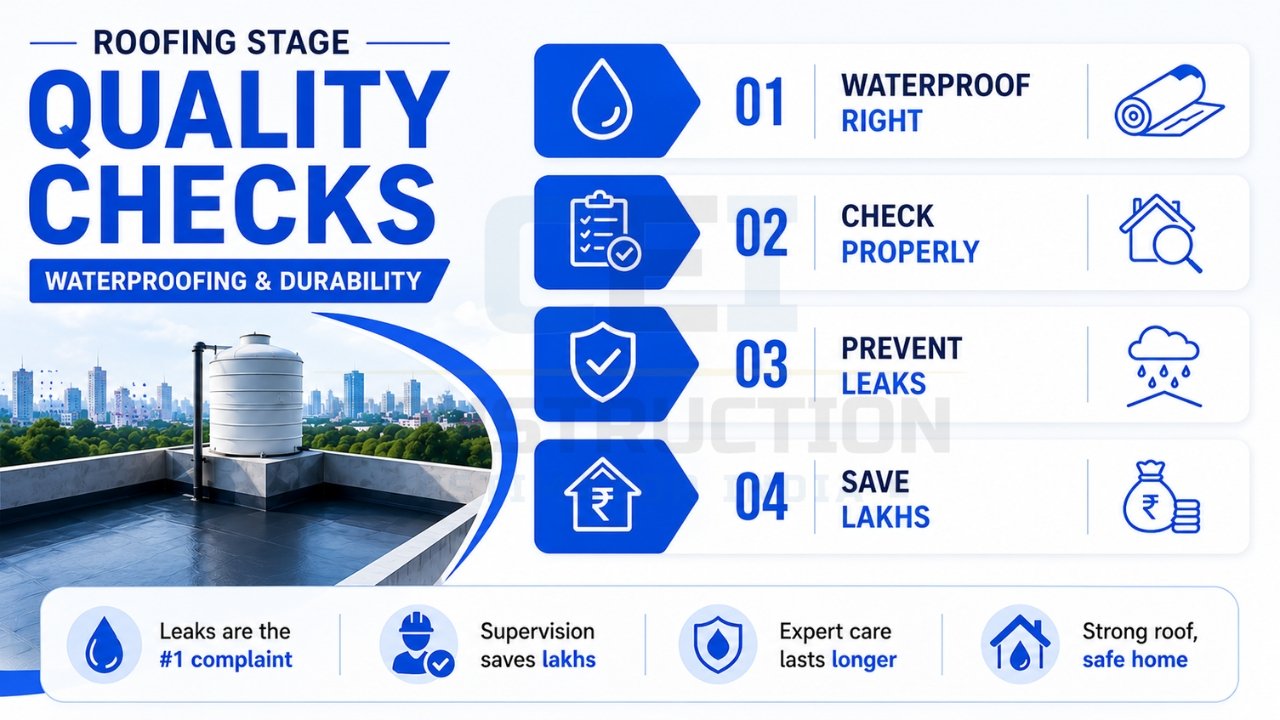
Roofing Stage Quality Checks (Waterproofing & Durability)
A leaking roof is the most common complaint in Indian homes. Proper supervision at this stage saves lakhs in future repairs. Utilizing expert waterproofing services in roorkee (or your region) offers long-term protection. Contact Construction Estimator India (+91 8630676890) for a free roofing quality audit.
Check Roof Concrete Thickness
- What to Check: Uniformity of the roof slab thickness.
- Why It’s Important: Roofs are exposed to the harshest weather. Variable thickness leads to “ponding” where water collects in depressions.
- How to Check: Use a level pipe to ensure the slab has a slight slope (1:100) toward the rainwater pipes. Measure the concrete thickness at multiple points.
- What If Wrong: Flat or uneven roofs lead to standing water, which will eventually penetrate any waterproofing layer.
👉 Get professional support to ensure your house is built to the highest standards.
Verify Waterproofing Application
- What to Check: The type and method of waterproofing (Bituminous, Crystalline, or Brick-bat Coba).
- Why It’s Important: Concrete is naturally porous. Waterproofing is the only barrier against monsoon rains.
- How to Check: Ensure the surface is cleaned of all dust before application. Perform a “Water Test” by flooding the roof with 2 inches of water for 48 hours and checking the ceiling below.
- What If Wrong: Once a house is finished, fixing a roof leak involves breaking the tiles—an expensive and messy process.
Ensure Proper Curing Period for Roof
- What to Check: Slabs must be cured for a minimum of 14 days.
- Why It’s Important: Roof slabs are large surface areas; they lose water to evaporation very quickly.
- How to Check: Use “Ponding” method. Ensure the water level is maintained daily.
- What If Wrong: A poorly cured roof will develop “hairline cracks” which are the entry points for water seepage.
Electrical & Plumbing Supervision (Hidden Work Quality)
Most electrical and plumbing work is hidden behind plaster. If it fails, you have to break your walls.
Check Wire Gauge & Brand
- What to Check: Thickness of the wires (sq. mm) and the ISI mark as mandated by the Bureau of Indian Standards (BIS).
- Why It’s Important: Using a thin wire for an AC or Geyser will cause it to melt, leading to short circuits and fires.
- How to Check: Verify: 1.5mm for lights, 2.5mm for power sockets, and 4mm-6mm for ACs/Main line. Use brands like Havells, Polycab, or Anchor as per the BOQ.
- What If Wrong: Inferior wiring is a major fire hazard and will cause frequent tripping of MCBs.
Verify Pipe Quality & Pressure Testing
- What to Check: Pipe brands (Astral/Supreme/Prince) and pressure testing of joints.
- Why It’s Important: A single leaking joint behind a bathroom tile can ruin the adjacent bedroom’s wardrobe and paint.
- How to Check: Use a “Pressure Pump” to test the plumbing lines at 10kg/sq.cm for at least 6 hours before plastering. Look for any moisture at the joints.
- What If Wrong: Undetected leaks lead to dampness that spreads through the entire wall structure.
Ensure Proper Concealment Before Wall Closing
- What to Check: Conduits and pipes are properly fixed with “Gitti” and “Nails.”
- Why It’s Important: Loose conduits will move during plastering, potentially cracking the plaster or disconnecting wires.
- How to Check: Take high-resolution photos and videos of all open conduits before they are covered. This is your “X-ray” for the future.
- What If Wrong: If you need to drill a hole for a TV mount later, you won’t know where the wires are, leading to accidental damage.
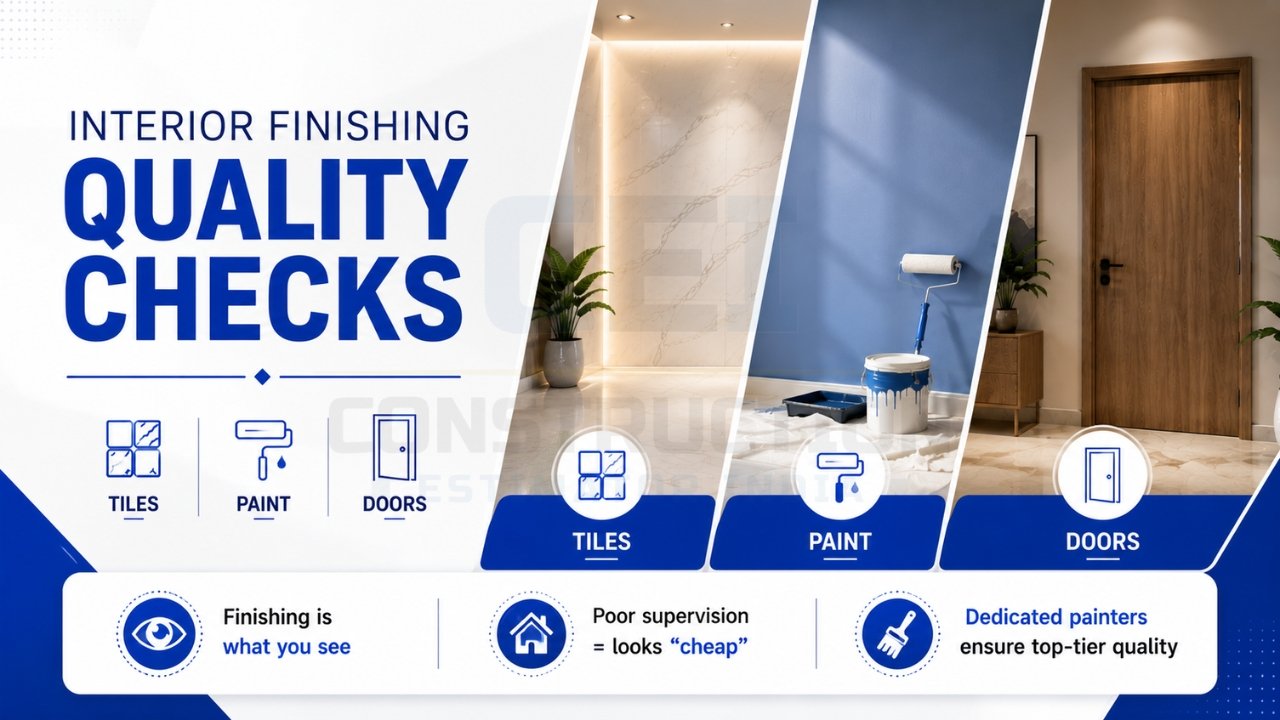
Interior Finishing Quality Checks (Tiles, Paint, Doors)
Finishing is what you see every day. Poor supervision here results in a house that looks “cheap” despite high spending. Working with dedicated painters in roorkee ensures top-tier quality.
Check Tile Alignment & Quality
- What to Check: Level, slope, and “hollow” sounds.
- Why It’s Important: Uneven tiles are a tripping hazard and look unprofessional.
- How to Check: Tap every tile with a wooden mallet/stick. A “hollow” sound means there isn’t enough mortar underneath. Use a spirit level to check the slope toward floor drains in bathrooms.
- What If Wrong: Hollow tiles will crack as soon as you move furniture over them. Poor slope means water will stay on your bathroom floor forever.
Verify Paint Quality & Application
- What to Check: Number of coats and surface preparation.
- Why It’s Important: Paint protects the plaster. If applied on a damp or dusty wall, it will peel (Flaking).
- How to Check: Ensure one coat of primer and at least two coats of the final paint. Check the wall under a bright light (side-lighting) to see any uneven patches of putty.
- What If Wrong: Skipping the primer or using low-quality putty results in a dull finish that fades in less than a year.
Inspect Door & Window Quality
- What to Check: Wood seasoning, plywood grade, and hardware.
- Why It’s Important: Doors that “warp” in the monsoon won’t close properly, compromising security and AC cooling.
- How to Check: Check for the BWP (Boiling Water Proof) stamp on plywood for kitchen and bathrooms. Ensure hinges are stainless steel (SS 304) to prevent rusting.
- What If Wrong: Cheap hardware will rust and jam within months, requiring expensive replacements.
👉 Start your construction journey with expert guidance at every step.
Tools That Make Supervision Easy & Efficient
Modern technology has made construction monitoring much easier for the average person.
Apps You Can Use for Supervision
Construction Estimator India recommends using simple project management apps like SiteFlow or BuildTake. These allow you to upload daily photos, track the labor count, and record material arrivals. Even a simple WhatsApp group with your contractor, architect, and a consultant from Construction Estimator India (+91 8630676890) can act as a powerful documentation tool.
Photo Logs for Documentation
Take photos of everything. Specifically, document the “hidden” elements: foundation steel before pouring, plumbing lines before plaster, and electrical conduits. Create folders on Google Drive labeled by stage (e.g., “Footing Stage,” “Slab 1”). This documentation is invaluable for future maintenance or if you decide to sell the house.
Site Diary for Record Keeping
Maintain a physical “Site Diary.” Every time you visit, record:
- Date and time.
- Number of laborers on site.
- Material delivered (Brand and Quantity).
- Any instructions given to the contractor.
- Weather conditions.
This diary is your primary evidence if the project faces delays or billing disputes.
Common Mistakes to Avoid During Supervision
Mistake 1: Blind Trust in Builder
As mentioned, “Trust, but verify.” Even if the builder is a family friend, construction is complex. Errors are often accidental. If you don’t check, they won’t know they made a mistake. Always measure, always count, and always check the brand of the bag.
Mistake 2: Inconsistent Site Visits
Make supervision a ritual. Your brain loves predictability, and so does a contractor. If they know you show up every Wednesday at 10 AM, they will ensure the site is clean and work is as per plan. Random visits are good, but consistent ones ensure the project stays on schedule.
Mistake 3: Not Checking Material on Delivery
Contractors often order in bulk. If the sand delivered is “silty” (too much mud) or the aggregates are too large, reject the load immediately. Once it’s mixed into the concrete, it’s too late. Are you able to find time to inspect every truck? If not, hire a supervisor from Construction Estimator India at +91 8630676890.
50-Point Final Construction Supervision Checklist
Use this checklist during your weekly site visits. Mark (✓) for compliance.
| Category | Item to Check | Compliance |
|---|---|---|
| Pre-Construction | Site Boundary measured and marked | |
| Soil test report reviewed and signed | ||
| Approved drawings available on site | ||
| Foundation | Excavation depth as per drawing | |
| Anti-termite treatment done in soil | ||
| Cover blocks (50mm) used in footing | ||
| Curing of footing for 7 days | ||
| Structure | Column verticality checked with Plumb Bob | |
| Beam stirrup spacing (rings) verified | ||
| Slab thickness (min 5″) checked | ||
| Shuttering/Centering is stable and oiled | ||
| Masonry | Bricks soaked in water before use | |
| Mortar ratio (1:4 or 1:6) followed | ||
| Vertical joints are staggered | ||
| Electrical | Wire gauge matches load requirements | |
| All switch boxes are leveled | ||
| Plumbing | Pressure test (10kg) passed for all lines | |
| Slope in floor drains verified | ||
| Finishing | Tile joints are straight and uniform | |
| Paint primer coat applied on dry walls |
When to Contact Construction Estimator India for Supervision Help
If you find that the technical details are too complex or you simply don’t have the 10-15 hours a week required for proper supervision, it’s time to call in the experts. Construction Estimator India offers specialized third-party supervision services tailored for Indian homeowners ensuring adherence to state guidelines like RERA Uttarakhand.
Contact us if you need:
- A Quality Audit: Before you release a major payment to your contractor, let us verify if the work is actually worth the amount.
- Site Inspection for Hidden Work: We can inspect your reinforcement and plumbing before they are covered forever.
- Material Verification: We ensure that the brands you paid for are the ones being used.
- Free Supervision Consultation: Not sure where to start? Call us for a free 15-minute guidance session.
Construction Estimator India Services:
- Free Construction Supervision Consultation.
- Professional Site Engineer Visits.
- Structural Safety Audits.
- Bill Verification and Cost Control.
WhatsApp/Call: +91 8630676890
Frequently Asked Questions (FAQs)
Q1: How much does construction supervision cost in India?
Professional supervision charges are generally 5% to 10% of the total project cost. If you hire a monthly consultant, the cost is typically between ₹5,000 and ₹25,000 per month. This depends on the size of the house and the frequency of visits required. Investing in supervision often saves you 2-3 times that amount by preventing material theft and poor workmanship.
Q2: Should I supervise myself or hire a professional?
If you have a basic understanding of civil engineering and can spend at least 3-4 days a week at the site, you can self-supervise. However, for critical stages like foundation, column casting, and slab pouring, hiring a professional like Construction Estimator India is highly recommended to ensure structural safety.
Q3: How many times should I visit the construction site?
As a homeowner, you should visit at least 2–3 times a week. During critical stages (concrete pouring, electrical wiring), daily visits or hiring a full-time supervisor is necessary. Consistency is key; random visits are helpful, but regular inspections ensure the contractor stays disciplined.
Q4: What is the most critical stage for supervision?
The Foundation and the RCC Structure (Columns/Slabs) are the most critical. Mistakes in these stages are permanent and can lead to the collapse of the building. Finishing mistakes are cosmetic and can be fixed, but structural mistakes are life-threatening.
Q5: How do I check concrete quality on site?
The simplest way is the “Slump Test,” which measures the consistency of the mix. Ensure the contractor isn’t adding too much water to make it “easy to pour.” Also, verify the “Batching Box” measurements for the cement-sand-aggregate ratio.
Q6: What if my contractor resists supervision?
This is a major red flag. A professional contractor welcomes accountability. If they resist, remind them of the contract terms. If the behavior continues, it is often safer to stop work and consult with a third-party expert like Construction Estimator India (+91 8630676890).
Q7: Is supervision during monsoon different?
Yes, it is twice as critical. You must ensure that fresh concrete is protected from rain and that the curing time is extended due to humidity. You must also check for soil stability in the excavation pits to prevent cave-ins.
Q8: Can I hire a freelance supervisor?
Yes, many retired engineers or freelance site supervisors are available. However, ensure they have a proven track record and check their previous projects. Working with a company like Construction Estimator India provides better accountability and a standardized checklist.
Q9: What tools should I use for supervision?
At a minimum, you need a 5-meter and a 30-meter steel measuring tape, a plumb bob, a spirit level, and a high-quality camera for documentation. Using a mobile app for site logs is also highly recommended.
Q10: How do I verify material quality on delivery?
Check for the brand name, grade, and date of manufacture on cement bags (should be less than 3 months old). For steel, look for the TMT grade stamp. For sand, perform a “silt test” by mixing a sample with water in a glass; if the mud layer is more than 8%, reject it.
Q11: What is the best contract type for supervision?
A “Labor Contract with Material Specifications” is often the best for homeowners. It allows you to supervise the quality of materials you purchase while the contractor is supervised for their workmanship.
Q12: How do I contact Construction Estimator India for supervision?
You can reach us directly for a free consultation or to book a site inspection via WhatsApp or Call at +91 8630676890. We provide expert services across India to ensure your home is built to the highest standards.
Contact Construction Estimator India for Construction Supervision Services
Don’t leave your dream home to chance. Professional supervision is the bridge between a “house” and a “home that lasts.” Construction Estimator India provides expert engineering oversight to ensure your contractor delivers exactly what you paid for.
Our Core Supervision Services:
- Daily/Weekly Site Inspections: Technical checks on reinforcement, masonry, and finishing.
- Quality Audits: Comprehensive reports on the health of your construction.
- Cost Management: Verifying bills and preventing material wastage.
- Free Site Inspection: For first-time clients looking to evaluate their current project quality.
Company: Construction Estimator India
WhatsApp/Call: +91 8630676890
Email: constructionestimatorindia@gmail.com
Conclusion: Supervision is Your Responsibility, Not Optional
In the final analysis, the quality of your home is your responsibility. While you hire experts to build, you must remain the “Chief Quality Officer” of your project. Supervision isn’t optional, it’s foundational. By following this complete stage-by-stage quality checklist, you protect your investment, your family’s safety, and your peace of mind.
Remember: Trust, but verify. Even the best builders can miss things unintentionally. Whether you are self-supervising or hiring a professional supervisor for ₹5,000–₹25,000 per month, the goal is the same—a perfect home. If the process feels daunting, reach out to Construction Estimator India at +91 8630676890 for a free construction supervision consultation. Build smart, supervise strictly, and live happily in a home built to last.