
Negotiating with contractors in the Indian construction landscape is often perceived as a daunting battle of wits. However, for a homeowner, it is a critical procurement exercise that directly dictates the financial health and quality outcome of their dream project. When you learn how to plan home construction in India, you realize that construction projects are complex, involving high-value transactions, multi-year timelines, and a multitude of variables. Negotiating contractor rates effectively is not just about “haggling”; it is about securing a fair deal that ensures your home is built to the highest standards while staying within a realistic budget. By getting at least 3+ competing bids, you immediately shift the power dynamic in your favor.
👉 Negotiating with a Contractor? Get Expert Guidance Before You Sign Any Agreement.
In India, common challenges include highly inflated initial quotes, hidden costs that surface mid-project, compromises on material quality to preserve contractor margins, and frustrating delay tactics. Negotiation is a critical part of procurement because it directly affects costs, schedules, risks, and the overall quality of project outcomes. Knowing the market rate for your specific city is the most powerful tool in your arsenal. For instance, a commercial office or shop project of 1000 Sq.Ft. might carry an estimated cost range of ₹ 17.1 – 20.9 Lakhs depending on quality. Without this knowledge, you are navigating in the dark.
At Construction Estimator India, we specialize in empowering homeowners with data-driven insights. With 15+ years of experience, we have seen that homeowners using a systematic negotiation framework can achieve average savings of 15–30% on total construction costs. Effective negotiation strategies help secure favorable terms with suppliers and service providers, ensuring that every rupee spent adds value to your property. It is important to remember that negotiating with contractors requires a blend of strategic thinking, clear communication, and mutual respect. However, you must avoid negotiating below a fair rate, as this inevitably leads to material quality compromises that will cost you more in the long run.
For expert assistance, contact Construction Estimator India at WhatsApp/Call: +91 8630676890. We offer free contractor rate consultations, free construction cost estimates, and professional negotiation coaching to ensure you get the best possible deal.
Pre-Negotiation Preparation Strategy
Preparation is the bedrock of any successful negotiation. In the Indian context, where rates can fluctuate wildly between neighborhoods and cities, walking into a meeting without data is a recipe for overpaying.
Market Rate Research Process
Knowing the market rate for your city is essential before you even speak to a contractor. You should utilize price guides or online resources to understand the current “going rate.” Our research shows significant variations: Mumbai typically ranges from ₹2,500–₹3,500/sq ft, Delhi from ₹2,000–₹3,000/sq ft, and Bangalore from ₹1,800–₹2,800/sq ft. To execute this, you should conduct an online search, consult with an independent architect, and visit recently completed projects in your locality. Cross-referencing local data, such as the house construction per sq ft rate roorkee or in your city, gives you an immediate baseline. This research might cost between ₹500–₹2,000 if you hire a consultant, but it often results in savings of 10–20% by allowing you to immediately spot and discard inflated quotes.

Competitive Bidding Strategy
The most effective way to negotiate contractor rates is by getting at least three comparable bids or estimates for your project. You should explicitly announce that you are getting multiple bids to create natural competitive pressure. Send your plan out to three different contractors and provide them with identical project details to ensure you are comparing “apples to apples”. This process typically takes 7–10 days for bid collection but is the most reliable way to achieve 15–25% savings as contractors sharpen their pencils knowing they are in a race.
👉 Protect Your Budget and Interests with Professional Construction Advice.
Project Scope Definition Method
Ambiguity is the contractor’s best friend and the homeowner’s worst enemy. You must be clear about your scope of work and never leave things open for interpretation. Understand the project requirements thoroughly by listing every material, fixture brand, and quantity required. Create a one-page detailed specification sheet. Whether you pay an architect ₹500–₹1,500 for this, or consult directly with architects and architecture firms in roorkee, this step prevents 10–15% in “extra costs” or “hidden charges” that contractors often add once the work has started and you are “locked in.”
Budget Transparency Framework
While some believe in hiding their budget, being transparent about your financial constraints can actually work in your favor. Clearly define your budget upfront—for example, “My total budget for this civil work is ₹15 lakh.” This forces the contractor to propose a solution that fits your reality rather than a “dream quote” that you can’t afford. Budget-driven negotiation can lead to 10–20% savings by eliminating unnecessary high-end features that don’t fit your core needs.
BATNA Preparation Strategy
In negotiation theory, BATNA stands for “Best Alternative To a Negotiated Agreement”. If one contractor refuses to meet your terms or delivery dates, you must know exactly who else can do the job. Collect 2–3 backup contractor contacts before finalizing your primary choice. Having this leverage allows you to walk away from a bad deal with confidence, often resulting in the original contractor suddenly finding “wiggle room” of 15–25% to keep the business.
Negotiation Execution Strategy
Once you have your data and bids, the execution phase begins. This is where your assertive communication skills and strategic frameworks are put to the test.
Multiple Bids Announcement Script
Transparency about competition is a high-leverage tactic. When you receive a quote that is higher than expected, use this script: “I am currently evaluating bids from three different contractors. Your technical proposal is excellent, but your quote is at ₹20 lakh. I have another competitive bid at ₹17 lakh. Can you match this figure to win the project?”. This should be done approximately 3 days after receiving their quote, allowing them time to realize you are a serious, informed buyer. This tactic alone frequently yields 15–20% reductions.
Value Engineering Request Process
Value engineering is the process of achieving the same function or quality at a lower cost. Ask the contractor: “Can you suggest cost-saving alternatives without compromising the structural integrity or aesthetic quality of the project?” For example, using high-quality domestic tiles that are ISI-marked by BIS instead of imported ones can offer a massive discount. Often, contractors can offer a 10–20% discount if they can suggest more efficient ways to execute your plans.
Task Bundling Strategy
Contractors love volume and continuity. Use “Task Bundling” to negotiate lower rates for a combined scope. Instead of hiring different people for construction, painting, and plumbing, ask your primary contractor: “I also need the painting and plumbing done after this civil work. Can you give me a bundled quote for the entire package?” If you are managing a large-scale project, negotiating bundled rates with top commercial building contractors in roorkee (or in your region) can yield massive returns. A bundle that costs ₹15 lakh might have cost ₹18 lakh if negotiated as separate contracts, saving you 10–20%.
Quick Payment Incentive Framework
Cash flow is the lifeblood of Indian contractors. You can offer incentives for better terms, such as a discount for early payments. Use this framework: “I will release each milestone payment within 48 hours of approval if you can provide a 5% discount on the total labor cost”. Because contractors value cash flow certainty to pay their laborers on time, this is a powerful “win-win” that can save you 5–10% without affecting the contractor’s bottom line significantly.
Material Procurement Strategy
One of the biggest areas for savings is through material procurement. Negotiate materials separately by buying them yourself and paying the contractor only for labor. This often saves the 8–12% GST difference (verify current regulations at the official GST Portal) that contractors might otherwise markup, plus it ensures you are getting exactly the quality you paid for. If a contractor quotes ₹22 lakh inclusive of materials, you might find that paying ₹12 lakh for labor and buying ₹8 lakh in materials yourself saves you ₹2 lakh instantly.
Option-Requesting Technique
Instead of asking for a flat discount, ask for options. Ask: “What are three different ways we can reduce the total project cost by 15%?” This shifts the contractor from a “defensive” mode to a “problem-solving” mode. They might suggest changing a specific brand of cement or a different waterproofing technique that still meets standards but costs less. This collaborative approach often leads to 10–20% in smart savings.
Itemized Bids Demand Process
Never accept a “lumpsum” quote. Demand itemized bids that break down the quote into materials, labor, and timelines. Ensure all quotes you receive are costing out the same list of items so you can identify where a specific contractor is “padding” their margins. This transparency allows you to challenge specific line items that are above market rates, helping you shave 10–15% off the total.
Final Negotiation with Top 2 Strategy
When you have narrowed your choice down to two contractors, conduct a final negotiation. Call them and explain: “Both your bids are extremely close (e.g., ₹17.5 lakh vs ₹17.8 lakh). I really like your work portfolio, but I want to see if you have any final wiggle room to help me make my decision today”. This often triggers a final competitive drop of 5–10% as they strive to close the deal.
Timing & Seasonal Strategy
The timing of your project can be as impactful as the negotiation itself. The Indian construction market is highly seasonal due to the monsoon and major festivals.
Off-Season Hiring Strategy
Timing is everything in construction. Hiring contractors during the “off-season”—typically summer (April–June) or the monsoon (July–September)—can lead to 15–20% lower rates. During these times, contractors are often looking for work to keep their core team employed and are much more likely to accept lower margins than during the peak Diwali (October–December) or New Year (January–March) seasons.

Project Timing Selection Method
Choose the right time for your project to maximize leverage. During the monsoon, many homeowners pause work, making labor more available and cheaper. If your project is internal (like updates efficiently handled by house renovation roorkee specialists), this is the ideal time to negotiate. Conversely, starting a project right before Diwali when everyone wants their home “ready” will result in a 20% premium. Plan your start date 3 months in advance to avoid these peak-season traps.
👉 Make Confident Contractor Decisions with Expert Support.
Patience-Based Negotiation
Avoid rushed decisions and give both sides time to evaluate and respond. After receiving a quote, wait 2–3 days before initiating the negotiation. If you respond instantly, you signal desperation. By showing patience, you signal that you are a disciplined buyer with other options. This psychological shift can lead to a 5–10% “patience discount” as the contractor becomes eager to secure your commitment.
Cost Breakdown Analysis Strategy
To negotiate like an expert, you must understand the “anatomy” of a construction quote.
Detailed Cost Breakdown Request Process
Request a breakdown of every component: Materials (₹X/kg), Labor (₹Y/hour), and Overheads (₹Z%). This allows you to compare specific unit rates against current market standards. If a contractor is charging ₹450 for a bag of cement that costs ₹380, you have concrete data to challenge the quote. This level of scrutiny can reduce inflated costs by 10–15%.
Direct vs Indirect Cost Analysis
Analyze direct costs (materials, labor) versus indirect costs (margins, overheads, and contingencies). In many Indian projects, contractors add a 15–20% “buffer” for contingencies. While some buffer is necessary, you can negotiate this down by agreeing to pay for “actuals” for certain unpredictable items. Reducing overhead and profit margins from a standard 20% to a more competitive 12–15% can save you significant sums.
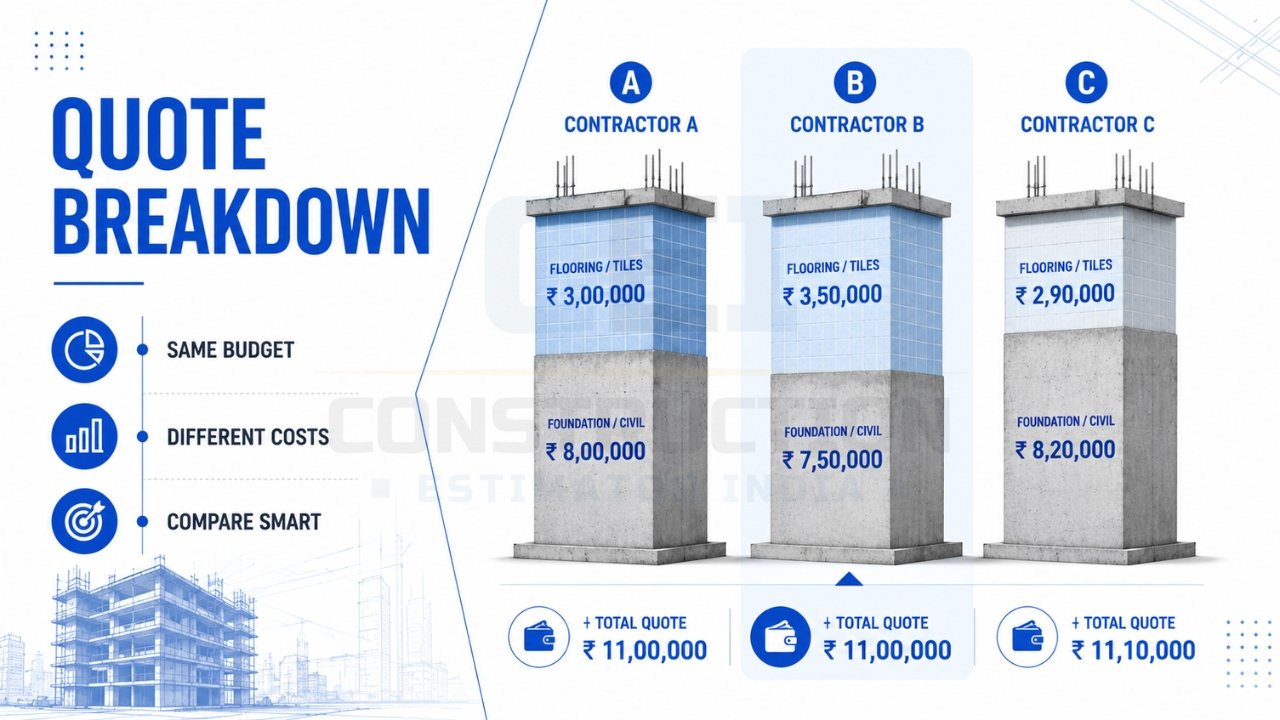
Bid Comparison Spreadsheet Creation
Once you receive multiple bids, create a spreadsheet. Use the following format:
| Category | Contractor A | Contractor B | Contractor C |
|---|---|---|---|
| Foundation/Civil | ₹ 8,00,000 | ₹ 7,50,000 | ₹ 8,20,000 |
| Flooring/Tiles | ₹ 3,00,000 | ₹ 3,50,000 | ₹ 2,90,000 |
| Total Quote | ₹ 11,00,000 | ₹ 11,00,000 | ₹ 11,10,000 |
Seeing the numbers side-by-side allows you to say to Contractor A: “Your total is fine, but why is your flooring cost ₹50,000 higher than others?” This identifying of the lowest-cost options per category can save you 10–20%.
Hidden Cost Challenge Process
Challenge inflated pricing or hidden costs like transport, storage, or “management fees”. Many contractors hide their profits in these miscellaneous categories. By asking for a justification for a ₹50,000 “site mobilization fee,” you can often get it reduced or waived, saving another 5–10% of the contract value.
👉 Get Expert Insights Before Finalizing Your Construction Contract.
Payment Terms Strategy
The way you pay is just as important as how much you pay. Payment terms provide the ultimate leverage for quality control.
Advance Payment Rejection Process
Do not pay upfront for work that has not happened yet. In India, contractors often demand 30–50% as an advance. You should reject this and stick to a maximum of 10–15% for mobilization. Deposits should only be made for special order, non-returnable items. Limiting the advance payment protects your capital (typically saving ₹50,000–₹200,000 in risk) and keeps the contractor motivated to perform.
Milestone Payment Structure
Structure payments around clear milestones: Foundation, Structure, and Finishing. Combine this with your quick payment incentive: “I will pay within 48 hours of a milestone being approved”. This creates a rhythm of performance and reward. It also prevents the “disappearing contractor” syndrome common in India, ensuring you only pay for value received.
Retention Clause Implementation
Always include a retention clause in your contract. This involves holding back 5% of the total contract value until 3–6 months after the project is completed. This “trial period” ensures that any structural cracks, plumbing leaks, or electrical issues that appear after the contractor has left are fixed at their cost. This provides financial protection worth ₹50,000–₹100,000 in future repair costs.
Change Order Pricing Negotiation
“Change orders” (modifications after the contract is signed) are where many homeowners lose their savings. Negotiate the markup for these changes upfront. Ask the contractor to agree that any change orders will be priced at the sub-contractor’s price plus a fixed 15% for management and 5% for profit. This limits the markup to 20%, preventing the typical 30–50% “penalty” pricing contractors apply mid-project.
Contract Terms & Quality Assurance Strategy
A negotiation is not finished until it is written down. The contract is your safety net.
Liquidated Damages Clause
Include a “liquidated damages” clause for delays. In the Indian market, projects often overrun by months. Set a penalty of ₹5,000–₹10,000 per day for every day the project is delayed beyond the agreed-upon completion date. This costs you nothing to implement but ensures the contractor prioritizes your site over others, potentially saving you months of rent or interest costs.
Warranty & Guarantee Negotiation
Negotiate explicit warranties and guarantees for the work performed. Aim for a 1-year structural warranty and a 6-month warranty on finishing items like paint and tiling. This protects you from the cost of poor workmanship and can save ₹20,000–₹50,000 in immediate post-construction repairs.
Contractor Reference Verification Process
Check references diligently; there are many honest and talented contractors out there. Ask specifically who will be working on your project—will they be employees or subcontractors?. Call at least 3 previous clients and visit at least one completed project. This prevents 20–30% in potential quality compromises by ensuring you aren’t hiring someone with a history of cutting corners.
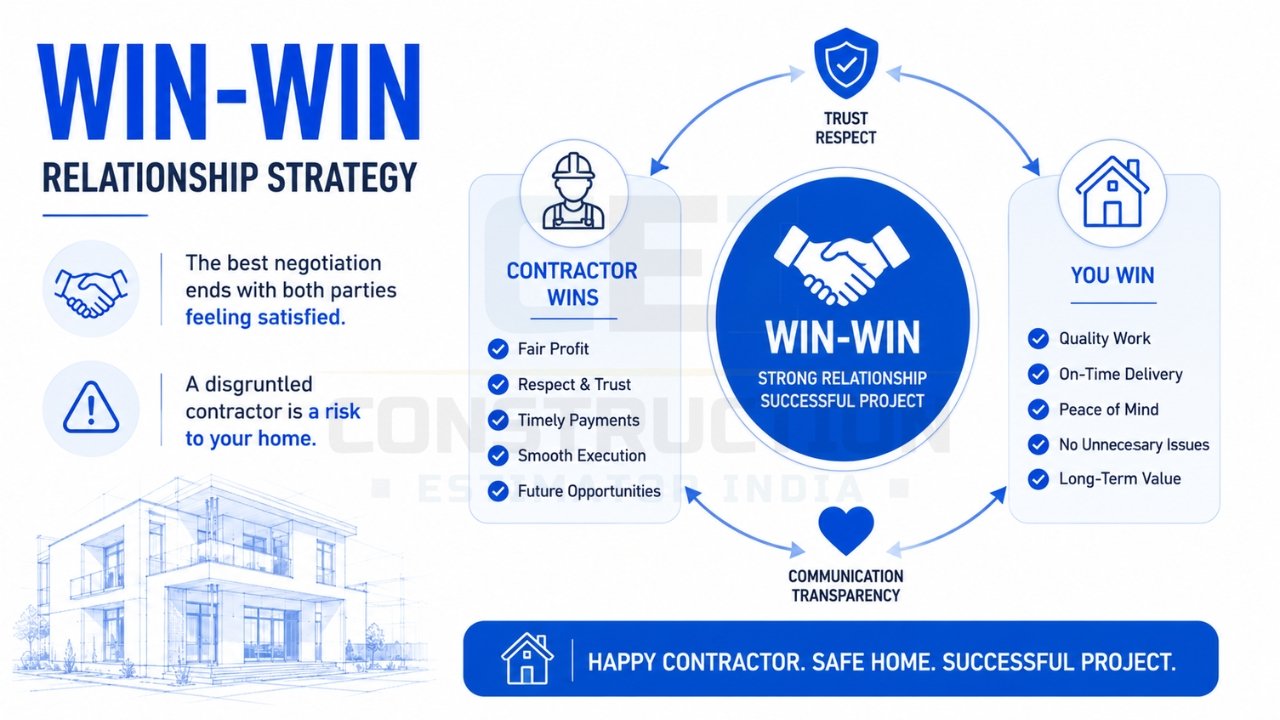
Win-Win Relationship Strategy
The best negotiation ends with both parties feeling satisfied. A disgruntled contractor is a risk to your home.
👉 Planning to Hire a Contractor? Make Every Negotiation Count.
Mutually Beneficial Agreement Framework
Aim for mutually beneficial agreements to foster a long-term relationship. Use an approach like: “I really want to work with you because of your reputation, but my budget is strictly ₹15 lakh. How can we work together to make this happen?” This invites the contractor to be your partner rather than your adversary, often resulting in 10–15% savings through better collaboration.
Transparent Constraint Communication
Be transparent about your constraints, whether they are related to budget or schedule. If you have a hard deadline for a housewarming ceremony, communicate it. If your budget is tight, say: “My budget is very tight. Can you help me find ways to save 15%?” This honesty often builds the rapport needed to get the “friendship rate” or “loyalty discount” that isn’t available to more aggressive negotiators.
Advanced Negotiation Strategies
For large-scale projects, you may need to use more sophisticated leverage.
Relationship Leverage Method
In the Indian context, relationships (Sifarish) matter. Use your network to get an “inside” introduction. Ask friends and family for recommendations. A contractor is much less likely to overcharge or underperform for someone who was referred by a trusted past client. This referral leverage can easily shave 10–15% off the standard “walk-in” rate.
Confidence-Based Negotiation Framework
When negotiating costs, keep your cards close to your chest. Reveal only the details of the work you need done and let the contractor do the talking first. By listening more than you speak, you allow the contractor to reveal their pricing logic and potential areas of flexibility. Maintaining a confident, quiet demeanor often forces the contractor to offer their best price sooner.
When to Contact Construction Estimator India for Contractor Negotiation Help
If you feel overwhelmed by the complexities of contractor quotes or are unsure if the rates you are being offered are fair, it is time to call in the experts. Construction Estimator India serves as your professional advocate in the construction market. Whether you require standard insights or specialized oversight from civil engineers general contractors in rishikesh, we have you covered.
Contact us if:
- You need a professional comparison of multiple contractor bids to find the best value.
- You want a highly accurate construction cost estimate before you start talking to contractors, so you know exactly where the “floor” is.
- You are managing a high-stakes project and need 1-on-1 negotiation coaching to handle tough contractor conversations.
Construction Estimator India offers:
- Free Contractor Rate Consultation: We analyze your quotes and tell you if they are market-aligned.
- Free Construction Cost Estimate: Get a baseline for your project budget.
- Free Negotiation Coaching: Learn the exact scripts and tactics for your specific situation.
Contact us today: WhatsApp/Call +91 8630676890.
FAQs
Q1: How much can I save by negotiating with contractors in India?
By using a systematic framework—including competitive bidding, material self-procurement, and value engineering—homeowners typically save between 15% and 30% on their total construction costs. For a ₹50 lakh project, this can mean a saving of ₹7.5 to ₹15 lakh.
Q2: How many contractor bids should I get?
You should get at least three comparable bids. Getting fewer than three gives you no point of comparison, while more than five can lead to confusion and analysis paralysis. Three is the “sweet spot” for creating healthy competition.
Q3: What is the ideal advance payment percentage?
In India, you should aim for a maximum of 10–15% as an advance. Avoid the 30–50% advances often demanded. Higher advances shift all the risk to you and reduce the contractor’s incentive to finish the work on time.
Q4: Should I buy materials myself or through the contractor?
Buying materials yourself can save you 8–12% by avoiding the contractor’s markup and GST complications. However, it requires you to manage logistics and storage. If you have the time, “Labor-only” contracts are almost always more cost-effective.
Q5: When is the best time to negotiate with contractors?
The “off-season” (Summer or Monsoon) is the best time to negotiate, as contractors are often looking for work to keep their teams busy. Avoid negotiating right before major festivals like Diwali when demand peaks.
Q6: What questions should I ask during contractor negotiation?
Ask: “Can you provide an itemized breakdown?” “Who will be the site supervisor?” “What is your policy on change orders?” and “Can you suggest three ways to reduce costs without losing quality?”.
Q7: How do I verify a contractor’s references?
Don’t just take their word for it. Call at least three previous clients and ask about their experience with delays, cost overruns, and post-construction issues. Visiting a live site is the best way to judge their current work quality.
Q8: What should be included in a construction contract?
At a minimum: Detailed scope of work, itemized pricing, payment milestones, a completion date, a liquidated damages clause for delays, and a retention clause.
Q9: How do I handle change orders during construction?
Pre-negotiate the markup for change orders (e.g., Cost + 15–20%) in your initial contract. This prevents the contractor from overcharging you for modifications once the project is underway.
Q10: What if a contractor refuses to negotiate?
This is why you have a BATNA. If a contractor is rigid and their price is above market rates, move to your second or third bid. Often, seeing you walk away will bring them back to the table with a better offer.
Q11: Should I hire the cheapest contractor?
Not necessarily. The cheapest bid often indicates that the contractor has missed something or plans to use sub-standard materials. Aim for the “Best Value”—a fair price from a reputable contractor like leading building contractors in roorkee who understand your quality requirements.
Q12: How do I contact Construction Estimator India for negotiation help?
As a consumer, you are protected under the Consumer Protection Act, 2019 and, for relevant real estate projects, the Real Estate Regulatory Authority (RERA).
Contact Construction Estimator India for Contractor Negotiation Services
Navigating the complexities of the Indian construction industry doesn’t have to be a solo journey. Construction Estimator India is dedicated to providing homeowners with the transparency and data they need to build their homes with confidence. We bridge the gap between contractors and homeowners, ensuring that every project is a success story of quality and financial prudence.
Our Core Services:
- Free Contractor Rate Consultation: We will review your current bids and tell you where you can save money.
- Free Construction Cost Estimate: Get a detailed report on what your project should cost in today’s market.
- Free Negotiation Coaching: Let our experts guide you through the negotiation process to secure 15–30% savings.
Connect with us:
- Company: Construction Estimator India
- WhatsApp/Call: +91 8630676890
Conclusion: Negotiate Smart, Save Big Without Quality Compromise
Negotiating with contractors in India is a skill that combines market data with strategic communication. By getting at least 3+ competing bids, you immediately put yourself in a position of strength. Remember that negotiation is a critical part of procurement because it directly affects the risks and quality of your project.
While achieving savings of 15–30% is a primary goal, never sacrifice the structural integrity of your home. Negotiating with contractors requires strategic thinking and mutual respect to ensure a smooth project lifecycle. By following this comprehensive framework—from pre-negotiation research to final contract signing—you can build your dream home while keeping your finances firmly under control.
For professional support every step of the way, Construction Estimator India is just a call away at +91 8630676890. Negotiate smart, save big, and build better.