
To learn how to read house construction plan documents correctly, you must start by identifying the site plan to understand the property layout and building position. Next, review the floor plans to grasp room dimensions and window orientations. Always examine the title block for the scale, date, and latest revision history to ensure accuracy. By following a structured 6-step process—moving from the overall layout to specific details—you can interpret the hundreds of symbols and technical details required to build a safe, compliant home in India. For professional assistance with plan reviews or BOQ preparation, contact Construction Estimator India via WhatsApp or Call at +91 8630676890.
How to Read House Construction Plan (Quick Answer)?
Reading a house construction plan involves decyphering a technical language used by architects and engineers. To get started quickly, follow these five essential steps:
- Start with the Site Plan: This provides a bird’s-eye view of your plot. It identifies property boundaries, setbacks, the north arrow, and where utilities connect.
- Review Floor Plans: Look at each level as if the roof were removed. This shows you wall thicknesses, room sizes, and which way doors and windows open.
- Check the Title Block: Located in the corner, this tells you the project name, architect details, and most importantly, the scale and revision history.
- Consult the Legend: This acts as your dictionary, explaining what every line and symbol represents—from electrical outlets to wall types.
- Use the 6-Step Process: Systematically move from identifying the project to cross-referencing elevations and MEP (Mechanical, Electrical, Plumbing) plans.
Understanding these blueprints is the first step in how to read construction drawings in India effectively to avoid costly rework.
Types of Construction Drawings You’ll Encounter
When building in India, you won’t just receive one drawing; you will receive a set of documents categorized by their technical focus.
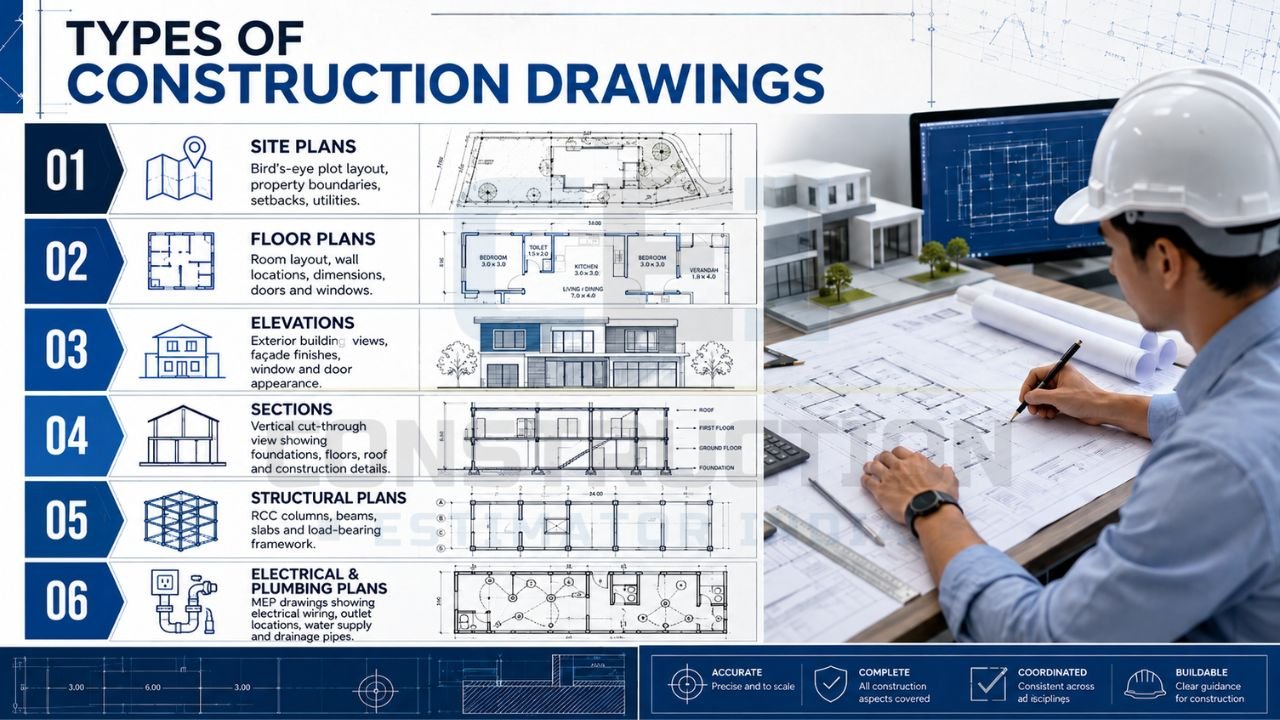
1. Site Plans
The site plan shows your property from a bird’s-eye view. It is critical for understanding the building’s orientation and how it fits within your plot boundaries.
- Property boundaries and setbacks: Ensures you comply with local municipal laws.
- Building location: Shows the exact footprint of the house.
- Utilities: Indicates where water, sewer, and electrical lines enter the property.
- Pro Tip: Always check the site plan first to understand the building’s relationship with the surrounding environment.
2. Floor Plans
Floor plans show the interior layout of each level from a top-down perspective.
- Wall locations: Shows both interior and exterior wall thicknesses.
- Dimensions: Provides exact measurements for rooms, hallways, and closets.
- Openings: Clearly shows window and door locations and their swing directions.
3. Elevations
Elevations provide exterior views of each side of the building (North, South, East, West). These show the height of the building, exterior finishes like paint or stone, and the final appearance of windows and doors.
4. Sections
A section is a drawing that shows the building as if it were cut vertically. This reveals hidden interior construction methods, foundation details, floor/ceiling assemblies, and roof ventilation.
5. Structural Plans
These drawings focus on the “skeleton” of the building. In Indian residential construction, this typically includes the placement of reinforced concrete columns, steel beams, and slabs. These must be reviewed carefully to ensure load-bearing elements align with the architectural design.
6. Electrical and Plumbing Plans
MEP drawings show the hidden systems of your home. Electrical plans show wiring and outlet positions, while plumbing plans detail water supply and drainage pipes.
Essential Elements Every Construction Plan Has
Every professional construction plan contains specific elements designed to keep the project organized and accurate.
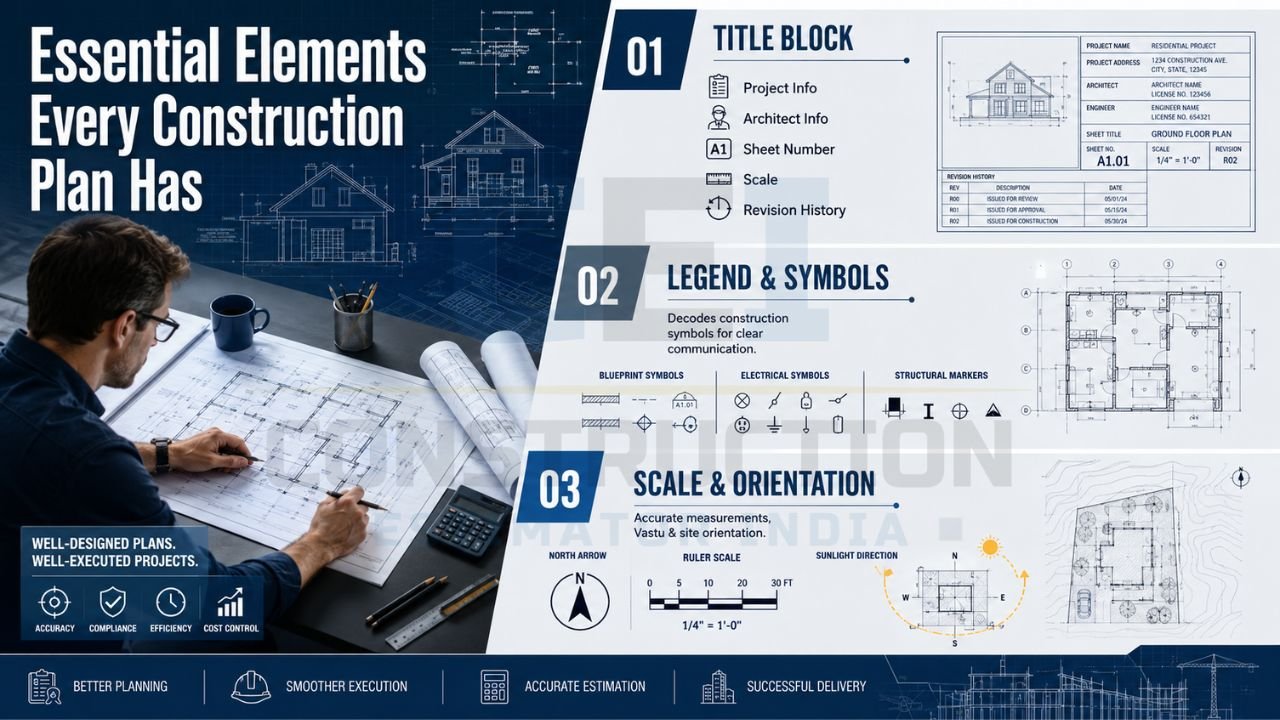
The Title Block
The title block is the “ID card” for the drawing. It includes:
- Project Info: Name and address.
- Architect Info: Who designed the plan.
- Sheet Number: Essential for cross-referencing (e.g., A-101, S-201).
- Scale: Tells you the ratio of the drawing to real life (e.g., 1:100).
- Revision History: Ensures you are not using an outdated version, which could lead to massive financial losses.
Legend and Symbols
Each plan can contain hundreds of unique symbols representing everything from a simple light switch to complex structural reinforcement. Without understanding the legend, interpreting these symbols is impossible. It ensures clear communication between the owner, architect, and contractor.
Scale and Orientation
The North Arrow is vital for Vastu and understanding sunlight exposure. The Scale allows you to use a ruler to measure distances on the paper and convert them to actual feet or meters on-site.
6-Step Process: How to Read Construction Plans
To master how to read house construction plan documents, follow this systematic professional approach:
- Identify Information: Review the title block first. Check the date and revision number.
- Check the Legend: Study the abbreviation key and symbols specific to that sheet.
- Understand Orientation: Locate the North arrow. Match lines that continue on other pages.
- Analyze Overall Layout: Don’t look at details yet. Get a sense of the building’s general shape and major structural points.
- Examine Details: Now, look at room layouts, door swings, and wall types.
- Cross-Reference: Check if the floor plan matches the elevations and structural drawings.
Before breaking ground, ensure you have completed the checklist before starting construction in India to avoid legal or technical hurdles.
Common Construction Plan Symbols
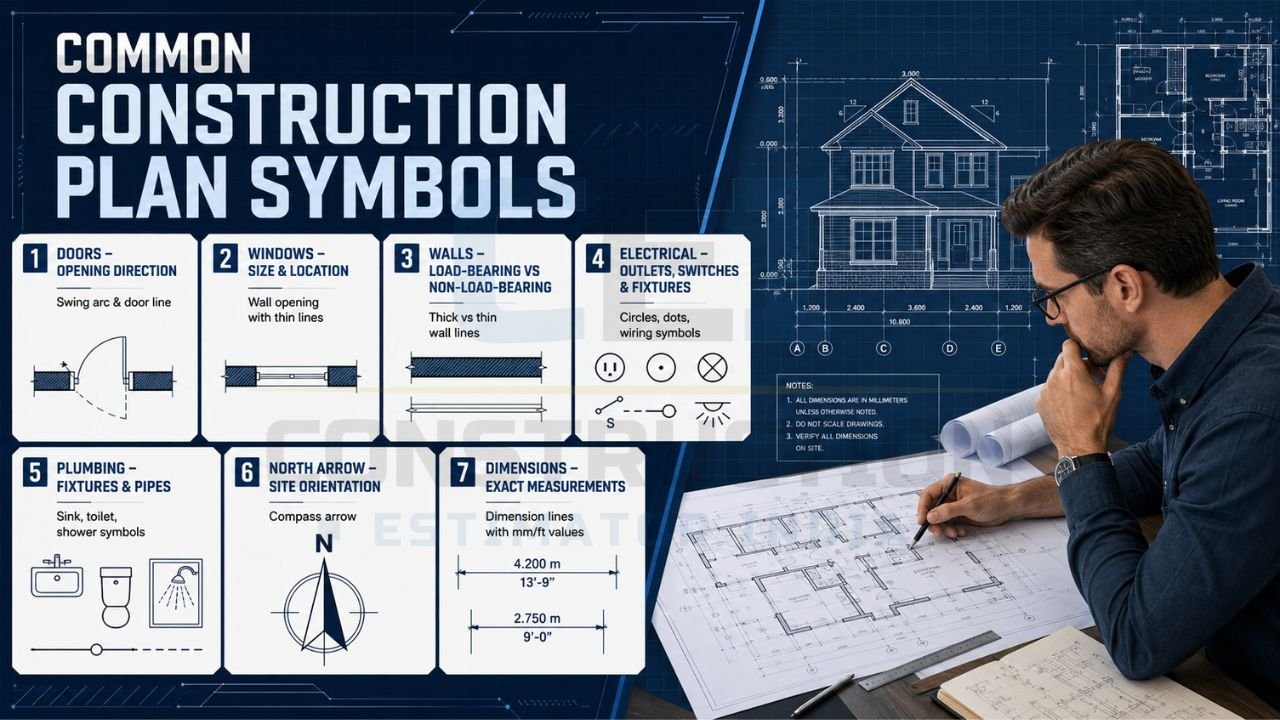
| Symbol Type | What It Shows | Common Examples |
|---|---|---|
| Doors | Locations and opening direction | A swing arc and door line |
| Windows | Window size and location | A break in the wall with thin lines |
| Walls | Load-bearing vs Non-load-bearing | Thick solid lines vs thin lines |
| Electrical | Outlets, switches, fixtures | Circles with lines or dots |
| Plumbing | Fixtures and pipes | Sink, toilet, and shower outlines |
| North Arrow | Orientation | A compass arrow |
| Dimensions | Exact measurements | Lines with numerical values (mm or ft) |
Common Mistakes When Reading Construction Plans
Even experienced builders can make errors. To safeguard your project, avoid these pitfalls:
- Ignoring Revisions: Using an old plan version is a primary cause of rework. Always check the “Revision Cloud” (bubbled areas) for changes.
- Skipping the Legend: Don’t guess what a symbol means. A mistake in interpreting an electrical symbol could lead to unsafe wiring.
- Not Cross-Referencing: A door shown on an architectural plan must exist on the structural plan as well.
- Misreading Scale: Never “eye-ball” a measurement. Use the stated scale for precision.
To avoid these and other setbacks, read about the 7 common expensive mistakes in house construction in India.
Tips for Reading Complex Blueprints
- Start Simple: Master the floor plan before trying to understand the structural steel layout.
- Use Digital Tools: Many contractors now use tablet apps that allow you to zoom in on tiny details.
- Ask the Professionals: If a symbol is unclear, contact your architect or call Construction Estimator India at +91 8630676890 for a technical review.
Conclusion
Building your dream home in India is a major investment. Don’t let a misread plan turn into a costly disaster. At Construction Estimator India, we provide professional construction plan reviews to help you understand every detail before work begins.
We specialize in:
- Construction Plan Explanation: Walking you through your drawings so you can oversee your contractor with confidence.
- DPR Support: Helping you understand what is DPR in construction and why it’s needed for bank loans.
- BOQ Preparation: Clarifying what is BOQ in construction to ensure you never overpay for materials.
- Estimation & Planning: Detailed cost breakdowns and scheduling to keep your project on track.
WhatsApp / Call us today at +91 8630676890. We serve homeowners, NRIs, and contractors India-wide.
FAQ — How to Read House Construction Plan
How to read house construction plan documents efficiently?
Start with the site plan for context, move to floor plans for layout, and use the title block and legend to decypher technical data.
What is the difference between architectural and structural plans?
Architectural plans focus on space, finishes, and aesthetics. Structural plans focus on the strength, concrete, and steel required to hold the building up.
What is a floor plan and how do I read it?
It is a top-down view of a building floor with the roof removed. Read it by identifying room names, following wall lines, and checking door swing arcs.
Why is the title block important?
It contains the project identity, the architect’s signature, the scale of the drawing, and the revision history to ensure accuracy.
How do I contact Construction Estimator India for a plan review?
You can reach us directly via WhatsApp or Call at +91 8630676890 for expert guidance across India.