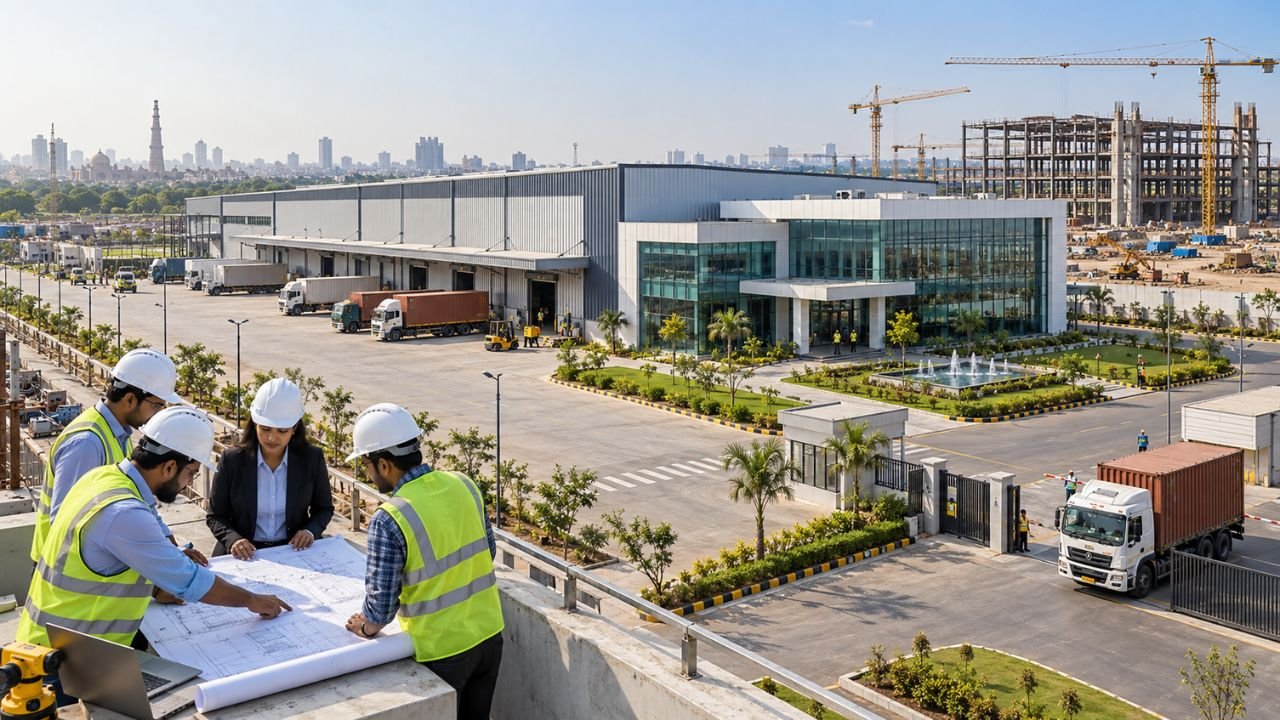
Selecting the right foundation types for house construction India is the most critical decision in your building journey. The foundation acts as the backbone of your structure, safely transferring loads—including dead, live, and seismic loads—to the soil to prevent settlement or collapse. Broadly, Indian houses utilize two categories: Shallow Foundations (like isolated or raft footings) and Deep Foundations (like piles), depending on the ground’s bearing capacity. In 2026, with rising material costs and stricter RERA regulations, precision in foundation planning is non-negotiable. If you are planning your dream home, professional guidance from Construction Estimator India (+91 8630676890) ensures your structure stands on solid ground while avoiding budget overruns.
What Are the Foundation Types for House Construction in India? (Quick Answer)
In India, foundations are classified based on their depth and the way they transfer structural loads to the strata. There are two main categories:
- Shallow Foundations: These are constructed at relatively low depths, generally less than 3 meters from ground level. They are the most economical choice for residential buildings in India where the soil is firm.
- Isolated footing: Individual concrete pads for columns; the most common choice for G+1 or G+2 houses.
- Strip footing: Continuous concrete strips under load-bearing walls, ideal for masonry construction.
- Raft / Mat foundation: A thick RCC slab covering the entire plot area, perfect for weak soil.
- Deep Foundations: These are utilized when the surface soil is too weak to support the structure, transferring loads to deeper, stronger layers.
- Pile foundation: Deep columns (10–20m) driven or bored into the ground; essential for coastal areas or black cotton soil.
- Pier foundation: Larger diameter support often used for heavier loads or in hilly terrain.
- Caisson foundation: Watertight chambers primarily used for waterfront or massive infrastructure projects.
The selection process is governed by the soil bearing capacity (SBC), building weight, and your construction budget. A professional soil test report house construction is the only reliable way to determine which type fits your plot.
Shallow Foundations for House Construction in India
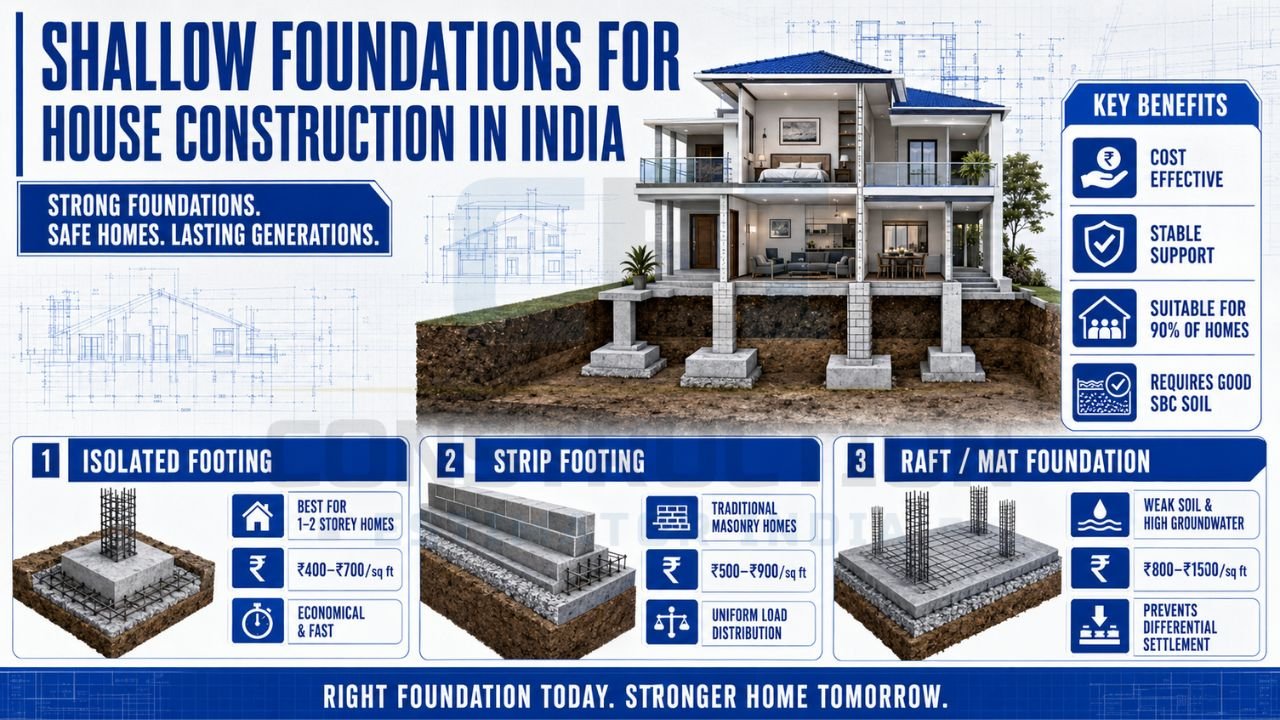
Shallow foundations are the standard for 90% of residential projects across India because they are cost-effective and simpler to construct. They are preferred when the soil near the surface has a Safe Bearing Capacity (SBC) of at least 15 t/m².
Isolated Footing (Individual Footing)
Isolated footings are individual pads of concrete that support a single column. This is the most popular what are footings in construction type for RCC framed structures in India.
- Best For: 1–2 story residential houses on stable, sandy, or silty soil found in parts of Delhi NCR and UP.
- Pros: Extremely economical (₹400–₹700 per sq ft) and fast to build.
- Cons: Prone to uneven settlement if used on soft or expansive soils without expert design.
Strip Footing (Wall Footing)
Strip footings consist of a continuous strip of concrete under load-bearing walls.
- Best For: Traditional masonry houses and rural/semi-urban North Indian constructions where walls carry the weight instead of columns.
- Pros: Provides uniform load distribution for wall-based homes and is very cost-effective (₹500–₹900 per sq ft).
- Cons: Inefficient for structures that rely solely on a column-beam framework.
Raft / Mat Foundation
A raft foundation is a massive RCC slab that covers the entire building footprint.
- Best For: Weak soil (SBC <10 t/m²), marshy land, or areas with high groundwater tables to prevent differential settlement.
- Pros: Acts as a stable platform for 1–3 story houses on weak soil and doubles as a waterproof barrier for basements.
- Cons: Higher material consumption, increasing costs to ₹800–₹1500 per sq ft.
Shallow foundations are significantly more budget-friendly than deep options, making them the ideal choice for most Indian homeowners unless technical soil reports dictate otherwise.
Deep Foundations for House Construction in India
Deep foundations are mandatory when surface soil is loose, expansive (like black cotton soil), or if the project involves a multi-story building (G+3 or higher).
Pile Foundation
Piles are long, slender columns driven or bored deep into the earth to reach rock strata or stronger soil layers.
- Bored Piles / Under-Reamed Piles: In regions like Maharashtra, MP, and parts of UP, under-reamed piles are the “gold standard” for black cotton soil. They feature bulbs at the base to anchor the house against seasonal soil swelling.
- Use Case: Essential for coastal areas (like Mumbai or Kerala), riverbeds, and high-rise apartments.
Pier Foundation
Piers are similar to piles but have a larger diameter and are often used to support massive loads over shorter depths.
- Use Case: Commonly used for bridges and large institutional buildings, or in hilly terrains where rocky strata are found at variable depths.
Caisson Foundation
Caissons are watertight retaining structures used as a foundation for massive infrastructure.
- Use Case: While rare for typical residential houses, they are used in waterfront construction, ports, and deep riverbed foundations.
Deep foundations are technically complex and more expensive, often costing between ₹1,200 and ₹3,000+ per sq ft depending on the depth and rig equipment needed.
Foundation Types Comparison Table
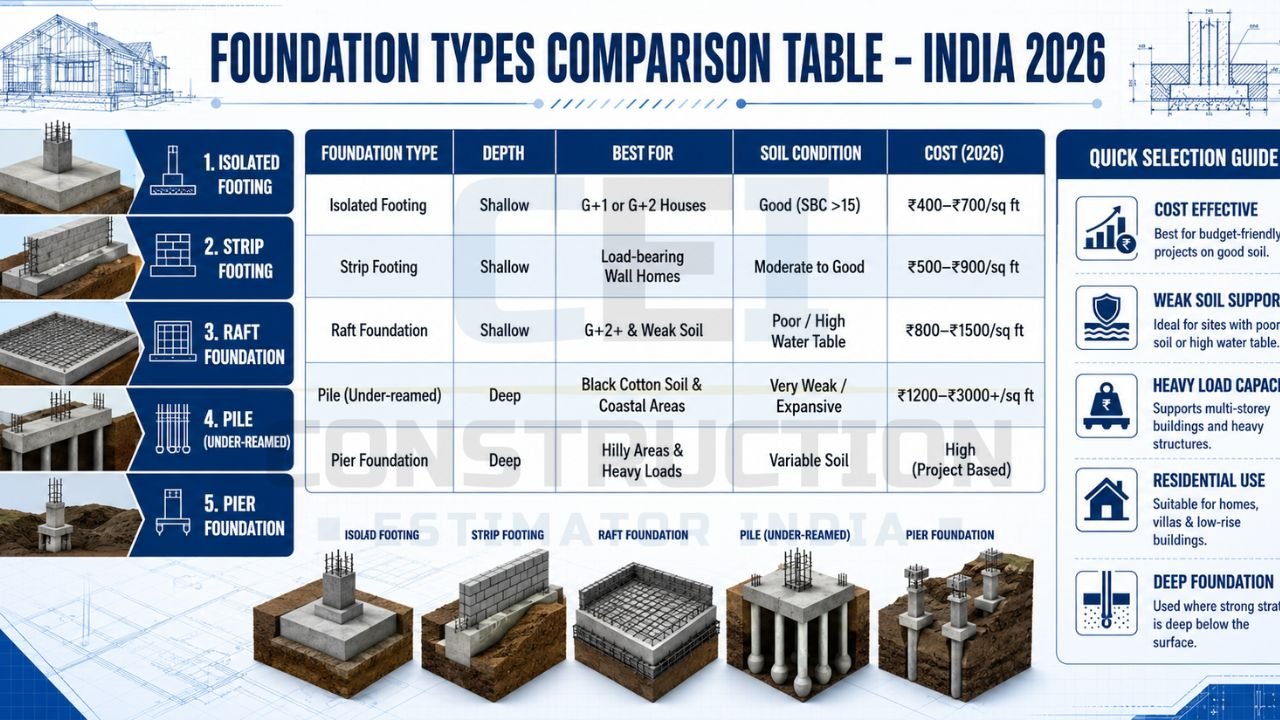
| Foundation Type | Depth | Best For | Soil Condition | Cost (2026) |
|---|---|---|---|---|
| Isolated Footing | Shallow | G+1 or G+2 Houses | Good (SBC >15) | ₹400 – ₹700/sq ft |
| Strip Footing | Shallow | Load-bearing Wall Homes | Moderate to Good | ₹500 – ₹900/sq ft |
| Raft Foundation | Shallow | G+2+, Weak soil | Poor, High Water | ₹800 – ₹1500/sq ft |
| Pile (Under-reamed) | Deep | Black Cotton Soil, Coastal | Very Weak / Expansive | ₹1200 – ₹3000+/sq ft |
| Pier Foundation | Deep | Hilly areas, Heavy loads | Variable | High (Project based) |
How to Choose the Right Foundation for Your House in India?
Choosing between house foundation types India should never be a guess; it requires a structured engineering approach.
Step 1: Soil Test
A professional geotechnical soil test is non-negotiable. For roughly ₹15,000 to ₹40,000, you can identify if you are building on firm sand or dangerous black cotton soil that expands and shrinks by 20–30%.
Step 2: Determine Building Load
The number of floors and the type of construction (RCC vs. load-bearing) dictate the total weight. A G+3 apartment requires a drastically different foundation than a single-story villa.
Step 3: Consider Local Soil Conditions
- Black Cotton Soil: Found in Maharashtra and MP; requires under-reamed piles.
- Sandy/Silty Soil: Common in Delhi NCR; usually supports isolated footings.
- Coastal/Marshy areas: High groundwater often mandates raft or pile foundations.
Step 4: Budget Consideration
Shallow foundations save 40–60% compared to piles but should only be used if soil strength allows. Over-designing a foundation leads to waste, while under-designing leads to structural failure.
Step 5: Consult a Structural Engineer
Expert analysis from Construction Estimator India helps you finalize a design that complies with Indian building codes while keeping costs in check.
Foundation Cost in India (Approximate)
Foundation costs typically account for 10%–20% of the total building budget. In 2026, prices have risen due to 15% YoY increases in material rates.
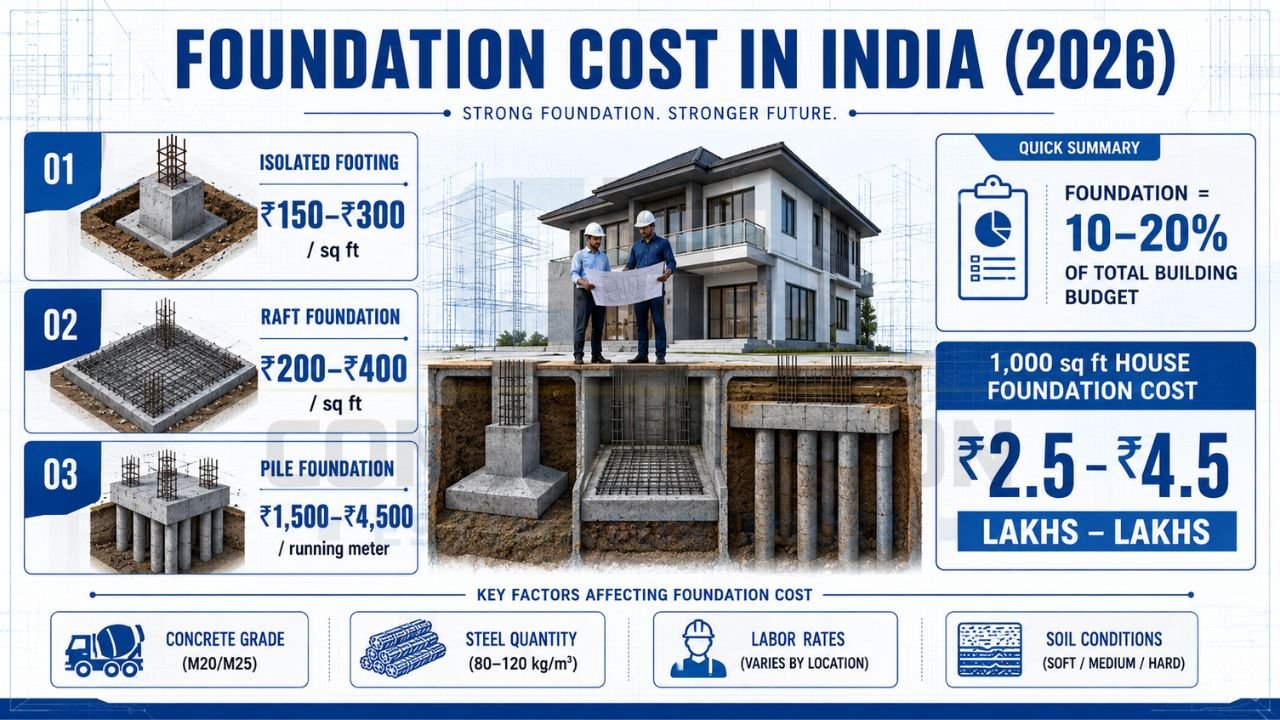
- Isolated Footing: ₹150–₹300 per sq ft of foundation area.
- Raft Foundation: ₹200–₹400 per sq ft.
- Pile Foundation: ₹1,500–₹4,500 per running meter.
Total foundation costs for a standard 1,000 sq ft house range from ₹2.5 Lakhs to ₹4.5 Lakhs. This varies based on the grade of concrete (M20/M25), steel weight (80–120 kg/m³), and labor rates in your specific city.
Common Foundation Mistakes in House Construction
Failing to plan properly can lead to wall cracks, dampness, and structural instability. Avoid these 7 common expensive mistakes in house construction in India:
- Skipping the Soil Test: This is the #1 cause of foundation failure in Indian homes.
- Insufficient Depth: Saving on excavation often results in a foundation that doesn’t reach stable soil strata.
- Wrong Foundation Choice: Placing isolated footings on expansive black cotton soil.
- Poor Materials: Using low-grade concrete or rusted steel.
- Omitting PCC: Failing to lay a what is PCC in construction base to protect reinforcement from soil moisture.
- Ignoring the difference between PCC and RCC in construction: Using structural concrete for levelling or non-structural concrete for load-bearing elements.
Conclusion
Building your home is a once-in-a-lifetime investment. Don’t risk it by choosing the wrong foundation type. Construction Estimator India provides expert guidance tailored to your specific plot and soil condition.
We help you with:
- Foundation selection based on soil and building load.
- Detailed Bill of Quantities (BOQ) and Detailed Project Reports (DPR).
- Accurate construction cost estimation to prevent budget leaks.
WhatsApp / Call: +91 8630676890
Build with confidence. Build with precision.
FAQ — Foundation Types for House Construction India
What are the foundation types for house construction in India?
The main types are Shallow (isolated, strip, raft) and Deep (pile, pier) foundations.
Which foundation is best for black cotton soil in India?
Under-reamed pile foundations are the gold standard because they anchor the house against soil volume changes.
Which foundation is best for a 2BHK house in India?
Isolated footings are usually the most common and economical for small houses on stable soil.
Do I need a soil test before foundation design?
Yes, it is a mandatory legal requirement in 2026 to prevent structural failure.
How much does a foundation cost in India?
Typically between ₹180 and ₹350 per sq ft for shallow foundations.
How do I contact Construction Estimator India?
You can reach them via WhatsApp or Call at +91 8630676890 for detailed BOQ and estimation reports.