Imagine standing in your newly built master bedroom in Noida or a renovated living room in Meerut, ready to apply that perfect “Moonlit Silk” finish. You have budgeted for the renovation, but a critical question stalls the project: how to calculate paint quantity for room without overbuying and wasting money, or under-buying and facing the nightmare of a color-mismatch during the final coat? In 2026, where “Quiet Luxury” and sustainable home improvement define the Indian market, a “rough guess” by a contractor is a financial liability.
The direct answer to how to calculate paint quantity for room is a precise technical formula: Total Net Surface Area (sq. ft.) ÷ Paint Coverage Rate (sq. ft. per Liter). However, achieving a professional-grade Bill of Quantities (BOQ) requires adjusting for wall porosity, the number of coats needed for deep pigments, and India’s unique humidity factors.
At Construction Estimator India, we have seen how a minor 10% error in quantity takeoff can swing a project budget by thousands of rupees. Drawing on our 10+ years of construction estimating expertise, we have developed this definitive guide to help you calculate paint like a pro.
For accurate paint quantity calculation or full BOQ for your room painting project in India, WhatsApp or call us today at +91 8630676890.
2026 Room Paint Quantity Quick Reference (Liters)
| Surface / Paint Type | Standard Formula | 2026 Avg. Coverage (2 Coats) | Cost Impact Insight |
|---|---|---|---|
| Interior Walls (Emulsion) | (Perimeter × Height) – Openings | 140–160 sq. ft. / Liter | High-end Royale Glitz covers more area. |
| Room Ceilings (Distemper) | (Length × Width) / Coverage | 120–140 sq. ft. / Liter | Porous ceilings “drink” more paint. |
| New Drywall Walls | Area / Coverage | 110–130 sq. ft. / Liter | Drywall is a “paint sponge”; needs primer. |
| Textured Accent Walls | Area / (Coverage × 0.8) | 100–120 sq. ft. / Liter | Texture increases surface area by 20%. |
The 2026 Gold Standard Formula:
Total Liters = [(Net Room Area × Number of Coats) ÷ Spreading Rate] + 10% Wastage Buffer.
Why Accurate Paint Quantity Calculation for Room Matters for Your BOQ ?
In the professional world of house construction cost estimation services, paint is often viewed as the final “skin” of the building. However, it is also one of the most frequently miscalculated line items. Precision in “how to calculate paint quantity for room” is critical for four reasons:
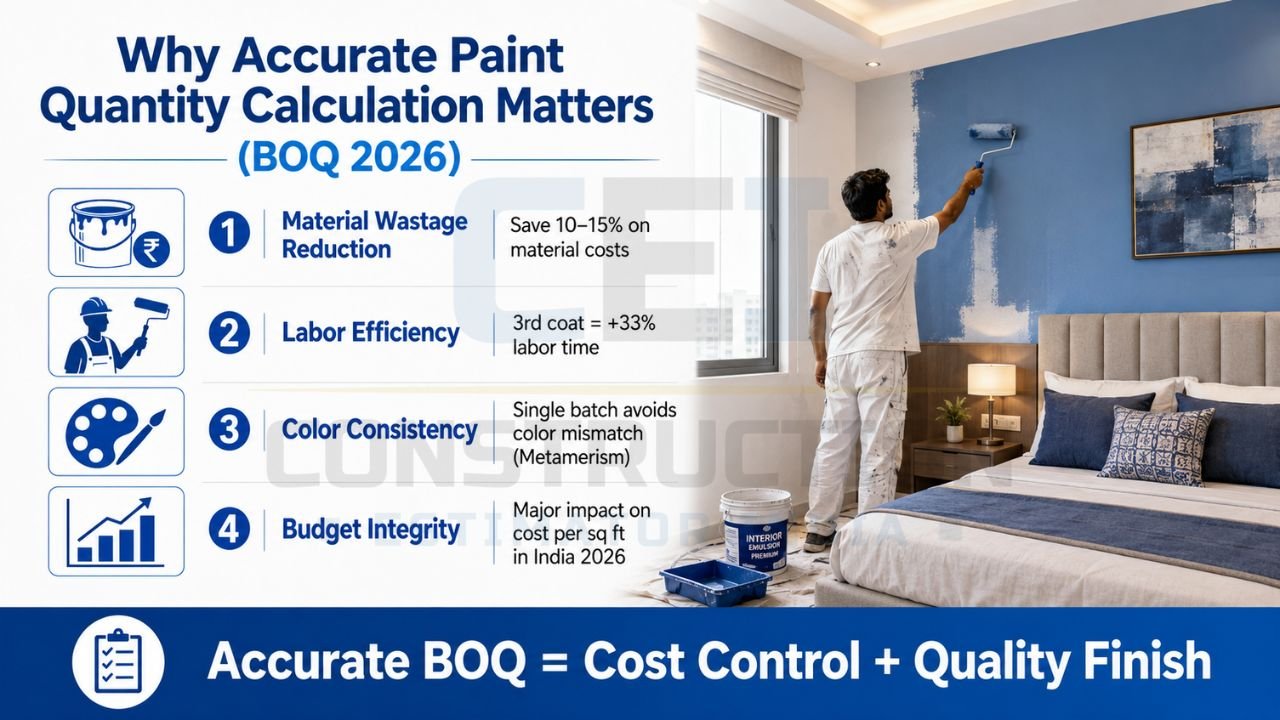
- Material Wastage Reduction: Accurate calculations typically save our clients 10–15% on wasted material costs.
- Labor Efficiency: A third coat adds 33% more labor time. Knowing your requirement beforehand allows for better scheduling of professional interior painting estimation services.
- Color Consistency: Buying all your liters in one “batch” ensures there is no “Metamerism” (color shift) between production runs.
- Budget Integrity: Paint accounts for a significant portion of the interior painting cost per sq ft in India 2026.
Step-by-Step Guide: How to Calculate Paint Quantity for Room Walls
To determine how to calculate paint quantity for room like the experts at Construction Estimator India, follow this technical sequence:
Step 1: Measure Gross Wall Area
Measure the perimeter of the room and the height of the walls using a digital laser measurer.
- Formula: (Wall 1 Length + Wall 2 Length + Wall 3 Length + Wall 4 Length) × Wall Height = Gross Wall Area.
- Example for a 12×10 room with 10ft height: (12+10+12+10) × 10 = 440 sq. ft.
Step 2: Calculate Deductions (Dead Areas)
You don’t paint doors, windows, or fixed wardrobes.
- Standard Door Deduction: ~21 sq. ft. (7ft × 3ft).
- Standard Window Deduction: ~12 sq. ft. (4ft × 3ft).
- Net Paintable Area = Total Gross Area – Total Openings Area.
Step 3: Account for Primer
For new walls or significant color changes, 1 coat of primer is non-negotiable to prevent the wall from “soaking” expensive finish paint.
- Primer Coverage: Generally 180–200 sq. ft. per liter.
Step 4: Division by 2026 Coverage Rates
Divide your Net Paintable Area by the spreading rate. Always refer to the official 2026 paint coverage standards for rooms in India for technical accuracy.
The Ceiling Factor: Measuring and Calculating Paint for Room Ceilings
Many homeowners focus only on walls and forget the ceiling, which often requires a different paint type (usually matte or distemper).
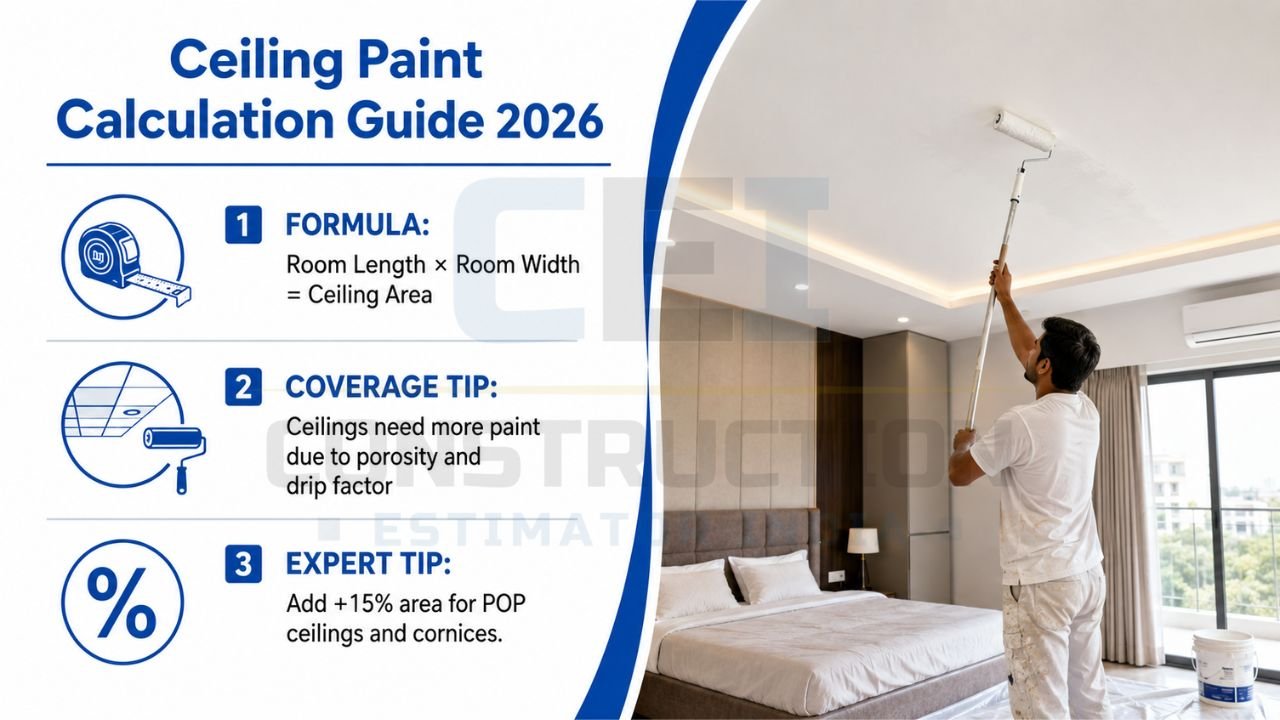
- Formula: Room Length × Room Width = Ceiling Area.
- Coverage Tip: Ceilings often require more paint because of higher porosity and the “drip factor” during application.
- Lead Tip: If you have decorative cornices or pop-ceilings, increase the calculated ceiling area by 15% to account for the extra surface area of the moldings.
The Science of Surfaces: Porosity and Paint Absorption in India
Before picking up a calculator, we at Construction Estimator India evaluate the substrate. Not all walls are equal in the eyes of an estimator:
- Fresh Sand-Faced Plaster: This is the “paint sponge” of Indian construction. New cement plaster is highly porous and can “drink” up to 25% more liters if not primed correctly.
- POP (Plaster of Paris) and Level 5 Putty: Common in high-rises in Gurgaon, POP surfaces are smoother and require fewer liters for the first coat but demand extreme precision to avoid “roller marks”.
- Gypsum Board (New Drywall): Drywall joint compound has a different absorption rate than the paper facing. A “High-Build” primer is essential to ensure a uniform finish.
2026 Coverage Rates: Asian Paints, Berger, and Nerolac Standards
When determining the best paint for home interior, we evaluate coverage as a primary metric.
| Brand & Product | Coverage (2 Coats) | Best For |
|---|---|---|
| Asian Paints Royale Glitz | 140–160 sq. ft. / L | Luxury Living Rooms |
| Berger Silk Breathe Easy | 130–150 sq. ft. / L | Kids’ Bedrooms (Health) |
| Nerolac Impressions Ideo | 125–145 sq. ft. / L | Modern Apartments |
| Dulux Velvet Touch | 120–140 sq. ft. / L | Designer Accent Walls |
Refer to the Asian Paints 2026 paint coverage rates for rooms or the latest 2026 paint coverage guidelines by Berger and Nerolac for rooms for updated product-specific data.
The “Dark Pigment Factor”: When 2 Coats Aren’t Enough
The 2026 trend toward “Desert Terracotta” and “Deep Navy” comes with a technical price. Deep colors use organic pigments that are notoriously difficult to distribute evenly.

If you are opting for a deep accent wall, budget for at least three coats. Why? Because deep colors tend to “streak” during the first two applications. A 3-coat specification increases your paint purchase by exactly 50% compared to a 2-coat job, a fact we always include in our professional interior painting estimation services.
India-Specific Adjustments: Humidity, Monsoon, and Vastu
- Monsoon Humidity: In high-humidity zones like Mumbai or during the North Indian monsoon, paint drying times increase. We add a 5% “evaporation and waste” buffer to our BOQs to account for thicker applications needed in damp weather.
- Vastu Shastra: Many of our 500+ clients choose different colors for different directions (e.g., Light Blue for North, Orange for South-East). Since you cannot mix leftover “North Blue” with “South Orange,” you must calculate each wall independently to avoid material waste.
- Dust Factor: In high-dust cities like Meerut, a second coat is mandatory to create a smooth surface that prevents road dust from sticking to the wall.
Common Calculation Mistakes That Drain Your Budget
- Forgetting Deductions: Not subtracting large wardrobes can lead to 20% over-ordering.
- Ignoring the “Thirsty” Wall: Applying premium paint directly to new plaster without primer.
- The “One-Size-Fits-All” Coverage: Assuming a budget distemper will cover as much as a luxury emulsion.
- Buying Small Cans: Buying 1L cans instead of 20L buckets. Bulk buying (20L) is generally 15–20% cheaper per liter.
Professional Case Study: Calculating a 12×10 Master Bedroom
- Room Size: 12ft (L) x 10ft (W) x 10ft (H).
- Gross Wall Area: (12+10+12+10) × 10 = 440 sq. ft..
- Ceiling Area: 12 × 10 = 120 sq. ft.
- Deductions: 1 Door (21 sq. ft.) + 1 Window (12 sq. ft.) = 33 sq. ft.
- Net Paintable Area (Walls): 440 – 33 = 407 sq. ft.
- Calculation (2 Coats of Royale Glitz): 407 ÷ 150 (Avg coverage) = 2.71 Liters.
- Final Order: 3 Liters for walls + 1 Liter for ceiling + 10% buffer = ~5 Liters Total.
Conclusion and Expert Advice
Mastering how to calculate paint quantity for room is the first step toward a successful, budget-friendly home transformation. In 2026, precision is your best defense against rising material costs. By following the 1 Primer + 2 Finish Coats rule and adjusting for your specific wall surface, you ensure a finish that is both beautiful and durable.
Don’t leave your project to a “rough guess.” At Construction Estimator India, we combine our 10+ years of construction estimating expertise with advanced digital tools to ensure your BOQ is accurate to the last drop.
For accurate paint quantity calculation or full BOQ for your room painting project in India, WhatsApp or call us today at +91 8630676890.
FAQ: Real Answers for Indian Homeowners
- How much paint is needed for a 10×10 room in India 2026?
Assuming a 10ft ceiling and standard deductions, you would need approximately 3.5 to 4.5 Liters for two coats of standard emulsion. - Does the brand of paint change the quantity needed?
Yes. Premium brands like Royale Glitz have higher solids and cover more area (140-160 sq. ft./L) compared to budget brands that might need more coats. - How to calculate paint quantity for room with textured walls?
Texture increases surface area. Divide your net area by a lower coverage rate (approx. 100–120 sq. ft. / L) to account for the undulations. - How do I calculate paint for a ceiling with a fan?
You don’t deduct the fan area, but you should add 10% for the “cut-in” labor and wastage around the fan hook and electrical points. - Can I use an online paint calculator for India?
While they provide a baseline, they miss India-specific factors like masonry porosity and monsoon humidity. For a precise BOQ, consult professional estimation services. - Is it better to buy paint in 10L or 20L containers?
If your calculation exceeds 15L, always buy the 20L bucket. It is 15–20% more cost-effective per liter. - How many coats of paint are actually needed for a new room?
The 2026 standard for high-quality results is 1 coat of primer followed by 2 coats of finish paint.