Imagine standing in your newly constructed apartment in Gurgaon or a traditional bungalow in Meerut, staring at a blank canvas of freshly plastered walls. You’ve selected the ethereal “Moonlit Silk” for the living room and a grounded “Desert Terracotta” for the social hub. But then comes the million-rupee question: how to calculate paint quantity for wall without overbuying and bleeding your budget, or under-buying and facing color-mismatch delays? In 2026, where construction material prices are volatile and “Quiet Luxury” demands absolute perfection, a “rough guess” by a contractor is no longer acceptable.
👉 Avoid Paint Wastage & Achieve Smooth, Elegant Wall Finishes with Expert Painters.
At Construction Estimator India, we’ve found that precision in paint quantity calculation can reduce material wastage by 15–20%, directly impacting your final Bill of Quantities (BOQ). For accurate paint quantity calculation or full BOQ for your wall painting project in India, WhatsApp or call us today at +91 8630676890.
The 2026 Paint Calculation Shortcut
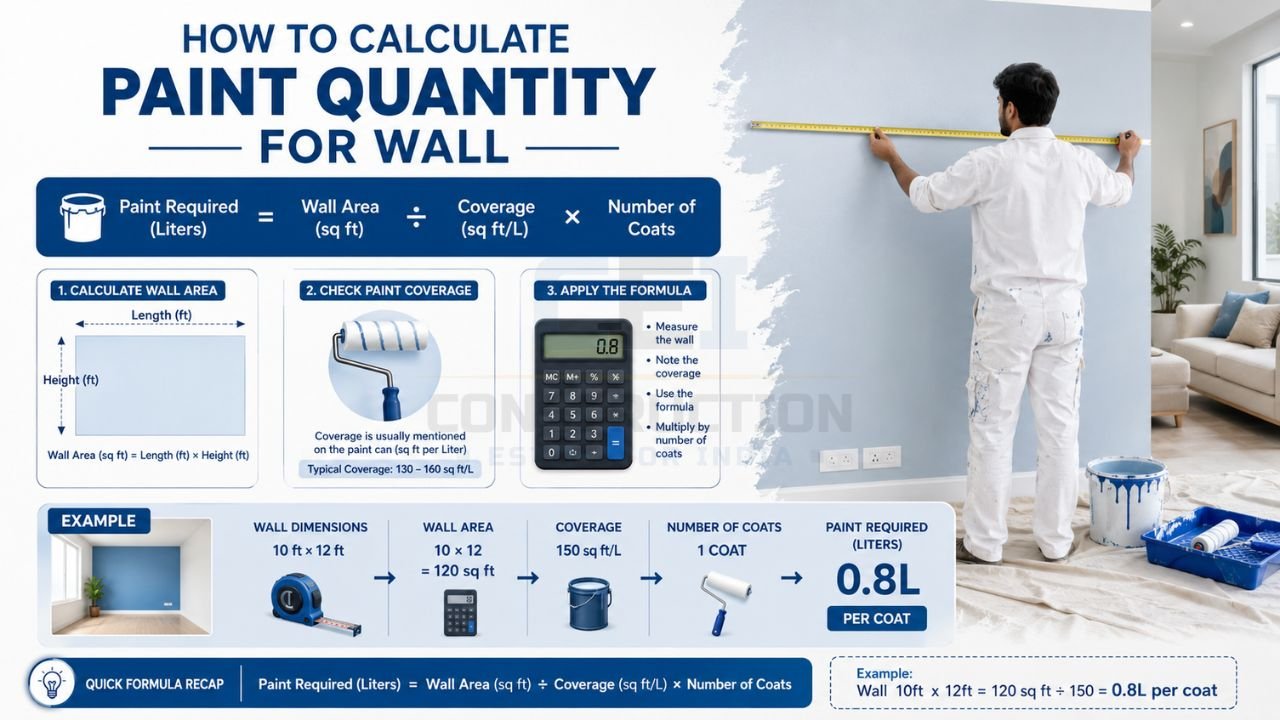
- Calculate Total Area: (Length × Height) – Area of Openings (Windows/Doors).
- The Gold Standard Formula: (Total Wall Area × Number of Coats) ÷ Coverage Rate per Litre.
- Standard Coverage: 140–160 sq. ft. per litre for 2 coats of premium emulsion.
- Expert Tip: Always add a 5–10% wastage buffer for surface absorption and roller losses.
Why Accurate Paint Quantity Calculation for Walls India Matters
In the professional world of house construction cost estimation services, paint is often viewed as the final “skin” of the building. However, it is also one of the most miscalculated line items. If you calculate too little, you face the risk of a “different batch” color shift during the final coat. If you calculate too much, you’re left with expensive buckets of premium emulsion that dry up in your garage.
Drawing on our 10+ years of construction estimating expertise, we have seen that accurate calculation ensures:
- Budget Integrity: No hidden costs or “emergency runs” to the paint shop.
- Labor Efficiency: Painters can work continuously without waiting for more material.
- Sustainability: Reducing the carbon footprint by minimizing chemical waste, a primary concern in 2026.
👉 Upgrade Your Home with Accurate Paint Planning, Modern Colours & Professional Craftsmanship.
The Science of Surface: How Different Walls Absorb Paint
Before you pick up a calculator, you must understand your substrate. Not all walls are created equal in the eyes of an estimator.
1. Fresh Sand-Faced Plaster
This is the “paint sponge” of Indian construction. New cement plaster is highly porous and can “drink” up to 25% more paint if not primed correctly. For these surfaces, we always recommend a high-quality acrylic primer to seal the pores before the first finish coat.
2. POP (Plaster of Paris) and Level 5 Putty
Common in luxury high-rises in Noida and Delhi, POP surfaces are smoother and require less paint for the first coat but demand extreme precision to avoid “roller marks”. Here, the paint coverage per litre for walls India tends to be on the higher end of the manufacturer’s spectrum.
3. Gypsum Board (New Drywall)
Drywall behaves differently than masonry. The paper facing and joint compound have different absorption rates, often requiring a “High-Build” primer to ensure a uniform finish. Using professional interior painting estimation services ensures these nuances are reflected in your BOQ.
The 3-Step Formula to Calculate Paint Quantity for Wall
This is the standard protocol used by the team at Construction Estimator India to deliver precision results for our 500+ happy clients.
Step 1: Calculate the Gross Wall Area
Measure the length and height of every wall in the room.
- Formula: Length (ft) × Height (ft) = Area (sq. ft.).
- Example: A 12ft wall with a 10ft ceiling = 120 sq. ft.
Step 2: Subtract the “Dead Areas” (Openings)
Don’t pay for paint you won’t use. Subtract the area of windows, doors, and built-in wardrobes.
- Standard Door: ~21 sq. ft.
- Standard Window: ~12 sq. ft.
- Net Area = Gross Area – Total Openings Area.
Step 3: Apply the Coverage and Coat Factor
Most premium projects in 2026 require 1 coat of primer and 2 coats of emulsion.
- Total Quantity (Litres) = (Net Area × Number of Finish Coats) ÷ Coverage Rate.
👉 Need Help Calculating Paint Quantity for Your Wall Painting Project? Get Professional Painting Consultation & Interior Solutions Today.
2026 Coverage Rates: Emulsion, Distemper, and Texture
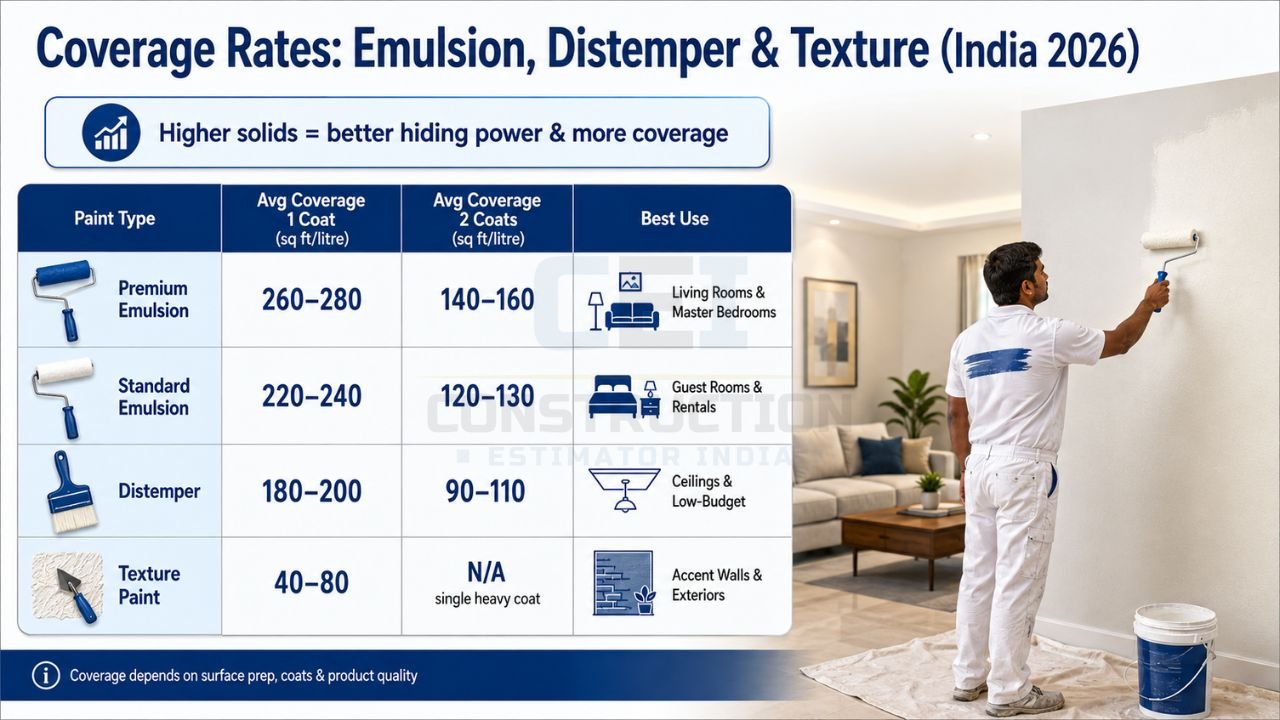
Coverage varies by the “solids content” of the paint. Higher-end paints like Asian Paints Royale Glitz have higher solids and better “hiding power,” meaning they cover more area with less liquid.
| Paint Type | Average Coverage (1 Coat) | Average Coverage (2 Coats) | Best For |
|---|---|---|---|
| Premium Emulsion | 260–280 sq. ft./L | 140–160 sq. ft./L | Living Rooms & Master Bedrooms |
| Standard Emulsion | 220–240 sq. ft./L | 120–130 sq. ft./L | Guest Rooms & Rental Units |
| Distemper | 180–200 sq. ft./L | 90–110 sq. ft./L | Ceilings & Low-Budget Areas |
| Texture Paint | 40–80 sq. ft./L | N/A (Single Heavy Coat) | Accent Walls & Exteriors |
For brand-specific data, refer to the Asian Paints 2026 paint coverage rates for walls or the latest 2026 paint coverage guidelines by Berger and Nerolac for walls.
India-Specific Adjustments: Humidity, Monsoon, and UV
A paint estimator for wall 2026 must account for the Indian micro-climate. In Meerut and the Delhi-NCR region, the extreme heat and humidity impact “viscosity” and “spread”.
- The Humidity Factor: During the North Indian monsoon, paint cures slower. If a second coat is applied too quickly, it can “slide,” requiring an extra corrective coat which increases quantity by 33%.
- The UV Factor: In South-facing rooms with intense direct sunlight, cool-toned pigments (Blues/Teals) often require 3 coats to achieve full depth and resist fading, increasing the material requirement significantly.
- Surface Heat: Exterior walls in 2026 often use “Heat-Reflective” technology. These paints are thicker and require a lower spreading rate to be effective.
Consult the official 2026 paint coverage standards for walls in India for advanced climate-resilient application standards.
The Estimator’s Secret: Impact on BOQ and Project Costs
At Construction Estimator India, we view paint quantity as a critical pivot point in your budget. The interior painting cost per sq ft in India 2026 is not just about the price of the bucket; it’s about the yield.
- The Pigment Cost: Deep, vibrant colors like “Deep Navy” or “Forest Green” use organic pigments with lower hiding power. We always calculate for 3 coats for these shades, which increases the material cost by 50% in the BOQ.
- Wastage Buffer: Professional estimators include a 5% buffer for smooth walls and 10% for rough or textured walls. This accounts for paint left in rollers, trays, and minor spills.
- The Primer Savings: Spending on 1 coat of primer is cheaper than using 1 extra coat of premium emulsion to achieve the same opacity.
For accurate paint quantity calculation or full BOQ for your wall painting project in India, WhatsApp or call us today at +91 8630676890.
Worked Example: Calculating Paint for a 12×10 Room
Let’s calculate the paint quantity calculation for walls India for a standard master bedroom.
- Room Size: 12ft (L) × 10ft (W) × 10ft (H).
- Total Wall Length: 12 + 12 + 10 + 10 = 44 ft.
- Gross Wall Area: 44 ft × 10 ft = 440 sq. ft.
- Subtractions: 1 Door (21 sq. ft.) + 1 Window (12 sq. ft.) = 33 sq. ft.
- Net Area: 440 – 33 = 407 sq. ft.
- Finish Coats: 2 Coats of Royale Luxury Emulsion.
- Coverage Rate: 150 sq. ft. per litre (for 2 coats).
- Calculation: 407 ÷ 150 = 2.71 Litres.
- Wastage (5%): 2.71 × 1.05 = 2.85 Litres.
Final Order: You would purchase a 4-litre pack (or 3-litre individual cans if available) to ensure you have enough for minor touch-ups later.
Common Mistakes in Wall Paint Estimation
Even seasoned contractors often fail to follow the CPWD guidelines for paint quantity calculation on walls. Here are the top “budget killers” we see:
- Ignoring the Ceiling: Many homeowners forget that the ceiling usually requires a different paint type (distemper) and adds roughly 25-30% to the total room area.
- Over-dilution: Adding too much water to “make the paint go further” ruins the film thickness and durability, leading to premature peeling during the monsoon.
- Forgetting the “Metamerism” Effect: Colors look different under 2700K (Warm White) vs 5000K (Daylight). Sometimes, a color requires a 3rd coat to look consistent under modern LED lighting.
FAQ: Real Answers for Indian Homeowners
- How much paint is needed for a 10×10 room in India?
A 10x10x10 room typically has ~360 sq. ft. of wall area. After subtractions, you usually need 2.5 to 3 litres of premium emulsion for 2 coats. - Can I use the same coverage rate for exterior walls?
No. Exterior walls are rougher and exposed to the elements. Coverage for weatherproof paints like Apex Ultima is generally lower (120–140 sq. ft. for 2 coats) compared to interior emulsions. - Does the brand change how to calculate paint quantity for wall?
Yes. Premium brands have higher solids. While a budget paint might need 3 coats (using more liquid), a premium brand like Berger Silk or Asian Paints Royale achieves the same look in 2 coats. - Is primer necessary for repainting the same color?
If the wall is in good condition, you can skip primer. However, if there are repairs or you’re changing the sheen (matte to silk), 1 coat of primer is mandatory for adhesion. - How much extra paint should I buy for a dark accent wall?
For dark colors, budget for 50% more paint as they almost always require 3 coats to achieve a streak-free, velvety finish. - Does Vastu Shastra impact paint quantity?
Not directly, but Vastu-recommended colors for different directions (e.g., Yellow in the South-West) use specific pigments that may have different hiding powers, affecting the number of coats needed.
Conclusion and Expert Advice
Mastering how to calculate paint quantity for wall is the first step toward a successful, stress-free home transformation. In 2026, precision is your best defense against rising labor costs and material wastage. By following the 1 Primer + 2 Finish Coats rule and adjusting for your specific wall surface and local climate, you ensure a finish that is both beautiful and durable.
Don’t leave your home’s aesthetic and financial health to chance. At Construction Estimator India, we provide the technical precision needed to turn your vision into a reality with zero surprises.
For accurate paint quantity calculation or full BOQ for your wall painting project in India, WhatsApp or call us today at +91 8630676890.