Imagine standing before your newly constructed home in Meerut or a coastal villa in Kerala, watching the fierce afternoon sun beat down on the fresh masonry. In the unique and often harsh Indian climate—characterized by intense UV radiation, heavy monsoons, and relentless dust—your choice of paint isn’t just about color; it’s about a protective shield. One of the most critical questions every homeowner and contractor asks is: how many coats of exterior paint are needed?
The direct answer for 2026 standards in India is: one coat of high-quality exterior primer followed by a minimum of two coats of premium weatherproof emulsion. For homes in high-exposure areas like coastal regions or North Indian cities with extreme heat, a third finish coat is often recommended to ensure maximum durability, color retention, and crack-bridging performance.
At Construction Estimator India, we know that getting the number of coats right is the difference between a home that looks stunning for a decade and one that requires a costly redo after just two monsoon seasons.
2026 Standard Exterior Painting Specs
- Primer: 1 Coat (Mandatory for adhesion and pH balance).
- Finish Coats: 2 Coats (Standard) | 3 Coats (Premium/Extreme Climate).
- Total Recommended: 3 Total Coats (1 Primer + 2 Paint).
- Key 2026 Brands: Asian Paints Apex Ultima Protek, Berger Weathercoat Anti-Dust.
- Cost Impact: A 3rd coat typically increases material costs by 15-20% but extends life by 3-5 years.
For accurate exterior painting cost estimation or BOQ for your house in India, WhatsApp or call us today at +91 8630676890.
The Science of Exterior Coats: Why One is Never Enough
In our our 10+ years of construction estimating expertise, we have seen that many homeowners try to save money by opting for a single “thick” coat of paint. In the world of civil engineering and professional finishing, this is a recipe for disaster.
Exterior paint in India must perform multiple functions simultaneously: it must bridge micro-cracks in the masonry, reflect heat, resist fungal growth during high humidity, and remain color-fast under intense UV rays. A single coat cannot provide the structural film thickness (DFT – Dry Film Thickness) required to withstand these stresses. Multiple thin, even coats create a cohesive polymer chain that bonds more effectively to the substrate, providing the “breathable yet waterproof” barrier that modern homes require.
The Foundation: How Many Primer Coats are Needed for Exterior Walls?
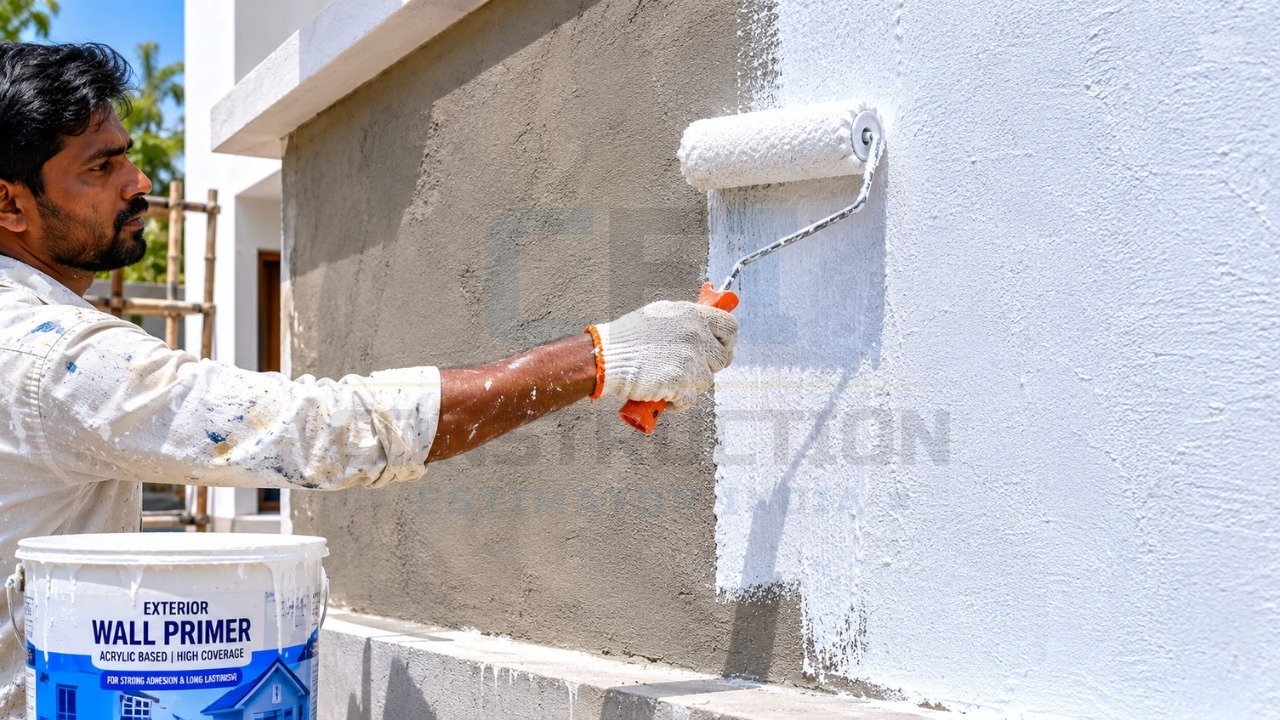
Before you even think about the color, you must address the primer. For exterior walls, the answer is almost always one coat, provided the surface is properly prepared.
Why is the primer coat non-negotiable?
- Alkali Resistance: New cement plaster is highly alkaline. Without a primer, this alkalinity will “burn” through your expensive paint, causing white patches and fading.
- Adhesion: Primer acts as the “glue” between the rough concrete and the smooth emulsion.
- Uniform Porosity: Concrete is naturally porous. Primer seals these pores, ensuring that your finish coats aren’t absorbed unevenly, which leads to a patchy appearance.
We recommend checking the CPWD guidelines for exterior painting and number of coats for the technical standards used in large-scale residential projects across India.
👉 Protect Your Home with Proper Exterior Painting Techniques & Coating Strategy
The Debate: 2 Coats vs 3 Coats of Exterior Emulsion
While two coats are the industry standard for most interior projects, the “how many coats of exterior paint for house India 2026” question often leads to a recommendation for three coats in specific scenarios.
When 2 Coats are Sufficient:
- You are using a high-hide, premium paint like Asian Paints Apex Ultima.
- The new color is very similar to the existing color (for repainting).
- The home is in a moderate climate zone with low pollution and average rainfall.
When 3 Coats are Mandatory:
- Vibrant/Deep Colors: Shades like terracotta, deep navy, or forest green use organic pigments that have lower “hiding power.” A third coat is essential to achieve the true depth of color.
- Extreme Weather Zones: If your home is in a high-rainfall area (like Mumbai or Kerala) or a high-heat zone (like Rajasthan), the extra film thickness from a third coat provides vital protection against UV degradation.
- Drastic Color Changes: If you are moving from a very dark base to a light cream, three coats ensure no “ghosting” of the old color.
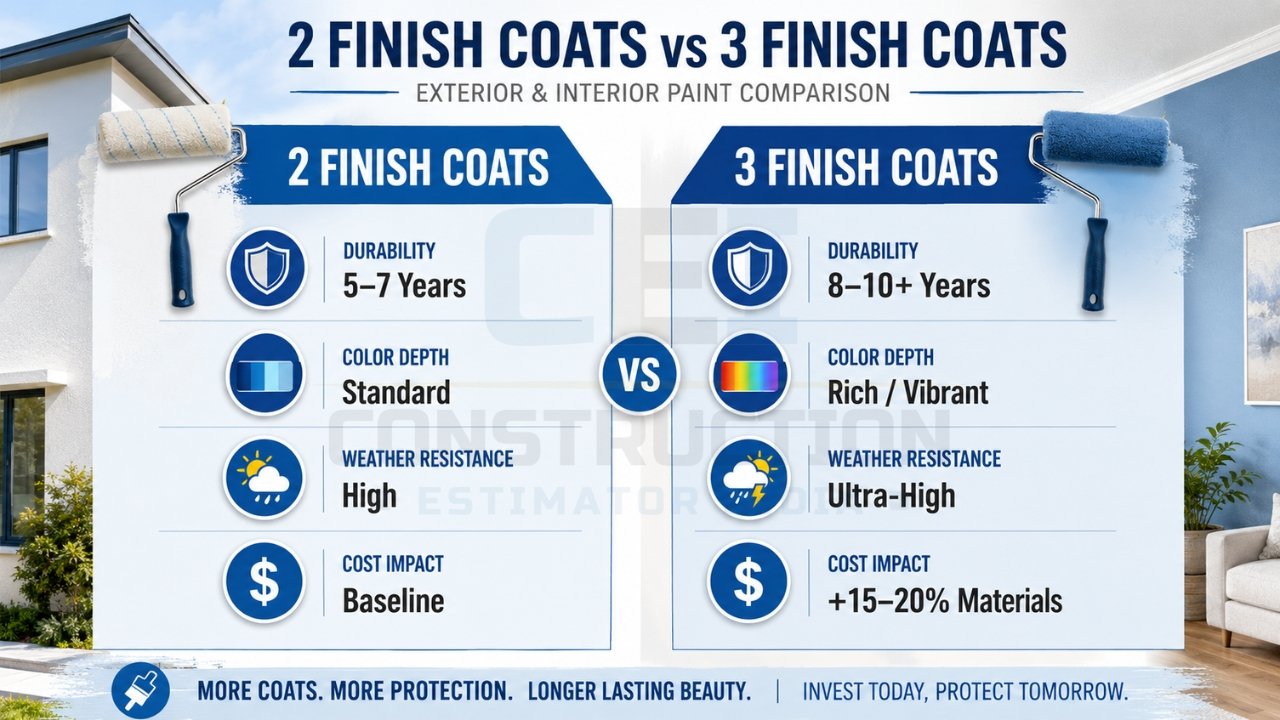
| Feature | 2 Finish Coats | 3 Finish Coats |
|---|---|---|
| Durability | 5–7 Years | 8–10+ Years |
| Color Depth | Standard | Rich/Vibrant |
| Weather Resistance | High | Ultra-High |
| Cost Impact | Baseline | +15-20% on Materials |
👉 Make Your Exterior Paint Job Strong, Durable & Visually Appealing
Climate Variations: Coats for Monsoon, UV, and Dust Protection
India is a subcontinent with vastly different micro-climates. At Construction Estimator India, we calibrate our house construction cost estimation services based on your specific geography.
- The Dust Belt (NCR/Noida/Meerut): In areas with high airborne dust, we recommend two coats of a specialized “Anti-Dust” paint like Berger Weathercoat. The third coat in these regions is less about weather and more about creating a smoother surface that dust cannot cling to.
- The Coastal/Heavy Rain Zones: For homes in Chennai or Kochi, we specify three coats of a “Crack-Bridging” paint. These paints are elastic; the extra coat allows the paint to stretch over masonry cracks that expand and contract with moisture, preventing internal dampness.
- High-Heat Zones: In Central India, light-colored “Heat Reflective” paints are standard. Two coats are usually enough, but they must be applied over a high-quality “Cool Roof” or wall primer to be effective.
Brand-Specific Guidelines for 2026 (Apex, Berger, Nerolac)
For the best results, you must follow the manufacturer’s technical data sheets. For instance, the Asian Paints Apex Ultima 2026 – recommended coats for exterior specifically mandates a two-coat finish over a single coat of primer for their 10-year warranty to remain valid.
Similarly, the latest 2026 exterior paint coat guidelines by Berger and Nerolac emphasize the importance of “re-coat time.” Applying a second coat before the first is fully cured (usually 4-6 hours in Indian conditions) can trap moisture and lead to peeling, regardless of how many coats you apply.
The Estimator’s Secret: How Extra Coats Impact Your BOQ and Budget
This is where the expertise of Construction Estimator India saves you from financial surprises. Most people calculate exterior painting cost per sq ft in India 2026 based on a flat rate. However, a professional Bill of Quantities (BOQ) accounts for the “spreading rate” of the paint across multiple coats.
- Material Consumption: The first finish coat is always the most “thirsty” as it bonds with the primer. The second and third coats require significantly less paint per square foot. In our BOQs, we factor in a 10% reduction in material for subsequent coats.
- Labor Costs: Applying a third coat doesn’t just increase material costs; it increases the “labor days” on-site. If you have a large 2500 sq ft home, an extra coat could add 3-5 days of scaffolding and labor time.
- Long-Term ROI: While the upfront cost of 3 coats is higher, the “cost per year of protection” is lower because you delay the expensive repainting cycle by several years.
Compare this with interior painting cost per sq ft in India 2026, where the environmental stress is lower, and two coats are almost always sufficient.
Step-by-Step Exterior Painting Process for 2026
- Surface Preparation: Pressure washing to remove all dust and algae.
- Crack Filling: Using specialized structural acrylic fillers for any visible cracks.
- Primer Application: 1 Coat of exterior wall primer. Wait 4 hours.
- First Finish Coat: Apply the first coat of weatherproof emulsion.
- The 24-Hour Observation: Check for any “holidays” (missed spots) or uneven drying.
- Second Finish Coat: Apply the second coat perpendicular to the first for even coverage.
- Optional Third Coat: For deep colors or high-exposure walls (South/West facing).
Consult the official 2026 exterior paint coat recommendations in India for advanced application techniques using airless sprayers, which can sometimes achieve the required DFT in fewer passes.
👉 Plan Your Exterior Painting Project for Maximum Coverage & Longevity
FAQ: Real Answers for Indian Homeowners
- Can I use 1 coat of paint if it’s a high-quality brand like Apex Ultima?
No. Even the best paint needs a minimum of two coats to create a durable, protective film. A single coat will look patchy and will fail within 12-18 months of Indian weather. - How many coats of exterior paint are needed for a new house vs. an old house?
New houses require 1 primer + 2-3 paint coats. Old houses, if the existing paint is in good condition, might only need 2 coats of paint after thorough cleaning. If the old paint is peeling, you must scrape to the base and follow the new house protocol. - Does the color choice affect how many coats I need?
Yes. Light colors like beige or off-white usually cover well in 2 coats. Darker or brighter colors like red, navy, or yellow often require 3 coats to avoid a “streaky” appearance. - What is the average time between coats in India?
In dry months, 4–6 hours is sufficient. During high humidity, we recommend waiting 8–12 hours. Never paint during active rainfall. - How much does a third coat increase the total painting cost?
Generally, a third coat adds about 15-20% to the total material cost and 10% to the labor cost. However, it can increase the life of the paint by up to 40%. - Is primer necessary for repainting an exterior wall?
If you are changing the color significantly or if the surface is chalky/powdery, a primer is mandatory. If it’s a simple refresh of the same color, you may skip it, though we don’t recommend it for long-term results. - Can I use interior paint for my exterior balcony?
Absolutely not. Interior paint lacks the UV stabilizers and anti-fungal additives required for outdoor exposure. It will peel within one monsoon.
Conclusion & Final Expert Advice
Determining how many coats of exterior paint are needed is a balance of science, climate, and budget. While the 2026 industry standard remains 1 coat of primer and 2 coats of premium emulsion, the technical reality of the Indian climate often favors a 3-coat finish for maximum longevity.
By investing in that extra coat today, you aren’t just buying “more paint”—you are buying years of freedom from dampness, fading, and structural maintenance. Remember, the most expensive paint job is the one you have to redo. Avoid the guesswork and ensure your home transformation is backed by a professional estimate.
For accurate exterior painting cost estimation or BOQ for your house in India, WhatsApp or call us today at +91 8630676890.