Imagine standing in your newly renovated living room in Meerut or Delhi, the soft glow of the evening sun hitting the walls. You spent weeks choosing the perfect “Moonlit Silk” or “Desert Terracotta” shade, but something is wrong. The color looks patchy, the old wall’s texture is peeking through, and the vibrant depth you saw on the swatch is missing. This is the nightmare of an under-coated paint job. In 2026, where “Quiet Luxury” and “Biophilic Sanctuaries” define Indian home improvement, the question of how many coats of paint are required is no longer just a contractor’s guess; it is a critical calculation that impacts your home’s durability, health standards, and, most importantly, your construction budget.
At Construction Estimator India, we know that an extra coat of paint isn’t just about labor; it can swing a Bill of Quantities (BOQ) by 15–20%. After helping over 500 clients with precision estimation, we have identified that the direct answer to your painting woes is a strategic combination: 1 coat of specialized primer followed by 2 coats of high-quality finish paint as the absolute baseline for most Indian homes. However, factors like the intense UV index of North India, the humidity of the monsoon, and the shift toward deep, organic pigments can push this requirement to 3 or even 4 coats for a professional-grade finish.
For accurate painting cost estimation or BOQ for your home project in India (including number of coats), WhatsApp or call us today at +91 8630676890.
2026 Paint Coat Quick Reference Table
| Surface / Paint Type | Recommended Primer Coats | Recommended Finish Coats | Durability (Years) | Cost Impact on BOQ |
|---|---|---|---|---|
| New Interior Wall (Emulsion) | 1 Coat (Acrylic) | 2–3 Coats | 7–10 Years | High (Quality prep needed) |
| Repainting (Light to Light) | 0–1 Coat | 2 Coats | 5–7 Years | Moderate |
| Repainting (Dark to Light) | 1 Coat (White) | 3 Coats | 6–8 Years | Very High (Material + Labor) |
| Exterior Walls (Weatherproof) | 1 Coat (Silicon-based) | 2 Coats | 7–10 Years | High (Climate additives) |
| New Drywall / Gypsum Board | 1 Coat (High-Build) | 2 Coats | 8–10 Years | Moderate (Absorption factor) |
| Interior Doors (PU/Enamel) | 1–2 Coats (Wood Filler) | 2 Coats | 8–10 Years | Moderate (Technique-heavy) |
The 2026 Baseline: Why 2 Coats is the Golden Rule
In the professional world of house construction cost estimation services, we rarely sign off on a project that specifies only one coat of finish paint. One coat is almost always translucent, showing “lap marks” and unevenness where the roller has passed.
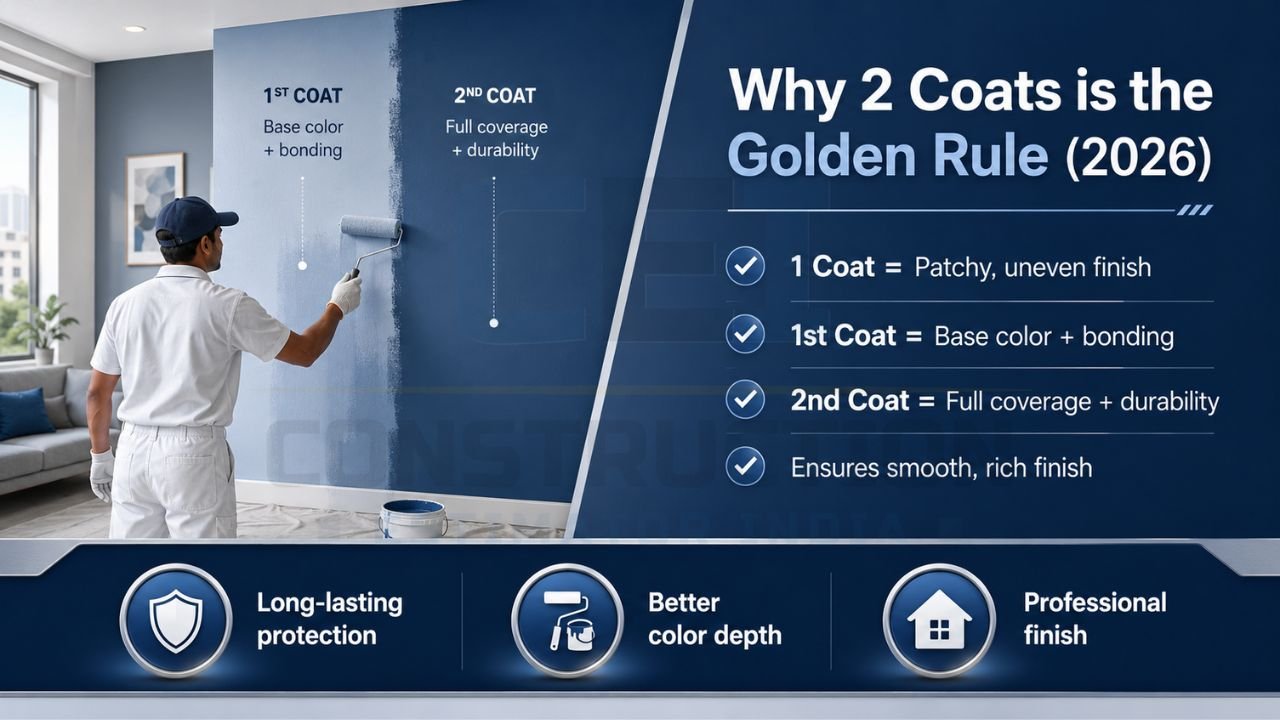
The first coat provides the color and begins the bonding process with the primer. The second coat provides the “hiding power,” depth of color, and the protective film thickness required to handle daily wear and tear. For the 2026 Indian market, brands like Asian Paints and Berger have formulated their luxury emulsions to reach full opacity in two coats, but only if the surface has been prepared with Level 5 putty and a high-quality primer. Following the official 2026 painting coats recommendations in India ensures that your home doesn’t just look good on day one but remains vibrant for the next decade.
Primer Coats Needed Before Painting: The Non-Negotiable Foundation
Most homeowners view primer as an unnecessary expense, but from our perspective as estimators, it is the most cost-effective line item in your BOQ. A primer acts as a bridge between the masonry and the paint, sealing the porous surface of the wall putty.
- New Walls: For a new home in Noida or Gurgaon, one coat of primer is mandatory after the wall putty has dried and been sanded. This prevents the wall from “sucking in” the more expensive emulsion paint, which can increase your material cost by 30%.
- Repainting Dark Colors: If you are transitioning from a deep navy to a soft cream, you may need a specialized white-pigmented primer to neutralize the base.
- Monsoon Protection: In high-humidity areas, we recommend a silicon-based primer to prevent moisture from bubbling the paint.
Refer to the CPWD guidelines for number of coats in interior and exterior painting for the technical benchmarks used in high-end government and residential projects across India.
How Many Coats of Emulsion Paint for Walls India: Premium vs. Standard
When determining how many coats of emulsion paint for walls India projects require, the grade of the paint is the deciding factor.
- Premium Emulsions (e.g., Asian Paints Royale Glitz): These are “high-solids” paints. Because they contain more pigment and fewer fillers, they often achieve 100% opacity in two coats. They also feature Teflon surface protectors that allow for washability, making them ideal for living rooms and master bedrooms.
- Standard Emulsions: These may have lower “hiding power”. If you are using a lighter shade over a patched wall, you might find that a third coat is necessary to hide imperfections, which can increase the interior painting cost per sq ft in India 2026 significantly.
Ceiling Strategies: How Many Coats Required for Ceiling?
Ceilings are often neglected, but they play a vital role in light distribution. How many coats required for ceiling depends largely on the material—distemper vs. emulsion.
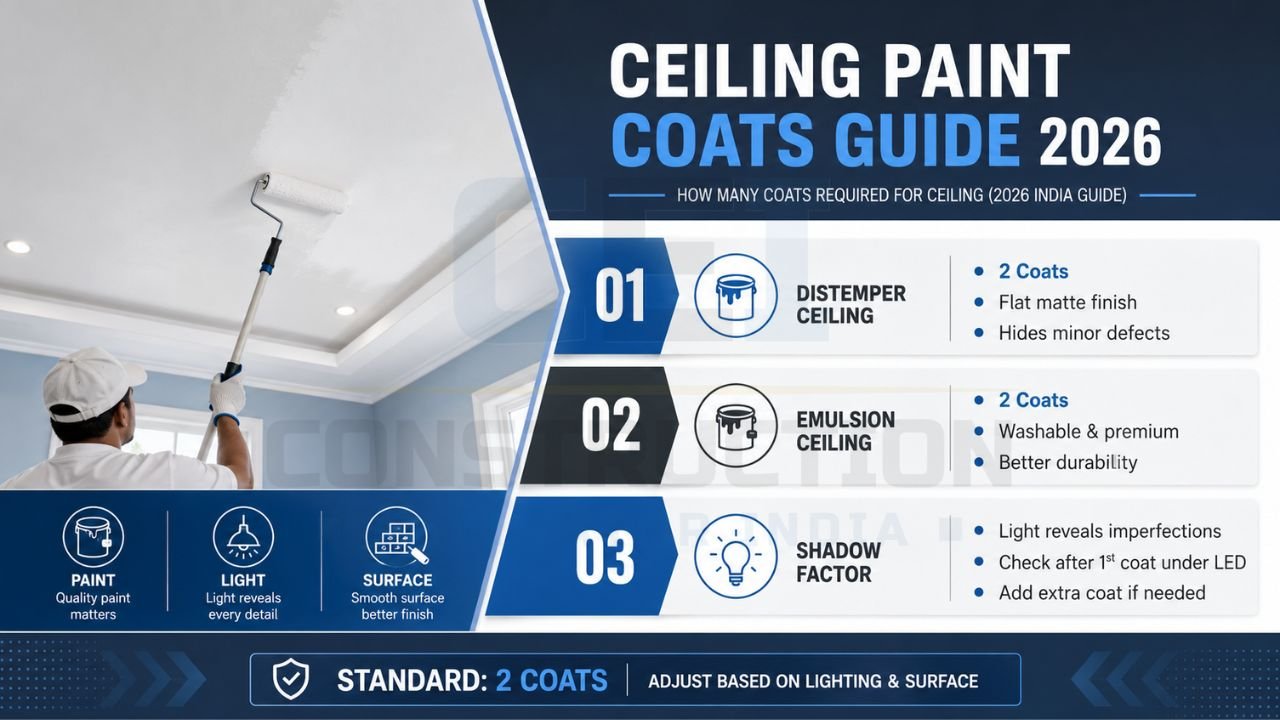
- Distemper: Often used for ceilings to maintain a flat, matte finish. Two coats are usually sufficient to hide minor masonry defects.
- Emulsion: If you want a more luxury, washable ceiling, two coats are required.
- The “Shadow” Factor: Because ceilings are viewed under artificial light, any unevenness is magnified. We recommend observing the first coat under your actual 2026 LED lighting before deciding if a second or third coat is necessary.
The Dark Side of Design: When 3 Coats are Mandatory
The 2026 trend toward “Desert Terracotta,” “Deep Navy,” and “Charcoal Grey” comes with a technical price. Dark colors use organic pigments that are notoriously difficult to distribute evenly.
If you are opting for a deep accent wall, we at Construction Estimator India advise our clients to budget for at least three coats. Why? Because deep colors tend to “streak” during the first two applications. To achieve the velvety, immersive look seen in luxury catalogs, the third coat is essential to saturate the wall and hide roller marks. To stay ahead of the curve, review the Asian Paints official guide on how many coats of paint are required 2026 for their latest high-pigment saturation guidelines.
Exterior Strategies: Defeating the Indian Monsoon and UV Rays
Exterior paint is the first line of defense for your home in Uttar Pradesh or Rajasthan. Here, the number of coats is a matter of structural health.
- Heat Reflective Technology: For 2026, we recommend light-colored, heat-reflective exterior paints. Two coats of a high-quality product like Asian Paints Apex Ultima Protek can reduce internal temperatures by 3–5°C.
- Crack Bridging: In regions with extreme temperature shifts (like Meerut), a thicker application of two heavy coats is required to allow the paint to bridge micro-cracks that appear in the masonry during summer.
- Dust Resistance: In high-dust environments, a second coat creates a smoother surface that prevents Indian road dust from sticking to the wall.
To understand the full financial scope of these requirements, review our guide on exterior painting cost per sq ft in India 2026.
New vs. Old Surfaces: The Drywall and Repainting Nuance
The surface history dictates the “thirst” of the wall.
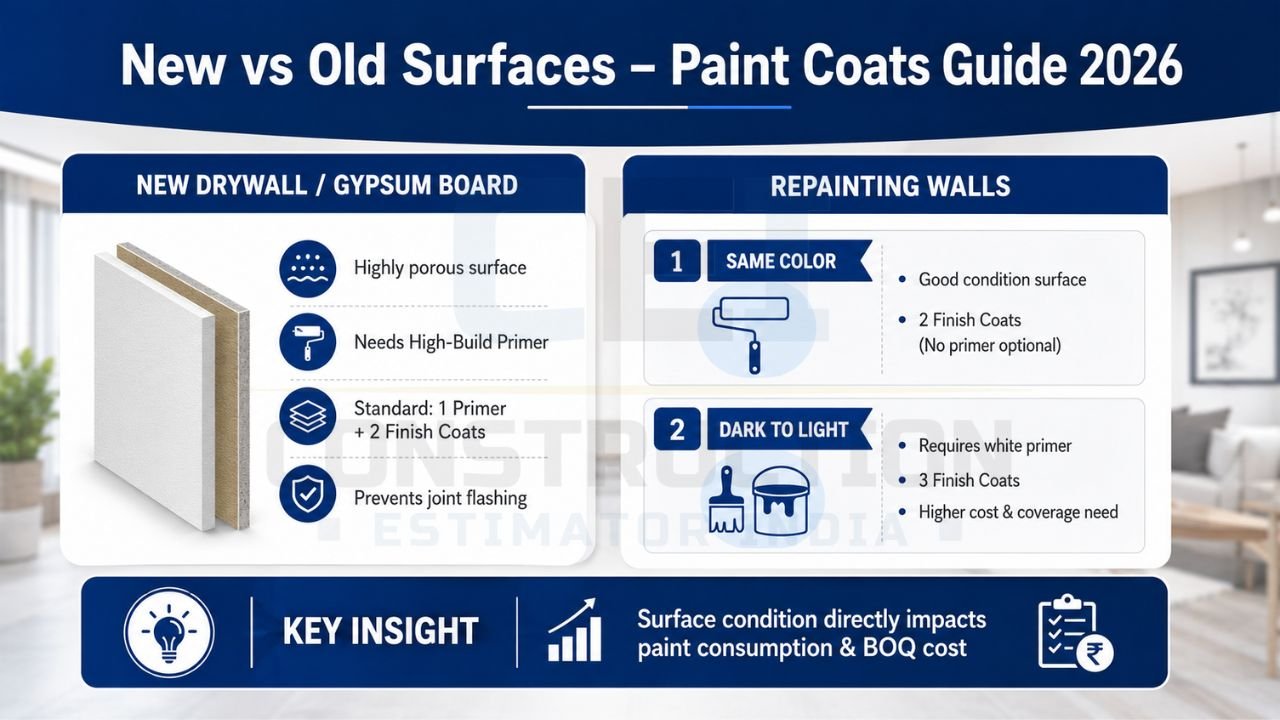
- New Drywall / Gypsum Board: Drywall is incredibly porous. Without a dedicated high-build primer, you may experience “joint flashing,” where the seams between boards look different from the rest of the wall. The 2026 standard for drywall is 1 primer coat + 2 finish coats.
- Repainting (Same Color): If the existing paint is in good condition, you might get away with 2 coats of finish paint and no primer.
- Repainting (Light over Dark): This is the most expensive scenario. You will almost certainly need a white-pigmented primer and 3 coats of light paint to hide the old dark color.
The Estimator’s Secret: How Extra Coats Change Your BOQ
This is where house construction cost estimation services become invaluable. Most homeowners assume that the cost of painting is just “Area x Rate.” However, every extra coat added to a project impacts the following:
- Material Volume: A 3-coat specification increases your paint purchase by 50% compared to a 2-coat job.
- Labor Time: A painter can only apply one coat per day to allow for proper curing. A 3-coat job adds 33% more time to your project timeline.
- Wastage Factor: With more coats, the chance of paint dripping or being wasted in trays increases. We use our 10+ years of construction estimating expertise to include a 5–10% wastage buffer in every BOQ.
Vastu and Light: How Direction Affects Pigment Absorption
Vastu Shastra and lighting science intersect when choosing the number of coats.
- North-Facing Rooms: These receive cool light, making colors look flatter. We often recommend three coats of warm tones here to ensure the color has enough “body” to counteract the cool shadows.
- South-Facing Rooms: Intense sunlight can “wash out” a color. Two thick coats of cool blues or greens are essential to maintain the pigment’s integrity under the harsh glare.
Refer to the latest 2026 painting coat guidelines by Berger and Nerolac for direction-specific application tips that harmonize energy and aesthetics.
Step-by-Step Selection: From Sampling to Final Sign-Off
To ensure your project remains on budget and matches your vision, follow this 2026 framework:
- Test 2ft x 2ft Patches: Never judge a color by a 1-inch swatch. Apply two coats of your chosen color on the actual wall to see how it looks under “Golden Hour” light.
- Check for Metamerism: Observe the patch at 10 AM, 4 PM, and 8 PM (under LED lights). Some colors require a third coat to look consistent throughout the day.
- Verify the BOQ: Ensure your contractor specifies the number of coats in writing. This prevents them from cutting corners by “thinning” the paint to make one coat look like two.
Conclusion and Expert Advice
Mastering the science of how many coats of paint are required is the difference between a house that looks “painted” and a home that feels “designed.” In the 2026 Indian climate, cutting corners on the number of coats is a false economy that leads to fading, peeling, and increased heat absorption. By sticking to the gold standard of 1 primer + 2 finish coats (and adjusting for deep pigments), you protect your investment and your family’s well-being.
Don’t leave your home transformation to chance or contractor guesswork. Accurate estimation is the foundation of a stress-free renovation.
For accurate painting cost estimation or BOQ for your home project in India (including number of coats), WhatsApp or call us today at +91 8630676890.
FAQ: Real Answers for Indian Homeowners
- Can I save money by skipping the second coat of paint?
No. Skipping the second coat leads to uneven color and poor durability. You will end up repainting in 2 years instead of 8, costing you more in the long run. - How many coats of paint are required for a dark accent wall?
In 2026, for deep pigments like “Navy” or “Forest Green,” three coats are usually required to ensure a streak-free, velvety finish. - Is one coat of primer enough for a new wall?
Yes, provided it is a high-quality acrylic primer applied over well-sanded putty. Very porous walls may occasionally need a second coat of primer. - Does the number of coats change the labor rate in India 2026?
Yes. Most contractors charge a “per coat” labor rate. Adding a third coat can increase your labor cost by roughly 25–30% for that specific wall. - How many coats of paint are required for interior wooden doors?
For a professional finish, we recommend one coat of wood primer and two coats of PU or Enamel paint. - Do I need primer if I am repainting the same color?
If the wall is in good condition, you may skip it, but primer is recommended if the surface is chalky or has visible repairs. - How much does a 3rd coat of paint cost per room?
On average, it increases the total painting cost for that room by 30-40% due to increased material and labor.