Excavation is the very first physical step in any construction project — yet it is also one of the most underestimated tasks when it comes to budgeting and planning. Whether you are building a residential house in Pune, a commercial complex in Mumbai, or an industrial facility in Gujarat, getting your excavation quantity calculation in construction right from day one can be the difference between a profitable project and a costly disaster.
Inaccurate earthwork estimates lead to contractor disputes, budget overruns, material wastage, and project delays. On the other hand, precise excavation quantity calculations help builders, civil engineers, and homeowners plan machinery deployment, labour allocation, soil disposal, and backfilling volumes with confidence.
At Construction Estimator India, we have helped hundreds of clients across India prepare accurate excavation estimates backed by sound engineering principles, local soil knowledge, and years of on-site experience. This comprehensive guide walks you through everything you need to know about excavation quantity calculation — from basic formulas to advanced cut-and-fill methods.
What Is Excavation Quantity Calculation and Why Does It Matter?
Excavation quantity calculation is the process of measuring and computing the volume of earth, rock, or soil that must be removed from a site to create space for foundations, basements, trenches, roads, or drainage systems. It is a critical component of any pre-construction quantity survey.
Why it matters in Indian construction:
- Determines the cost of earthmoving machinery (JCB, excavator, tipper)
- Helps plan soil disposal logistics and landfill requirements
- Enables accurate pricing of backfilling and compaction work
- Prevents over-excavation which weakens adjacent structures
- Ensures compliance with structural drawings and soil bearing capacity requirements
- Critical for projects under RERA, municipal building plans, and BOQ submissions
A well-prepared excavation quantity takeoff in India can save 8–15% of overall project costs by eliminating guesswork from earthwork contracts.
Common Types of Excavation in Construction
| Type of Excavation | Where Used | Typical Depth (India) |
| Foundation Excavation | Residential / commercial buildings | 1.0 m – 3.0 m |
| Trench Excavation | Plumbing, drainage, electrical conduits | 0.6 m – 2.0 m |
| Basement Excavation | Multi-storey buildings, parking | 3.0 m – 8.0 m |
| Bulk / Mass Excavation | Large commercial/industrial sites | Varies widely |
| Roadway / Highway Cutting | Roads, highways, railway cuttings | 0.3 m – 5.0 m |
| Canal / Drainage Excavation | Irrigation, stormwater channels | 1.0 m – 4.0 m |
| Rock Excavation | Hilly terrain, rocky sub-strata | Varies by blasting depth |
Methods of Excavation Quantity Calculation
1. Manual Calculation (Formula-Based)
The oldest and most widely used method. Engineers calculate volume using standard geometric formulas based on drawing dimensions. Ideal for small residential projects and quick estimates.
2. Microsoft Excel-Based Calculation
Excel sheets with pre-programmed formulas allow estimators to input dimensions and get instant volume totals. At Construction Estimator India, we use customised Excel templates that include swell factors, depth variations, and multiple soil layers.
3. AutoCAD / CAD-Based Takeoff
For projects with detailed architectural or structural drawings, AutoCAD Civil 3D and similar tools can extract excavation volumes directly from 3D terrain models. This is highly accurate and used for large-scale infrastructure projects.
4. Estimating Software
Software like CostX, Candy, PlanSwift, and Buildxact allow digital quantity takeoffs from PDF or CAD drawings. These tools reduce human error and are increasingly popular among professional estimators in Tier-1 Indian cities.
5. Average End Area Method (for Roads/Canals)
Used in linear projects. Volume is calculated by averaging cross-sectional areas between two stations and multiplying by the length between them.
Step-by-Step Guide to Excavation Quantity Calculation
Core Formula
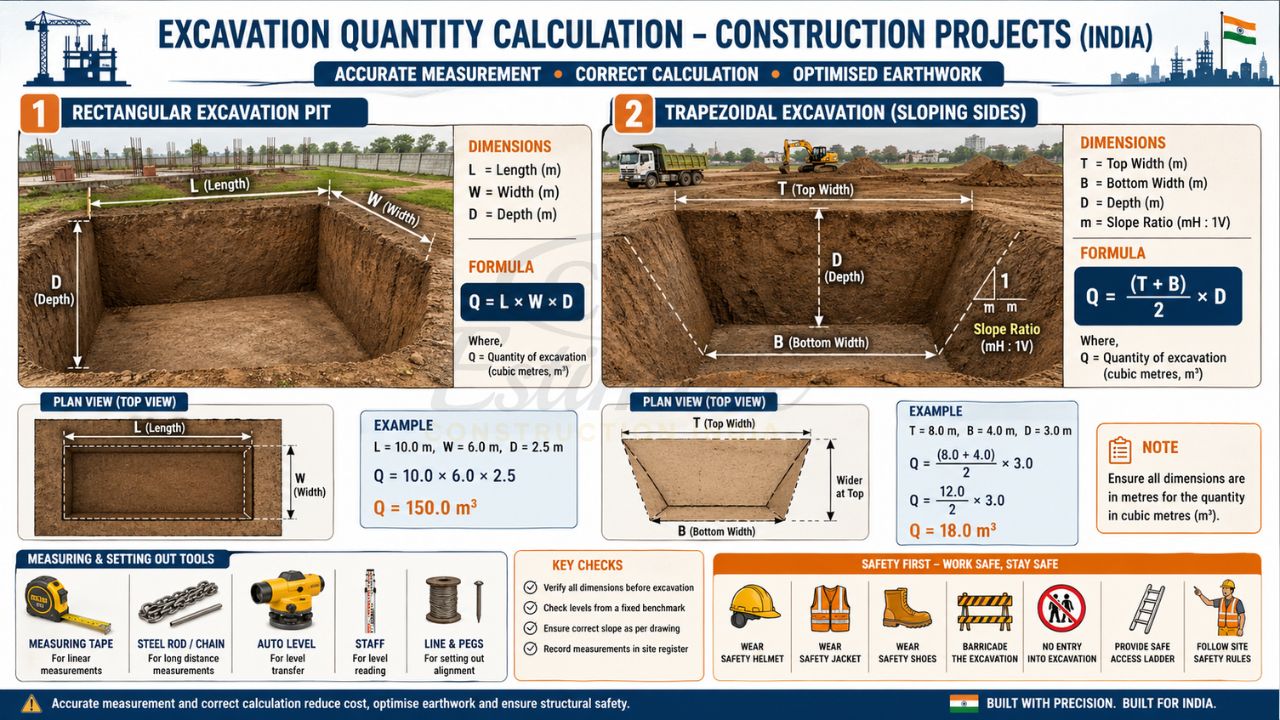
Volume of Excavation = Length (L) x Width (W) x Depth (D)
For regular rectangular/square pits, this is straightforward. For irregular shapes or sloped ground, additional adjustments are applied.
Step 1: Identify the Excavation Area from Drawings
Extract the length, width, and depth of excavation from structural/architectural drawings. Add a working space allowance of 300–600 mm on each side for formwork and worker access.
Step 2: Add Working Space Allowance
Effective Length = Foundation Length + 2 x Working Space (0.3 to 0.6 m per side)
Effective Width = Foundation Width + 2 x Working Space (0.3 to 0.6 m per side)
Step 3: Calculate Gross Volume
Volume (m³) = Effective Length x Effective Width x Excavation Depth
Step 4: Apply Swell Factor
When soil is excavated, it expands (swells). The swell factor depends on soil type:
| Soil Type | Swell Factor | Loose Volume Multiplier |
| Sandy Soil | 10–15% | 1.10 – 1.15 |
| Normal Earth (loam) | 15–25% | 1.15 – 1.25 |
| Clay | 20–30% | 1.20 – 1.30 |
| Rock (blasted) | 30–50% | 1.30 – 1.50 |
Loose Volume = Bank Volume x Swell Factor
Step 5: Deduct for Backfilling (if applicable)
If part of the excavation will be backfilled around the foundation, subtract that volume to get the net disposal quantity.
Net Disposal Volume = Gross Excavation Volume – Backfill Volume
Excavation Calculation for Different Scenarios
Example 1: Simple Column Foundation (Isolated Footing)
Project: Residential house in Nagpur | Foundation: Isolated footing 1.5 m x 1.5 m | Depth: 1.2 m | Working space: 0.3 m on each side
Effective Size = (1.5 + 0.6) x (1.5 + 0.6) = 2.1 m x 2.1 m
Volume = 2.1 x 2.1 x 1.2 = 5.29 m³ per footing
For 10 column footings: Total = 5.29 x 10 = 52.9 m³
Example 2: 20 x 30 Feet Plot — Strip Foundation
Plot: 20 ft x 30 ft (6.09 m x 9.14 m) | Foundation type: Strip footing along all walls | Width of strip: 0.6 m | Depth: 1.0 m | Working space: 0.3 m per side
Perimeter of strips (running along outer walls and internal walls):
Assume outer perimeter = 2 x (6.09 + 9.14) = 30.46 m | Internal wall = 6 m | Total strip length = 36.46 m
Volume = 36.46 x (0.6 + 0.6) x 1.0 = 43.75 m³
Example 3: 30 x 40 Feet Plot (G+1 Residential)
Plot: 30 ft x 40 ft (9.14 m x 12.19 m) | Foundation: Combined footing | Depth: 1.5 m | Working space: 0.45 m per side | Built-up area: ~80% of plot
Excavation Area = (9.14 x 12.19) x 0.80 = 89.14 m²
Volume = 89.14 x 1.5 = 133.7 m³
Swell factor (normal earth, 1.20): Loose disposal volume = 133.7 x 1.20 = 160.4 m³
Example 4: Basement Excavation (2BHK with 1 Basement Floor)
Basement area: 8 m x 12 m | Depth: 3.5 m | Working space: 0.6 m per side
Effective = (8+1.2) x (12+1.2) = 9.2 m x 13.2 m
Volume = 9.2 x 13.2 x 3.5 = 424.9 m³
This volume would require approximately 60–70 tipper truck loads for disposal in a typical Indian urban project.
Earthwork Calculation — Cut & Fill Method with Examples
The cut and fill method is used when a site has uneven terrain. Material cut from high areas is used to fill low areas, minimising waste and haulage cost. This is widely used in road construction, land development, and large residential layouts across India.
Average End Area Method
Volume = ((A1 + A2) / 2) x L
Where: A1 = Cross-sectional area at Station 1 | A2 = Cross-sectional area at Station 2 | L = Distance between the two stations
Practical Example — Road Project in Rajasthan
Station 1: Cut area = 12.5 m² | Station 2: Cut area = 18.0 m² | Distance between stations = 20 m
Volume = ((12.5 + 18.0) / 2) x 20 = 305 m³
Prismoidal Formula (More Accurate)
Volume = (L/6) x (A1 + 4Am + A2)
Where: Am = Cross-sectional area at the midpoint | This method is preferred for curved terrain and large infrastructure projects.
Pro Tip from Construction Estimator India: Always prepare a cut-fill balance sheet before mobilising equipment. Balancing cut and fill on-site can reduce earthwork cost by 20–30% on large layouts.
Factors Affecting Excavation Quantity & Cost in India
| Factor | Impact on Cost | Notes |
| Soil Type (clay, sand, rock) | High | Rocky soil needs blasting; clay needs dewatering |
| Depth of Excavation | High | Deeper = more volume + shoring required |
| Water Table Level | Medium-High | Dewatering pumps add ₹8,000–25,000/day |
| Site Accessibility | Medium | Narrow sites limit machinery; manual digging costs more |
| Proximity to Existing Structures | High | Requires underpinning or sheet piling |
| Monsoon Season | Medium | Wet soil = higher swell + extra transport cost |
| Disposal Distance | Medium | Farther disposal = more tipper trips = higher cost |
| Local Labour Rates | Varies | ₹400–700/day for unskilled labour (varies by state) |
Tools & Software Used for Accurate Excavation Calculation
Free Tools
- Microsoft Excel / Google Sheets — Custom formula-based templates
- AutoCAD LT — Basic 2D drawing measurement
- SketchUp Free — 3D volume estimation for simple shapes
- Calculator apps with unit conversion for quick field checks
Paid / Professional Tools
- AutoCAD Civil 3D — Industry standard for terrain modelling and earthwork volumes
- PlanSwift — Digital takeoff from PDF drawings, widely used in India
- CostX — BIM-compatible, supports IFC files
- Candy Estimating — Popular for infrastructure and civil contractors
- Buildxact — Cloud-based, suited for residential builders
- Pro / Tekla — For integration with structural models
At Construction Estimator India, we combine AutoCAD Civil 3D with customised Excel templates to deliver fast, accurate, and cost-effective excavation quantity takeoffs for projects of all sizes.
Common Mistakes in Excavation Quantity Calculation and How to Avoid Them
| Common Mistake | Impact | How to Avoid |
| Ignoring working space allowance | Under-excavation; formwork issues | Add 300–600 mm per side to dimensions |
| Not applying swell factor | Under-budgeting transport & disposal | Always multiply by soil swell factor |
| Overlooking rock or hard strata | Cost overruns of 40–60% | Get a soil investigation report (SIR) done first |
| Incorrect unit conversion (ft to m) | Major volumetric errors | Standardise all inputs to SI units |
| Ignoring sloped terrain in cut/fill | Wrong volumes; site imbalance | Use contour maps + Average End Area method |
| Not accounting for dewatering | Project delays during monsoon | Include dewatering cost in BOQ |
| Taking single depth reading | Uneven base ignored | Take multiple depth readings across the pit |
How Accurate Excavation Calculation Saves Money?
Many Indian homeowners and contractors learn the hard way that even small errors in excavation estimation can snowball into significant financial losses. Here are real-world cost impact examples:
Scenario A — 10% Under-Estimation on a 200 m³ Project
Under-estimated volume: 20 m³ | Extra tipper trips required: 5–6 | Extra cost at ₹1,500/trip: ₹7,500–9,000 | Additional JCB overtime: ₹3,000–5,000 | Total unexpected cost: ₹10,000–14,000
Scenario B — Ignoring Rock Strata on a Bangalore Site
Original estimate (normal earth): ₹45,000 | Actual cost with rock blasting: ₹1,20,000 | Cost overrun: ₹75,000 (167% over budget)
A soil investigation report costing ₹3,000–8,000 would have prevented this.
Scenario C — Correct Cut-Fill Balance on a Layout Project
Without cut-fill analysis: External soil procurement ₹2,50,000 | With proper cut-fill balance sheet: Zero imported soil needed | Saving: ₹2,50,000
Conclusion: Investing in a professional excavation quantity survey from Construction Estimator India — typically costing ₹2,000–15,000 depending on project size — can save lakhs of rupees over the course of a project.
Role of Professional Estimators in Excavation Quantity Survey
Excavation quantity surveying is not just about plugging numbers into a formula. A seasoned estimator brings value at every stage:
- Reading and interpreting structural/geotechnical drawings accurately
- Understanding local soil conditions, water tables, and seasonal variations
- Coordinating with architects and civil engineers to validate scope
- Preparing BOQ-format reports suitable for tendering and contractor billing
- Recommending the right excavation method (machine vs. manual)
- Advising on soil disposal sites and recycled material usage
- Identifying risk factors such as adjacent structures, utilities, or rock zones
Construction Estimator India provides professional excavation quantity surveys for residential, commercial, and infrastructure projects across India. Our reports are BOQ-ready, GST-compliant, and accepted by banks, developers, and municipal authorities.
Contact us today: Phone/WhatsApp: +91 86306 76890 | Email: info@constructionestimatorindia.com
Frequently Asked Questions (FAQs) about Excavation Quantity Calculation in Construction
Q1. What is the basic formula for excavation quantity calculation?
The fundamental formula is: Volume (m³) = Length x Width x Depth. For a rectangular pit, simply multiply the three dimensions in metres. For working space, add 300–600 mm on each side to length and width before calculating. For road or canal projects, use the Average End Area Method: Volume = ((A1 + A2) / 2) x L, where A1 and A2 are cross-sectional areas at two stations and L is the distance between them. Always apply the appropriate swell factor (1.10–1.50 depending on soil type) to convert bank volume to loose volume for transport and disposal calculations.
Q2. How do I calculate excavation quantity for a 30×40 feet plot?
First, convert to metres: 30 ft = 9.14 m and 40 ft = 12.19 m. Determine the type of foundation (isolated, strip, raft) and excavation depth from structural drawings. For a raft foundation at 1.5 m depth covering 80% of the plot: Excavation Area = 9.14 x 12.19 x 0.80 = 89.14 m²; Volume = 89.14 x 1.5 = 133.7 m³. Add working space (0.45 m per side) and apply swell factor for the actual disposal volume. For individual column footings, calculate each pit separately and sum the total. Construction Estimator India can prepare a detailed takeoff for your specific drawing.
Q3. What is the swell factor and how does it affect excavation calculations?
The swell factor accounts for the fact that soil expands in volume when excavated from its natural (bank) state. Sandy soil swells 10–15%, ordinary earth 15–25%, clay 20–30%, and blasted rock up to 50%. It affects two key calculations: the volume of trucks/tippers required for disposal (loose volume = bank volume x swell factor) and the cost of transport. For example, 100 m³ of clay (swell factor 1.25) becomes 125 m³ of loose material to be transported. Ignoring the swell factor leads to significant under-budgeting of haulage and disposal costs.
Q4. What is cut and fill in excavation and how is it calculated?
Cut and fill is a technique used when a site has uneven terrain. Areas higher than the design level are ‘cut’ (excavated), and the material is used to ‘fill’ lower areas. This reduces the need for external soil import or disposal. Calculation uses the Average End Area Method or Prismoidal Formula. A cut-fill balance sheet is prepared by surveying the existing ground levels and the finished grade levels at grid points across the site. When cut volume equals fill volume (balanced earthwork), haulage costs are minimised. This is critical for road projects, housing layouts, and large commercial developments in India.
Q5. What unit is used for excavation quantity in India?
In India, excavation quantity is officially measured and billed in cubic metres (m³) as per the Schedule of Rates (SOR) of State PWDs and CPWD. Older contracts or local contractors may sometimes refer to ‘brass’ (1 brass = 100 cubic feet ≈ 2.83 m³), especially in Gujarat, Rajasthan, and Maharashtra. For all formal BOQ submissions, tenders, and bank-approved estimates, cubic metres is the standard unit. Our estimators at Construction Estimator India always prepare reports in m³ and provide conversion tables for clients who need reference values in other units.
Q6. How accurate does excavation quantity calculation need to be?
For budgeting purposes, an accuracy of ±5–10% is generally acceptable. However, for contractor billing, tendering, and formal BOQ submissions, accuracy should be within ±2–3%. Accuracy depends on the quality of drawings, the precision of site measurements, the soil investigation data available, and the method of calculation used. Manual calculations are sufficient for small residential projects, while AutoCAD Civil 3D or specialised software should be used for large sites. At Construction Estimator India, we target ±2% accuracy on all our excavation quantity takeoffs using a combination of digital tools and site verification.
Q7. Do I need a soil investigation report before excavation quantity calculation?
A Soil Investigation Report (SIR) is not always mandatory for small projects, but it is strongly recommended for any project exceeding two storeys, or where the plot has unknown fill, waterlogged conditions, or rocky outcrops. The SIR reveals soil bearing capacity, water table depth, presence of rock or hard strata, and soil type — all of which directly impact excavation method, depth, cost, and safety. In India, SIRs typically cost ₹3,000–15,000 depending on depth and number of bore holes. Skipping this step has caused severe cost overruns and structural failures on many projects.
Q8. What is the cost of excavation per cubic metre in India (2024–25)?
Excavation cost in India varies by region, soil type, and method. Approximate indicative rates: Manual excavation (ordinary earth): ₹150–300/m³; Machine excavation (JCB/Poclain, ordinary earth): ₹80–200/m³; Rock excavation (chiselling/blasting): ₹400–1,200/m³; Trench excavation (narrow, manual): ₹250–500/m³. These costs exclude soil disposal and transport. Metro cities like Mumbai, Bengaluru, and Delhi typically have 20–30% higher rates than Tier-2 cities. Contact Construction Estimator India at +91 86306 76890 for current local rates specific to your project location.
Q9. Can I calculate excavation quantity from Google Earth or satellite images?
Google Earth can provide approximate ground levels and site dimensions for very early-stage feasibility estimates, but it is not suitable for accurate excavation quantity calculation. The elevation data on Google Earth has a vertical accuracy of ±5–15 m, which makes it unreliable for precise earthwork volumes. For accurate calculations, you need actual survey levels obtained through Total Station, Auto Level, or GPS survey equipment. For large infrastructure projects, drone-based photogrammetry surveys (accuracy ±50–100 mm) are increasingly used in India and offer a cost-effective middle ground.
Q10. How does Construction Estimator India help with excavation quantity takeoffs?
Construction Estimator India provides end-to-end excavation quantity surveying services for residential, commercial, and infrastructure projects across India. Our services include reading and interpreting structural/geotechnical drawings, preparing detailed BOQ-format excavation quantity reports, cut and fill analysis for uneven terrain, swell factor adjustments, backfill and disposal volume calculations, and cost estimates including machinery, labour, and transport. We serve clients in Mumbai, Pune, Bengaluru, Hyderabad, Chennai, Delhi-NCR, Ahmedabad, and all major Indian cities. Reach us at +91 86306 76890 or info@constructionestimatorindia.com.
Conclusion
Excavation quantity calculation in construction is far more than a simple length x width x depth exercise. It involves understanding soil behaviour, terrain variation, working space requirements, swell factors, cut-fill dynamics, and local site conditions — all of which directly impact your project’s budget, timeline, and structural safety.
Whether you are a homeowner planning your dream house, a developer managing a large residential layout, or a contractor preparing a tender — accurate earthwork estimates are non-negotiable. A single miscalculation can cost tens of thousands of rupees in unexpected expenses.
At Construction Estimator India, we bring years of hands-on experience in the Indian construction industry, combined with professional tools and deep knowledge of local conditions, to deliver excavation quantity reports you can trust. Our estimates are detailed, BOQ-ready, and designed to protect your investment from day one.
Ready to get a precise excavation quantity estimate for your project?
Call / WhatsApp: +91 86306 76890
Email: info@constructionestimatorindia.com
Get your free consultation today and let our expert estimators ensure your project starts on the right foot!