India is changing the way it builds. With rising temperatures, depleting groundwater, and skyrocketing electricity bills, more and more homeowners, developers, and architects across India are asking the same question: “How can I build smarter, greener, and more economically?”
Green building construction in India 2026 is no longer just a trend for multinational corporations or luxury developers. Thanks to more affordable sustainable materials, clear certification pathways like IGBC and GRIHA, and government incentives pushing eco-friendly construction, building green is now within reach for a middle-class homeowner in Pune or a plot owner in Lucknow.
But where do you start? What does a green building actually cost versus a conventional one? Which certification – IGBC, GRIHA, or LEED – makes sense for your project? And which materials actually save you money in the long run?
This complete 2026 guide answers all of that. We also show you exactly how Construction Estimator India helps you plan sustainable house construction with accurate cost estimates, detailed BOQ for green materials, and honest ROI analysis – so you build green without budget surprises. Ready? Let’s build.
What is Green Building Construction in India?
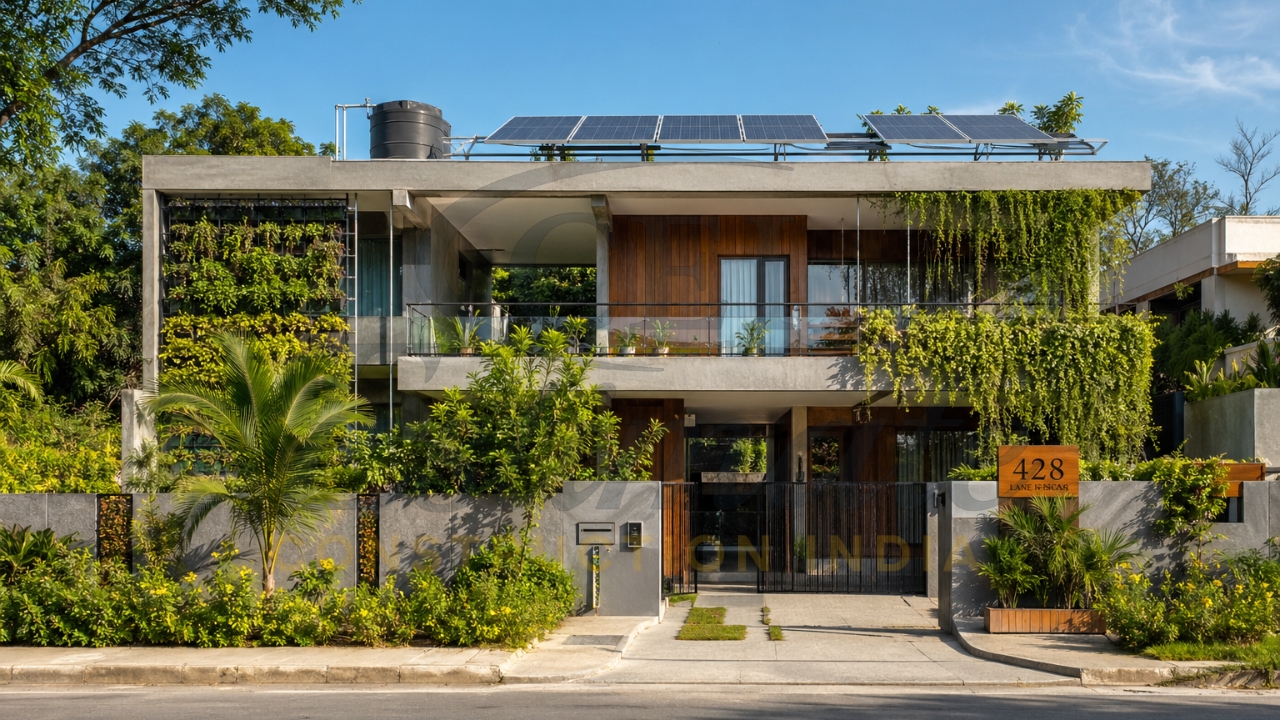
Green building construction refers to the practice of designing and building structures that use fewer natural resources, generate less waste, produce lower carbon emissions, and provide healthier indoor environments – over the entire lifecycle of the building.
In the Indian context, green building goes beyond just adding solar panels. It involves a holistic approach covering:
- Site selection and orientation – maximising natural light and ventilation to reduce energy loads
- Energy-efficient design – insulated walls, cool roofs, energy-efficient lighting and HVAC
- Water conservation – rainwater harvesting, dual plumbing, STP for water recycling
- Sustainable materials – AAC blocks, fly ash bricks, recycled steel, low-VOC paints
- Indoor air quality – non-toxic materials, proper ventilation, daylight access
- Waste management – construction waste reduction, on-site composting, segregation
According to the Indian Green Building Council (IGBC), India now has over 10 billion sq. ft. of green building footprint – one of the largest in the world. In 2026, this number is growing rapidly with new government mandates in states like Maharashtra, Tamil Nadu, and Haryana requiring green features in new construction above a certain built-up area.
Major Green Building Certifications in India 2026: IGBC, GRIHA & LEED Compared
Choosing the right certification is one of the biggest decisions in your green building journey. Here is a clear comparison of the top certification systems in India in 2026:
| Certification | Governing Body | Best For | Levels | Key Focus |
| IGBC Green Homes | Indian Green Building Council | Residential | Certified, Silver, Gold, Platinum | Energy, water, materials, IEQ |
| GRIHA | TERI / MoHUA | All building types | 1 to 5 Stars | Site planning, energy, water, waste |
| LEED India | IGBC (US Green Building Council) | Commercial / Large projects | Certified, Silver, Gold, Platinum | Energy, water, materials, innovation |
| BEE Star Rating | Bureau of Energy Efficiency | Energy efficiency | 1 to 5 Stars | Energy performance only |
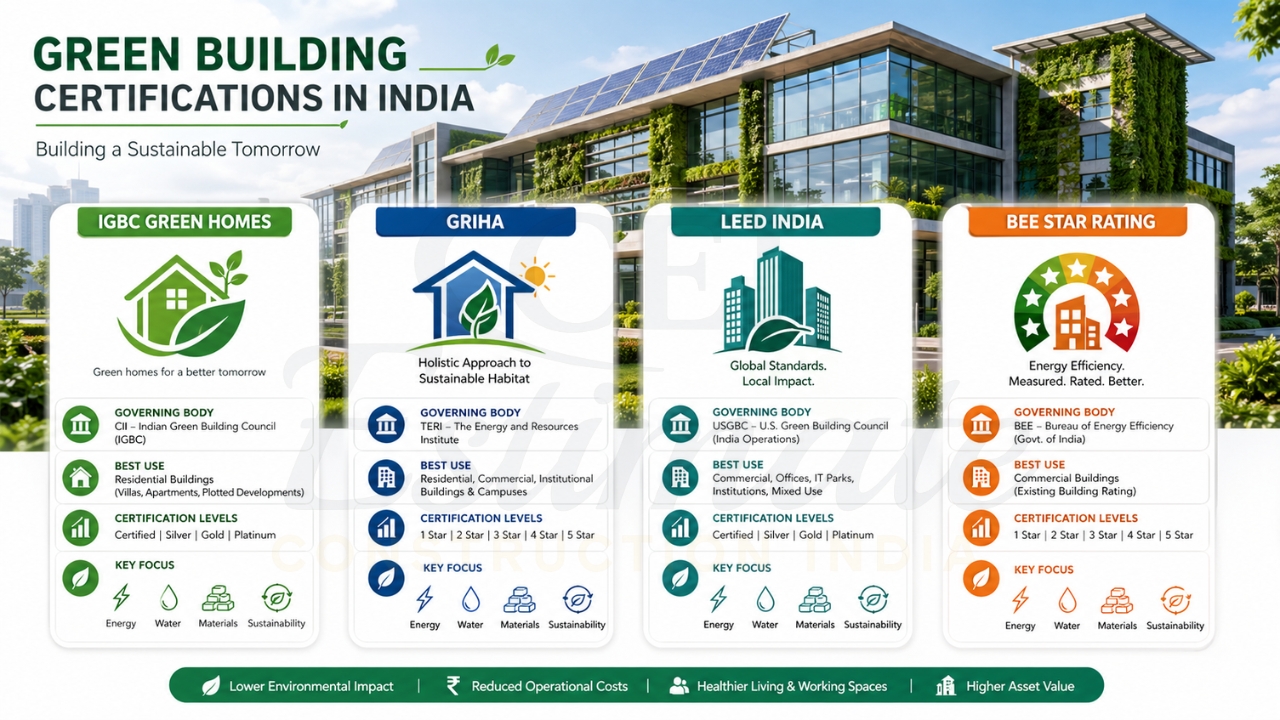
Which certification is best for green homes in India – IGBC or GRIHA?
For residential projects (individual houses, villas, housing societies): IGBC Green Homes is generally the most practical and widely recognised choice. It has specific criteria tailored for Indian housing, the process is well-supported, and it adds verifiable resale value.
GRIHA (Green Rating for Integrated Habitat Assessment) is excellent for government projects, institutional buildings, and developers who want a nationally mandated rating. GRIHA is also the preferred rating under several central and state government incentive schemes.
LEED India is best for large commercial buildings, IT parks, and projects targeting international tenants or ESG compliance. The certification cost is higher and the process more complex.
Pro tip from Construction Estimator India: If you are a homeowner building a 2,000–5,000 sq. ft. house, start with IGBC Green Homes Certified or Silver level. The cost premium is manageable and the long-term savings are significant. WhatsApp us at +91 8630676890 and we will help you map your current design against IGBC/GRIHA criteria and estimate the cost of getting certified.
Key Features of Green Building Construction
1. Energy Efficiency
Energy efficiency is the cornerstone of any green building. In India’s climate, this means:
- Building orientation to minimise east/west heat gain
- Insulated walls and roofs (AAC blocks, cavity walls, insulated panels)
- Double or low-E glazing on windows
- LED lighting with occupancy sensors
- 5-star or Inverter-rated HVAC systems
- Solar PV for electricity and solar water heating
2. Water Conservation
Water scarcity is a reality in most Indian cities. Green buildings address this through:
- Rainwater harvesting (RWH) systems – mandatory in many cities
- Low-flow fixtures (faucets, showers, flush tanks)
- Sewage Treatment Plants (STP) for water recycling in larger projects
- Drip irrigation for landscaping
3. Sustainable Materials
Green buildings use materials with lower embodied energy and environmental impact. (Detailed in the next section.)
4. Indoor Air Quality (IAQ)
- Low-VOC paints and adhesives to reduce toxic off-gassing
- Proper mechanical and natural ventilation design
- Cross-ventilation planning at design stage
- No asbestos, no formaldehyde-heavy products
5. Waste Management
- Construction waste plan – segregation of steel, concrete, wood waste for recycling
- On-site waste composting for organic waste during occupation
- Use of recycled content materials (fly ash bricks use coal combustion waste)
Best Green Building Materials Used in India 2026
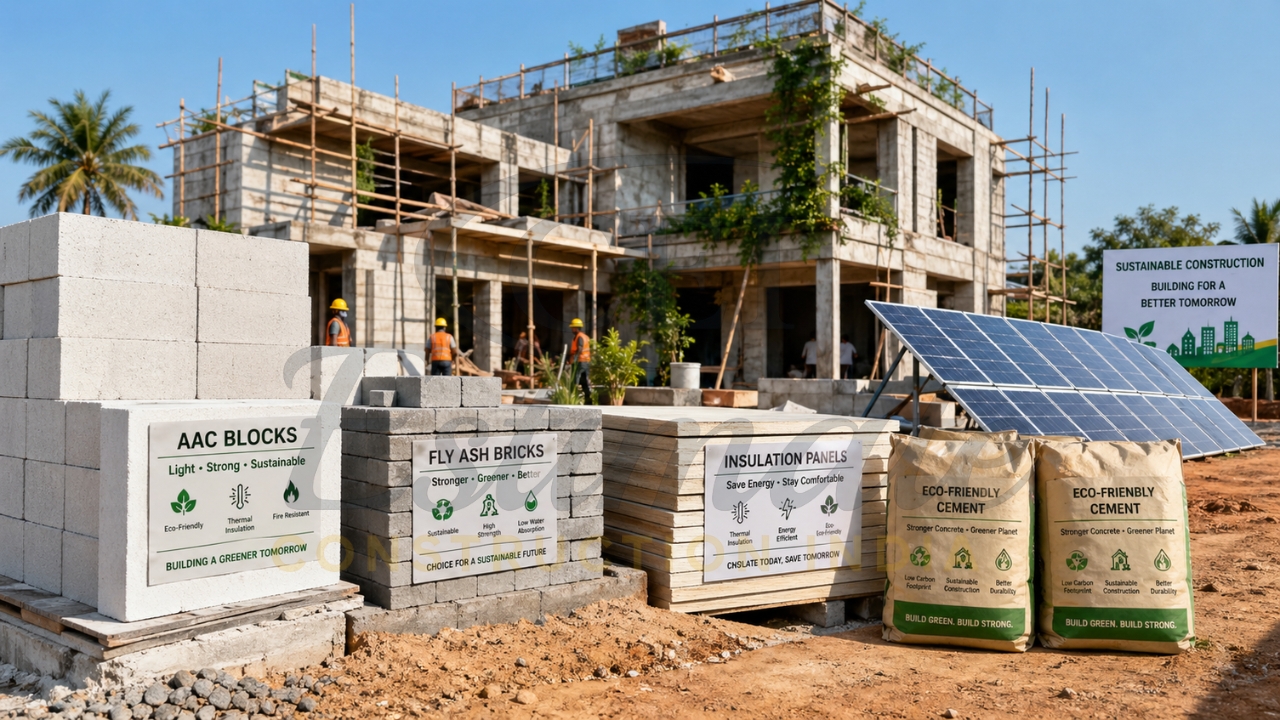
The right material choice drives both sustainability and long-term savings. Here are the most widely used green building materials in India in 2026:
- AAC (Autoclaved Aerated Concrete) Blocks – Lightweight, thermally insulating, and made with fly ash. AAC blocks reduce wall weight by 60% vs. red brick, cut masonry time, and improve energy performance. Cost: ₹40–₹55 per block (100mm)
- Fly Ash Bricks – Made from industrial waste (fly ash from thermal power plants), these are stronger, more uniform, and consume less energy to produce than clay bricks. Cost: ₹5–₹7 per brick (comparable to red brick but more eco-friendly)
- Insulated Wall Systems – EPS (Expanded Polystyrene) sandwich panels, cavity wall insulation, or external wall insulation systems that dramatically cut cooling/heating loads. Savings: 25–40% on AC electricity bills
- Low-VOC Paints – Water-based paints with minimal Volatile Organic Compounds. Brands like Berger EcoSure, Asian Paints Royale Aspira, and Nerolac Excel all offer compliant ranges. Cost premium: ₹5–₹15/sq.ft. over standard paint
- Double-Glazed / Low-E Glass Windows – Reduce solar heat gain significantly, cutting AC load. Essential for south-facing and west-facing facades. Cost premium: ₹150–₹250/sq.ft. of glass area
- Solar PV Panels – Monocrystalline panels are now highly affordable. A 3 kW system costs ₹1.5–₹2 lakh after PM Surya Ghar scheme subsidy (up to ₹78,000 for 2 kW systems). Most residential systems pay back in 5–7 years.
- Rainwater Harvesting (RWH) Systems – Roof-top collection, filtration, and underground sump storage. A basic residential RWH system costs ₹30,000–₹80,000 depending on roof area and storage capacity.
- Recycled Steel & Green Concrete – Specifying TMT steel with high recycled content and using Portland Pozzolana Cement (PPC) instead of OPC reduces embodied carbon by 20–30%.
- Terracotta Jaali & Sunshading Devices – Traditional Indian building elements that dramatically cut solar heat gain on west/south facades without affecting daylight. Cost-effective and maintenance-free.
- BIPV (Building-Integrated Photovoltaics) – Solar cells integrated into facade cladding or roofing material. A premium product gaining traction in 2026 for commercial green buildings in India.
Cost of Green Building Construction in India 2026
The most common fear: “Green building is too expensive.” The reality is more nuanced. Yes, there is an upfront cost premium – but it is significantly lower than most people assume, and the lifetime savings more than compensate.
Overall Cost Premium: Green vs. Conventional Construction
| Building Type | Conventional Cost (₹/sq.ft.) | Green Building Cost (₹/sq.ft.) | Premium % |
| Budget Residential (Tier 2 cities) | ₹1,400–₹1,800 | ₹1,600–₹2,100 | 10–15% |
| Mid-Range Residential (Metro) | ₹1,900–₹2,500 | ₹2,200–₹2,900 | 12–18% |
| Premium Residential | ₹2,800–₹4,000 | ₹3,200–₹4,700 | 10–20% |
| Commercial / Office | ₹2,200–₹3,500 | ₹2,600–₹4,200 | 15–22% |
Key insight: The 10–18% premium on a 1,500 sq. ft. house (at ₹2,000/sq.ft. conventional cost) translates to ₹3–₹5.5 lakh extra upfront. But annual savings on electricity and water bills alone can be ₹40,000–₹80,000 – giving full payback in 5–8 years, with 25+ years of continued savings.
Stage-wise Cost Breakdown of Green Features
| Green Feature | Approx. Cost (per sq. ft.) | Conventional Alternative | ROI Period |
| AAC Block walls | ₹25–₹40 premium | Red brick walls | 4–6 years (energy savings) |
| Solar PV (3 kW system) | ₹1.5–₹2 lakh total | Grid electricity only | 5–7 years |
| Rainwater Harvesting | ₹30,000–₹80,000 total | Municipal water only | 3–5 years |
| Double-glazed windows | ₹15–₹25 premium/sq.ft. | Single-pane glass | 6–8 years |
| Low-VOC paints | ₹5–₹10 premium/sq.ft. | Conventional paints | Health benefit – no payback needed |
| Green roof / insulation | ₹20–₹40 premium/sq.ft. | Conventional RCC roof | 5–7 years |
| IGBC / GRIHA certification fee | ₹1–₹3 lakh (residential) | No certification | Resale value premium 10–15% |
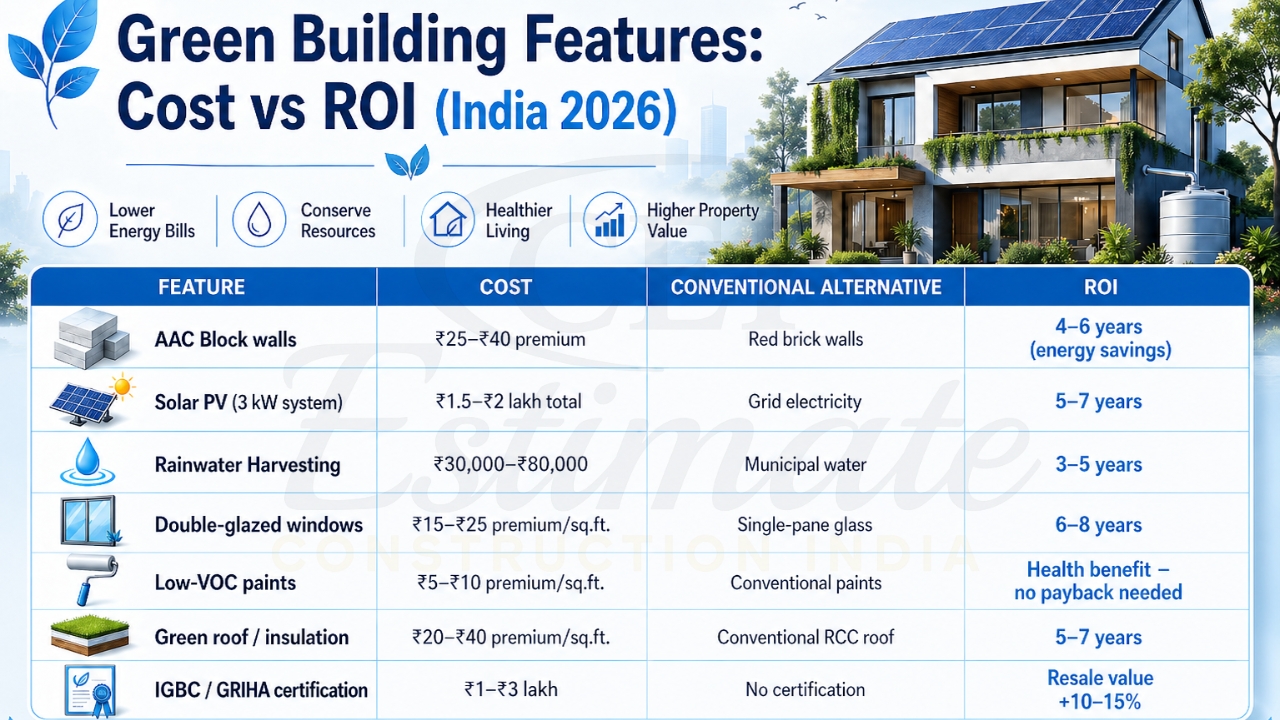
How much more does a green building cost in 2026?
For a typical 1,500–2,000 sq. ft. residential house in India, expect an upfront premium of:
- Basic green features only (AAC blocks, fly ash bricks, RWH, LED): ₹1.5–₹3 lakh extra
- Mid-level (above + solar PV, double glazing, low-VOC, insulation): ₹4–₹8 lakh extra
- Full green + IGBC certification: ₹8–₹15 lakh extra (includes certification fees and documentation)
Construction Estimator India prepares itemised BOQ for each green feature so you know exactly where the extra money goes – and which features give you the best ROI for your specific project.
Step-by-Step Process to Build a Green House in India
- Define your green goals – Decide which aspects matter most: energy savings, water conservation, indoor air quality, or certification. Your budget and location will also shape this.
- Choose your certification level – Consult an expert to decide between IGBC, GRIHA, or no formal certification (but still using green materials and practices).
- Select a green-aware architect or consultant – Ensure they have IGBC/GRIHA experience and can incorporate passive design principles from day one.
- Get accurate green building cost estimates – This is where Construction Estimator India helps. Before locking your design, get a detailed green BOQ and cost-benefit analysis. WhatsApp +91 8630676890.
- Design for passive performance – Optimise orientation, window sizes, shading, and cross-ventilation at the design stage (costs nothing but saves everything).
- Source green materials and verify compliance – Specify AAC blocks, fly ash bricks, low-VOC paints, and energy-efficient fixtures in your BOQ and ensure contractors source compliant products.
- Install active green systems – Solar PV, STP/RWH, HVAC with BMS (Building Management System) for large projects.
- Get third-party commissioning and certification – Submit documentation to IGBC or GRIHA for rating. Budget 6–12 months for this process.
- Monitor and optimise – Use smart meters and IoT sensors to track energy and water consumption post-occupancy.
Benefits of Green Building Construction in India
Building green delivers benefits at multiple levels – for you, your community, and the planet:
Financial Benefits
- 30–50% reduction in electricity bills through solar, insulation, and efficient systems
- 20–40% reduction in water bills through RWH and conservation fixtures
- 10–15% higher resale value for IGBC/GRIHA-certified homes (per JLL and Knight Frank India data)
- Faster lease-up for commercial green buildings with premium tenants
- Property tax rebates available in cities like Pune, Hyderabad, and New Delhi for green-certified buildings
Health & Comfort Benefits
- Better indoor air quality through low-VOC materials and proper ventilation
- More natural daylight reduces eye strain and improves well-being
- Stable indoor temperatures through insulation mean less AC dependence
- Reduced noise pollution with better wall and window systems
Environmental Benefits
- 30–40% lower carbon footprint over the building’s lifecycle
- Conservation of water resources in water-stressed Indian cities
- Reduced urban heat island effect through cool roofs and green landscaping
- Lower construction waste in landfills through material efficiency
Government & Policy Benefits in 2026
- PM Surya Ghar Muft Bijli Yojana: Subsidies up to ₹78,000 for rooftop solar (2–3 kW systems)
- PMAY (Pradhan Mantri Awas Yojana): Preference to green-rated affordable housing
- Green building FSI (Floor Space Index) bonus in Maharashtra (up to 7% additional FSI)
- Expedited building plan approval for green-certified projects in several states
- GRIHA-rated buildings preferred for Central Government institutional projects
How Construction Estimator India Helps You Build a Green Home?
At Construction Estimator India, we specialise in one thing: making sure you know exactly what your construction will cost before you spend a single rupee on it. For green buildings, this matters even more because the choices you make – which materials, which certifications, which systems – have long-term financial consequences.
Here is exactly what we do for green building projects:
- Green Building Cost Estimation: Detailed line-item cost comparison between your conventional construction plan and a green alternative – so you can see exactly where the extra cost lies and decide what to implement
- Detailed BOQ for Green Materials: Quantity takeoff and BOQ covering AAC blocks, fly ash bricks, insulated wall systems, solar PV, RWH systems, double glazing, low-VOC paints, and more – with current 2026 market rates
- ROI Analysis for Green Features: We calculate the payback period and 20-year financial benefit of each green feature so you can prioritise intelligently within your budget
- Certification Cost Mapping: We map your current design against IGBC or GRIHA criteria and estimate the cost of reaching your target certification level
- Value Engineering: We identify where you can substitute standard materials with green alternatives at minimal extra cost (e.g., switching from red brick to fly ash brick with near-zero premium)
Our Simple 4-Step Process
- WhatsApp us at +91 8630676890 with your plot details, project size, location, and green building goals
- Free preliminary green building cost estimate – Within 24–48 hours, receive a ballpark green vs conventional cost comparison for your project
- Detailed BOQ and green material schedule – Full quantity takeoff for all green materials and systems with current market rates
- ROI & certification roadmap – A clear financial case for your green investment including payback periods and certification recommendations
Frequently Asked Questions (FAQ) – Green Building Construction India 2026
1. What exactly qualifies as a green building in India?
A green building in India is one that uses less energy, water, and resources compared to a conventional building of the same type. It also provides a healthier indoor environment and reduces its environmental impact over its entire life. Formal green buildings are certified by bodies like IGBC or GRIHA, but many builders incorporate green features without formal certification.
2. How much does green building construction cost extra in India in 2026?
The cost premium for green buildings in India typically ranges from 10–20% over conventional construction costs, depending on the features chosen and the level of certification pursued. For a 1,500 sq. ft. home, this translates to roughly ₹2–₹6 lakh extra upfront, which is recovered through energy and water savings within 5–10 years.
3. Is IGBC or GRIHA better for residential projects in India?
IGBC Green Homes is generally preferred for residential projects in India because it has specific, practical criteria for housing. GRIHA is excellent for government and institutional buildings. Both are highly respected, and either adds resale value to your property. Your choice should depend on your location, project type, and which certification your state’s government offers incentives for.
4. Are there government subsidies or incentives for green buildings in India in 2026?
Yes. Key incentives include: PM Surya Ghar Muft Bijli Yojana (up to ₹78,000 subsidy for rooftop solar), property tax rebates in cities like Pune and Hyderabad, FSI bonus in Maharashtra, and priority approvals in many states. The incentive landscape varies by state – WhatsApp Construction Estimator India at +91 8630676890 for state-specific guidance.
5. Can I build a green house on a limited budget?
Absolutely. You do not need to implement every green feature at once. Start with the high-ROI basics: fly ash bricks or AAC blocks, proper building orientation, rainwater harvesting, LED lighting, and low-VOC paints. These add minimal upfront cost but deliver meaningful long-term savings. Add solar PV and insulation as budget allows.
6. What are the best green building materials to start with in India?
Fly ash bricks (near-zero premium over red brick) and AAC blocks (10–15% wall cost premium but big energy savings) are the best starting points. Follow with rainwater harvesting systems (often government-mandated anyway) and low-VOC paints (minor premium, major health benefit).
7. Do green buildings have better resale value in India?
Yes. Studies by JLL India and CBRE India consistently show that IGBC or GRIHA-certified buildings command 10–15% higher resale prices and rent 15–20% faster in commercial markets. As green awareness grows in 2026, this premium is likely to increase further.
8. How long does it take to get IGBC or GRIHA certification?
The certification process typically takes 6–18 months depending on the complexity of the project and documentation readiness. It is critical to register with the certifying body at the design stage – not after construction – to ensure all criteria can be met.
9. Do I need a special architect or contractor to build a green home?
Not necessarily a specialist, but your architect should be aware of passive design principles (orientation, shading, ventilation) and the specific requirements of your target certification. Construction Estimator India can provide detailed BOQ and material specs that help any architect or contractor understand what is needed for a green build.
10. Can Construction Estimator India help with green building BOQ and cost estimates?
Yes, absolutely. This is our core service. We prepare detailed BOQ for all green materials and systems with current 2026 market rates, calculate ROI for each green feature, and map your project against IGBC or GRIHA criteria. WhatsApp us at +91 8630676890 with your project details to get started.
11. What is the difference between a 5-star BEE rating and IGBC certification?
BEE Star Rating is purely about energy performance – it rates how energy-efficient a building is. IGBC and GRIHA certifications are holistic – they cover energy, water, materials, indoor air quality, site management, and more. For a comprehensive green building credential, IGBC or GRIHA is more valuable.
12. Is rainwater harvesting mandatory for new construction in India?
It depends on your state and plot size. Rainwater harvesting is mandatory for new constructions above 100–300 sq. metres in states like Maharashtra, Karnataka, Tamil Nadu, and Delhi. Many other states have similar regulations. Check with your local municipal authority – and regardless of mandate, it is an excellent investment that pays back quickly.
Conclusion – Build Smarter, Build Green in 2026
Green building construction in India 2026 is not a luxury – it is a smart investment in your family’s health, your finances, and India’s future. With materials like AAC blocks, fly ash bricks, and solar PV becoming more accessible, certifications like IGBC and GRIHA providing clear roadmaps, and government incentives making the economics even more compelling, there has never been a better time to build green.
The upfront premium – typically 10–18% over conventional construction – is recovered within 5–8 years through energy and water savings alone. Add certification-driven resale value premiums and government incentives, and green building is one of the soundest financial decisions a homeowner or developer can make in India today.
But none of this works without accurate cost planning from day one. That is exactly what Construction Estimator India provides: detailed green building cost estimates, precise BOQ for every sustainable material and system, and honest ROI analysis tailored to your project, location, and budget.