In the fast-paced Indian construction industry, most projects are executed through subcontractors. A poorly drafted subcontract agreement in construction can lead to disputes, delays, cost overruns, and legal battles. In 2026, with increasing project complexity and stricter compliance requirements, having a clear, comprehensive subcontract agreement is no longer optional — it is essential for risk management and smooth execution.
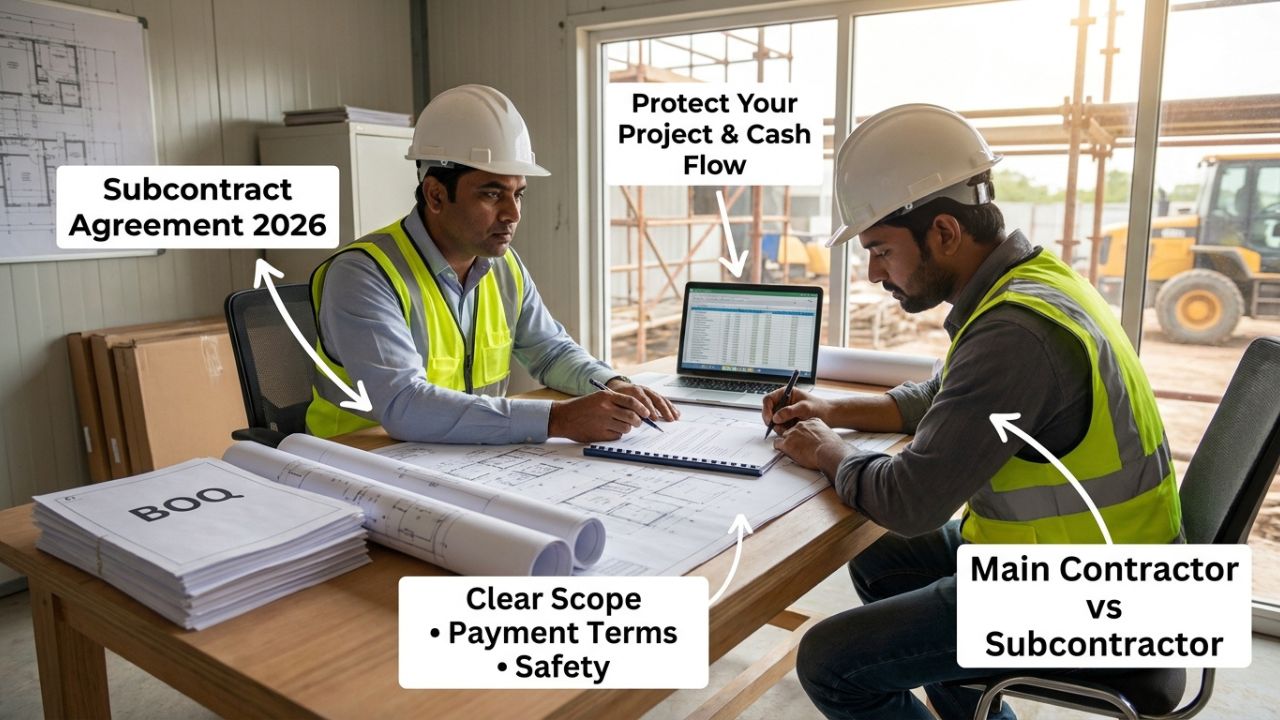
This detailed guide covers everything about subcontract agreement format India, key clauses, legal requirements, drafting process, and best practices for main contractors and subcontractors.
What is a Subcontract Agreement in Construction?
A subcontract agreement is a legally binding contract between the main contractor and a subcontractor for a specific portion of work. It defines the scope, timelines, payment terms, quality standards, and responsibilities of both parties while remaining under the umbrella of the main contract.
Why a Proper Subcontract Agreement is Essential?
- Clearly defines scope to prevent scope creep
- Protects cash flow through defined payment terms
- Reduces disputes and litigation risk
- Ensures compliance with labour laws and safety norms
- Helps in smooth project handover and defect liability management
A solid agreement strengthens your position during prequalification in construction tender in India.
Main Contractor vs Subcontractor: Roles and Responsibilities
Understanding the difference between a builder and a contractor helps clarify subcontracting dynamics. The main contractor remains responsible to the client for the entire project, while the subcontractor is accountable to the main contractor for their assigned portion.
Key Clauses Every Subcontract Agreement Must Include
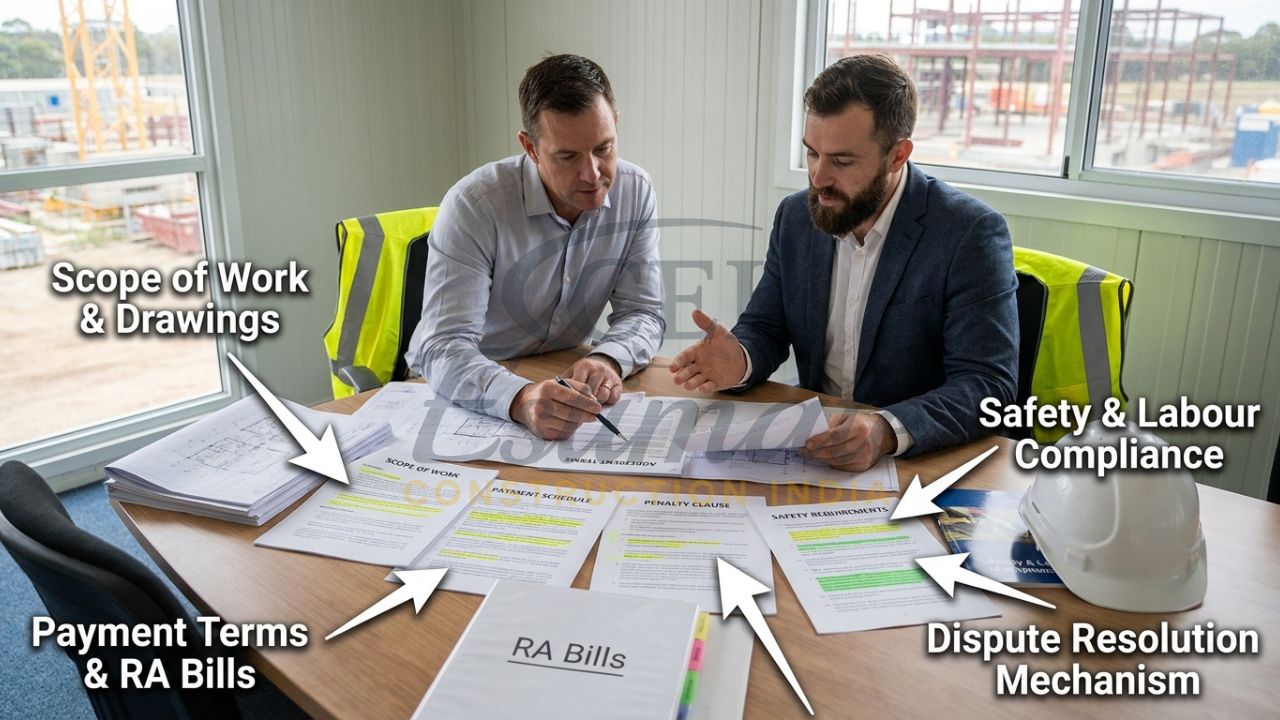
- Parties Involved — Full details of main contractor and subcontractor
- Scope of Work — Detailed description with drawings and specifications
- Contract Value & Payment Terms — Milestone-based or running bill system
- Timeline & Milestones — Start date, completion date, and penalties for delay
- Quality Standards & Testing — Reference to IS codes and approval process
- Safety & Labour Compliance — BOCW Act, insurance, and PPE requirements
- Insurance & Indemnity — Who bears what risk
- Termination Clause — Conditions for ending the agreement
- Dispute Resolution — Arbitration or mediation mechanism
- Force Majeure — Natural calamities, pandemics, etc.
Legal Requirements and Compliances for Subcontract Agreements in India 2026
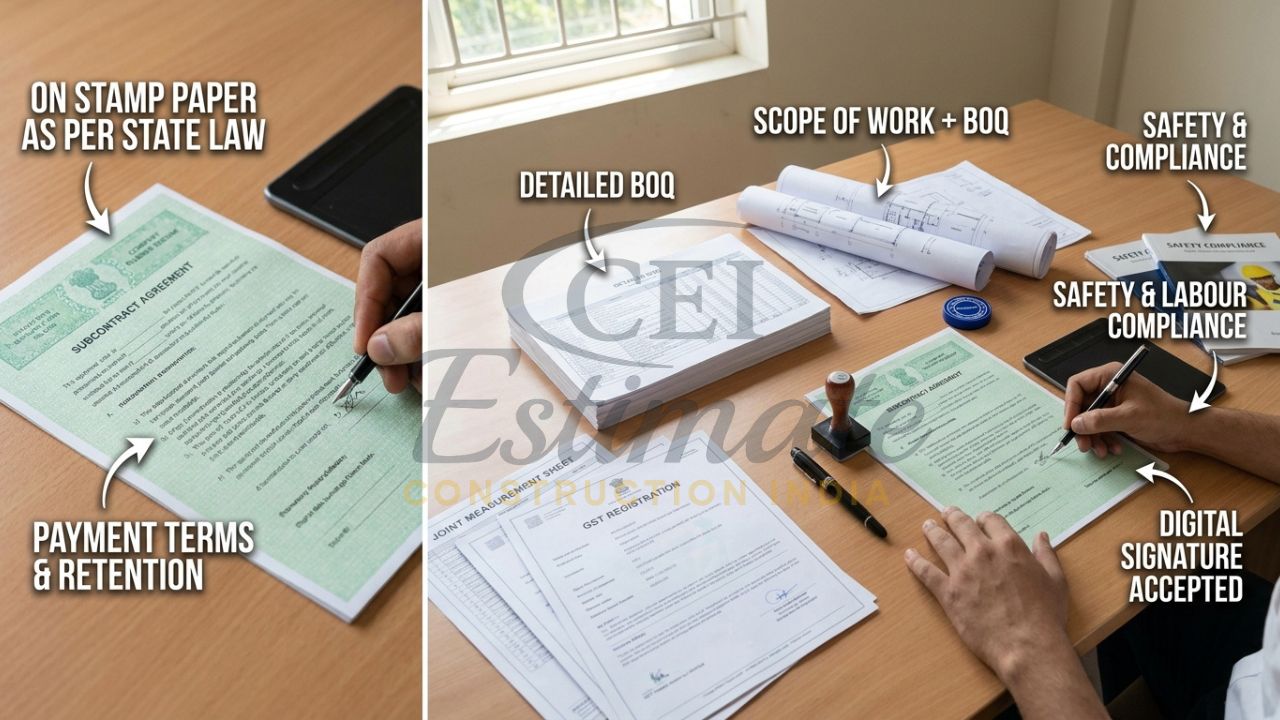
- Must be on stamp paper as per state law
- GST registration and proper invoicing mandatory
- Compliance with Contract Labour Act, EPF, ESIC
- Adherence to RERA (if applicable)
- Digital signatures accepted under IT Act 2000
Step-by-Step Guide: How to Draft a Subcontract Agreement
- Collect project details and main contract copy
- Define clear scope of work
- Fix rates, payment schedule, and retention percentage
- Include all statutory compliances
- Add protection clauses (defect liability, warranty)
- Get reviewed by a legal expert
- Execute on proper stamp paper with witnesses
Standard Subcontract Agreement Format & Sample Clauses
Sample Payment Clause:
“The Subcontractor shall submit Running Account Bills on a monthly basis. The Main Contractor shall release 75% payment within 15 days of certification, subject to 5% retention.”
Sample Delay Penalty Clause:
“In case of delay beyond the agreed milestone, the Subcontractor shall pay liquidated damages at the rate of 0.5% per week, subject to maximum 10% of the subcontract value.”
Always link your quantities with detailed estimate vs abstract estimate in construction for accuracy.
Payment Terms, Retention, and Penalty Clauses
- Running bills (RA Bills) every 15/30 days
- Retention money: 5–10%
- Release of retention: 50% after completion, 50% after defect liability period
- Price escalation clause (if project duration >12 months)
Common Risks in Subcontracting and How to Mitigate Them
- Scope disputes → Use detailed drawings and BOQ
- Payment delays → Define clear timelines and interest on delayed payment
- Quality issues → Mandatory stage inspections
- Labour disputes → Clear compliance responsibility
- Back-to-back risks → Flow-down clauses from main contract
Best Practices and Tips for Successful Subcontracting
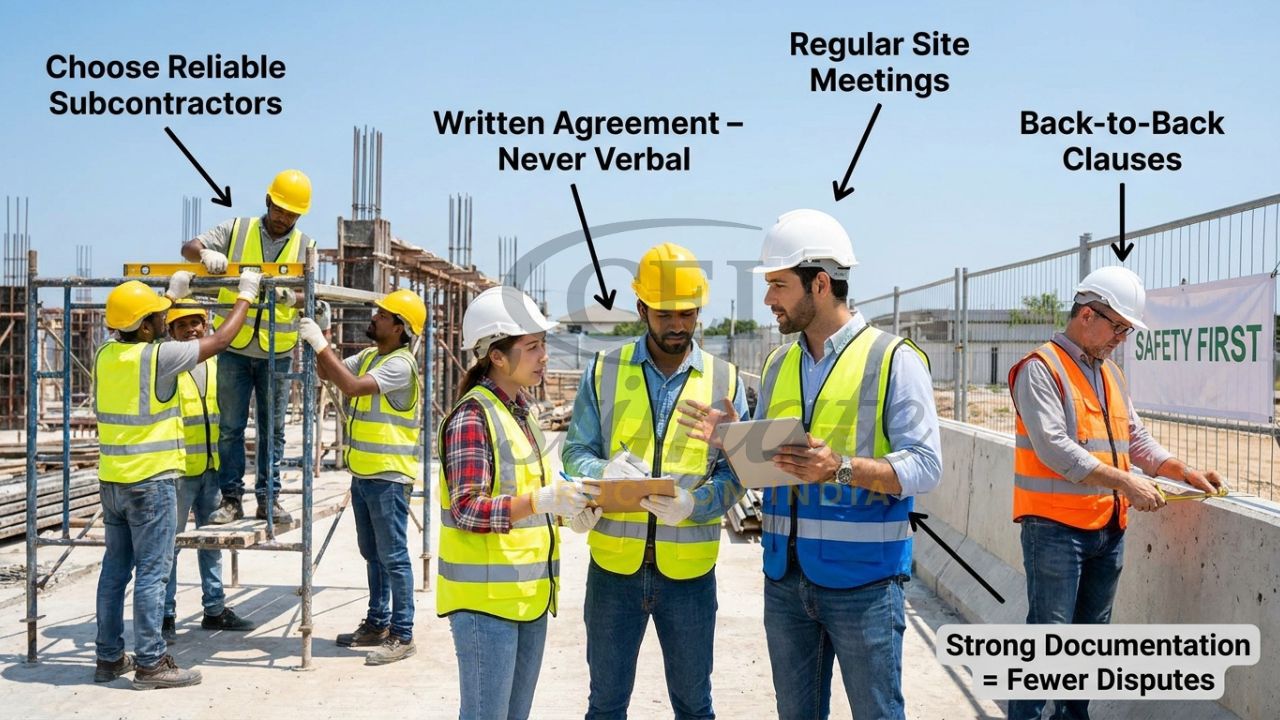
- Choose subcontractors with proven track record
- Always use written agreements — never verbal
- Maintain proper records and joint measurements
- Conduct regular site meetings
- Use best BOQ templates for interior works in India for specialized packages
- Build long-term relationships with reliable subcontractors
Conclusion
A well-drafted subcontract agreement in construction protects both main contractors and subcontractors, ensures smooth project execution, and minimizes disputes. In 2026, clear agreements are the foundation of profitable and stress-free project delivery.
The best construction management app is the one that fits your workflow, your project scale, and your business goals. In 2026, Indian contractors and builders need tools that improve site tracking, labour attendance, material management, billing accuracy, and documentation while keeping operations simple and efficient.
If you want expert help choosing the right software and connecting it with accurate estimation and BOQ services, contact Construction Estimator India today on WhatsApp +91 8630676890. A better digital workflow can help you reduce delays, improve cost control, and build a more profitable construction business.
FAQs
- Is a subcontract agreement legally compulsory?
Yes. It is highly recommended and often mandatory for large projects to avoid disputes.
- What stamp paper value is required?
It varies by state — usually ₹100 to ₹500 depending on contract value.
- Can a subcontractor claim payment directly from the client?
Generally no, unless there is a specific tripartite agreement.
- What is back-to-back subcontracting?
When the subcontractor’s terms mirror the main contract terms.
- How much retention is standard?
5% to 10% is common in Indian construction contracts.
- Who is responsible for subcontractor labour safety?
The subcontractor is primarily responsible, but the main contractor has overall accountability.
- Can I use a simple template or do I need a lawyer?
Use a good template as base, but always get it reviewed by a construction lawyer.
- Is GST applicable on subcontract payments?
Yes, usually 18% on works contract services.
- What happens if subcontractor delays the work?
Main contractor can impose penalty as per agreement and recover losses.
- Should subcontract agreement be registered?
Not mandatory but recommended for high-value contracts.