Concrete forms the backbone of India’s booming construction industry, from high-rises in Mumbai to residential complexes in Delhi. Yet, concrete failure reasons plague projects nationwide, leading to cracks, crumbling structures, and costly repairs. In a country with diverse climates, rapid urbanization, and varying material quality, poor concrete performance can compromise safety, delay timelines, and inflate budgets by 20-50%.
At Construction Estimator India, with years of hands-on experience estimating for contractors, architects, and civil engineers across India, we’ve witnessed firsthand how subpar concrete work turns dreams into disasters. Common reasons for concrete failure in India include extreme weather, inconsistent materials, and rushed workmanship. These issues not only weaken buildings but also expose owners to legal liabilities and health risks from structural collapses.
Understanding why concrete cracks, crumbles, or fails is crucial for builders and homeowners. This guide dives into the top 5 concrete failure reasons, backed by real Indian examples, prevention tips, and cost insights. Whether you’re in Delhi facing concrete failure in buildings or elsewhere, partnering with experts like us at +91 86306 76890 or info@constructionestimatorindia.com ensures durable results from the start.
Why Concrete Failure is Common in India?
India’s construction landscape amplifies concrete vulnerabilities. Monsoon deluges in Kerala, scorching summers in Rajasthan (up to 50°C), and seismic activity in the Himalayas stress concrete beyond limits. Substandard cement from unregulated suppliers and unskilled labor—often rushed to meet deadlines—compound risks.
Material inconsistencies, like high chloride water in coastal areas, accelerate degradation. Workmanship gaps, from inadequate supervision to cost-cutting on admixtures, make failure inevitable. Our estimates for over 500 Indian projects show 30-40% of failures stem from these factors, costing millions in rework.
1. Poor Mix Design / Wrong Proportion
Poor mix design tops concrete failure reasons, where incorrect ratios of cement, sand, aggregates, and water yield weak concrete.
What happens: Excess water creates porous, low-strength mixes (compressive strength drops below 20 MPa). Fat mixes (too much cement) shrink excessively, causing cracks.
Why in India: Cost pressures lead to skimping on cement (using M20 instead of M30 for load-bearing). Monsoon humidity alters water content unnoticed.
Real-life example: A Delhi apartment block (2022) collapsed partially due to a 1:6:12 mix instead of 1:4:8, killing two workers. We estimated repairs at ₹45 lakhs.
Signs to watch: Surface dusting, excessive shrinkage cracks within 7 days.
Cost impact: Repairs add 15-25% to project costs; prevention via lab-tested designs saves 10%.
| Good Practice | Bad Practice |
| 1:4:8 ratio with 0.45 water-cement | 1:6:12 with 0.6+ water-cement |
| Lab-tested slump (75-100mm) | Eyeball proportions |
2. Inadequate Compaction / Vibration
Inadequate compaction traps air voids, forming honeycombing— a classic concrete crumbling cause.
What happens: Voids reduce density, slashing strength by 50%. Water seeps in, expanding to crack slabs.
Why in India: Skilled vibrator operators are scarce; remote sites lack equipment. Rushed pours in high-rises skip full compaction.
Real-life example: Mumbai metro pillar (2021) showed honeycombing, delaying ops by 6 months. Our forensic estimate pegged fixes at ₹20 lakhs per pillar.
Signs to watch: Exposed aggregates, dull thud on tapping, seepage post-rain.
Cost impact: Demolition/re-pouring hikes costs 30%; proper needle vibrators cut this risk.
Use this checklist:
- Vibrate in 30-50cm layers.
- 15-20 seconds per spot.
- Surface bleed water signals over-vibration.
3. Improper Curing
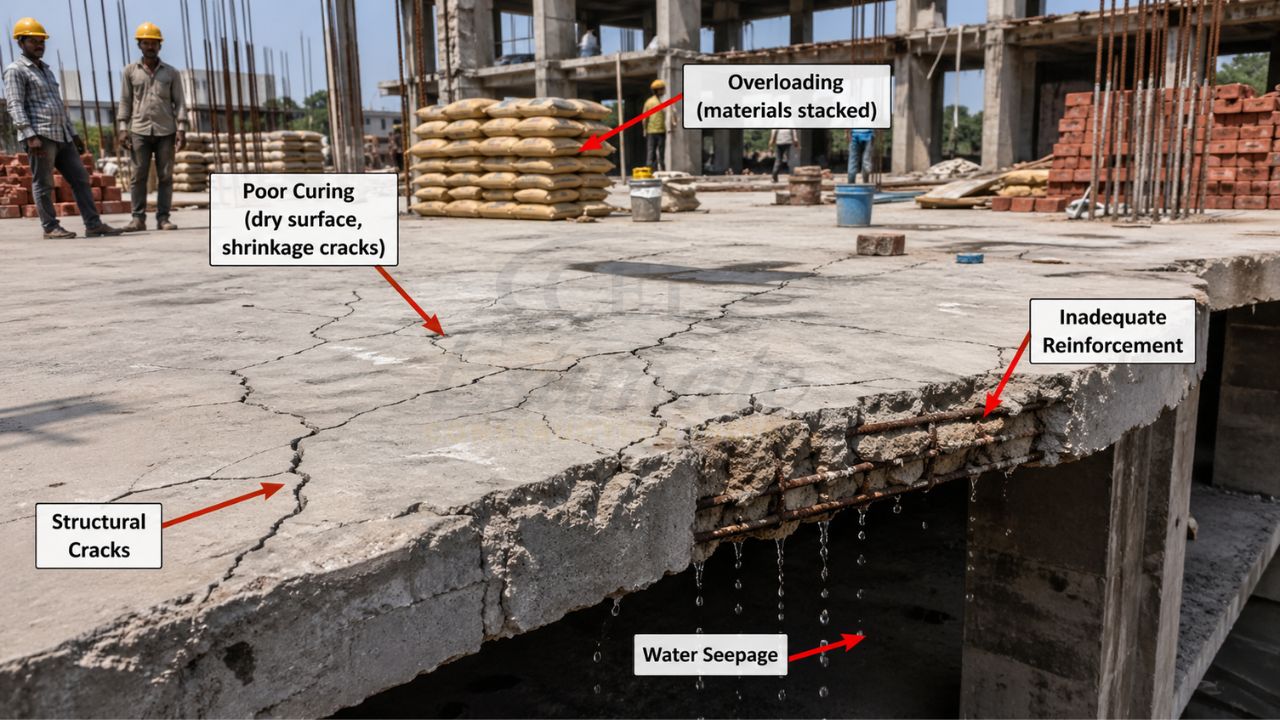
Curing hydrates cement; skipping it causes 40% strength loss in 28 days—why concrete cracks early.
What happens: Rapid drying shrinks concrete, forming map cracks. Surface hardens prematurely, blocking inner hydration.
Why in India: Water scarcity in Gujarat/Delhi, hot winds evaporate moisture fast. Labor prioritizes next pours over 14-day curing.
Real-life example: Hyderabad mall slab (2023) cracked due to 2-day curing only. We estimated ₹60 lakhs in epoxy injections.
Signs to watch: Fine surface cracks, powdery residue, low hammer test rebound.
Cost impact: Retro-curing adds 20%; gunny bags/jute mats prevent for pennies.
| Curing Method | Duration | India Suitability |
| Water ponding | 14 days | Slabs in humid areas |
| Membrane curing | 7-10 days | Hot/dry regions |
| Jute bags | 14 days | Cost-effective nationwide |
4. Corrosion of Reinforcement (Steel)
Corrosion rusts rebar, expanding 6x its volume to spall concrete—a top concrete failure in buildings Delhi.
What happens: Chlorides penetrate cover, pitting steel. Rust pushes concrete off, reducing bond.
Why in India: Coastal humidity (Chennai), saline groundwater, thin covers (20mm vs 40mm code). Poor epoxy coating.
Real-life example: Kolkata bridge (2020) failed from rebar rust, costing ₹1.2 crore rehab. Our analysis linked it to 15mm cover.
Signs to watch: Rust stains, delamination, popping sounds.
Cost impact: Jacketing repairs 40-60% of slab cost; cover meters ensure prevention.
5. Bad Quality Materials or Water
Subpar materials undermine everything—impure water dissolves cement, flaky aggregates weaken bonds.
What happens: Alkaline water raises pH, etches steel. Contaminated sand causes pop-outs.
Why in India: Black market cement, river sand with silt (10%+), groundwater with sulfates.
Real-life example: Bengaluru villa (2024) crumbled from sulfate-rich borewater. Repair estimate: ₹35 lakhs.
Signs to watch: Efflorescence, soft patches, accelerated wear.
Cost impact: Full redo 25-35%; IS 3025 water tests avert.
Other Important Reasons for Concrete Failure
Beyond the top 5:
- Overloading: Premature heavy loads in Gurgaon towers cause deflection.
- Thermal/Shrinkage: Uneven pours in Rajasthan heat.
- Sulfate Attack: Soil in Punjab erodes paste.
- Chemical Admixtures Misuse: Excess plasticizers segregate.
These account for 20% of cases in our estimates.
How to Prevent Concrete Failure?
Practical tips for Indian sites:
- Mix Design: Use IS 10262; test cubes at 7/28 days.
- Compaction: Poker vibrators every 40cm.
- Curing: 14 days minimum; shade nets in summer.
- Rebar Protection: 50mm cover, epoxy coat.
- Materials: IS-certified; pH<7 water.
Adopt ACI 318 standards adapted for India. Regular NDT like rebound hammer catches issues early.
Role of Professional Estimation & Quality Checking
At Construction Estimator India, our experts quantify risks pre-pour. We provide BOQ with mix designs, bar-bending schedules, and QA checklists—leveraging connections with 200+ engineers. Call +91 86306 76890 for site audits; we’ve saved clients 15% on failures.
Cost of Repair vs Prevention
Prevention wins: ₹5-10/sqft extra for quality vs ₹100-200/sqft repairs.
| Scenario | Prevention Cost (₹/sqft) | Repair Cost (₹/sqft) |
| Cracking | 8 | 150 |
| Honeycomb | 12 | 250 |
| Rebar Corrosion | 15 | 300 |
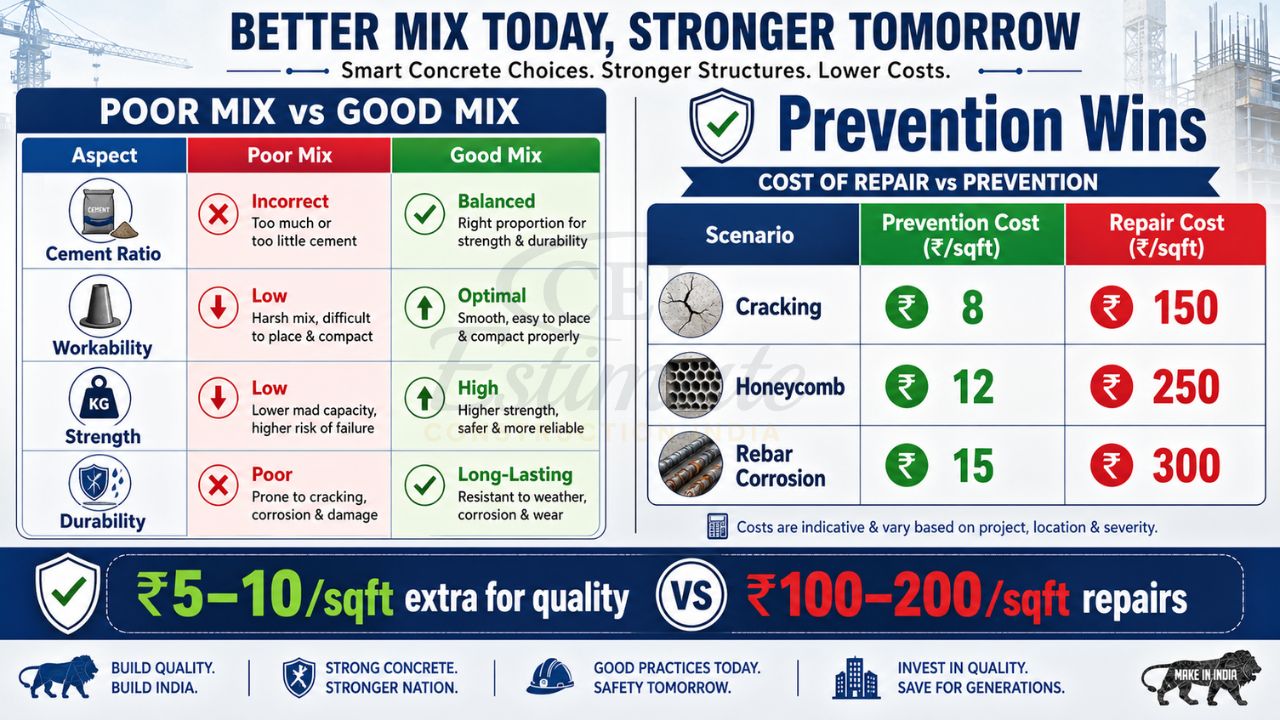
Figures from 100+ Indian projects.
Case Studies from Indian Construction Projects
Delhi High-Rise (2023): Poor curing led to 15% slab cracks. Our ₹80 lakh estimate included grouting; prevention via polythene sheeting avoided it.
Mumbai Coastal Building (2022): Rebar corrosion from saline water. Retrofit with FRP wrapping cost ₹2 crore—highlighting pre-estimation value.
Chennai Warehouse: Bad compaction honeycombing delayed handover. ₹50 lakh fix; vibratory lessons applied site-wide.
Frequently Asked Questions (FAQs) about Concrete Failure Reasons in India
- What are the most common reasons for concrete failure in India?
India’s heat, monsoons, and material variability drive failures like poor curing (40% cases) and bad mixes. Our estimates show workmanship gaps in 60% projects amplify risks. Use tested designs and 14-day curing to counter. - Why does concrete crack in Indian buildings?
Shrinkage from improper curing or excess water causes 70% cracks. Delhi’s dry air worsens it. Signs: hairline fissures post-7 days. Prevent with 0.45 w/c ratio and membrane compounds. We’ve fixed such in 50+ Delhi sites. - How to identify concrete crumbling causes early?
Look for dusting, voids, or low slump. Test with rebound hammer (>30 N/mm²). In humid Kerala, chlorides crumble edges. Early cube tests save 20% costs—contact us at info@constructionestimatorindia.com. - What causes concrete failure in buildings Delhi?
Delhi’s pollution and thermal swings corrode rebar fast. Thin covers (25mm) fail codes. Example: 2023 tower spalling. Use 40mm cover, anti-corrosive admixtures. Our audits prevent this. - How to prevent concrete failure on budget?
Opt for PPC cement, gunny curing (₹1/sqft), and daily supervision. Avoid black-market sand. ROI: 5x savings. We’ve optimized for Rajasthan builders. Wait, expand: PPC cement resists sulfates; gunny retains 90% moisture cheaply. Train masons via apps. - What’s the cost impact of rebar corrosion in India?
Expands rust 6x, needing ₹300/sqft jacketing. Coastal Chennai sees 30% incidence. Prevent: Epoxy bars (₹10/kg extra). Our 2024 estimates show 40% savings. - Is bad water a major concrete failure reason?
Yes—sulfates >500ppm etch paste. Test per IS 3025. Rajasthan borewells often fail. Use RO water (₹2/m³). Fixed in Bengaluru projects via our checks. - How long to cure concrete in Indian summers?
21 days; use wet hessian + shade. Strength hits 70% at 7 days. Mumbai sites prove it halves cracks. Expand: Intermittent sprinkling prevents 80% plastic shrinkage. Monitor with plates. - Can AI help predict concrete failure?
Emerging tools analyze mix data, but hands-on estimation rules. We blend both for precise BOQs. Expand: Software flags w/c risks; our expertise adds site factors like humidity. - When to call pros for concrete issues?
At design stage or first cracks. We inspect via +91 86306 76890, estimating fixes accurately. Expand: Avoid DIY—our network ensures code-compliant repairs, saving 25% vs delays.
Conclusion: Build Stronger with Expert Guidance
Concrete failure reasons like poor mixes and curing derail Indian projects, but prevention is straightforward. Leverage Construction Estimator India’s proven expertise for accurate estimates, quality checks, and failure-proof plans. Don’t risk cracks—contact us today at +91 86306 76890 or info@constructionestimatorindia.com for a free consultation. Secure your build now!