In the high-stakes world of Indian real estate and infrastructure—now heavily guided by frameworks like RERA—the difference between a profitable venture and a financial disaster often lies in a single document: the cost estimate. Knowing how to choose a construction estimator is arguably more critical than selecting your primary building contractors, yet it is a step many developers and homeowners overlook. A professional estimator acts as your financial navigator, ensuring that every bag of cement and every hour of labour is accounted for before the first shovel hits the ground.
Whether you are a seasoned developer in Mumbai, a growing contractor in Delhi, or an NRI planning a dream home in Kerala, the accuracy of your Bill of Quantities (BOQ) determines your project’s viability. Hiring the wrong person can lead to “budget creep,” where costs spiral out of control, or worse, “under-pricing,” where a contractor wins a bid but cannot afford to finish the work.
👉 Hire a Construction Estimator You Can Trust—Get Accurate Estimates from Experienced Professionals.
In this comprehensive guide, we will explore the essential criteria for selecting a professional partner. We will discuss the necessity of local experience, the clarity of documentation, and the importance of technological proficiency. We will also introduce you to Construction Estimator India, a brand dedicated to providing forensic-level cost breakdowns for projects across the country.
If you want a professional opinion on how to choose a construction estimator for your project, you can contact Construction Estimator India on WhatsApp / Call +91 8630676890.
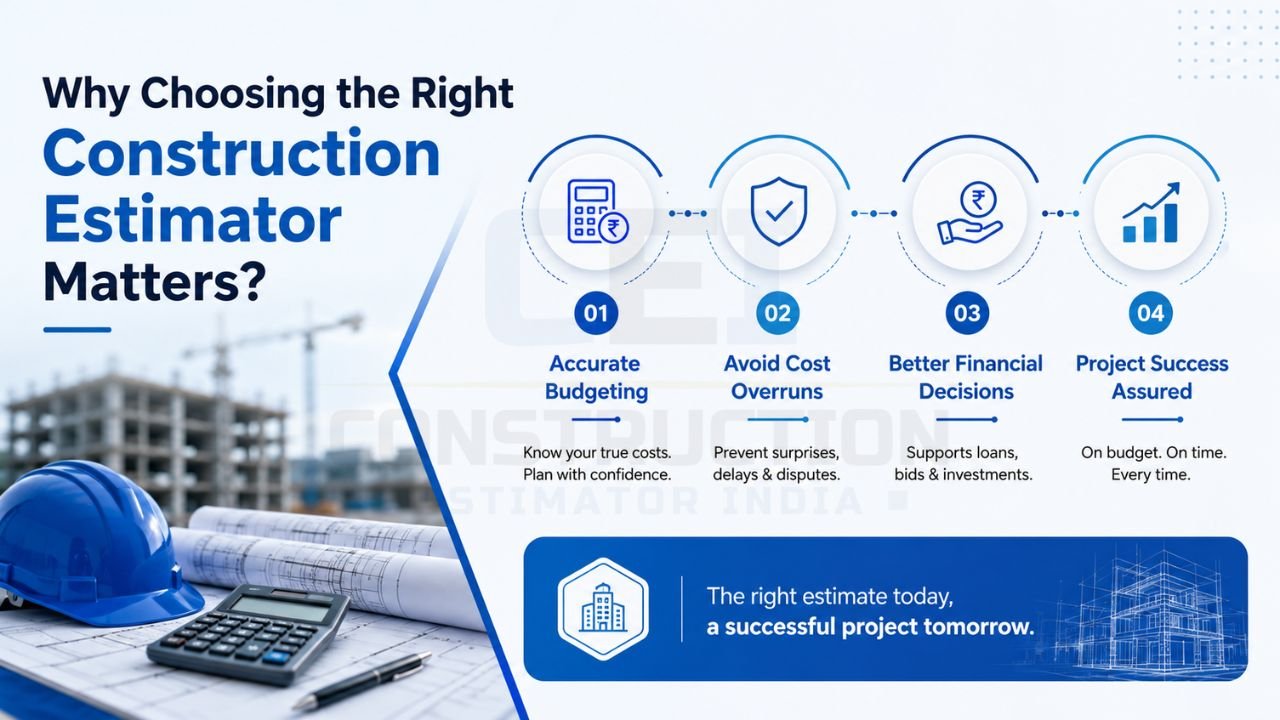
Why Choosing the Right Construction Estimator Matters?
The construction estimator is the architect of your project’s finances. Their work influences your tender price, the total budget you set aside, and the loan amount you request from banks. In the Indian context, where material prices fluctuate and labour availability varies by region, an inaccurate estimate is a recipe for dispute.
Consider a contractor who wins a large commercial project by submitting the lowest bid. Mid-way through, they realize the estimator missed the technical complexity of the HVAC system or underestimated the local cost of high-grade steel. The contractor now faces a choice: cut corners on quality, halt work to renegotiate, or suffer a massive financial loss. None of these outcomes are desirable.
Conversely, for a homeowner, under-budgeting can lead to a “half-finished shell” syndrome. If the initial estimate was too optimistic, the owner might run out of funds just as the finishing works—and managing the massive plaster cost per square foot with material in India—begin. A professional estimator helps avoid these pitfalls by providing a realistic roadmap of expenses.
👉 Make Every Construction Decision with Confidence Through Accurate Cost Estimation.
7 Things to Check Before Hiring a Construction Estimator in India
Understanding exactly how to plan home construction in India and choose your estimator requires a systematic approach. You are not just hiring someone who is good with numbers; you are hiring a consultant who understands engineering, local markets, and project management.
1. Relevant Experience in Indian Projects
India’s construction landscape is unique. From the seismic risks in Uttarakhand to the humid coastal conditions of Chennai, materials and methods change significantly. You must check if the estimator has handled projects similar to yours.
- Why it matters: An estimator who only knows residential villas might struggle with the complexities of a commercial high-rise or an industrial warehouse built to Central Public Works Department (CPWD) standards. Local knowledge of material grades (e.g., Fe500 vs. Fe550 steel) and mastering what is RCC construction is essential for accuracy.
- The Check: Ask for a portfolio. If you are building a commercial office, ask if they have handled advanced fire safety or structural spans before.
- Example: A “bad” case involves an estimator using generic national averages for sand and aggregate in a region where local mining bans have doubled prices. A “good” case involves an estimator who identifies these regional spikes early, allowing for a realistic contingency.
2. Ability to Prepare Clear BOQs and Quantity Takeoffs
A Bill of Quantities (BOQ) should be a transparent list of every item and its cost, not a vague summary.
-
Why it matters: A detailed BOQ prevents “hidden charges” later on. It allows you to compare different contractor quotes and pin down an accurate baseline house construction per sq ft rate on an “apples-to-apples” basis.
- The Check: Look for item-wise breakdowns, correct units (cum, sqm, kg), and clear descriptions of the work involved.
- How we handle it: Construction Estimator India specializes in forensic-level quantity takeoffs and structured BOQs that serve as a transparent foundation for the entire project.
3. Transparency of Assumptions, Rates, and Inclusions/Exclusions
No estimate is perfect, but every estimate should be honest about its limitations.
- Why it matters: If an estimate assumes “standard grade” flooring but you want “premium Italian marble,” the numbers will be useless. Transparency regarding what is not included is just as important as what is.
- The Check: Ask the estimator to provide a list of assumptions. What is the assumed cement price? Are taxes registered through the GST Portal and transportation included?
- Example: A professional will clearly state if the estimate excludes the cost of temporary electricity connections or site office setup, preventing a 5% “surprise” cost later.
4. Use of Tools, Software, and Standard Methods
In the digital age, manual calculations on scraps of paper are no longer acceptable.
- Why it matters: Digital estimation allows for faster updates when drawings change. It also ensures that standard measurement codes (like IS 1200, strictly regulated by the Bureau of Indian Standards (BIS)) are followed consistently.
- The Check: Ask if they use specialized estimation software or at least highly systematic, formula-driven spreadsheets.
- The Benefit: Organized digital data is easier to share with stakeholders and track throughout the construction lifecycle.
5. Communication Skills and Response Time
An estimator who cannot explain their numbers is a liability.
- Why it matters: Construction is dynamic. You will have questions about why a certain quantity is high or how a change in design affects the bottom line.
- The Check: During the initial consultation, gauge how well they listen. Do they ask clarifying questions about your drawings?
- Construction Estimator India prides itself on maintaining clear, professional communication, acting as consultants who guide you through financial decisions.
6. Understanding of Your Project Goals and Constraints
Your project is not just a set of drawings; it has a purpose and a budget limit.
- Why it matters: If your goal is a high-speed “turnkey” handover, the estimate must reflect premium labour or pre-cast methods. If your goal is maximum ROI for a rental property, the estimator should suggest “Value Engineering”—identifying cost-effective alternatives without compromising safety.
- The Check: See if they suggest ways to save money during the estimation phase. This shows they are thinking about your success, not just filling out a form.
7. Reputation, References, and Sample Work
Never hire an estimator based solely on the lowest fee they charge you.
- Why it matters: An estimator who charges ₹5,000 but misses ₹5,00,000 worth of steel is the most expensive person on your team.
- The Check: Ask for references or testimonials from previous clients. Request a sample BOQ (with project names redacted) to see the level of detail they provide.
- Expert Tip: Repeat clients are the best sign of a reliable estimator.
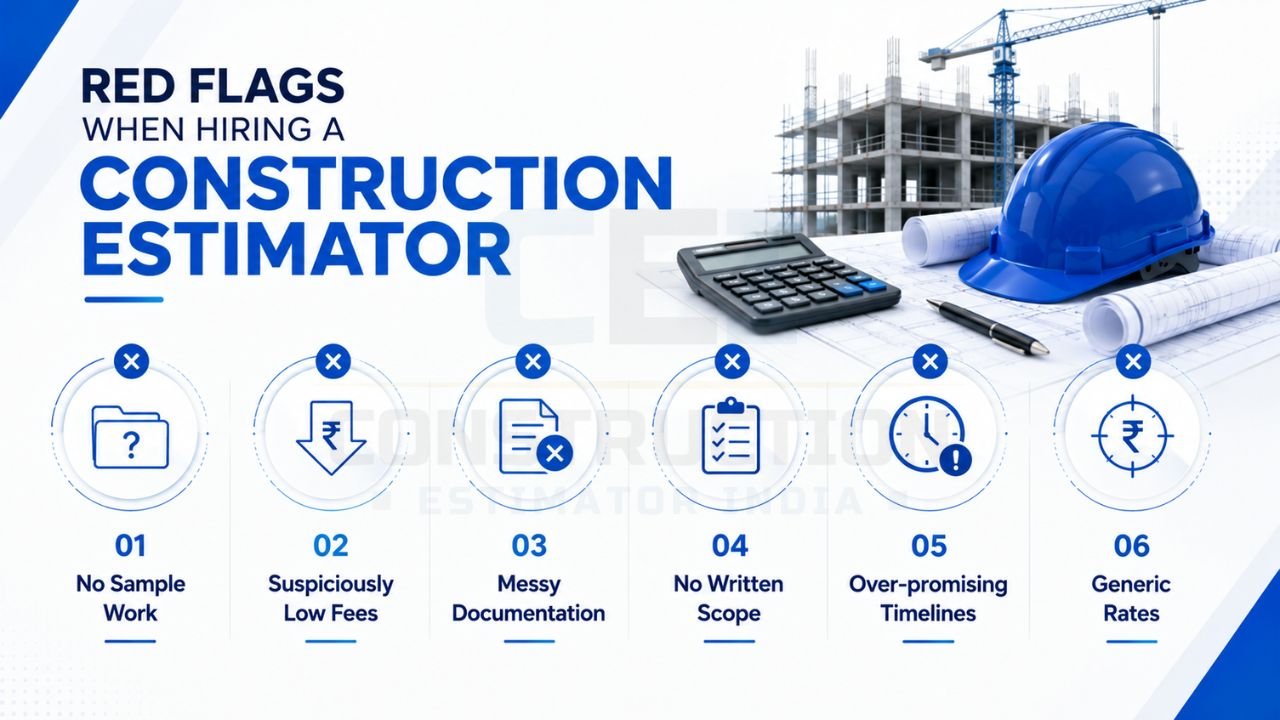
Red Flags When Hiring a Construction Estimator
When evaluating how to choose a construction estimator, keep an eye out for these warning signs:
- No Sample Work: If they cannot show you what a finished BOQ looks like, they likely lack a systematic process.
- Suspiciously Low Fees: If their fee is a fraction of the market rate, they may be using “per square foot” shortcuts rather than detailed takeoffs.
- Messy Documentation: Typoes in units or missing sections in a sample BOQ suggest a lack of attention to detail.
- No Written Scope: If they won’t put in writing what they will provide (e.g., just the BOQ or also rate analysis), expect disputes later.
- Over-promising Timelines: Quality estimation takes time. Anyone promising a full commercial BOQ in 24 hours is likely cutting corners.
- Generic Rates: Using the same rates for a project in a metro city and a remote village without checking local market conditions.
👉 Build Smarter with Accurate Estimates That Keep Your Project on Time and Within Budget.
How to Discuss Scope and Fees with a Construction Estimator?
Once you have a shortlist, you need to finalize the contract.
Defining Scope Clearly
Be specific about what you are providing. Do you have full structural and architectural drawings? Do you need a Bill of Quantities (BOQ), a detailed cost estimate, or support during the tender process? Clarifying these “outputs” ensures everyone is on the same page.
Agreeing on Timelines and Format
Construction moves fast. Agree on a delivery date for the first draft and the final version. Ensure the output is in a format you can use (like a protected Excel sheet or a detailed PDF).
Agreeing on Fees and Payment Terms
Be clear on whether the fee includes revisions. If the lead planner from top architects and architecture firms changes the design mid-way, will the estimator charge extra to update the numbers? Having this in writing prevents awkward conversations later.
If you want to discuss scope, timelines, and fees with a professional estimator, contact Construction Estimator India on WhatsApp / Call +91 8630676890.
How to Choose a Construction Estimator for Different Project Types?
Different projects require different “flavours” of expertise:
- Residential Projects: Focus on finishings. A house estimator needs to be an expert in tiles, woodwork, and plumbing fixtures, as these often make up 40% of the cost.
- Commercial Projects: Focus on MEP (Mechanical, Electrical, Plumbing). Offices and malls have complex HVAC, fire suppression, and data cabling requirements that need specialized knowledge.
- Industrial Works: Focus on structural spans and specialized flooring. These projects often involve massive quantities of steel and concrete with very specific technical requirements.
Construction Estimator India works across all these project types, providing customized, negotiable pricing based on the specific complexity of your build.
FAQs: How to Choose a Construction Estimator in India
What is the most important factor in how to choose a construction estimator?
The most critical factor is their ability to produce a detailed and transparent Bill of Quantities (BOQ). A simple “total cost” number is not enough; you need to see the “how” and “why” behind every rupee to avoid disputes and budget creep.
Should I hire a local estimator or is online estimation service enough?
In many cases, a professional online service like Construction Estimator India is superior because they have access to broader market data and advanced software. However, ensure they demonstrate an understanding of your specific local labour and material costs before hiring.
How do I check if an estimator’s BOQ is reliable?
Verify a few “high-value” items. For example, check if the steel and cement quantities in the BOQ match the structural drawings. If the estimator can explain their calculation method for these items clearly, the rest of the document is likely reliable.
How many projects should an estimator have handled before I hire them?
Look for a team with at least 5–10 years of experience or a portfolio of 50+ diverse projects. This depth of experience ensures they have seen common pitfalls and know how to account for them in your estimate.
How can Construction Estimator India help me choose and work with an estimator?
We act as your expert partners, providing the data you need to make informed decisions. By delivering professional quantity takeoffs and ROI analyses, we help you understand the financial viability of your project before you commit to large contracts.
Conclusion
Choosing the right estimator is the most important “pre-construction” decision you will make. It is the foundation upon which your project’s financial success is built. By following these 7 checks—focusing on experience, clarity, transparency, and reputation—you can avoid the common traps of under-pricing and cost overruns that plague the Indian construction industry.
Remember, a professional estimate is not a cost; it is an investment that saves you lakhs by preventing waste, theft, and disputes from assessing foundation types for house construction in India to handing over the final keys. Using these checks is the practical way to decide how to choose a construction estimator in India and ensure your project moves from a drawing to a reality without financial stress.
If you want expert estimation support or guidance on how to choose a construction estimator for your upcoming projects, contact Construction Estimator India on WhatsApp / Call +91 8630676890.