
Building a home is often the most significant financial and emotional investment for families in India, representing years of meticulous planning and hard-earned savings. For many, it is a once-in-a-lifetime achievement—a journey paved with dreams of security and identity. However, this dream can quickly turn into a stressful ordeal when a contractor suddenly stops work midway through the project. Knowing exactly how to plan home construction in India from day one can mitigate some risks, but if you are currently facing a silent site, unanswered calls, and unfinished structures, you need a definitive strategy to protect your investment and sanity.
👉 Estimate Your Construction Cost in Minutes and Plan Your Project with Confidence.
In the Indian construction landscape, which is often fragmented and unregulated, homeowners frequently fall prey to unreliable “Thekedars” or firms that abandon projects after taking substantial advances. This guide, provided by the experts at Construction Estimator India, is designed to walk you through the practical, financial, and legal steps required to navigate this crisis. Whether you are dealing with a small renovation or a multi-story independent house, understanding your options is the first step toward reclaiming control of your property.
For professional estimation support, contact Construction Estimator India on WhatsApp / Call +91 8630676890.
Why Contractors Stop Work Midway?
Understanding the root cause is essential for resolution. In India, construction stops rarely happen without warning; they are often the result of deep-seated project management failures or financial mismanagement.
Cash Flow Mismanagement and “Kiting”
The most common reason a contractor stops work midway in India is cash-flow mismanagement. Many local contractors practice “kiting”—using the advance payment from your project to finish a previous client’s house. When they fail to secure a new project to fund your materials and labor, your site falls silent. This creates a vicious cycle where your money is spent elsewhere, leaving your project starved of essential funds.
Material Price Volatility
The Indian market frequently sees sharp spikes in the cost of essential materials like steel, cement, and river sand. If a contractor provided a “fixed price” quote without a proper Bill of Quantities (BOQ), they may realize midway that they are losing money. Rather than absorbing the loss or negotiating fairly, some choose to abandon the project entirely.
Labor Migration and Shortages
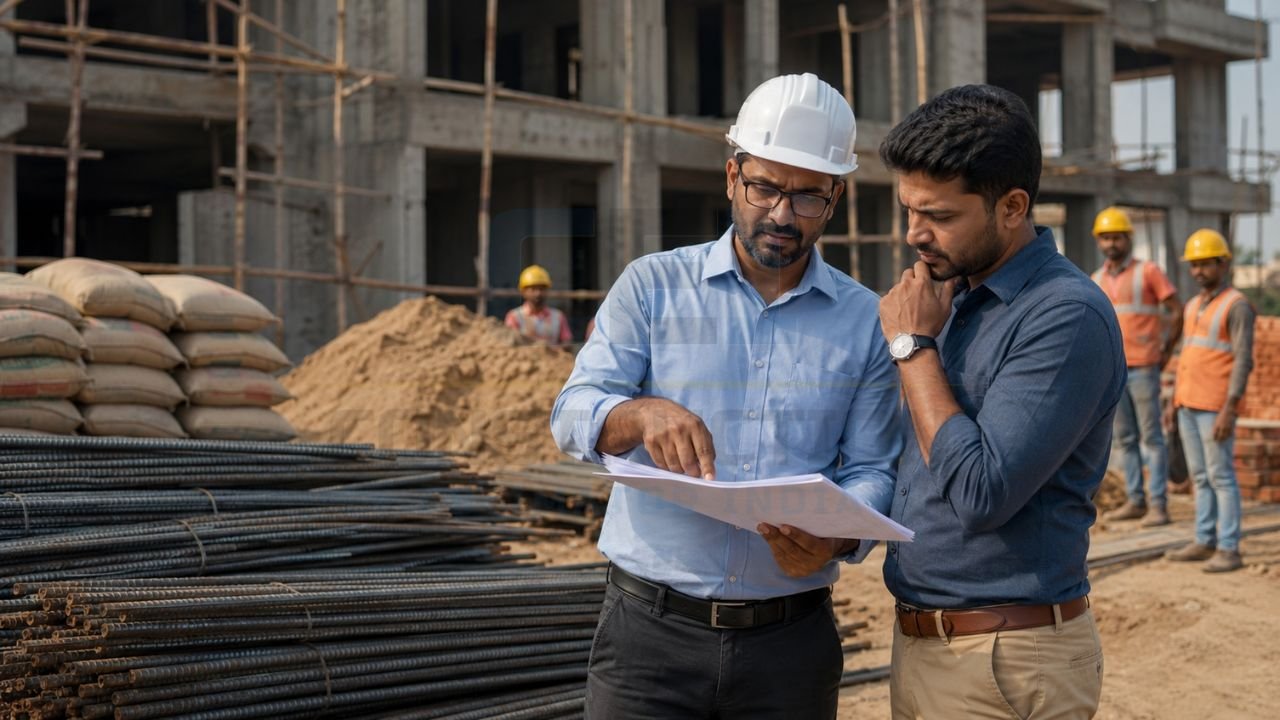
Construction in India is highly seasonal and relies heavily on migratory labor. During major festivals like Diwali, Holi, or the harvest season, laborers often return to their home villages for weeks. If a contractor lacks a stable labor force or has failed to pay their workers, the crew may leave the site permanently, leading to a significant construction delay.
👉 Start with a Free Construction Cost Calculator and Get Expert Guidance for Accurate Budgeting.
What to Check First at the Site
Before initiating legal action or hiring a new team, you must conduct a physical “health check” of your property to prevent further financial loss.
Physical Safety and Structural Integrity
A construction site that has been abandoned is a major structural risk. In the Indian climate, exposed steel (rebar) can rust rapidly during the monsoon, and partially cast slabs that haven’t been properly cured can become safety hazards. You should call an independent expert to inspect the current state of your RCC construction to determine if the structure is stable or if you need to add temporary supports immediately.
Material Inventory and Security
It is common for “leakage” to occur on abandoned sites, where valuable items like cement bags, electrical wiring, or plumbing fixtures suddenly disappear. Your first practical move should be to hire a private security guard or move valuable items to a locked room on the site. If the site is an open plot, consider basic fencing or tarpaulin covers to protect exposed brickwork and steel from the elements.
How to Review the Agreement and Payment Terms?
Once the site is secured, you must analyze your original agreement to understand the “Scope of Work” and identify where the breach occurred.
Timeline and Payment Schedules
Identify three things in your agreement: the timeline, the payment schedule, and the scope of work. Even if you don’t have a 50-page formal contract, a handwritten “Work Order” or a series of emails can establish an “intended timeline”. Indian courts increasingly recognize that a consumer cannot be expected to wait indefinitely for a service they have paid for.
Labor vs. All-Inclusive Contracts
A common point of dispute is when an owner expects the contractor to handle everything (material plus labor), but the contractor claims the agreement was “labor only”. Look at your payment history; if you have been paying for cement and steel separately, it supports the contractor’s claim. If you have been giving “all-inclusive” lumpsum amounts, it supports yours.
How to Calculate Completed Work and Pending Work?
This is the most technical and critical stage. You need a clear comparison between what was promised, what was built, and what you have paid for.
The Need for a Technical Audit
Hire a third-party surveyor to assess the “work done” versus “payments made.” They will create a detailed report showing whether the contractor has overcharged you. For example, if you paid 50% of the contract value but only the foundational excavation and baseline foundation types are complete, you have a strong case for deficiency in service.
Creating a New Bill of Quantities (BOQ)
To restart the project, you need a clear list of exactly what is left to be done. A new contractor cannot give you a fair price without a fresh BOQ based on the current site status. This document ensures that the new quote covers every single pending item, from structural reinforcement down to your exact plaster cost per square foot with material.
How to Collect Proof and Documentation?
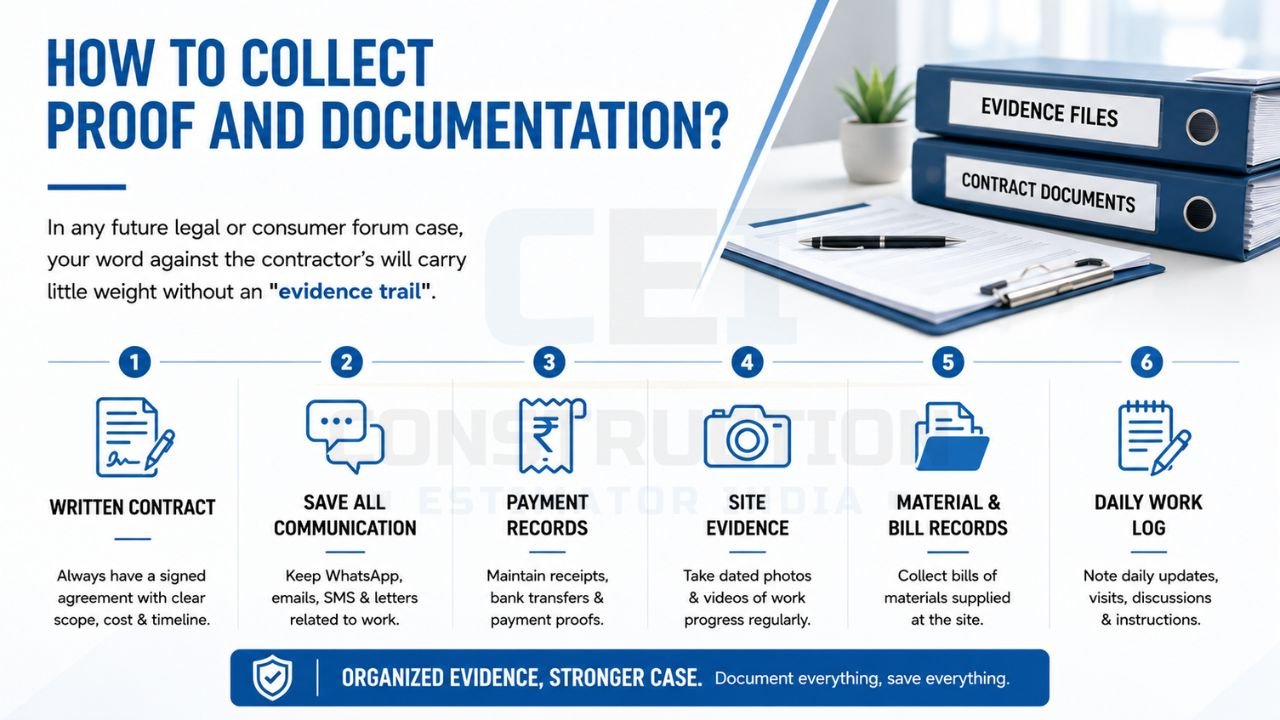
In any future legal or consumer forum case, your word against the contractor’s will carry little weight without an “evidence trail”.
Visual Evidence
Start by taking high-quality photos and videos of the entire site. Focus on the details: unfinished wiring, unpainted walls, and specific areas where work has stalled. Use a camera app that provides a date-and-time stamp to prove when the photos were taken. This record is crucial if the contractor later claims they did more work than they actually did.
Digital and Paper Trail
In 2026, WhatsApp is a primary tool for construction management in India. Export your chat history and take screenshots of specific promises made, such as “I will start the flooring by Monday”. Alongside this, gather all bank statements showing transfers and any physical receipts or “kacha” bills. These messages and payment proofs can build a very strong case in India.
👉 Get Instant Cost Insights and Professional Support for Your Construction Project.
How to Communicate with the Contractor?
While your instinct might be to threaten the contractor, it is often wiser to try a calm, documented approach first.
The Final Sit-Down
Before escalating, try to have a “final sit-down” meeting. Ask direct, professional questions: “What exactly is the reason work has stopped?” and “What is your plan to resume?”. Listen to their answers; sometimes a genuine labor shortage or family crisis is to blame.
Documenting the Commitment
Every such meeting must be followed by a summary message. A simple WhatsApp saying, “As discussed in our meeting today at 4 PM, you have promised to bring 10 laborers back to the site by Wednesday. Please confirm,” is incredibly powerful. If they fail to show up after such a promise, your case for moving to formal action becomes much stronger.
When to Issue a Written Notice
If amicable attempts fail and the contractor remains unreachable or continues giving excuses, it is time to send a formal legal notice.
Purpose of the Notice
A legal notice acts as a final ultimatum and creates a “cut-off date” in the eyes of the law. It proves that you gave the contractor a fair chance to fix the situation before taking further steps. It should demand that they either finish the work within a specific timeframe (usually 15 days) or refund the excess money and terminate the contract.
Professional Drafting
While you might find generic templates online, it is highly recommended that you have this notice drafted by a local lawyer who understands the specific nuances of contract law and guidelines established by the Central Public Works Department (CPWD). A poorly worded notice can sometimes accidentally compromise your own legal standing.
Legal and Practical Options in India
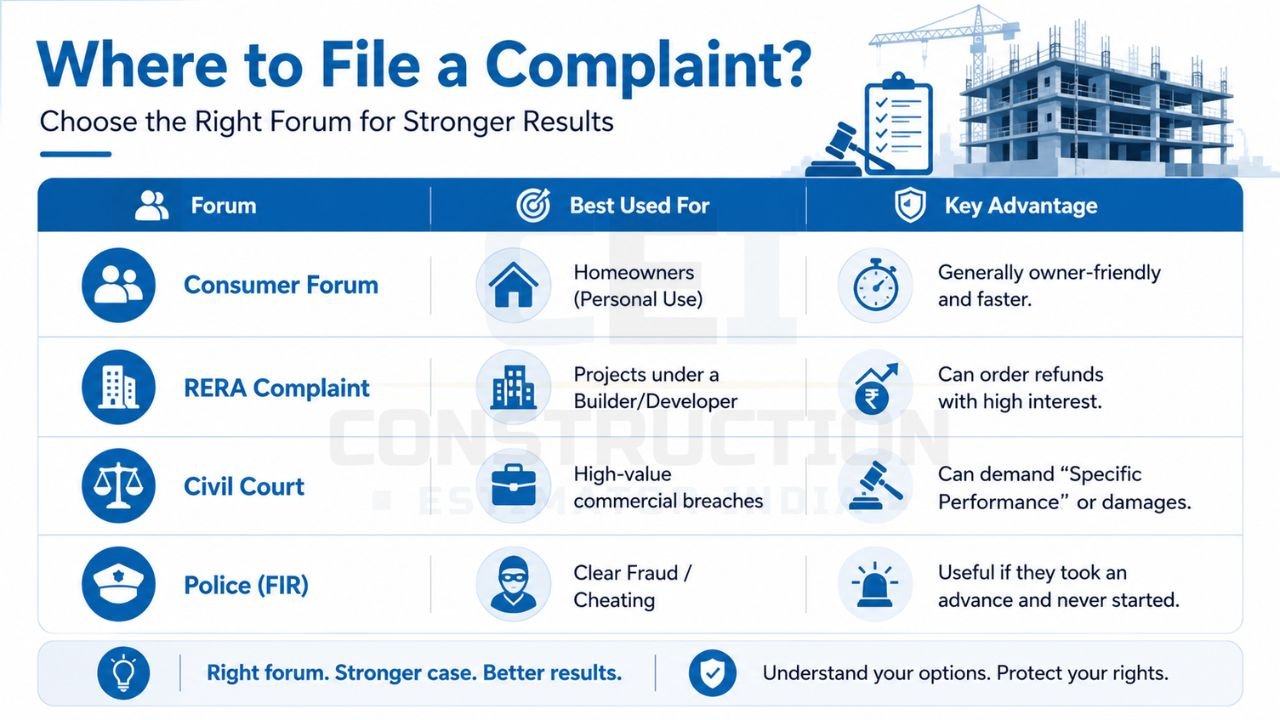
When a builder abandoned project remains stalled, you have several routes for recovery depending on the nature of your agreement.
| Forum | Best Used For | Key Advantage |
|---|---|---|
| Consumer Forum | Homeowners (Personal Use) | Generally owner-friendly and faster. |
| RERA Complaint | Projects under a Builder/Developer | Can order refunds with high interest. |
| Civil Court | High-value commercial breaches | Can demand “Specific Performance” or damages. |
| Police (FIR) | Clear Fraud / Cheating | Useful if they took an advance and never started. |
How to Assess Cost to Complete the Project?
Completing an abandoned project is almost always more expensive than starting from scratch. You must account for several factors beyond simple labor and materials.
- Defect Rectification: Fixing crooked walls or poor plumbing left by the previous contractor.
- Material Degradation: Replacing rusted steel or hardened cement that was left exposed.
- Cost Escalation: Current market rates for labor and materials may have risen since the original contract was signed.
Construction Estimator India provides pending work assessment services to give you an accurate budget for completion.
👉 Planning to Build? Calculate Your Estimated Cost Before You Begin.
When to Hire a Replacement Contractor
Do not hire a new contractor until the first one is legally terminated.
Formal Termination
A proper termination usually requires a “Notice of Termination” following the initial legal notice. If you hire someone else while the first contract is still active, the original contractor could claim you “prevented” them from finishing and sue you for their full profit.
Joint Measurement
Before the old contractor leaves for good, you should ideally perform a “joint measurement”. This is where you, an independent engineer, and the contractor walk through the site and record exactly what has been built. Both parties should sign this to protect you from future claims that you “stole” the contractor’s work.
How to Manage Quality, Materials, and Labour After the Delay?
A “rescue project” needs much tighter supervision than a standard build to avoid repeating the same mistakes.
Technical Audit and Structural Check
Before the new team starts, have a structural engineer check the “health” of the abandoned structure. Fixing structural mistakes now is much cheaper than fixing them after the house is painted.
Material Sourcing Control
Consider moving to a “Labor-Only” contract where you buy the materials yourself. This prevents the new contractor from cutting corners on quality or mismanaging your funds through material procurement.
Daily Reporting
Insist on daily site photos and labor counts via a dedicated WhatsApp group. Stay involved; construction in India is not a “set it and forget it” activity.
How to Avoid the Same Problem in Future Projects?
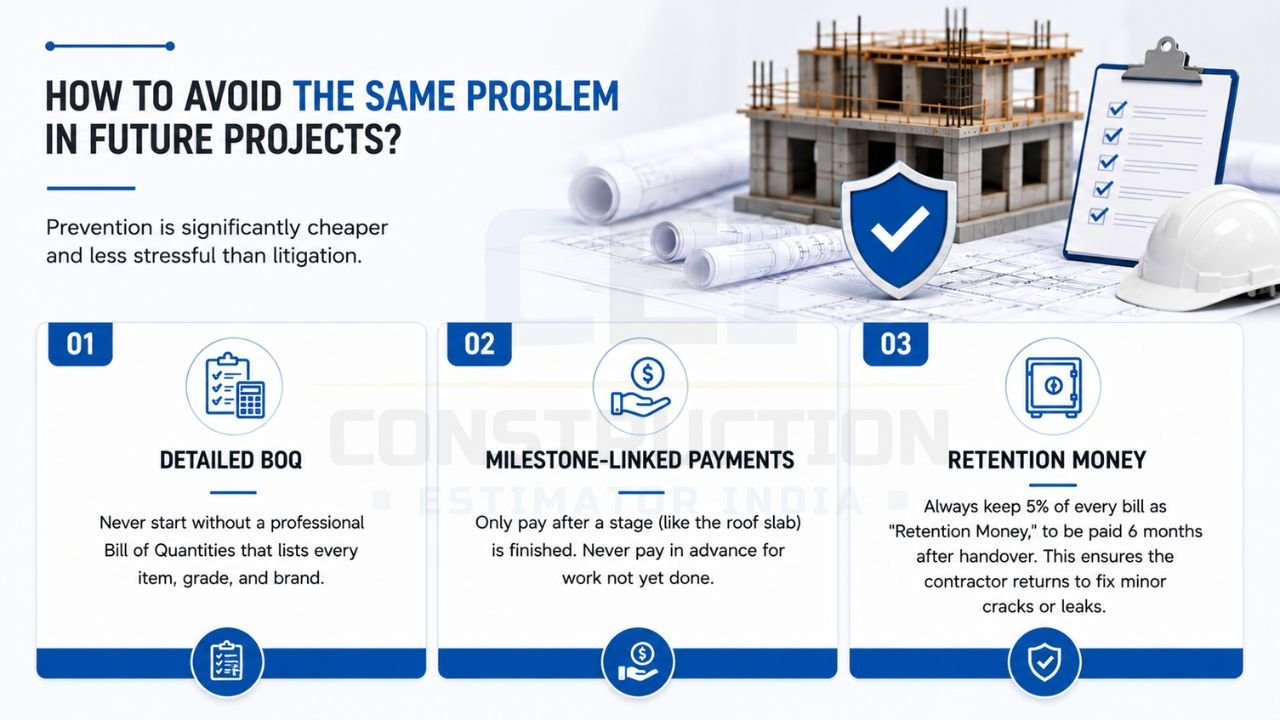
Prevention is significantly cheaper and less stressful than litigation.
- Detailed BOQ: Never start without a professional Bill of Quantities that lists every item, grade, and brand.
- Milestone-Linked Payments: Only pay after a stage (like the roof slab) is finished. Never pay in advance for work not yet done.
- Retention Money: Always keep 5% of every bill as “Retention Money,” to be paid 6 months after handover. This ensures the contractor returns to fix minor cracks or leaks.
Common Mistakes People Make
- Paying More to “Bring Them Back”: Giving more money to a contractor who has already mismanaged your funds is rarely the solution.
- Not Having a Written Contract: Relying on “friendship” or verbal promises often leads to disaster.
- Delayed Action: Waiting months for a contractor to “come back” while the structure degrades in the rain.
- Hiring the Cheapest Bid: Extreme low bids are almost always a precursor to project abandonment.
Expert Tips for Recovery and Damage Control
- Third-Party Assessment: A report from a professional firm like Construction Estimator India carries significant weight in consumer courts as independent expert testimony.
- Site Security: Change the locks or change the security guard the day you terminate the contractor to prevent “revenge damage” to the site.
- Technical Audit: Fixing mistakes early is “insurance” against the massive cost of a stalled project.
👉 Need a More Detailed Estimate? Our Construction Experts Are Here to Help.
FAQ Section
Q1: Can I hire a new contractor immediately?
No. You must first formally terminate the existing agreement or send a legal notice to avoid counter-claims from the original contractor.
Q2: What if I don’t have a written contract?
You can still use WhatsApp messages, bank transfers, and site photos to prove a “de facto” agreement in Indian consumer forums.
Q3: Can I get my money back?
Yes, through a Consumer Forum or Civil Court, but you need a professional audit proving you paid more than the value of work delivered.
Q4: Is a contractor stop work midway a criminal offense?
Usually, it is a civil matter. It becomes criminal (cheating) only if you can prove they had the intention to defraud you from the start.
Q5: How do I calculate the “Cost to Complete”?
You need a new BOQ based on the current site status and current market rates. Construction Estimator India can help with this.
Q6: Should I finish the work myself?
Only if you have extensive experience. Managing multiple labor teams (plumbers, electricians, masons) is difficult without a professional supervisor.
Q7: What is the most common reason for delays?
Cash flow mismanagement, where the contractor uses your money to fund other projects (kiting).
Q8: Can I file a case in Consumer Court for house construction?
Yes, under the Consumer Protection Act, construction is considered a “service”.
Conclusion
Finding that your contractor has stopped work midway in India is undeniably a traumatic experience that tests your patience and finances. However, it is a manageable crisis if you act with logic rather than emotion. By securing your site, documenting every detail, and getting a professional audit of the work done, you can protect your investment and move forward.
Don’t let an abandoned project drain your life savings. Whether you need a pending work assessment, a cost-to-complete report, or contractor dispute support, our experts are here to help. For professional estimation support, contact Construction Estimator India today.
- WhatsApp / Call: +91 8630676890
- Website: constructionestimatorindia.com