Designing a single floor house front design often presents a unique set of challenges for Indian homeowners. Most of the inspiration found online features sprawling double-floor bungalows or massive luxury villas, leaving those with compact plots or ground-floor structures feeling restricted. The reality is that a building with a lower height and limited width requires a specialized approach to maintain proper proportions and visual appeal. Without the vertical drama of a second floor, the focus must shift toward clean lines, high-quality materials, and a balanced arrangement of windows and doors.
👉 Design a Beautiful Single Floor House Front That Reflects Your Style.
Many homeowners worry that a smaller house cannot look modern or premium, but with the right architectural “language,” even a modest home can stand out on a busy street. This guide is designed to help you navigate these choices, from choosing a style to selecting cost-effective materials. To ensure your vision aligns with your budget, Construction Estimator India provides professional quantity takeoffs and cost analyses. If you want to understand the budget impact of your elevation choices before finalizing your plan, feel free to contact Construction Estimator India on WhatsApp / Call +91 8630676890.
Why Single Floor House Fronts Need a Different Approach?
Low Height, Narrow Plot, and Street View
A single floor house is fundamentally closer to the viewer’s eye level than a multi-story building. On a typical Indian street, passersby see the details of your ground floor much more clearly than they would the upper levels of a taller house. This means that every element of your single floor house front design—the texture of the plaster, the design of the window grills, and the finish of the main door—carries more weight. You cannot rely on height to create an impression, so you must rely on “rhythm” and “depth.”
In narrow urban plots, where the frontage might only be 20 to 25 feet, the primary goal is often to make the house appear wider and more open. Using vertical elements can help the building feel taller, while horizontal lines can make it feel broader and more grounded. The key is to avoid overcrowding the façade. A single floor house only has one “layer” of architecture to express itself; if you try to pack in too many different materials or complex shapes, the front can quickly look cluttered and small.
Two Short Real-Life-Style Examples
Consider a 20-foot wide plot where the front is dominated by a car parking gate. In this scenario, the parking area is the most visible part of the small single floor house front design. Instead of treating the parking as a separate utility zone, the modern approach is to integrate it. For example, using the same tile or stone cladding on the parking pillar and the main house entrance creates a unified look that makes the entire plot feel like part of the design.
In contrast, a single floor corner plot offers visibility from two sides. This provides an opportunity to create a “wrap-around” design where the elevation features continue around the corner. Instead of a flat front, the architect might use a slightly taller parapet wall or a small corner garden to break the boxy shape. These scenarios require different strategies, which are compared in the table below to help you identify the best direction for your specific plot type.
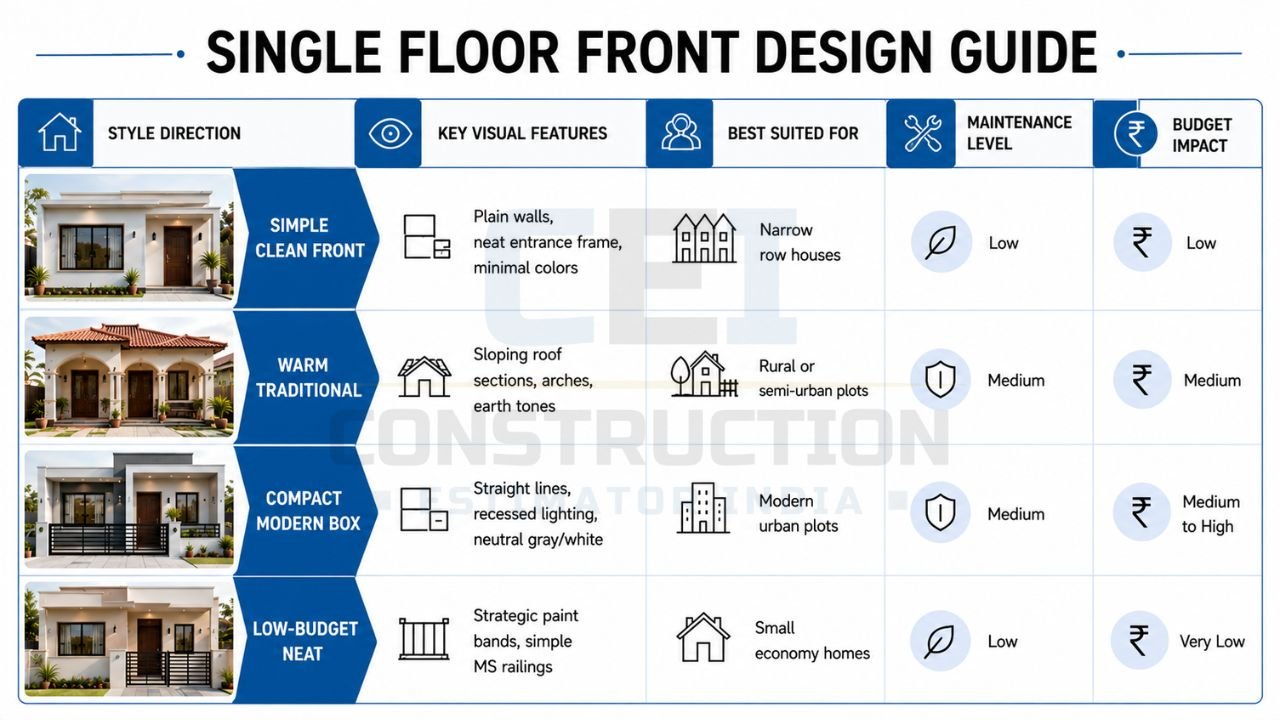
The following table compares different architectural styles suited specifically for single-story residences to help you choose a direction that fits your plot and budget.
| Style Direction | Key Visual Features | Best Suited For | Maintenance Level | Budget Impact |
|---|---|---|---|---|
| Simple Clean Front | Plain walls, neat entrance frame, minimal colors | Narrow row houses | Low | Low |
| Warm Traditional | Sloping roof sections, arches, earth tones | Rural or semi-urban plots | Medium | Medium |
| Compact Modern Box | Straight lines, recessed lighting, neutral gray/white | Modern urban plots | Medium | Medium to High |
| Low-Budget Neat | Strategic paint bands, simple MS railings | Small economy homes | Low | Very Low |
When using this table, consider your plot’s environment. If you are in a high-density urban area, the “Compact Modern Box” style often helps a small house feel more sophisticated and intentional. For those in more open or suburban areas, the “Warm Traditional” approach can provide a cozy, welcoming feel that blends better with nature. Choosing a style early on allows Construction Estimator India to provide a more accurate estimate of the specialized materials required for that specific look.
👉 Get a Custom Single Floor House Front Designed for Your Dream Home.
Front Style Ideas for Single Floor Houses
Simple Clean Front for Very Small Houses
A simple ground floor front design is often the most effective choice for very small plots, such as those under 800 square feet. This style focuses on “subtraction” rather than “addition.” By keeping the walls flat and using a high-quality smooth plaster finish, the house looks neat and well-maintained. The visual interest is created through the “openings”—the main door and the windows. A slightly wider window with a slim, dark-colored aluminum frame can act as a focal point.
To prevent the front from looking too plain, you can use a “recessed” entrance. Instead of the door being flush with the front wall, pushing it back by just 1 or 2 feet creates a natural shadow and a sense of depth. This simple civil change costs very little but significantly improves the aesthetic. It also provides a practical sheltered spot for visitors during the rain.
Warm Traditional Touch on a Single Floor Front
For many Indian families, a home should feel “grounded.” A single floor house front elevation with traditional influences often uses a small sloping roof over the entrance porch. Using Mangalore-style clay tiles or even modern concrete tiles on this slope adds texture and a “heritage” feel. You don’t need a full sloping roof; even a 4-foot projection over the door can change the entire character of the house.
Another way to add this touch is through the use of “pillars.” Simple square pillars with a bit of stone cladding at the base can define the veranda. This style works exceptionally well in regions with heavy monsoons, as the sloping elements and deep sunshades (chajjas) are naturally designed to shed water away from the walls.
Compact Modern Box-Style Front
The modern single floor front in India is currently dominated by the “box” aesthetic. This involves creating rectangular frames around sections of the house. For a single floor, you might create a projecting concrete border that wraps around the main bedroom window and the entrance. This “frame” can be painted in a contrasting color or finished with a subtle texture.
This style relies on “solids and voids.” You might have one heavy, solid wall section finished in a dark grey stone tile, balanced by a large glass window. Because this style uses straight lines, it makes the house look very tidy and architectural. To make the low height feel taller, you can use vertical grooves in the plaster or vertical “louvers” made of powder-coated aluminum or wood-look HPL (High-Pressure Laminate).
Low-Budget Yet Neat Front Design
A low-budget single floor front does not have to look cheap. The secret lies in “paint and proportion.” Instead of using expensive stone cladding, you can use a “two-tone” paint scheme. For instance, if the main house is a light cream color, you can use a deep terracotta or a modern charcoal grey on one specific projecting wall or around the windows.
Another cost-saving tip is to use “grooves” in the plaster. While the plaster is still wet, the mason can create horizontal or vertical lines (U-shaped or V-shaped) that mimic the look of expensive paneling. These grooves create small shadows that break up the flat surface of the wall, giving it a more premium, designed appearance at almost zero extra material cost.
Openings, Balconies, and Front Rhythm
Main Door, Windows, and Alignment
In a compact house front design, the alignment of openings is critical. In a tall building, small misalignments are often hidden by the sheer scale of the structure. On a single floor, if the top of the window does not align with the top of the door (the “lintel level”), the house can look disorganized. Ensuring a single, continuous line for all your window and door tops creates a sense of “rhythm” that is pleasing to the eye.
The main door should be the hero of the front. Even if the rest of the house is simple, investing in a high-quality, solid-looking door can elevate the entire façade. If budget is a concern, a simple flush door with a high-quality veneer or a smart paint finish, paired with a modern long handle, can look just as good as a heavy carved teak door.
Small Projections, Sunshades, and Grills
Projections, often called “chajjas” in India, are essential for climate control, but they also serve a major design purpose. For a modern look, avoid the old-fashioned curved or sloping chajjas. Instead, go for flat, thin concrete slabs that project 1.5 to 2 feet from the wall. Painting the underside of these projections a different color or adding a small recessed spotlight can make the house look incredibly modern at night.
Window grills are a security necessity in most Indian homes, but they are often the part that “breaks” a good design. Instead of bulky, ornate ironwork, choose minimalist grills with thin, straight bars. If possible, integrate the grill into the window frame itself so it doesn’t bulge out from the wall. This keeps the lines of your single floor house front elevation clean and unobstructed.
Roof Edge, Parapet, and Top Line
The parapet wall is the “crown” of your single floor house. Because there is no second floor, the roofline is what defines the building’s silhouette against the sky. A common mistake is to keep the parapet at a standard 3-foot height all the way around. Instead, you can vary the height slightly. Making the front section of the parapet 4 feet high and adding a small “coping” (a slight projection at the very top) makes the house look more finished and substantial.
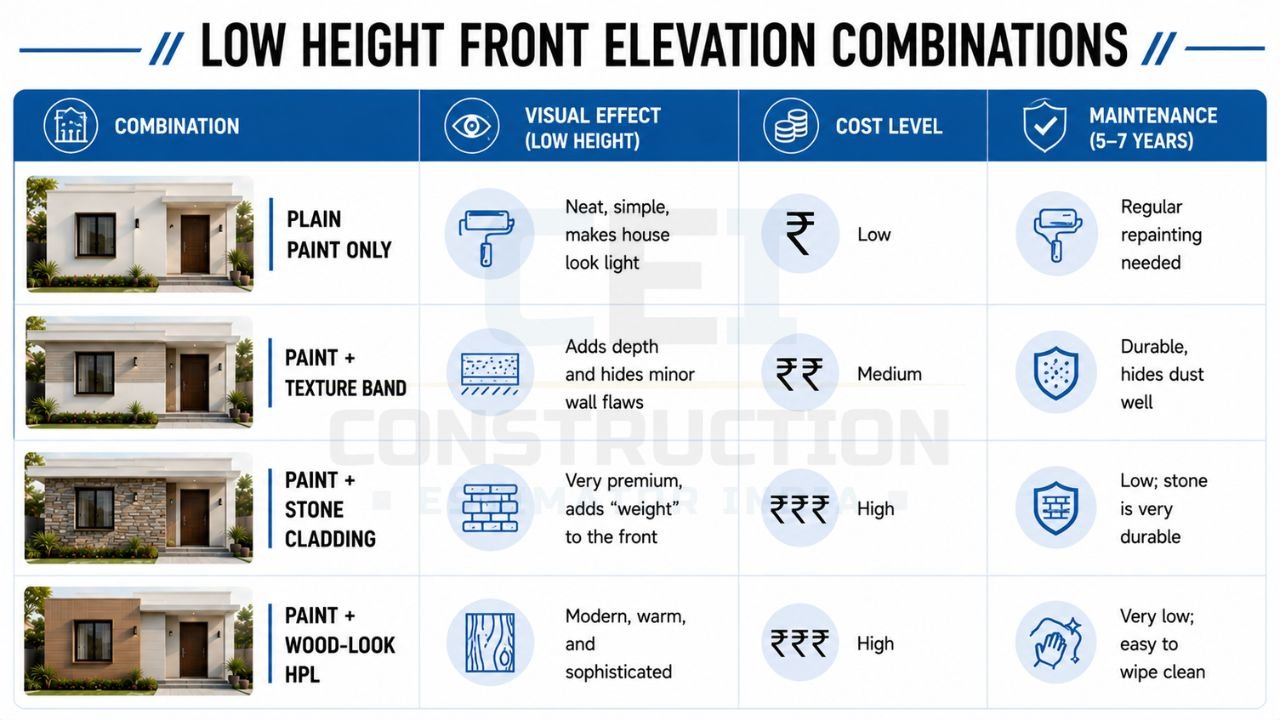
The following table helps you compare common material and color combinations used for single-story façades, focusing on their visual impact and long-term costs.
| Combination | Visual Effect (Low Height) | Cost Level | Maintenance (5–7 Years) |
|---|---|---|---|
| Plain Paint Only | Neat, simple, makes house look light | Low | Regular repainting needed |
| Paint + Texture Band | Adds depth and hides minor wall flaws | Medium | Durable, hides dust well |
| Paint + Stone Cladding | Very premium, adds “weight” to the front | High | Low; stone is very durable |
| Paint + Wood-Look HPL | Modern, warm, and sophisticated | High | Very low; easy to wipe clean |
This table shows that while plain paint is the cheapest option initially, it may require more frequent maintenance in dusty or high-traffic areas. Using a “texture band” or stone cladding on the lower parts of the wall can be a smart investment because these areas are more prone to dirt and splashes during rain. If you are unsure about which material to choose, you can contact Construction Estimator India to get a precise quantity takeoff and check the cost difference between these options for your specific plot size.
👉 Build a Functional and Elegant Single Floor Home with Expert Guidance.
Materials, Colours, and Maintenance for Single Floor Fronts
Choosing Materials That Suit Low-Height Elevations
When selecting materials for a single floor house front design, scale is everything. Large, heavy stone slabs that look great on a big building can make a small house look “heavy” or “cramped”. Instead, use materials that have a finer texture. For example, thin “brick-style” tiles or small slate stone strips work better for a 20-foot wide façade than massive marble panels.
High-Pressure Laminate (HPL) sheets with a wood finish have become very popular because they provide the warmth of wood without the high maintenance of actual timber. On a single floor house, using just a small patch of HPL—perhaps on the ceiling of the porch or as a vertical strip near the door—can provide a “designer” look without a massive budget increase.
Colour Combinations That Help Single Floor Houses Look Bigger
To make a small house look larger, light colors are your best friend. Off-whites, light beiges, and soft greys reflect more light and make the building feel more open. However, a completely white house can look a bit “flat.” The trick is to use a darker accent color on the “recessed” parts of the house. For instance, if you have a frame around your window, painting the wall inside that frame a shade darker creates a shadow effect that adds depth.
Avoid breaking the façade into too many color blocks. If you have three different colors on a 20-foot wide house, it will look smaller and disjointed. Stick to a “rule of three”: one main base color (60-70%), one secondary accent color (20-30%), and one highlight material like wood or stone (10%). This balance ensures the modern single floor front in India looks professional and cohesive.
Dust, Rain, and Long-Term Maintenance
India’s climate is harsh, with intense sun followed by heavy monsoons. In many cities, dust is a constant problem. When designing your front, think about how it will look in three years. Pure white walls at the ground level will likely show dirt quickly. Using a slightly darker “dado” (the bottom 2-3 feet of the wall) or using a stone finish there is a practical choice.
Glossy finishes often show imperfections more than matte finishes. For exterior walls, a “weather-shield” matte paint or a subtle “silica” texture is often better at hiding small cracks and dust. If you need help checking the quantity and cost of paint, cladding materials, or railings for your maintenance planning, Construction Estimator India can provide detailed material estimation that helps you plan for the long term.
Integrating Gate, Boundary Wall, and Parking
Gate and Boundary Wall as Part of the Composition
For a single floor house, the boundary wall and gate are not just “fences”; they are a major part of the visual frontage. Often, the boundary wall hides a significant portion of the ground floor. Therefore, the style of the gate must match the style of the house. If you have a modern box-style house, a gate with horizontal metal slats and a simple black finish will complement it perfectly.
To make the house feel more spacious, you can use “semi-transparent” gate designs. Instead of a solid metal sheet, using slats with small gaps allows some light and air to pass through, making the front yard feel less like a closed box. Ensure that the height of the boundary wall is balanced—too high, and it will hide the design of the house; too low, and it may not provide enough privacy or security.
Front Parking and Entry Path
In many urban small single floor house front designs, the driveway takes up almost half of the front width. To prevent the parking area from looking like a plain concrete slab, you can use “paver blocks” or “grass pavers” that allow greenery to grow in between. This adds a “soft” element to the front, which balances the “hard” materials like concrete and steel.
The path to the main door should be clearly defined. Using a different floor texture or a few small “step lights” along the path makes the entrance feel welcoming. Even if you only have a 2-foot wide strip for plants, use it. A bit of greenery against the front wall can significantly “soften” the look of a compact house and make it feel more like a home.
Small Porch or Entrance Canopy
A porch is one of the most functional and aesthetic additions you can make to a single floor house. Even if you don’t have space for a full car porch, a small “cantilevered” canopy over the main door serves three purposes: it protects the door from rain, it provides shade for visitors, and it creates a visual “focus” for the elevation. This canopy can be made of RCC (concrete), steel with a wooden underside, or even toughened glass for a very modern look.
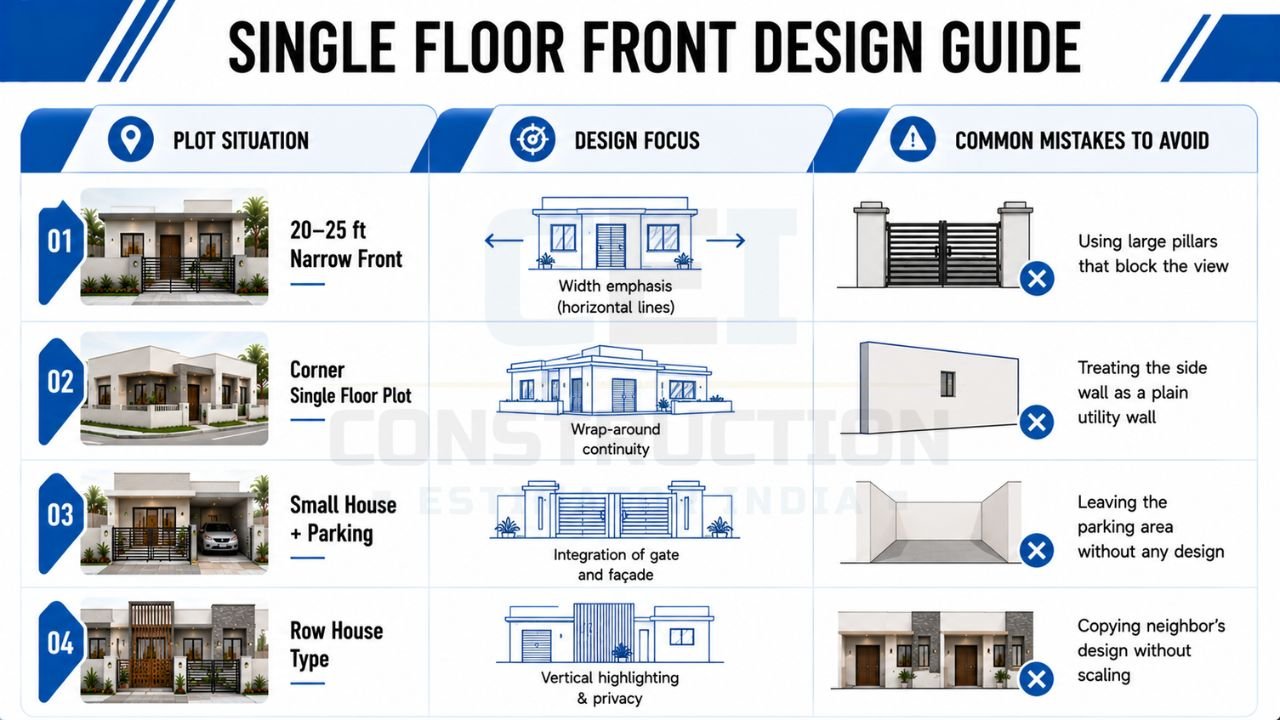
The following table links common Indian plot situations to their primary design focus and common mistakes to avoid.
| Plot Situation | Design Focus | Common Mistakes to Avoid |
|---|---|---|
| 20–25 ft Narrow Front | Width emphasis (horizontal lines) | Using large pillars that block the view |
| Corner Single Floor Plot | Wrap-around continuity | Treating the side wall as a plain utility wall |
| Small House + Parking | Integration of gate and façade | Leaving the parking area without any design |
| Row House Type | Vertical highlighting & privacy | Copying neighbor’s design without scaling |
This table serves as a quick checklist when you are sitting with your designer or contractor. For instance, if you have a narrow front, focusing on horizontal lines—like a wide parapet or horizontal paint bands—will make your home look broader and more prestigious. If you are struggling to balance these elements with your budget, involving Construction Estimator India during the planning stage can help you adjust the design to fit your funds, ensuring that your single floor house front design is both beautiful and affordable.
👉 Design a Modern and Attractive Front Elevation for Your Single Floor Home.
Budget Planning Specific to Single Floor House Front Design
Which Front Features Add Most Cost in Single Floor Houses?
Even in a small house, elevation costs can spiral if you aren’t careful. The most expensive items are usually “cladding” and “custom fabrication.” Natural stone cladding (like granite or slate) requires both the material cost and specialized labor for installation. Similarly, custom-designed laser-cut (CNC) metal gates or high-end glass railings can add significantly to the budget.
Deep concrete projections (cantilevers) also add cost because they require more steel and stronger shuttering. While these features look great, they must be planned carefully. Construction Estimator India specializes in helping owners understand these trade-offs by providing the cost difference between a plain front and one with these special features. By knowing these numbers early, you can decide whether to spend your budget on a premium gate or on better quality wall tiles.
Getting a Good-Looking Front on a Normal Budget
The best way to get a premium look on a standard budget is to follow the “80/20 rule”: keep 80% of the front simple and spend your budget on the 20% that people notice most. Focus your funds on a high-quality main door, one “feature” wall with nice texture or tiles, and good quality lighting. The rest of the house can be finished with standard weather-proof paint.
Lighting is perhaps the most cost-effective way to make a simple ground floor front design look expensive. A few well-placed “up-and-down” wall lights or a small LED strip under the parapet can transform a plain house into a stunning sight at night. These electrical additions are relatively cheap during the construction phase but have a massive impact on the final look.
How Construction Estimator India Helps Single Floor Homeowners?
Planning a house involves thousands of small decisions, each with a price tag. Construction Estimator India helps you navigate this by providing detailed quantity and cost estimates for every part of your front elevation. Whether you want to compare the cost of a wooden gate versus a steel one, or understand how much extra the “box-style” concrete work will cost, we provide the data you need to make informed choices.
Our service is particularly valuable for self-constructing homeowners who want to ensure they aren’t being overcharged by contractors for “special elevation work.” By providing an independent estimate of the cement, steel, paint, and cladding required, Construction Estimator India gives you the confidence to manage your project efficiently and stay within your budget.
Common Mistakes in Single Floor House Front Design
Trying to Copy Tall Double-Floor Designs on a Low House
One of the most frequent errors is “scaling” a design that wasn’t meant for a single floor. A massive, double-height grand entrance arch will look completely out of place on a 10-foot tall ground floor. The proportions will feel “squashed,” and the house will look smaller than it actually is. Always design for the actual height of your building. Focus on making the horizontal proportions look elegant rather than chasing vertical grandeur that isn’t there.
Overcrowding a Small Front with Too Many Materials
In an attempt to make the house look “modern,” many people use a mix of stone tiles, wood panels, glass, and three different paint colors all on one small front. This creates “visual noise.” A single floor house front design works best when it is calm and structured. Choose two main materials and stick to them. If you use too many textures, none of them will stand out, and the house will end up looking like a material showroom rather than a home.
Ignoring Future Additions on Roof or Front
Many Indian families eventually add a first floor or a room on the terrace as the family grows. If your front design is too “final”—meaning it doesn’t allow for vertical extension—the house might look like a “patchwork” later. Consider how the staircase “mumty” (the room covering the stairs to the roof) looks from the front. Designing it now as a neat “box” can prevent it from looking like an ugly concrete block sitting on your roof in the future.
👉 Bring Your Dream House Front to Life with Expert Planning and Design.
FAQs: Single Floor House Front Design for Indian Homes
How can I make my single floor house look taller from the front?
To add a sense of height, use vertical design elements. This could be a vertical strip of dark-colored tiles, a tall, narrow window, or vertical “grooves” in the plaster. Additionally, keeping the parapet wall slightly higher than the standard 3 feet can give the building a more substantial vertical presence.
Which style is safest for very small plots?
The “Simple Clean” or “Modern Box” styles are usually the safest. They prioritize order and clean lines, which prevents a small house from looking cluttered. On a very small plot, the goal is to make the architecture look “intentional” and neat.
How much does a front elevation design typically cost for a single floor house?
The “extra” cost for elevation features—like cladding, premium railings, and special lighting—usually ranges from 5% to 15% of the total civil cost. However, this varies greatly based on your material choices. You should contact Construction Estimator India to get a precise estimate based on your specific design.
How often do single floor fronts need repainting or maintenance?
In most Indian cities, a good quality weather-shield paint will last 5 to 7 years. However, the lower 3 feet of the wall may need more frequent cleaning or a touch-up every 2-3 years due to rain splashes and dust. Using stone cladding or tiles on the lower section can significantly reduce this maintenance.
When is the best time to contact Construction Estimator India for cost and quantity checks?
The best time to involve us is after you have a basic floor plan and a rough sketch of the elevation, but before you start actual construction or buy materials. This allows us to help you adjust the design to fit your budget, ensuring your single floor house front design is both beautiful and affordable.
Conclusion: Make Your Single Floor House Front Simple, Neat, and Budget-Friendly
Designing a single floor house front design in India is about finding beauty in simplicity and proportion. You don’t need a massive bungalow or an unlimited budget to have a home that looks modern and premium. By focusing on a clean architectural style—whether it’s a modern box-style or a warm traditional look—and using materials like paint, texture, and cladding strategically, you can create a façade that is both attractive and easy to maintain.
Remember that the best designs are those that are well-planned from the start. Avoid the common mistake of overcrowding a small front or trying to copy designs meant for much larger buildings. Instead, focus on the “rhythm” of your windows, the quality of your entrance, and the integration of your gate and parking area. This holistic approach ensures that your home feels cohesive and spacious, regardless of its footprint.
Before you finalize your single floor house front elevation and start buying materials, it is highly recommended to understand the financial side of your choices. Construction Estimator India is here to help you bridge the gap between a design sketch and a finished home. We can help you estimate construction costs for different design options, check the quantity of materials like paint and cladding, and guide you on how to stay within your budget while achieving a high-end look. For expert support in self-construction planning and material estimation, contact Construction Estimator India on WhatsApp / Call +91 8630676890 today.