
Terminating a business relationship is rarely a simple task, especially when it involves the specialized skills of a consultant, freelancer, or civil contractor. Whether you are a small business owner, a project manager, or a homeowner finalizing how to plan home construction in India, knowing how to terminate an independent contractor agreement properly is essential for protecting your legal and financial interests. Unlike the termination of a standard employee, ending a contractor relationship is governed almost entirely by the specific terms of the written contract and general commercial law. A misstep in this process—such as failing to provide the correct notice or miscalculating final payments—can lead to expensive litigation, project delays, and damaged professional reputations.
👉 Need to End a Contractor Agreement? Get Expert Guidance Before You Take the Next Step.
In many professional sectors, the termination process follows a structured sequence: reviewing the original agreement, determining the legal grounds for ending the relationship, issuing a formal notice, settling final dues, and reclaiming assets or system access. For projects involving physical works or technical deliverables, this process also requires a forensic assessment of “work-in-progress” to ensure you only pay for what has been completed to the agreed-upon standard. Handling these steps with precision ensures that both parties can move forward without lingering liabilities.
At Construction Estimator India, we specialize in helping businesses and individuals navigate the complexities of contractor management. Whether you are dealing with a service provider who has failed to meet deadlines or you simply need to scale back operations, our team provides expert guidance on the practical steps of termination, including notice drafting and final settlement verification.
For help reviewing the termination notice and next steps, you can contact Construction Estimator India on WhatsApp / Call +91 8630676890.
Review the Independent Contractor Agreement
Before you communicate your intent to end the relationship, you must perform a thorough forensic review of the signed agreement. This document is the “law” between you and the contractor, guided by the foundational frameworks of the Indian Contract Act via India Code. It dictates exactly how, when, and under what conditions the relationship can be dissolved. Acting without consulting this document is one of the most common mistakes in business, often leading to claims of “wrongful termination.”
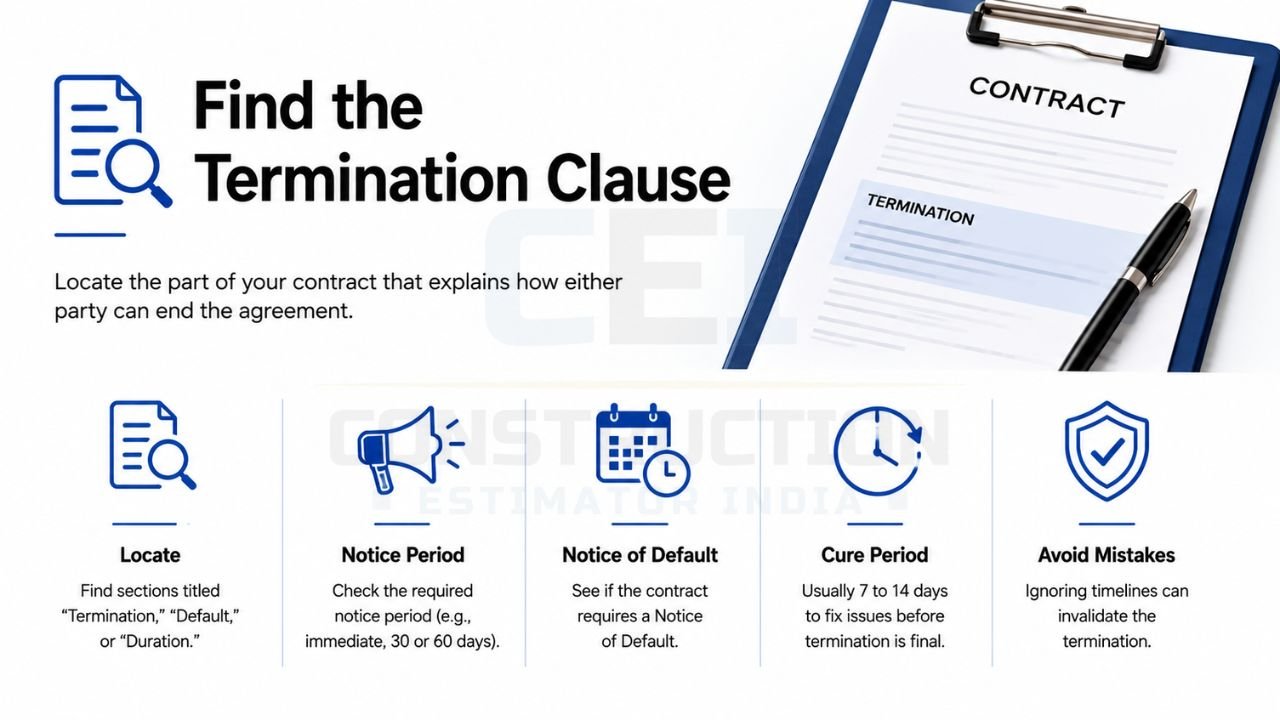
Find the termination clause
A termination clause is a specific section in your contract that outlines the rights of each party to end the agreement. It typically details two primary paths: termination “for cause” (due to a breach) and termination “for convenience” (without a specific reason). This clause will specify the “notice period”—the amount of time you must give the contractor before the contract officially ends—which can range from immediate effect to 30 or 60 days.
This step matters because it establishes the timeline and the legal justification for your actions. If the contract requires a 30-day written notice and you terminate the contractor via a phone call effective immediately, you may be liable for the contractor’s lost earnings during that 30-day window.
To take action, locate the contract and highlight the sections titled “Termination,” “Default,” or “Duration.” Identify whether the contract requires a “Notice of Default” and a “Cure Period”. A cure period is a set timeframe (often 7 to 14 days) during which the contractor has the opportunity to fix the issues you have raised before the termination becomes final. A common mistake is ignoring these specific timelines, which can invalidate the termination. If you are unsure about notice periods, final payments, or handover steps, Construction Estimator India can guide you step by step. Reach out on WhatsApp / Call +91 8630676890.
Check payment and handover obligations
The agreement should also specify what happens to money and materials once the termination is initiated. This includes terms regarding the final invoice, payment for partially completed milestones, and the ownership of “work product” (the results of the contractor’s labor).
This matters because financial disputes are the most frequent source of post-termination conflict. You need to know if you are obligated to pay for work that was started but not finished, or if payments are strictly tied to completed deliverables.
You should list all pending milestones and compare them against the contract’s payment schedule. Check if the contract allows you to withhold funds for defective work or “Liquidated Damages” resulting from delays. Typically, you should expect to pay for all work that was approved prior to the termination notice. A mistake here is promising a final payment amount before conducting a technical audit of the work completed.
👉 Protect Your Rights and Avoid Costly Disputes with Expert Construction Advice.
Identify any special conditions
Beyond the basics of termination, most independent contractor agreements contain “surviving clauses.” These include non-disclosure agreements (NDAs), confidentiality requirements, non-solicitation clauses, and the return of physical or intellectual property.
These conditions matter because they protect your business secrets and assets even after the contractor has left. For instance, a contractor may be legally required to delete all company data from their personal devices or return proprietary samples and blueprints.
Review the contract for sections titled “Confidentiality” or “Post-Termination Obligations.” Create a checklist of all items the contractor must return or confirm they have destroyed. Failing to enforce these clauses can lead to data leaks or the loss of expensive equipment. Construction Estimator India can help you review this checklist to ensure no critical business assets are left in the contractor’s possession.
Decide Whether It Is Termination for Cause or Convenience
Choosing the right “path” for termination is a strategic decision that affects your costs, your timeline, and your legal risk. You must determine if the contractor has failed to meet their obligations (cause) or if you simply no longer require their services (convenience).
Termination for convenience
Termination for convenience allows a party to end the contract for any reason or no reason at all, provided the agreement includes this specific right. It is often used when a project’s budget is cut, a company’s strategy changes, or the client feels the relationship is no longer a “good fit.”
This path matters because it often allows for immediate termination and may exempt the client from paying certain fees or allow them to claim damages for the cost of hiring a replacement. However, it requires a high burden of proof. You must have documented evidence of the failures, such as emails, site logs, or third-party inspection reports evaluating what is RCC construction failures or material defects on-site.
To use this, simply follow the notice requirements in the “Termination for Convenience” clause. Ensure your communication remains professional and neutral. A common mistake is attempting to terminate “for cause” to save money on a notice period, only to have the contractor successfully argue that no breach occurred, resulting in legal fees that far exceed the original notice cost.
Termination for cause
Termination for cause occurs when the contractor has committed a “material breach” of the agreement. Common reasons include persistent delays, poor quality of work that fails to meet specifications, abandonment of the project, or illegal conduct.
This path matters because it often allows for immediate termination and may exempt the client from paying certain fees or allow them to claim damages for the cost of hiring a replacement. However, it requires a high burden of proof. You must have documented evidence of the failures, such as emails, site logs, or third-party inspection reports.
You should gather all evidence of the breach—such as missed deadlines or failed quality tests—and issue a “Show Cause Notice” if the contract requires it. This gives the contractor a final chance to “cure” the problem. The most frequent mistake is terminating “for cause” without giving the contractually mandated cure period, which judges and arbitrators often view as a violation of “natural justice”.
Why the distinction matters
The distinction between cause and convenience dictates the tone of your communication and the finality of your financial settlement. In a “cause” scenario, the relationship is often strained, and the focus is on mitigation and damages. In a “convenience” scenario, the focus is on a smooth transition and maintaining professional bridges.
Choosing the wrong category can lead to “wrongful termination” lawsuits. If you claim cause but cannot prove it, you may be forced to pay the contractor’s full contract value plus legal costs.
To avoid this, consult your internal records and the contract terms. Construction Estimator India can help users decide what information should be documented and which path is safer based on the evidence available. Contact us on WhatsApp / Call +91 8630676890 before you commit to a specific termination strategy.
Prepare a Professional Termination Notice
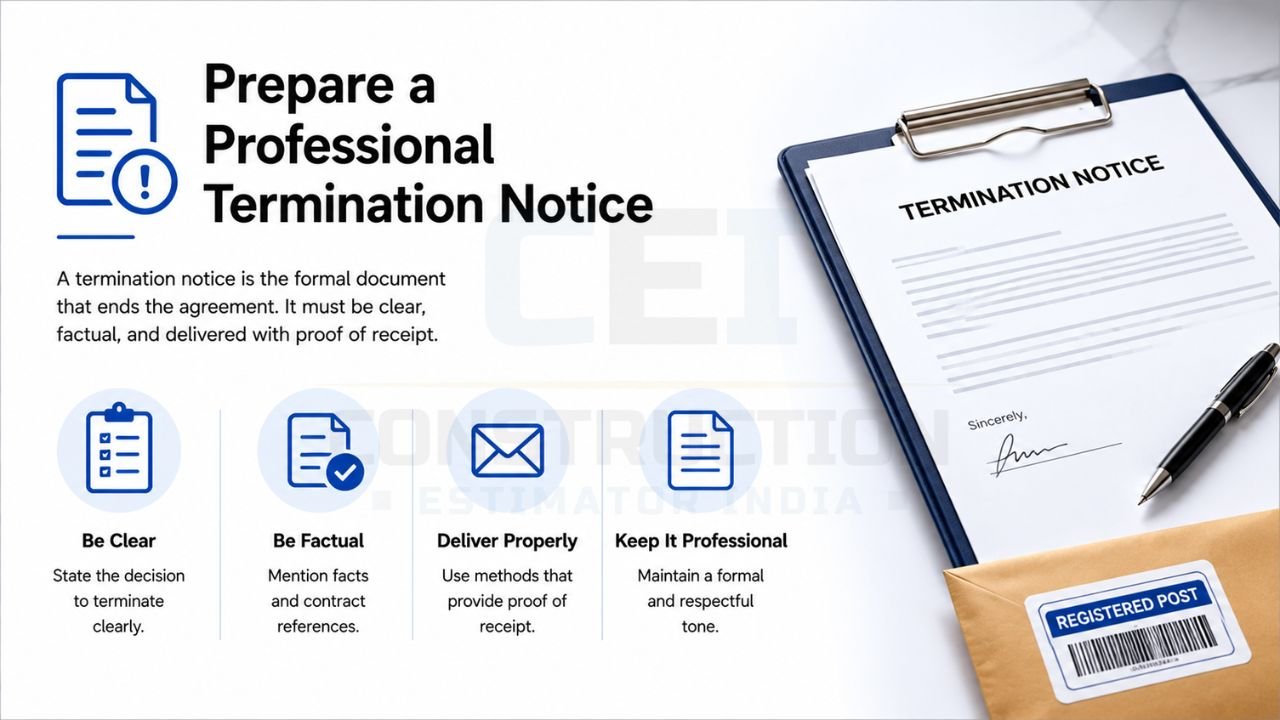
The termination notice is the formal legal document that ends the relationship. It must be clear, factual, and delivered in a manner that provides proof of receipt. In many jurisdictions, including India, physical proof of delivery (like Registered Post) is highly recommended even if you also send an email.
What the notice should include
A professional notice must leave no room for ambiguity. It should clearly state:
- The names of both parties.
- The date the original agreement was signed.
- The specific clause under which you are terminating (Cause or Convenience).
- The effective date of termination.
- A summary of final payment steps and asset return instructions.
- The name of the point of contact for the handover.
Including these details ensures there is no confusion about when the contractor’s obligations end and yours begin. For instance, stating “your access to the site ends at 5:00 PM on Friday” provides a clear boundary for security teams.
To take action, draft the notice using a formal letterhead. Avoid “texting” a termination, as WhatsApp messages may not be considered sufficient formal notice in a legal dispute. A common mistake is being too vague about the end date, which leads to “work-creep” and additional invoices.
👉 Get Professional Support for Contractor Disputes, Contracts, and Project Transitions.
Tone and wording to use
The tone should be clinical, professional, and firm. Termination is a business transaction, not a personal grievance. Avoid using emotional language, insults, or accusations that are not backed by contract clauses.
A factual tone reduces the likelihood of an emotional retaliation from the contractor and presents you as a “reasonable party” if the matter ever reaches a court or arbitrator. Use phrases like “Pursuant to Clause X of our agreement…” rather than “Because you are always late…”
Draft the letter and have it reviewed by a neutral third party. Avoid “burning bridges” unless absolutely necessary, as you may need the contractor’s cooperation during the handover of passwords or files. Construction Estimator India offers support for reviewing contractor termination drafts to ensure they are professional and compliant.
Sample termination notice structure
While every contract is different, a standard professional structure looks like this:Subject: Notice of Termination of Independent Contractor Agreement
Dear [Contractor Name],Please be advised that [Company Name] is exercising its right to terminate the Independent Contractor Agreement dated [Date] pursuant to Clause [Number] (Termination for [Cause/Convenience]).
The effective date of this termination will be [Date].
[If for Cause: As previously noted in our Notice of Default dated [Date], the following breaches remained uncured: (List brief facts).]
Regarding the transition:
- Final invoices for work completed up to [Date] should be submitted by [Date].
- Please return all company assets, including [Keys/Laptops/Files], by [Date].
- A final joint measurement/handover meeting is scheduled for [Date/Time].
We thank you for your contributions and wish you well.
Using a template like this ensures all legal bases are covered. Construction Estimator India can help you customize this draft to fit your specific project needs.
Handle Final Payment and Handover
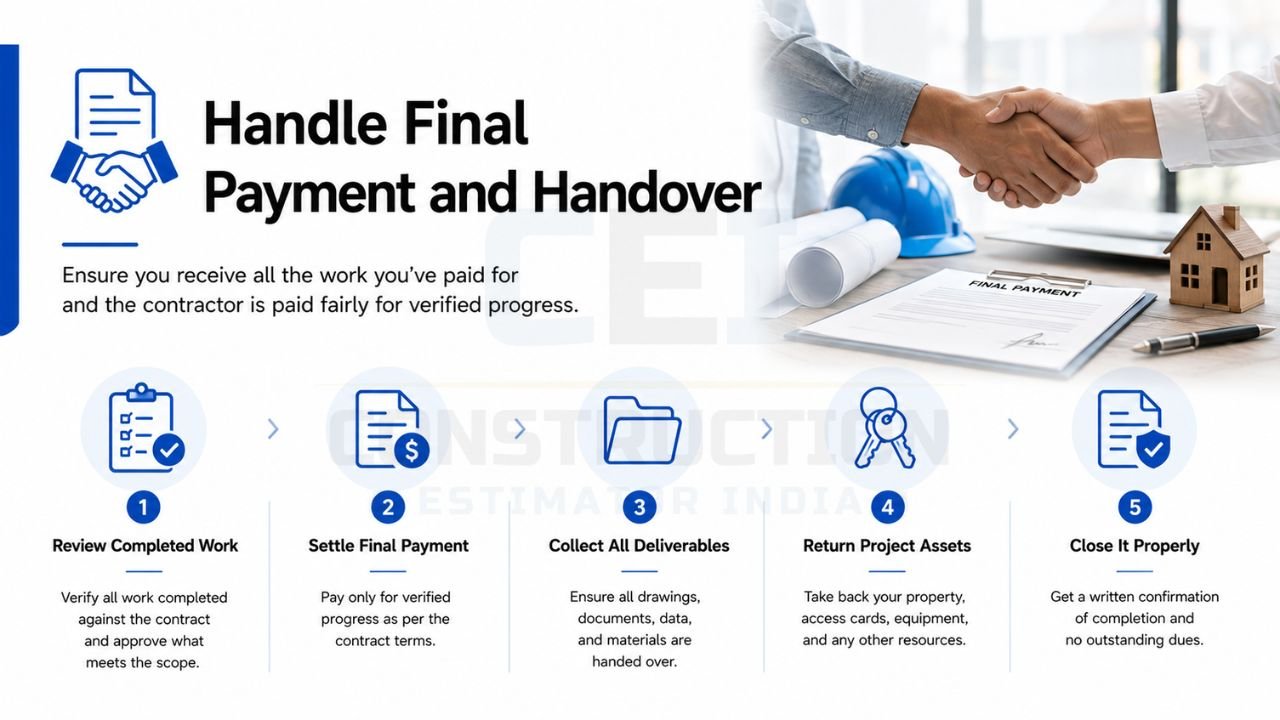
The period between the notice and the final departure is the most critical for project continuity. You must ensure that you receive all the work you have paid for and that the contractor is compensated fairly for verified progress.
Final invoice and approved work
Before making the final payment, you must conduct a “joint measurement” or technical audit. This involves walking through the project (or reviewing digital deliverables) to confirm exactly what was completed.
This matters because contractors may over-invoice during termination to “cut their losses.” You need to verify that the milestones claimed in the final invoice match the physical reality of the work done. For construction projects, this often involves a “Measurement Book” (MB) entry, following standards set by the Central Public Works Department (CPWD).
You should compare the final invoice against the original Bill of Quantities (BOQ). Deduct any costs for rectifying defective work or unfinished tasks that you will now have to pay someone else to complete. A common mistake is paying the final bill before receiving the final deliverables, leaving you with no leverage if the files are corrupted or the work is incomplete.
👉 Need Help with Contractor Agreements? Our Construction Experts Are Here to Help.
Return of company property and materials
Independent contractors often have access to company laptops, office keys, security badges, and physical materials (like raw materials for a building or product samples).
Securing these assets is vital for both security and financial reasons. If you have paid for materials that are sitting on a construction site, they belong to you, not the contractor.
Create a “Return of Assets” log. Have the contractor sign this log as they hand back items. If they claim to have lost an item, the value should be deducted from their final settlement. Construction Estimator India can help you create a practical offboarding checklist to track these items efficiently.
Handover of work and records
A successful termination requires the contractor to hand over all “intellectual property” and project records. This includes source code, passwords, project designs, drafted structural drawings, and status reports.
Without a proper handover, your project could be stalled for months as you try to “reverse-engineer” what the previous contractor did. For example, if a contractor holds your building’s structural drawings hostage, you cannot legally continue the work with a new team.
Schedule a formal handover meeting. Ensure that all digital files are uploaded to a company-controlled cloud drive and that all login credentials are changed immediately after. A mistake is assuming the contractor will remain helpful after they have received their final check; always ensure the handover is complete before the final payment is released.
Revoke Access and Close Out the Engagement
Once the contractor has physically or digitally left, you must “seal” your environment to prevent unauthorized access or future liability.
System and account access
The moment the termination becomes effective, you must revoke all digital access. This includes company email, Slack/Teams accounts, project management tools (like Jira or Asana), and cloud storage (Google Drive/Dropbox).
This is a critical security step. Bitter ex-contractors have been known to delete files or leak sensitive client data if their access is not promptly removed. In physical projects, this also means changing locks or notifying site security that the contractor is no longer authorized to enter the premises.
Coordinate with your IT or security department to have access cut off at the exact time specified in the termination notice. Failing to do this is a major security risk. Construction Estimator India helps businesses understand the practical steps for revoking access safely.
Client or team communication
You must manage the “narrative” of the termination within your own team and with any external clients who were working with the contractor.
Clear communication prevents confusion and ensures that everyone knows who the new point of contact is. It also prevents “shadow work,” where employees might continue to send tasks to the terminated contractor out of habit.
Send a brief, neutral announcement to relevant stakeholders: “As of [Date], [Contractor Name] is no longer working on [Project]. Please direct all future inquiries to [New Name].” Avoid sharing the “why” of the termination to prevent potential defamation claims.
Recordkeeping after termination
Even after the contractor is gone, you must keep a complete file of the termination process. This “Static Record” should include the original contract, all termination notices, proof of delivery, the final measurement/handover reports, and a record of the final payment.
This record is your primary defense if the contractor later files a claim for “wrongful termination” or unpaid dues in a commercial court or through arbitration. Store these documents in a secure digital folder for at least 3 to 7 years, depending on your local statutes of limitations and compliance standards guided by the Ministry of Corporate Affairs (MCA).
Important Risks and Common Mistakes
Ignoring the contract terms
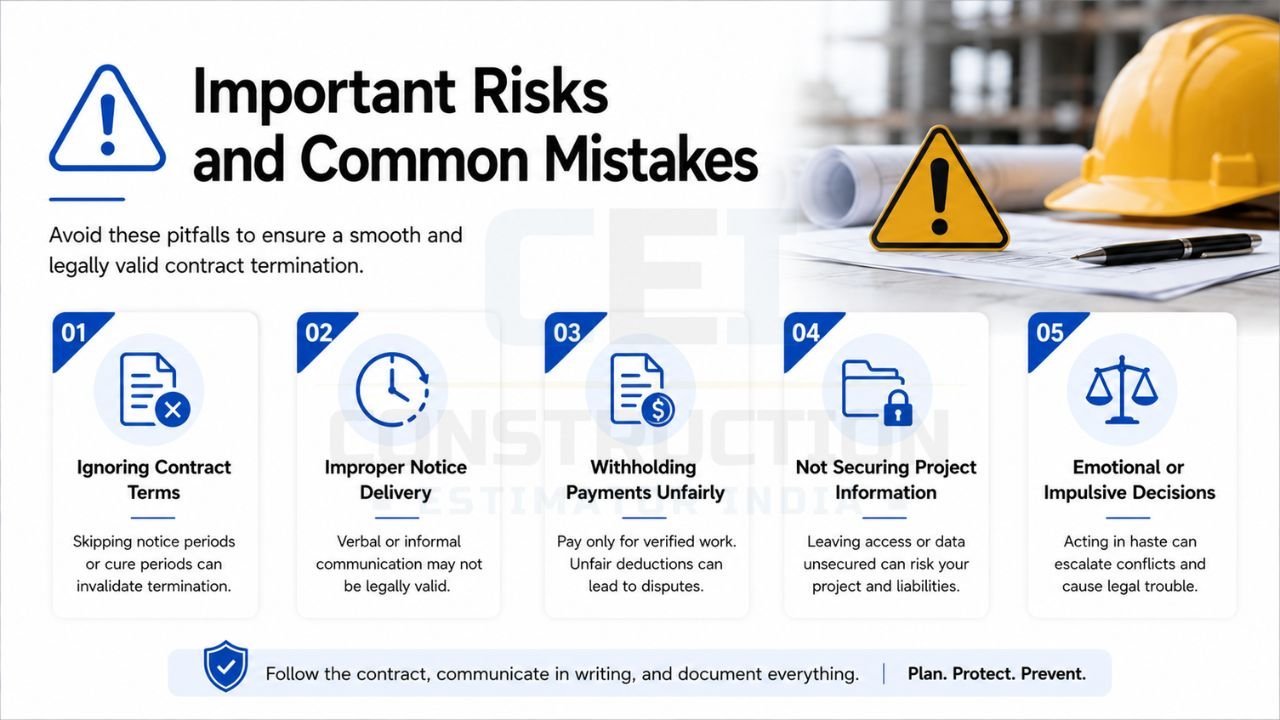
Many people treat termination as an emotional decision rather than a contractual one. If the contract says “14-day notice” and you give “7 days,” you have breached the contract yourself. This can flip the legal advantage to the contractor, even if they were the ones doing a poor job initially. Always follow the written word of the agreement to the letter.
Mixing up contractor and employee rules
In many regions, terminating an “independent contractor” too aggressively—such as controlling their hours or providing them with all their tools—can lead to a “misclassification” claim. If a court decides the person was actually an employee, you could be liable for back taxes, benefits, and much stricter labor law penalties enforced by the Ministry of Labour & Employment. Construction Estimator India can help you review your process to maintain the “independent” nature of the relationship during termination.
👉 Protect Your Investment with Expert Guidance on Contractor Contracts and Termination.
Using vague or hostile language
Writing “You’re fired” or “Your work is garbage” in an email is a recipe for disaster. Hostile language escalates conflict and can be used against you in court to show “malice.” Stick to factual, contract-based language: “The work delivered on [Date] did not meet the specifications outlined in Annexure A.”
Forgetting final settlement or asset return
Failing to close the financial loop is the #1 cause of lingering disputes, whether it’s a massive commercial build or a localized house renovation. If you don’t document the final measurement and payment, a contractor can come back months later claiming they are still owed money. Always get a “No Dues Certificate” or a signed final receipt once the settlement is done.
Frequently Asked Questions: Contractor Termination
Can I terminate an independent contractor agreement anytime?
Technically, yes, but your right to do so without penalty depends entirely on your contract. If you have a “Termination for Convenience” clause, you can end it anytime by giving the required notice. If you don’t have that clause, you can generally only terminate “for cause” (breach of contract). If you terminate without a specific right to do so, you may be liable for the contractor’s lost profits for the remainder of the contract term. Construction Estimator India can help you identify your rights within your existing document.
Do I need to give notice before termination?
In almost all cases, yes. Unless the contractor has committed a severe, incurable breach (like fraud or theft), most agreements and legal systems require a “Notice of Default” and a “Cure Period”. This gives the contractor a fair chance to fix the issue. Skipping this step is the most common reason owners lose arbitration cases in the construction and service sectors.
What is the difference between termination for cause and convenience?
Termination “for cause” is like a “fault-based divorce”—you are ending the relationship because the other party did something wrong (e.g., missed deadlines, poor quality). Termination “for convenience” is a “no-fault” ending—you are ending it because your needs have changed, even if the contractor did a good job. Cause usually allows for faster termination but requires more evidence; convenience is slower (requires notice) but is harder for the contractor to challenge.
Should final payment be made before or after the notice?
Final payment should always be made after the notice is issued and after the final handover and measurement are complete. You need to ensure that all assets have been returned and that any “Cost-to-Complete” (the extra money you’ll spend based on the localized house construction per sq ft rate to finish their work) has been calculated and potentially deducted from their final bill.
What if the contractor refuses to hand over work?
This is a serious breach of contract. If the contractor holds drawings, passwords, or materials hostage, you should first send a formal legal demand letter citing the “Ownership of Work Product” clause in your agreement. If they still refuse, you may need to seek an emergency injunction from a commercial court or file a police complaint if they are illegally occupying a physical site.
How do I revoke access safely?
Coordinate with your IT team to disable accounts exactly at the termination hour. If it’s a physical site, change the codes on digital locks or physically swap out padlocks. Notify your security personnel or building management that the individual is no longer authorized to enter. It is often helpful to have a “security checklist” ready before the notice is even sent.
When should I seek help reviewing the termination notice?
You should seek professional guidance the moment you realize the relationship is failing. Don’t wait until you are angry. A professional review of your “Notice of Default” or your “Cost-to-Complete” assessment can save you from a multi-year legal battle. Reach out to Construction Estimator India for a forensic look at your situation before you take the final step.
Conclusion: End the Relationship Professionally
Terminating an independent contractor agreement is a process that requires a “cool head” and a “sharp pencil.” By following a structured approach—Reviewing the contract, choosing the correct path (Cause vs. Convenience), issuing a factual notice, and meticulously documenting the handover—you can protect your business from unnecessary risk. Remember that the goal of a professional termination is not to “win” an argument, but to end a liability and move your project toward a successful completion with a new partner.
Clear communication, backed by solid evidence and a fair final settlement, is the best way to prevent a simple business change from turning into a costly legal dispute. Documentation is your shield; use it wisely.
If you are planning to end a contractor relationship and want help reviewing the notice, checklist, and final handover steps, you can contact Construction Estimator India on WhatsApp / Call +91 8630676890 for support before you proceed. Our team ensures your transition is backed by accurate data and professional standards.