Imagine stepping into your home in Meerut or Delhi after a grueling commute in the 48°C peak of an Indian summer. Instead of being greeted by a wall of stagnant, radiated heat that makes your AC struggle for hours, your walls feel noticeably cooler to the touch. In 2026, where “Thermal Comfort” is the new luxury, knowing how to reduce wall heat with paint is no longer just a DIY experiment; it is a critical engineering requirement for modern, energy-efficient living.
The direct answer to how to reduce wall heat with paint is to apply high-performance heat-reflective paints (also known as cool paints) that utilize a high Solar Reflective Index (SRI). These paints contain specialized infrared-reflective pigments and ceramic microspheres that bounce up to 90% of solar radiation back into the atmosphere, preventing the “Thermal Mass” effect where your brick walls store heat and release it into your rooms at night.
2026 Heat-Reduction Quick Guide
- Top 2026 Solution: Asian Paints Apex Ultima Protek with Nanogel or Dulux Weathershield Max.
- Key Metric: Look for an SRI (Solar Reflective Index) value of 100+ for roofs and 80+ for walls.
- Temperature Drop: High-quality heat-reflective paint can reduce internal room temperatures by 3°C to 5°C.
- Vastu Tip: Use light colors like “Moonlit Silk” or “Vanilla Mist” on South and West walls to maximize reflection.
- Cost Insight: While the material cost is 20-30% higher, the ROI is achieved within 24 months through reduced electricity bills.
For accurate heat-reflective paint selection, cost estimation or BOQ to reduce wall heat in India, WhatsApp or call us today at +91 8630676890.
The Science of Thermal Transfer: Why Your Walls Act Like Heaters
In regions like Uttar Pradesh and Rajasthan, masonry walls (bricks and concrete) are highly efficient “thermal batteries.” Throughout the day, they absorb solar energy. By 4 PM, the exterior surface can reach 60°C. This heat then travels through the wall thickness via conduction.
By the time you sit down for dinner, that heat is radiating into your living room. This is why many Indian homes feel hotter after the sun goes down. Standard “budget” paints offer zero resistance to infrared radiation, allowing the wall to soak up every watt of energy. Leveraging our 10+ years of construction estimating expertise, we have found that standard dark-colored exterior paints can increase the cooling load of a building by up to 25%.
How Heat-Reflective Paint Works: Reflection vs. Absorption?
When you ask how to reduce wall heat with paint, you are essentially looking for a “mirror” for infrared light. Modern 2026 formulations work through three primary mechanisms:
- Solar Reflectance: Specialized pigments reflect the visible and invisible (infrared) spectrum of sunlight.
- Thermal Emittance: The ability of the surface to release any heat it does absorb back into the air rather than passing it into the wall.
- Insulative Microspheres: High-end paints like Berger Weathercoat contain hollow glass or ceramic beads that create a microscopic “dead air space,” acting as a thin layer of insulation.
This technology is a cornerstone of the CPWD guidelines for heat-reflective wall painting, which now mandate specific SRI values for government residential projects to combat the Urban Heat Island effect.
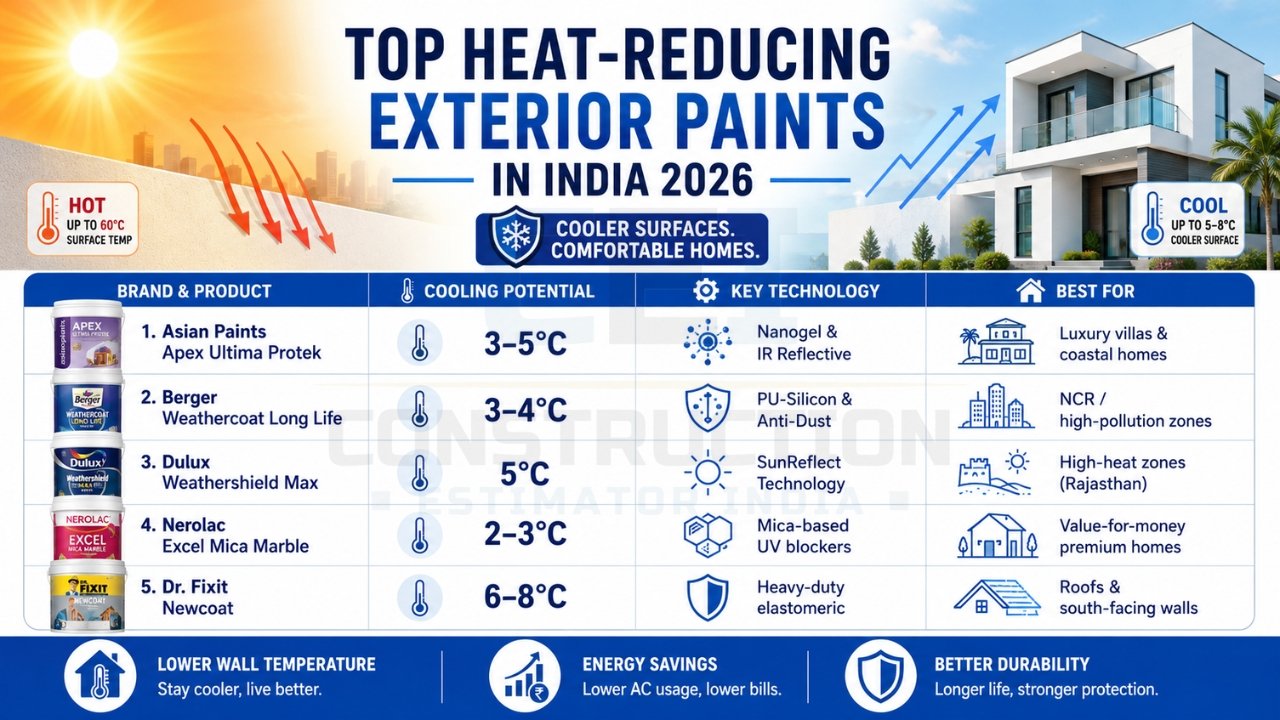
Best Heat-Reflective Paint for Walls India 2026: Top 5 Brands
Choosing the best heat reflective paint for walls India 2026 requires looking past the brand name to the chemical makeup. Here are the top performers we specify in our house construction cost estimation services:
| Brand & Product | Cooling Potential | Key Technology | Best For |
|---|---|---|---|
| Asian Paints Apex Ultima Protek | 3-5°C | Nanogel & IR Reflective | Luxury Villas & Coastal |
| Berger Weathercoat Long Life | 3-4°C | PU-Silicon & Anti-Dust | NCR / High-Pollution zones |
| Dulux Weathershield Max | 5°C | SunReflect Technology | High-heat zones (Rajasthan) |
| Nerolac Excel Mica Marble | 2-3°C | Mica-based UV blockers | Value-for-money premium |
| Dr. Fixit Newcoat | 6-8°C | Heavy Duty Elastomeric | Roofs & South-facing walls |
For more technical details, refer to the Asian Paints Apex 2026 heat reflective paint catalog or the latest 2026 heat-reflective paint recommendations by Berger and Nerolac.
The Estimator’s Secret: Impact of Cool Paint on Your BOQ
At Construction Estimator India, we view anti-heat wall paint as a strategic investment. While the per-liter price of heat-reflective paint is higher than standard emulsion, it drastically alters your Bill of Quantities (BOQ) in two ways:
- Reduced Cooling Capacity: Using heat-reflective paint can allow you to downsize your AC units (e.g., from a 2-ton to a 1.5-ton unit), saving lakhs in initial capital expenditure.
- Extended Repaint Cycles: These paints are engineered to resist UV degradation. While standard paint might fade and “chalk” in 3 years under the Meerut sun, a high-SRI paint remains flexible for 7–10 years.
To see how this fits into your budget, check the exterior painting cost per sq ft in India 2026 for updated rates on specialized thermal coatings.
Step-by-Step Guide: Professional Application for Maximum Cooling
To truly reduce room temperature with paint, the application must be flawless. If the film is too thin or the surface is dirty, the reflective properties drop by 40%.
- Surface Preparation: 100% removal of old flaking paint and dust.
- Moisture Check: Masonry must have less than 12% moisture.
- Priming: Use a specialized heat-shield primer. This acts as the “bonding agent” for the reflective topcoat.
- The Double-Coat Rule: Apply two heavy coats. For South-facing walls, a third coat is often recommended in our professional interior painting estimation services to ensure maximum opacity and reflectance.
Room-by-Room Strategy: Balancing Aesthetics with Thermal Defense
While the exterior is your primary defense, you can also reduce wall heat with paint internally.
- The Living Room (Social Hub): Use a high-sheen “Satin” finish. The mild reflectivity helps bounce light and heat away from the surface.
- The Master Bedroom: Prioritize low-VOC, breathable heat-reflective paints. This ensures that while the room is cool, the air quality remains healthy for sleep.
- South-Facing Kitchens: Use anti-fungal, water-resistant heat-reflective paints to handle both external solar heat and internal cooking steam.
For accurate heat-reflective paint selection, cost estimation or BOQ to reduce wall heat in India, WhatsApp or call us today at +91 8630676890.
Cost Per Sq Ft Analysis: Material vs. Long-Term Energy Savings
Understanding the interior painting cost per sq ft in India 2026 for specialized paints is vital for ROI calculations.
| Painting Level | Cost per Sq Ft (Approx.) | Expected Temp Drop | Energy Savings |
|---|---|---|---|
| Economy (Standard) | ₹15 – ₹22 | 0°C | 0% |
| Premium (Weatherproof) | ₹28 – ₹35 | 1-2°C | 5-8% |
| Luxury (Heat-Reflective) | ₹45 – ₹75 | 3-5°C | 15-20% |
Note: Costs include Level 5 putty preparation and 2 coats of premium topcoat.
Vastu Shastra and Cooling: Harmonizing Energy and Temperature
Vastu Shastra and thermal science often go hand-in-hand. For homeowners looking for cool paint for Indian homes, we recommend:
- North-East (Water Zone): Light blues or whites in high-gloss heat-reflective finishes to promote “cool” mental energy.
- South-West (Earth Zone): Soft yellows or light beiges. These walls bear the brunt of the afternoon sun; hence, a high-SRI coating here is mandatory for family stability and comfort.
Refer to the official 2026 best paints to reduce wall heat in India for Vastu-aligned thermal palettes.
Common Mistakes and Prevention Tips
- Choosing Dark Colors: Even if a dark paint claims to be “heat-reflective,” it will never perform as well as a light-colored one (Whites, Off-whites, Creams).
- Ignoring the Roof: 50% of your heat gain comes from the roof. Always combine wall cooling with a cool roof paint.
- Thinning the Paint: Never over-dilute heat-reflective paint with water. It ruins the SRI performance.
Frequently Asked Questions (FAQ)
- Does heat-reflective paint actually work in India?
Yes. In peak summer, it can reduce exterior wall temperatures by up to 15°C and internal room temperatures by 3-5°C. - How long does cool paint last?
Premium brands like Asian Paints Apex Ultima Protek come with a 7-10 year performance warranty. - Is it much more expensive than regular paint?
The material cost is roughly 1.5x to 2x higher, but the labor cost remains similar. The total project cost usually increases by 20-30%. - Can I apply heat-reflective paint over my old paint?
Yes, provided the old paint is not peeling. However, for maximum SRI performance, removing the old layer and priming is recommended. - Is heat-reflective paint available in different colors?
Yes, though pastel and light shades provide the best thermal results. Deep colors absorb more IR radiation regardless of technology. - Which city in India needs this most?
Cities with extreme dry heat (Meerut, Delhi, Jaipur) or high humidity (Mumbai, Chennai) benefit most from these breathable, reflective coatings.
Conclusion and Final Expert Advice
Mastering how to reduce wall heat with paint is the single most cost-effective way to upgrade your home’s climate resilience in 2026. By choosing high-SRI pigments, following professional application standards, and integrating these costs into a precise BOQ, you transform your home from a heat-trap into a sanctuary.
Avoid the guesswork of local contractors. At Construction Estimator India, we provide data-backed quantity takeoffs and heat-reduction strategies that save you lakhs in energy bills over the next decade.
For accurate heat-reflective paint selection, cost estimation or BOQ to reduce wall heat in India, WhatsApp or call us today at +91 8630676890.