
- Homepage
- How to Identify the Best Cement for Slab Casting in India
How to Identify the Best Cement for Slab Casting in India? – A Complete 2026 Guide
Your Trusted Partner for Precise Material Estimation
Choosing the best cement for slab casting is one of the most critical decisions in any Indian construction project. A poorly selected cement can lead to thermal cracks, deflection, water seepage, or even structural failure years later — especially in RCC roof slabs and floor slabs that bear the entire building load. In 2026, with rising construction costs, extreme weather patterns, and stricter BIS quality norms, homeowners and contractors cannot afford guesswork.
Common mistakes include buying cheap unbranded cement, using expired stock, or ignoring the difference between OPC vs PPC for slab. In hot and dry regions like Delhi and Rajasthan, high heat of hydration causes shrinkage cracks. In humid coastal areas (Kerala, Mumbai, Chennai), sulphate attack and corrosion become major risks. Even in moderate climates like Uttar Pradesh and Madhya Pradesh, improper grade selection leads to costly repairs.
This complete 2026 guide will help you identify the best cement for slab casting and best cement for RCC slab. You will learn about cement types, grades, key selection factors, top brands, and expert recommendations. Whether you are building a G+1 residential home, multi-storey apartment, or commercial structure, you will discover exactly how to choose cement for slab casting that delivers strength, durability, and value. We also cover cement for slab construction in India, the best grade cement for roof slab, and best cement brands for slab casting India trusted by engineers today.
By the end, you will confidently select the right cement and avoid expensive mistakes that affect safety and resale value.
Understanding Slab Casting and Cement Role
Slab casting refers to pouring Reinforced Cement Concrete (RCC) for roof slabs, floor slabs, or terrace slabs. The process involves placing steel reinforcement (TMT bars) and pouring concrete mix to create a monolithic, load-bearing element that transfers dead and live loads to beams and columns.
Cement acts as the binder that holds aggregates and sand together while providing compressive strength. For slabs, the cement must deliver:
- High early and ultimate compressive strength (M20–M30 grade concrete typical for residential slabs)
- Good workability for proper compaction around dense reinforcement
- Controlled heat of hydration to prevent thermal cracking in large pours
- Excellent long-term durability against weathering, moisture, and chemical attack
Three main cement types matter for slab casting in India:
Ordinary Portland Cement (OPC) is pure clinker-based and develops strength quickly. It suits projects needing fast formwork removal.
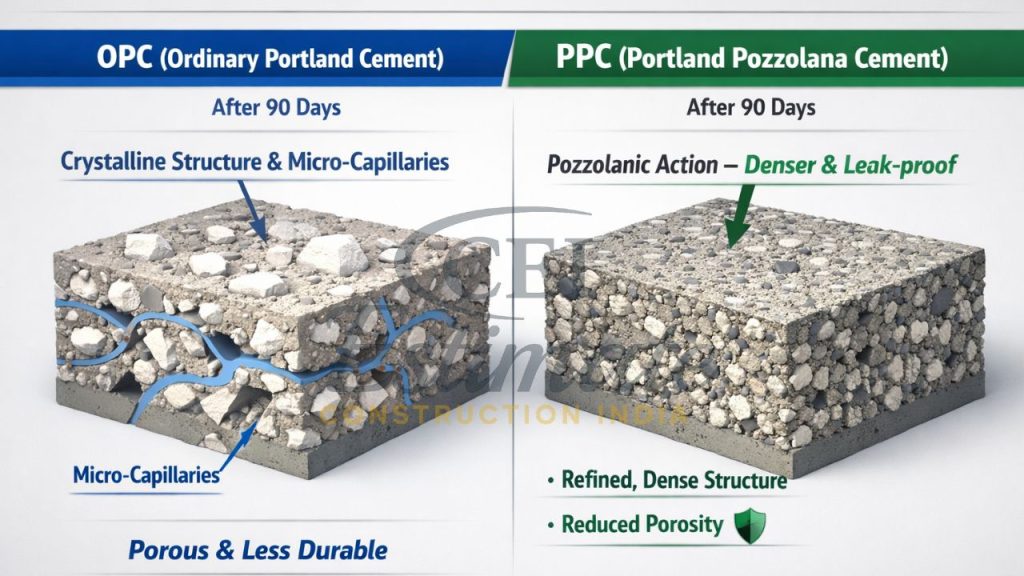
Portland Pozzolana Cement (PPC) blends clinker with pozzolanic materials (fly ash). It generates less heat, offers superior workability, and gains higher long-term strength — making it ideal for most residential roof slab applications.
Portland Slag Cement (PSC) incorporates blast furnace slag. It excels in sulphate-rich or coastal environments due to superior chemical resistance.
In 2026, most structural engineers recommend a hybrid approach: OPC 53 for high-rise or fast-track slabs where early strength is critical, and PPC for typical residential slabs where crack resistance and durability matter more. Proper curing (minimum 14–21 days) and a low water-cement ratio (0.45 or less) remain non-negotiable regardless of the cement chosen.
Cement Grades Explained for Slab Casting
Cement grades indicate minimum compressive strength at 28 days (in MPa). For slab casting, the grade directly affects load-bearing capacity, crack resistance, and construction speed.
Here is a clear comparison:
Cement Type/Grade | 28-Day Compressive Strength | Initial Setting Time | Heat of Hydration | Best for Slab Casting | Key Advantages & Limitations |
OPC 33 Grade | 33 MPa | 30–60 min | Low | Rarely used for slabs (non-structural only) | Low cost but insufficient early strength |
OPC 43 Grade | 43 MPa | 30–60 min | Medium | Small residential slabs, low-rise buildings | Balanced strength; good for general RCC |
OPC 53 Grade | 53 MPa | 20–40 min | High | High-rise slabs, heavy-load RCC slabs | Fast strength gain; allows early de-shuttering but higher crack risk if not cured properly |
PPC (IS 1489) | Equivalent to 43–53 MPa (higher long-term) | 30–90 min | Low | Residential roof slabs, most home slabs | Excellent durability, low heat, superior workability and crack resistance |
PSC (IS 455) | Equivalent to 43–53 MPa | 30–90 min | Low | Coastal, sulphate-prone areas, industrial slabs | Highest chemical resistance; slower early strength |
OPC 53 Grade is often the best grade cement for roof slab in multi-storey or commercial projects because it achieves 27–32 MPa strength in just 7 days, enabling faster construction cycles. However, its high heat of hydration can cause micro-cracks in large residential slabs if curing is inadequate.
PPC has become the preferred choice for most Indian homes in 2026. The pozzolanic reaction continues for months, producing denser concrete that resists seepage and thermal cracks — crucial for flat roofs exposed to monsoon rains and summer heat. Many BIS-certified PPC variants now match or exceed OPC 53 in ultimate strength while costing 5–10% less.
PSC remains the specialist option for slabs in marine or chemically aggressive environments (e.g., near sea coast or industrial zones).
Always verify the grade marking on the bag and insist on BIS certification (IS 269 for OPC, IS 1489 for PPC, IS 455 for PSC).
Key Factors to Identify the Best Cement for Slab Casting
Selecting the best cement for slab casting requires evaluating multiple parameters. Follow these expert steps:
- Determine Required Compressive Strength For residential roof slabs (M20–M25 mix), PPC or OPC 43/53 works well. For commercial or multi-storey slabs (M30+), OPC 53 or higher is mandatory.
- Assess Environmental Conditions Hot & dry climates (Delhi, Rajasthan) demand low-heat PPC to prevent cracks. Coastal or high-rainfall zones (Kerala, Goa) need sulphate-resistant PSC. Seismic zones require high-ductility mixes — often OPC 53 with proper reinforcement.
- Project Type and Scale Residential G+1 to G+3 homes → PPC for durability and cost savings. High-rise or fast-track projects → OPC 53 for early strength. Industrial slabs → PSC or high-performance OPC.
- Workability and Setting Time Dense reinforcement in slabs needs excellent flow. PPC offers superior workability and longer setting time, reducing cold joints.
- Heat of Hydration and Crack Prevention Large slab pours generate significant heat. PPC and PSC produce 20–30% less heat than OPC 53, minimising thermal cracking.
- BIS Certification and Freshness Always check for the ISI mark and manufacturing date. Use cement within 3 months of production; reject bags with lumps or dampness.
- Brand Reputation and Lab Testing Choose manufacturers with consistent quality control. Many top brands now offer third-party lab reports — request them before bulk purchase.
- Cost vs Long-Term Performance The cheapest cement often proves most expensive due to repairs. Factor in durability, maintenance savings, and resale value.
Top Recommended Cement Types and Brands for Slab Casting in India 2026
Based on current engineering practice and market performance in 2026:
- Best Overall for Structural Strength: OPC 53 Grade — ideal when early de-shuttering and high load-bearing are priorities.
- Best for Residential/Durability: PPC — the clear winner for most home roof slabs due to crack resistance and long-term performance.
- Best in Harsh Conditions: PSC — unbeatable in coastal or sulphate-rich soils.
Top Brands for Slab Casting India (ranked by consistency, availability, and engineer preference):
- UltraTech Cement — Market leader with excellent OPC 53 and Premium PPC. Consistent quality across 30+ plants; preferred for large residential and commercial slabs.
- Ambuja Cement — Superior workability and weather resistance; Ambuja Plus PPC is highly recommended for crack-free roof slabs.
- ACC Cement — Legacy brand with outstanding OPC 53 and Suraksha PPC; trusted for high-rise slabs and reliable performance.
- JK Cement — Strong northern India presence; JK Super Strong PPC offers great durability for home slabs.
- Birla Cement (MP Birla / Birla Gold) — Excellent bonding and crack resistance; popular for residential RCC work.
- Dalmia Bharat Cement — High-quality blended PPC and PSC variants; ideal for coastal or industrial slabs.
- Shree Cement — Cost-effective yet high-performance PPC; widely used in northern and western India for economical slab casting.
- Bangur Roofon & Nuvoco Concreto — Specialised products designed specifically for roof slabs with enhanced crack resistance.
Experts increasingly prefer blended cements (PPC/PSC) for modern slabs because they reduce carbon footprint, improve sustainability ratings, and deliver superior long-term results compared to pure OPC.
Common Mistakes to Avoid When Choosing Cement for Slabs
- Using low-grade or unbranded cement to save money — leads to weak slabs and early repairs.
- Ignoring OPC vs PPC for slab differences — many choose fast-setting OPC 53 for residential roofs and later face thermal cracks.
- Buying old or improperly stored cement — lumps reduce strength by 20–30%.
- Skipping proper curing after slab casting — even the best cement fails without 14–21 days of moist curing.
- Overlooking regional climate — using high-heat OPC in hot areas without admixtures.
- Purchasing without checking manufacturing date or BIS mark.
- Mixing different brands in one slab — causes inconsistent strength.
Avoid these pitfalls and your slab will last decades without issues.
Conclusion
Selecting the best cement for slab casting directly determines the strength, safety, and lifespan of your building. In 2026 India, the right choice — whether OPC 53 for speed and load-bearing capacity or PPC for crack-free durability — combined with proper mix design and curing, ensures a slab that performs flawlessly for decades.
Prioritise BIS-certified cement from trusted best cement brands for slab casting India, match the grade to your climate and project needs, and never compromise on quality. A slightly higher initial investment in the right cement saves lakhs in future repairs and adds significant resale value.
For accurate slab material estimation, detailed BOQ including cement quantity, steel, aggregates, or complete RCC slab casting cost planning in Delhi, Agra, or anywhere in India, contact Construction Estimator India — specialists in precise, trade-specific construction estimates and quantity takeoffs.
Call/WhatsApp: 📞 8630676890
Professional estimates starting at only ₹10,000 — fast, detailed, reliable, and BIS-compliant.
Use a reliable Cement Calculator for Slabs to estimate quantities accurately and ensure optimal material usage for a strong, durable finish.
FAQs – Best Cement for Slab Casting
Which cement is best for slab casting in India?
PPC is the most recommended for residential slabs due to its durability and low heat. For high-rise or fast-track projects, OPC 53 Grade offers superior early strength. Always match the choice to your structural design and climate.
Is OPC 53 or PPC better for RCC slab?
For most residential roof slab casting, PPC is better because it reduces cracking and provides higher long-term strength. OPC 53 is preferred only when construction speed is critical (e.g., multi-storey buildings requiring quick de-shuttering).
What grade of cement is used for roof slab casting?
The best grade cement for roof slab in residential construction is usually PPC (equivalent to 43–53 MPa) or OPC 43/53 Grade. Structural engineers specify based on span, load, and seismic zone.
Which brand cement is best for home slab construction?
UltraTech, Ambuja, ACC, JK Cement, and Birla Cement consistently rank among the best cement brands for slab casting India. UltraTech PPC and Ambuja Plus are particularly popular for residential projects.
How to check if cement is good for slab?
Check the manufacturing date (use within 3 months), look for the ISI mark, ensure bags are lump-free and dry, and verify the grade printed on the bag. Reputable brands also provide lab test certificates.
Can PPC be used for slab casting?
Yes — PPC is widely used and often preferred for slab casting in India. It offers excellent workability, lower heat, and superior durability for residential RCC slabs.
Best cement for slab in Delhi or hot regions?
In hot and dry areas like Delhi, low-heat PPC (UltraTech, Ambuja, or Shree) is the safest choice to prevent thermal cracks. Avoid high-heat OPC 53 unless you use ice water and proper admixtures.
How much cement is needed for slab casting?
Quantity depends on slab area, thickness (typically 5–6 inches for roofs), and mix ratio. Use a reliable Cement Calculator for Slabs for precise estimation — typical residential slabs require 60–100 bags per 1,000 sq ft depending on design.